To avoid these ads, REGISTER NOW!

MIG problem - What's causing it, and ...

BikerDad

Well-known member
Joined
Apr 24, 2014
Messages
975
Location
Utah
what's the solution?

Weekend before last, I welded on my cyclone cart, then put the welder away. Today I go to use it, decide to do a few practice beads first. Working with 1/8" plate (is it "plate" at 1/8", or does that fall into "sheet metal"?), so I changed the metal setting. Welder is a Millermatic 211 MVP, the inverter model, on auto-set, running 120v. This is only the second time I've changed it, everything I had done before the cyclone cart was 1/8", cyclone cart is 14g.

Wire (.030) feeds freely when not welding. Gas is @28cfh. One possibility, which just occurred to me due to a power outage (while I was away at lunch, not while welding) is my extension cord. Every time I've welded before I've used a 25' 12g cord, this afternoon I was using a 50'+ 14g cord.

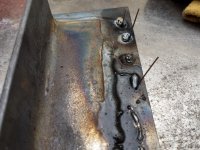
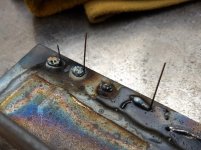
This is what I was seeing in my test beads:
 

Attachments

  • MIG sticking 2.jpg
    MIG sticking 2.jpg
    152.9 KB · Views: 297
  • MIG sticking 1.jpg
    MIG sticking 1.jpg
    153.4 KB · Views: 243
To avoid these ads, REGISTER NOW!

1/2 Cup

Member Emeritus
Joined
Apr 28, 2012
Messages
19,283
Location
Shepparton. Victoria. Australia
BikerDad yep. Keep your leads as short as possible as you get voltage drop with long leads which will impact your settings.

Are they correctly rated for the welder?

Do the leads run hot at all? as this indicates a bad connection or under rated for the job.

It also could be an earthing issue.

I trust this helps.
 
Joined
Jul 24, 2016
Messages
3,371
I've used a 211 quite a bit and welding Steel and Aluminum (with spool gun) I've always had better results hand contouring the controls rather than using the auto set. Also, as you already hinted at, the cord issue might be causing this.
 

gofastwclass

Well-known member
Joined
Oct 23, 2015
Messages
116
Location
KC Area
I would lose the extension cord. In my opinion, trying to weld on 120 volts is like driving a race car in rush hour traffic. Add in the resistance you get from 50' of extension cord plus trying to weld 1//8" plate you are probably close to the maximum potential of the welder under those conditions.

A quick google search shows the maximum output of the welder to be 3/8" steel in a single pass. I would assume that statement is made using the 220V input. Since your amperage and duty cycle both drop by roughly 50% on 120V it would be a logical conclusion to assume the maximum material thickness would do the same.


Looking at the welds, they are piled high and didn't appear to penetrate into the base metal. Between that and the long bits of wire on a few of them I also wonder how far your gun was away from the material. Too long of an arc and the welds get weird and the result is similar to not enough voltage.

I would check out Jody's website http://www.weldingtipsandtricks.com/ for information regarding MIG welding and troubleshooting. Jody also has years worth of videos (hosted on You Tube and on DVD) that cover all aspects of welding from beginner to expert looking for a new approach. I watch his videos weekly and many times I learn something new.
 

NUTTSGT

Super Moderator
Staff member
Joined
Sep 14, 2009
Messages
50,856
Location
Northern Central Ohio
Rule out the variables one at a time.

You already mentioned one new variable with that extension cord. Swap that out or lose the extension cord all together and see what happens.
 

yaidunno

Well-known member
Joined
Feb 10, 2011
Messages
1,336
Location
WI
As others have mentioned, a 50' 14 ga cable is not acceptable. That welder will draw up to 24.3 amps on 120V. 14 ga cable is not rated for that at 75* C.

If you absolutely need 50 feet, and 120 volt, I'd be using a 10 ga cord.

And while not likely the culprit, turn down the gas flow to 15-17 CFH.
 

red94chev

Well-known member
Joined
Jan 29, 2015
Messages
556
Location
Northeastern MD
Trying not to derail the thread but I have a 211 autoset also. Should the gas be set at standstill, the initial purge when you hit the trigger, or once the wire speeds up and the weld is going?
 

sberry

Banned
Joined
Jun 18, 2005
Messages
35,747
Location
Brethren, Michigan
I carry 50 ft 14 in my truck and use it for welding. The gas flow is high, the machine adjusted wrong, wire too hi and 030 is large for 120v circuits. The cord could be adding a little to this,,, but it's a little. If it's connected to a long circuit to start with then it adds.
I used to worry about it all, have the big cords, finally went back to practical and adequate.
 

yaidunno

Well-known member
Joined
Feb 10, 2011
Messages
1,336
Location
WI
I carry 50 ft 14 in my truck and use it for welding. The gas flow is high, the machine adjusted wrong, wire too hi and 030 is large for 120v circuits. The cord could be adding a little to this,,, but it's a little. If it's connected to a long circuit to start with then it adds.
I used to worry about it all, have the big cords, finally went back to practical and adequate.

Welding wire size is determined by output amperage, not your input voltage. For 1/8" material, .030-.035 is acceptable.

I know you love to brag about how you get by with using as little as possible, but the fact is, a 14 ga extension cord is not suitable for this welder. I can not say for certain that putting a proper size cord to it will solve the issue, but the fact remains that the cord is not sized correctly. Most 14 ga cords are only listed to handle 15 amps. Perhaps that is suitable for your welder, but it is not for the OP's.

The welder in question is rated for 115 amps and 20% duty cycle using the 120v input. While its claimed to be able weld 3/16 material on 120v, I think 1/8 is probably a safer bet for what it can do on single pass.
 

Stooge

Well-known member
Joined
Mar 24, 2013
Messages
3,533
Location
South Shore, MA
I have to agree with most on here, I have the older style 211;
*unless I am doing thick stuff, I always like to hand dial the settings rather than use the autoset, but even then its sort of a rarity to use the autoset feature
*gas flow around 15
*.030 for everything I do regardless of 120 or 240
* the very few times I have tried to use an extension cord when I am away from an outlet, it doesn't act right at and sputters. I would guess the extension cord is the culprit, but have you since tried to use it connected right to an outlet to see if it corrects itself?
 
Last edited:

Blazinzuk

Well-known member
Joined
Mar 13, 2016
Messages
637
Location
Afton Wy
I have used the exact machine on a 50 ft 14 gauge cord. My settings to get a decent weld on 3/16 were so far off what the autoset had it was crazy. But I knew they would be. The extension cord is likely your problem here.

Just for kicks one time we put it on a 100 ft cord. The difference between a 100 ft cord vs a 50 ft cord vs just plugged into the wall socket is huge.

Mess with the settings some. You should be able to produce good beads on thinner stuff even with the undersized cord.

Be aware if you weld for any amount of time, you will overheat that extension cord.
 

MoonRise

Well-known member
Joined
Nov 5, 2010
Messages
4,027
Location
NJ
.030 wire is usually ok on the small 120v welders (or a 240/120v welder when running on 120v).

Think about what you changed when you did those welds.

Same machine, same workpiece thickness, different longer and thinner extension cord.

Ditch the long skinny extension cord and try again.

Your weld beads look like they didn't have enough energy to properly melt into the workpiece.

On my 120v welder (red machine not a blue 211), solid wire GMAW with C25 was iffy on 1/8 inch plate. I didn't find the machine really had enough power to reliably weld anything thicker than 14 gauge, which matched what the parameter chart said. Plenty of energy to melt through 1/8 inch steel plate with 0.035 NR211 FCAW wire though.

re: shielding gas flow

Set the flow rate with the machine 'running'. Turn the machine on, squeeze the trigger, set the gas flow. Either turn the WFS all the way down or I'll just disengage the drive rolls so I don't have a bunch of wire squirting out of the torch.
 
Joined
Jul 24, 2016
Messages
3,371
Trying not to derail the thread but I have a 211 autoset also. Should the gas be set at standstill, the initial purge when you hit the trigger, or once the wire speeds up and the weld is going?

Just hit the trigger and once the solenoid kicks in, it will go to where it will stay. Then I just release the drive roller and spool the wire back in or just cut it off. If no breeze such as a fan in the shop, I've gone down to 15, but if you have air movement in the shop, 25 to 30 is fine, but no higher than 30.
 
OP
B

BikerDad

Well-known member
Joined
Apr 24, 2014
Messages
975
Location
Utah
I would lose the extension cord. In my opinion, trying to weld on 120 volts is like driving a race car in rush hour traffic.
Not using an extension cord is not an option. My welding location is 20' from the 120v outlet. It's 40' from a 220v. I CAN switch to a 6?8?g (can't remember offhand which it is) if I rig up a cord adapter and go to 220v.

Add in the resistance you get from 50' of extension cord plus trying to weld 1//8" plate you are probably close to the maximum potential of the welder under those conditions.
Yeah, I suspect you're right. The 50'+ 14g just doesn't move enough juice smoothly.

Looking at the welds, they are piled high and didn't appear to penetrate into the base metal. Between that and the long bits of wire on a few of them I also wonder how far your gun was away from the material. Too long of an arc and the welds get weird and the result is similar to not enough voltage.
Started darn close. Weld briefly, sputter, zap, push gun away. Feed some wire and cut it. Attempt again. Same result.

As an FYI, the switch in extension cords was not intentional. I simply didn't think about it this time, grabbed the most convenient cord, the one I had used over the weekend when fabricating the parts for this project. Hopefully the weather will cooperate this weekend (I have to weld outdoors) and I can git'r'done with the correct cord. Heck, I might even make up a wee adapter so I can use the big juice.

I will post back the results. And turn the gas down. Some more. :D
 
Last edited:
To avoid these ads, REGISTER NOW!

sberry

Banned
Joined
Jun 18, 2005
Messages
35,747
Location
Brethren, Michigan
It takes a lot more power to run a 030 than it does an 023. I am not bragging about using as little as possible but using something that is adequate vs jumping to the simple answer that it all needs a number 10 cord. if this is a MVP it comes with 14 cord on it.
I am not saying that it isn't possible that the smaller cord is effecting it but that its not likely to be a great contributing factor at this distance. Its probably a bit more with the larger wire than it might be with the smaller one.
Turn it down some on manual, turn the speed down, less speed is less current and see if it gets a little better. Too hi speed and low voltage makes for high bead.
 

sberry

Banned
Joined
Jun 18, 2005
Messages
35,747
Location
Brethren, Michigan
Not using an extension cord is not an option. My welding location is 20' from the 120v outlet. It's 40' from a 220v. I CAN switch to a 6?8?g (can't remember offhand which it is) if I rig up a cord adapter and go to 220v.
This is what I am talking about. First, move the machine back to the outlet and run a test piece or get a shorter heavier cord and see if this really is the problem. Yes,,,, you CAN switch to a 6 or 8 cord for 240v but it wont work any better than a 12. (this machine runs at rated output from 65 ft of 14 at 240V) It however needs a breaker limited to 30A for this and the recept isn't really listed for it,,,, makes for a les than ideal setup and these machines are really small, they do get a lot of help- from adequate cords which is a size bigger than comes on them, with a couple of exceptions.
 

KMinAF

Well-known member
Joined
Mar 5, 2011
Messages
698
Location
Fairview Utah
I had a very similar problem and it turned out to be that the braided cable that surrounds the liner had frayed close to where it exits the box resulting in poor continuity at the torch. Replaced the gun and cable assembly and the welder worked better than ever.
 
OP
B

BikerDad

Well-known member
Joined
Apr 24, 2014
Messages
975
Location
Utah
I'd pay to see 6 or 8 landed on 120v plug contacts.

You won't, at least not from me. I prefer my large element to small contacts activities to not involve electricity. The 6/8 (pretty sure it's 8) goes to the 240v dryer outlet in the laundry room. I use it to run my RPC for Papa Griggio and to run Uncle Max. The reason I haven't used it for the welder is the old "different plugs" issue, which is why making an adapter is on the list. Until my boneheaded grab of the wrong extension cord, the 120v has been fine for what I've done thus far. Well, at least I think it's been fine. :headscrat The tablesaw station and woodrack haven't fallen apart yet.
 

koditten

Well-known member
Joined
Apr 10, 2008
Messages
5,528
Location
Midland, Michigan
You won't, at least not from me. I prefer my large element to small contacts activities to not involve electricity. The 6/8 (pretty sure it's 8) goes to the 240v dryer outlet in the laundry room. I use it to run my RPC for Papa Griggio and to run Uncle Max. The reason I haven't used it for the welder is the old "different plugs" issue, which is why making an adapter is on the list. Until my boneheaded grab of the wrong extension cord, the 120v has been fine for what I've done thus far. Well, at least I think it's been fine. :headscrat The tablesaw station and woodrack haven't fallen apart yet.
My point was that it was suggested to use 6-8 for his extension cord. He is running 120v, so can't.
 

bczygan

Well-known member
Joined
Nov 4, 2009
Messages
22,002
Location
DETROIT! Arsenal of Scrappers
OK,

So based on the above, using my 120V, 135A, .030 MIG wire, standard gun, laying practice beads on bed frames, I should up the power and slow the wire feed and my speed?

Bill
 

Attachments

  • Beads2.jpg
    Beads2.jpg
    90 KB · Views: 72

sberry

Banned
Joined
Jun 18, 2005
Messages
35,747
Location
Brethren, Michigan
One thing that happens all the time,,, well 2, first, check the polarity. I have sen it from people that used them a good long time, more than 1 and for years even wonder wtf is wrong with the welder and its on straight. Ran across one not too long ago, it is a 140 Linc and the guy said keep it here and take a look at it, full bottle and all, just cant make it work right,,, sure as ****.
I didn't check it, had asked him I guess without looking and decided to try it on an exhaust. It took me a minute and then told the helper,,, I know wtf.
2nd,,, and it can happen any time is the connector at the ground clamp goes south and the machine stumbles and run like ****. The crappy clamp which aint that bad on the Linc is really OK, feel it and see if it gets hot fast.
The OP was definitely blowing thru gas, not sure how much it was hurting but using 2x as much as it needs for sure. Start at 15 flowing.
I will have to concede I havnt ran a lot of 030 on 120 but have metered and measured it on 240 out of this class a machine and don't remember the exact wire currents but can turn up 030 to pull 24A thru the machine. Right at the wall and good voltage but,,,, 2x the wattage when the machine is turned up. I might try some thru a smaller machine to see just how much power it can make and what the difference it makes on some test strips. Might even look at the door charts to see the difference and would be worth it to put an amp on the output.
Because of this continuing situation to some extent it would be worth it to take the meters on machines and 20A loads, some cord and see what the math really is.
So,,, now I have my first 120V machine in my possession I might test a little for giggles and I have DC clampon for the welder. I have a 12 box/cord for inserting in line and can meaure right at the plug. Both current and voltage.
Modern stuff is really hot, its easy to forget when they design the basics and write the code the voltage was 110,,, for a long time and now the wire size etc is all the same. Take a 225 buzzer, back in the day 43A, now closer to 38 maybe 39. Some of the electric service is 25 volts higher than when they invented the machine and established the codes. 12V higher on 120.
 
Last edited:

sberry

Banned
Joined
Jun 18, 2005
Messages
35,747
Location
Brethren, Michigan
My neighbor moved here, said, its all hotter than where he came from and might have been on old service. I had my Bud at the poco test something for me, I was concerned about a long daisey chain that an old 100 service came in on. Said it pulled 120+A with a volt drom and this had several residences, not much on them but it was long, hundreds of ft and the wire isn't huge by any means.
My Maxstar starts loosing power down about 200 ft of 12 on a 120V, loses power and trips a breaker. On 100 ft cant even tell you got a cord on it. But north of 200 have to turn it down from 85-90 to 75 to keep it from tripping.
With 14 @'50 ft cant tell and can run the 140 wire feeder all it can go with 023, cant tell.
 

sberry

Banned
Joined
Jun 18, 2005
Messages
35,747
Location
Brethren, Michigan
OK,

So based on the above, using my 120V, 135A, .030 MIG wire, standard gun, laying practice beads on bed frames, I should up the power and slow the wire feed and my speed?

Bill

The voltage is the arc length and the wire speed is really the power or current. More wire, more real power, it takes a pinch of pressure increase to burn it off at the right intensity. Slow the wire up and see if it melts off a bit better and flattens out.
This pic has 3 beads, Hobart 210 030. The bottom was the first, set from the door chart, first bead out of the box. The next 2 up are the second and 3rd where I reset the machine wide open with this wire, all it will go and got it to really melt.
Your beads on the top of an angle are not really true to some extent, no where to put the filler but on top.
Set your machine on 3 and E. Little movements will be more touchy on the feed with that machine and the larger wire, using E will flatten it out. Run it along a ways and see if it trips a breaker. 023 will be quite a bit easier on really light sheet. 030 gives it a bit more range, little harder on light but makes it weld thicker way better.
I really don't have great sheet pics, when I was machine testing always wanting to see how much could be wrung out of the top end. I can weld sheet but it is just a matter of fact and don't specialize in auto body so I am not as fussy on the bottom.
The parameters, inductance are set on these types of welders, only thing they give the operator is speed and voltage so they are a bit of compromise so they try to design them around the best wire sizes. As a general rule the 120V are 023 tunes, the 210 030 and the larger machines 035. They will run them all but the adjustments are often easier to tune exact with smaller wires on the smaller machines.
 

Attachments

  • SP test welds.JPG
    SP test welds.JPG
    56.5 KB · Views: 65
Last edited:

sberry

Banned
Joined
Jun 18, 2005
Messages
35,747
Location
Brethren, Michigan
I welded up a repair the other day, I am a 030 guy too but this was so ultra thin, foil thickness that the 023 made it possible. Needed to get the current low and still melt the wire off and fuse.
 

DieselNut88

Well-known member
Joined
Dec 14, 2016
Messages
453
Location
Northern,IL
I have the same machine. I run 15 to 17 on the gas with the trigger pulled. I have run it on 120v many times with a 10g cord 25ft long with no problems. That was welding 1/4" angle. I have also welded 1/2" plate with good penetration on 240v. I have never used the auto set. I just set it manually and run some test beads. You could make up a extension cord with SO cord to run 240v. I would do that before i would run it on 120v. Size the wires correctly and it should weld good.
 

joe49

Well-known member
Joined
Sep 25, 2009
Messages
1,883
Location
Tonica, Il
Started darn close. Weld briefly, sputter, zap, push gun away. Feed some wire and cut it. Attempt again. Same result.

This say's, wire speed to high or amps to low. I agree with the extension cord is to light, but that doesn't mean it won't work.
 

Bob P1

Well-known member
Joined
Mar 31, 2016
Messages
223
Location
Greenwich, NY
OK, two things one mentioned before, the ground clamp should be inspected/cleaned. A dirty, loose or poor ground is a bad ground. Also mig welders like "calm" air, no wind or fans. The shielding gas is easily blown away.
 

PCustoms

Well-known member
Joined
Jul 23, 2011
Messages
22,241
Location
VT
Check your tip too, if it's worn it won't make a great electrical path.

But my money is on the cord. It's worth making a new one to weld on 240v too.
 

sberry

Banned
Joined
Jun 18, 2005
Messages
35,747
Location
Brethren, Michigan
Yes, I understand. I was making the point that the speed is the current control. The other knob is the voltage which you would be correct that it could help flatten the puddle.
 
To avoid these ads, REGISTER NOW!
Top Bottom