To avoid these ads, REGISTER NOW!

Mill / Drill Recommendation

PotteryPal

Member
Joined
May 31, 2015
Messages
9
Location
Montgomery, TX
Fellow members,

I am in the market for a mill/drill unit. I have a budget ~2-3k. What brands should I be looking which represent a good value. I have looked at Grizzly, Jet, Baleigh, Smithy to name a few. I am a novice machinist and want to buy something that will meet my needs, allow me to learn and develop for many years to come. I'm not adverse to spending a bit more if needed.


Thanks in advance.
 
To avoid these ads, REGISTER NOW!

larry_g

Well-known member
Joined
Apr 28, 2007
Messages
16,872
Location
oregon
Give us some links to what you are looking at. Also give us a clue to the work envelope you need, the materials you are going to be using and the precision of the final parts. Some members here work to a tolerance of +/- .010" and others +/- .0001". All that plays into the selection of the proper tool we will select for you. You are also going to hear from some of the members who think M/D's are junk and you need a bridgeport or other knee mill.

lg
no neat sig line
 
Last edited:

Adam.C

Banned
Joined
Jan 29, 2013
Messages
1,490
Fellow members,

I am in the market for a mill/drill unit. I have a budget ~2-3k. What brands should I be looking which represent a good value. I have looked at Grizzly, Jet, Baleigh, Smithy to name a few. I am a novice machinist and want to buy something that will meet my needs, allow me to learn and develop for many years to come. I'm not adverse to spending a bit more if needed.


Thanks in advance.

I bought a Chinese mill drill. I learned a lot with it. One thing I learned was to sell it as quick as I could and buy an older american machine.

At your stage, people will tell you that you need to match the price of the mill in tooling. For me, alot of that tooling was inspection equipment that allowed me to inspect my Chinese mill so I could understand exactly what was wrong with it. Some things I could correct, other things I could compensate for. If you buy used, you will have wear. Start budgeting and buying inspection equipment now. Oh, and don't buy any Chinese inspection equipment or you will end up having to inspect that.
 

rmack898

Well-known member
Joined
Jan 23, 2007
Messages
3,148
Location
Honu Grove NE Florida
Most import MDs are pretty much the same quality although some of the Taiwanese machines are better and that will be reflected in the price.

If it were me, I'd spend just a little extra for a square column machine.
 

ecotec

Well-known member
Joined
Oct 5, 2010
Messages
5,420
So many shops have upgraded to CNC level machines, that quality manual machines can be had for reasonable amounts of money. I think that if you are not in a hurry, you can find a quality mill (maybe even with a good amount of tooling) for half your budget. On top of that you can find an awesome drill press for a couple hundred dollars.

I see that you are in Texas... I do not know if my response would be correct there. In the Detroit area, where I live, you can find used machinery pretty cheap. I do not know if that is true in Texas.
 

theoldwizard1

Well-known member
Joined
Feb 22, 2011
Messages
43,114
Location
SE MI
I bought a Chinese mill drill. I learned a lot with it. One thing I learned was to sell it as quick as I could and buy an older american machine.
There is a lot of truth there ! I am not saying all imported equipment is junk, but it you have the space, a 50 year old Bridgeport, even with a single phase motor is probably better.

Mill/drills are a compromise. Their round column means that under heavy X or Y pressure it will flex, or worse the head can move. With a square column and a head that rides on dovetails, you have a very limited amount a Z height, especially if you are using a large vice, rotatory or angle vise.
 

Adam.C

Banned
Joined
Jan 29, 2013
Messages
1,490
Bridgeport is really the best choice. They are complicated to move, but otherwise not that large. The advantage of a bridgie is that you can find them and parts cheap. It's also a large stiff mill with lots of capability.
The other options for smaller US mills are the Burke mill rite and the Rockwell 21-100. I don't think there are parts as available for the latter.

The Chinese mills are notorious. Run from round column models. The dovetail column models all have problems with head droop that are hard to diagnose and compensate for. Traversing the head on a dovetailed column is fraught with problems. Never buy a mill without a proper quill. That puts you into $$$$ territory for a Chinese machine where the dovetails and column may not even be straight.
 
Last edited:
OP
P

PotteryPal

Member
Joined
May 31, 2015
Messages
9
Location
Montgomery, TX
Give us some links to what you are looking at. Also give us a clue to the work envelope you need, the materials you are going to be using and the precision of the final parts. Some members here work to a tolerance of +/- .010" and others +/- .0001". All that plays into the selection of the proper tool we will select for you. You are also going to hear from some of the members who think M/D's are junk and you need a bridgeport or other knee mill.

lg
no neat sig line

Larry,

Ideally something with tolerances of +/- 0.001". I have limited space in my workshop (let's say ~3' x 3' area. I need to leave some room for some other equipment. I also only have 1 Phase 115 & 230VAC power. I would also prefer variable speed control and the ability to upgrade to a DRO in the future if possible. Some links below:

http://www.grizzly.com/products/Mill-Drill-with-Stand-and-DRO/G0759


http://www.baileigh.com/vertical-mill-drill-vmd-40g


https://detroitmachine.tools/mi-329m-mill


http://boltontool.com/Lathes/milling-machine/variable-speed-mill-drill-BF20VL?sort=p.price&order=ASC


Regards,

PotteryPal
 

theoldwizard1

Well-known member
Joined
Feb 22, 2011
Messages
43,114
Location
SE MI
Some (most?, all?) of those listed are probabl made in Taiwan by Rong Fo. Different paint job, maybe a few different bells and whistles. They are decent for what they are.

First you need to determine the material you are going to be working with. If it is mostly plastic or non-ferrous then you can use a much lighter machine.

Second, you need to decide to big the items you are going to be working on. Bigger or smaller than a shoe box.

Third is accuracy/repeatability, already mentioned.


Last, a decent vice, set of parallels, and a few tools could set you back most of your budget. You will ultimately need a tool bit grinder and the expertise to grind your own tooling.
 
To avoid these ads, REGISTER NOW!

blazemaster83

Well-known member
Joined
Oct 8, 2009
Messages
604
Location
Lacey, Wa.
Don't waste your time with a mill/drill. Look for a bridgeport sized machine. Powerfeeds and DRO are within your price if you look. The milling machine will most likely be your most used tool. 2nd is the Lathe, at least for me.
 

tool_scrounge

Well-known member
Joined
Jul 20, 2010
Messages
4,173
Location
Southern California
If I were looking for a smaller than regular Bridgeport mill, but better stiffness and quality than a mill/drill, I would be looking at a few used mills, such as:

Early Bridgeport with the short table

Rockwell vertical mill

Clausing vertical mill

Index model 40 mill

Burke or Powermatic Millrite mill (2/3 scale Bridgeport but really sturdy)

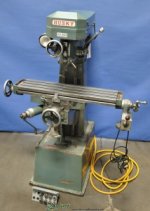
A1S style mill (Taiwan) with a 8x30" table (these were sold by Grizzly as a G1004 or G1008 and a lot of other folks). See picture below.
 

Attachments

  • A1s_mill.jpg
    A1s_mill.jpg
    19.4 KB · Views: 42
Last edited:

owdlvr

Well-known member
Joined
Oct 16, 2006
Messages
119
Location
Vancouver, BC
I'm Canadian, which means we get slightly different machines than you might find, but my Craftex unit comes from the same factories as the Grizzly units. The following is from a thread I started on hobby-machinist.com, but could help you in your decisions. The Asian machines CAN be good. You just need to understand their limitations. I'd stick to a Grizzly in the USA, they seem to have very good customer support.

CX601_org.1435535418.1280.1280.jpg


After quite a bit of research, I picked up a Craftex CX-601 Mill/Drill machine this week. The research was actually pretty tough, as there is little online written about the machine. I thought, therefore, it might be helpful to future users to have a little written up about the machine.

I'm presuming if you're looking at one of these, you're going to compare specs, and you’ll find that very similar machines are offered by Grizzly, Precision-Matthews and others . You’ll find the castings and controls are almost identical between machines, but the specs can vary wildly. Presumably all the castings are made in the same factory? It’s quite probable all the machines are made in the same factory, but the final specs are ordered by each customer and will vary from brand to brand. Work out what you want in a Mill / Drill, determine the specs you most require, and narrow your search accordingly.

I suppose I should note two key things: One, the Cx-601 is a Mill/Drill machine…not a ‘proper’ milling machine. I didn’t buy this expecting I could hog a ¼” of steel in one pass. Instead, I realize the smaller machine with no heavy base has limitations. My shop space has limitations as well, and quite frankly a mid-weight mill/drill is better than no mill! Secondly, it’s a machine made in China. I bought it knowing that China CAN make very good products, but they can also have issues. I inspected the floor model quite carefully, and looked for posts online with Craftex problems to try and work out if I thought it was generally a ‘quality’ brand. Ultimately I chose to buy one, so in my case I thought the price, quality and features lined up to my satisfaction.


On to the Mill!
23815510003_c652d7bea1_z.jpg


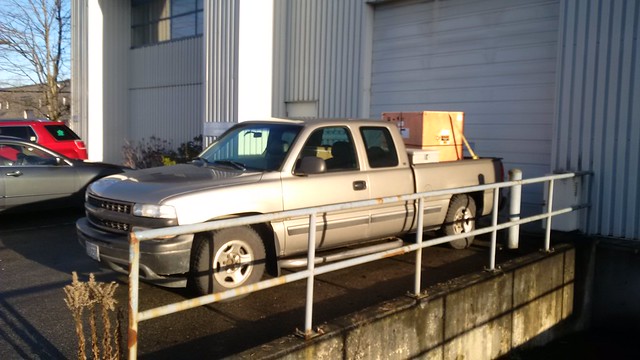
I suppose the first thing to consider is how you’ll unload it. I used an engine hoist and a specialized vehicle tie-down strap, but even with my 2wd truck it was a challenge. The mill weighs roughly 600lbs, so with the engine hoist extended all the way (1/2 Ton setting) there was plenty of leeway. With my truck, however, and the hoist lifted all the way up, it just cleared the bed to come out. This was with the head roughly halfway in the Z-Travel, so I could have dropped the head for more clearance. You’d need to in a lifted or 4wd truck. I managed to get it into my shop, and the stand almost bolted on before a buddy showed up to help. Two makes the stand easier, and you will definitely need two people to slide it into final position.
24359862251_8aa59cc6f7_z.jpg


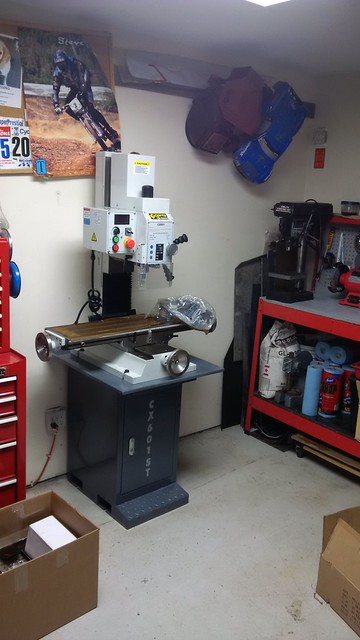
My mill was built in January of 2015, and I purchased it in January 2016. The date is stamped on the front cover, lower right. Unlike the reports from Grizzly owners, my stand was in perfect condition right out of the box. Its well built, and relatively sturdy, but I have to say the stand *****. If you’re over 5 foot 5 inches, save your money. I’m 6’3, and the mill table is painfully low, I’ll be building an additional stand to lift this thing up. Regardless of the stand you use, you want it to be as heavy as possible. Don’t use the stand for storage, use it for storing dead weight…and lots of it. Your mill will perform better.


The Craftex CX-601 ships with the following items (and my comments):
  1. Manual – It’s not terrible, but the Grizzly manuals are better. Go and download a Grizzly manual for a similar machine and use it for unloading tips, setup tips and break in.
  2. Tools – They’re terrible. Mine shipped with a 25mm wrench (nothing on the mill is 25mm), two double-ended open wrenches (chrome flaking off) and screwdrivers, allen keys and some other stuff I didn’t even open.
  3. Touch up paint – leaked into the bag, rock hard.
  4. Vice hold-down bolts – actually useful.
  5. And of course the Mill/Drill unit.


My mill arrived with the following issues:

24416092836_bca77815b4_z.jpg

1) Electrical cord fallen out of the grommet. Simple repair, required taking off the back of the electrical box and re-assembling the threaded grommet.

24334029972_9f758ede4f_z.jpg

2) Obviously poor bondo-repair job of casting flaw in table. The repair is laughable, but the T-Slot still works so I really could care less.

3) Oddly smooth-stiff-smooth-stiff action on both the X and Y movements. I thought at first perhaps the travel screws were bent, but upon closer inspection found that paint drips hadn’t been cleaned off the bottom of the dovetails for both the table and saddle. A razor blade and some light effort brought smooth travel to all directions (no photos).

24334029552_3b5e511932_z.jpg

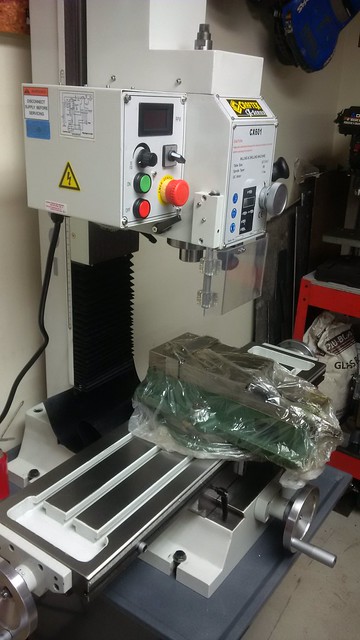
After cleaning all of the shipping grease off the mill, I lubricated the various bits of the mill and waxed the table. I then set the stops for the X-Travel, trammed the head and setup my vice so it was square. After mucking around with various methods found online, and getting quite frustrated, I finally figured out a quick(er) way to tram the head on the CX-601. The fine adjustment for the angle on the head isn’t done via mallet taps (like on some mills), but rather via the 5mm allen key on the right side of the head near the top. The key was to tilt the head slightly clockwise, and then tram using the standard test-indicator method. BUT if you over-adjust past center, stop trying and move the head back clockwise past zero. Took me less than 1min to get it dialed in perfect once I had figured it out.


I didn’t write it down, but there was less than .001 change in height between the extreme left and extreme right of my table. No measurable change fore and aft. I measured the spindle runout, but didn’t keep note of it because it was basically nil. Essentially it would appear I got a quality machine, with a bit of a bondo job in the one t-slot.

23814134454_efcf4f9294_z.jpg


24074535739_bc189856f3_z.jpg


24359871841_fd5c8f3418_z.jpg


The gearbox in the CX-601 uses the same plastic gear setup you’ll find in a number of mills, and the one you’ve probably found threads saying there are “lots of threads” talking about them breaking/stripping…but I didn’t find those actual threads. Regardless, there are four gears in the machine. A brass pinion gear on the motor, a plastic counter gear under the motor mount, a plastic gear which has a high and low gear on it and finally a metal gear on the column which has a corresponding high and low gear. I am not sure which gear is the one that strips out should you crash the machine, but I suspect it’s probably the counter gear. The machine has no provision for adjusting the gear lash on any of the gears, but I was able to adjust the gear lash on the motor pinion to counter gear by using the slight play in the six motor mount bolts. I essentially loosened them a touch, moved the motor as tight to the gear as I could, and then (with the machine running) tapped the motor mount back until it sounded right. You need some experience with gear noise to be able to do this with some confidence.

24146713130_e6dc8a1039_z.jpg

Speed is measured using a hall-effect sensor mounted to the top of the spindle. Max speed on my machine is building through break-in, and should hit the specs.

24074545439_04e6b36db6_z.jpg

The switchover to fine control on the Z-Axis leaves a lot to be desired. Basically you tighten the the down feed handle onto this brass cone which engages the fine feed knob up front. It slips, a lot, despite having the grease cleaned out. The digital readout on the front is very necessary, as the mechanism slips too much to make the traditional knob markings useable.

...TBC...
 
Last edited:

owdlvr

Well-known member
Joined
Oct 16, 2006
Messages
119
Location
Vancouver, BC
23815538313_b77c218dbe_z.jpg

I’ve you’ve read up on these machines you may have found a post or two claiming that the scale on the handles doesn’t match the feed, and/or that it’s a really weird amount. On my machine the scale is .0025”, and travel on the table matches exactly (as measured with a dial indicator). One full turn of the handle gives 0.125” movement, so the math is easy to do in ones head. I should note that the scaled collars on four of the five handles were so tight I could not turn them to zero the dial. I’ve popped one off and it was an easy fix (spring wasn’t in correctly), so I anticipate the others will be just as simple.

24334028742_f0a1ffd909_z.jpg

I bought a generic “Kurt-Style” 5” vice for the mill, despite the salesman suggesting a 4” was probably the better size for the mill. I disagree, the 5” is pretty much perfect, though I do lose the final ¼” of table movement in on the Y axis. Not a big deal, I’ll be mounting DRO scales back there eventually anyways…so I’m losing that travel regardless. As a side note, this Vice (bought from Busy Bee Tools as well) is pretty terrible. This is why we hate Chinese made goods. The moving jaw is shimmed with folded paper to make it square (WTH?!) and the tops of the jaws are not parallel. I should have inspected it much closer before cleaning it.

23815534443_c4aecd0c3f_z.jpg

I did follow the salesman’s recommendation on the 6” rotary table vs going with an 8”. Again, I disagree with him and think the 8” would have been a fine size. I was going to replace it, until I realized that I was going to want to create a pallet for the top of the table, so I could simply make my pallet 8”. (I'm checking the pin I made for centring the table.)


24442313515_eb096b0cc5_n.jpg

For those not familiar with the term, a pallet is basically a fixturing surface with options for bolting items to the table, or locating them with pins. The pallet can be sacrificial, ie you can cut into it with tools if needed, so that you don’t ruin your table base.

24146738450_843fb7a80a_c.jpg

Machine cuts quite nice both conventionally and climb cutting with various sized end mills. I did surface a 10x12” piece of aluminum using a 3” endmill with 6 carbide tips on it. Cuts of .005 were very smooth, cuts of .010 were at the limits of the machine. I want mine to last forever, so I was happy taking smaller passes.

CX601_5_org.1435541875.1280.1280.jpg

There are a two things on the machine (so far) not mentioned in the manual. First off is the oil window in the head. There is no oil in the head, only grease, so I’m thinking the casting must be used on machines of a different type and the window is simply ‘there’. With the grease sprayed on it, you’re definitely not going to be seeing anything inside!

23814128704_419f449a90_c.jpg

The second one is this spring loaded pin in the back. It's visible in the photo just a touch to the right of dead centre. No mention of it in the manual, and I haven’t worked out it’s purpose yet. I suspect it may be a safety pin to keep the head from rotating too far when you loosen in, but I don’t know yet. Once I trammed my head perfectly, I wasn’t going to change it!

Happy to add more or answer questions / queries on this machine. It was a bit frustrating when I was doing the research, not finding very much info out there on it.

-Dave
 
OP
P

PotteryPal

Member
Joined
May 31, 2015
Messages
9
Location
Montgomery, TX
If I were looking for a smaller than regular Bridgeport mill, but better stiffness and quality than a mill/drill, I would be looking at a few used mills, such as:

Early Bridgeport with the short table

Rockwell vertical mill

Clausing vertical mill

Index model 40 mill

Burke or Powermatic Millrite mill (2/3 scale Bridgeport but really sturdy)

A1S style mill (Taiwan) with a 8x30" table (these were sold by Grizzly as a G1004 or G1008 and a lot of other folks). See picture below.


The Grizzly g1004 or g1008 is what I am looking for. And so the search begins.....


Thanks!

PotteryPal
 
To avoid these ads, REGISTER NOW!
Top Bottom