I'm Canadian, which means we get slightly different machines than you might find, but my Craftex unit comes from the same factories as the Grizzly units. The following is from a thread I started on hobby-machinist.com, but could help you in your decisions. The Asian machines CAN be good. You just need to understand their limitations. I'd stick to a Grizzly in the USA, they seem to have very good customer support.
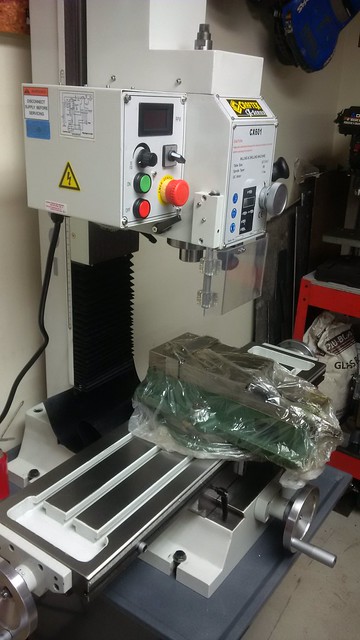
After quite a bit of research, I picked up a Craftex CX-601 Mill/Drill machine this week. The research was actually pretty tough, as there is little online written about the machine. I thought, therefore, it might be helpful to future users to have a little written up about the machine.
I'm presuming if you're looking at one of these, you're going to compare specs, and you’ll find that very similar machines are offered by Grizzly, Precision-Matthews and others . You’ll find the castings and controls are almost identical between machines, but the specs can vary wildly. Presumably all the castings are made in the same factory? It’s quite probable all the machines are made in the same factory, but the final specs are ordered by each customer and will vary from brand to brand. Work out what you want in a Mill / Drill, determine the specs you most require, and narrow your search accordingly.
I suppose I should note two key things: One, the Cx-601 is a Mill/Drill machine…not a ‘proper’ milling machine. I didn’t buy this expecting I could hog a ¼” of steel in one pass. Instead, I realize the smaller machine with no heavy base has limitations. My shop space has limitations as well, and quite frankly a mid-weight mill/drill is better than no mill! Secondly, it’s a machine made in China. I bought it knowing that China CAN make very good products, but they can also have issues. I inspected the floor model quite carefully, and looked for posts online with Craftex problems to try and work out if I thought it was generally a ‘quality’ brand. Ultimately I chose to buy one, so in my case I thought the price, quality and features lined up to my satisfaction.
On to the Mill!
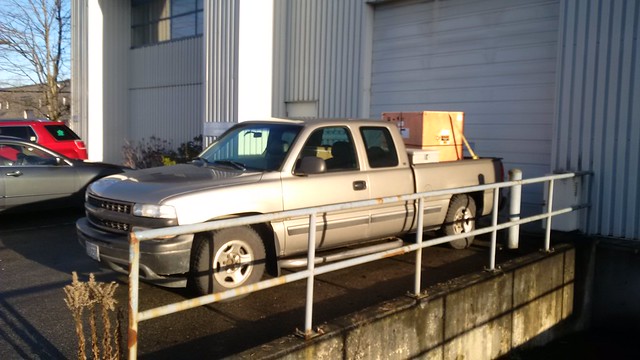
I suppose the first thing to consider is how you’ll unload it. I used an engine hoist and a specialized vehicle tie-down strap, but even with my 2wd truck it was a challenge. The mill weighs roughly 600lbs, so with the engine hoist extended all the way (1/2 Ton setting) there was plenty of leeway. With my truck, however, and the hoist lifted all the way up, it
just cleared the bed to come out. This was with the head roughly halfway in the Z-Travel, so I could have dropped the head for more clearance. You’d need to in a lifted or 4wd truck. I managed to get it into my shop, and the stand almost bolted on before a buddy showed up to help. Two makes the stand easier, and you will definitely need two people to slide it into final position.
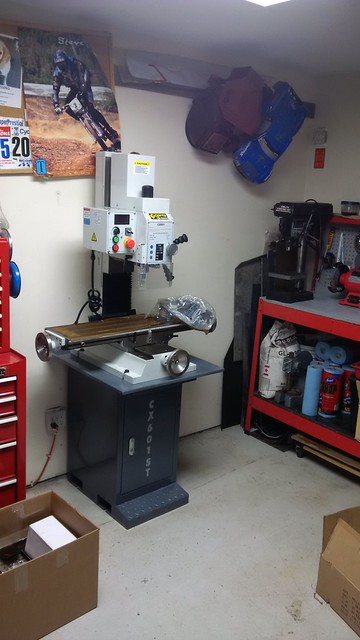
My mill was built in January of 2015, and I purchased it in January 2016. The date is stamped on the front cover, lower right. Unlike the reports from Grizzly owners, my stand was in perfect condition right out of the box. Its well built, and relatively sturdy, but I have to say the stand *****. If you’re over 5 foot 5 inches, save your money. I’m 6’3, and the mill table is painfully low, I’ll be building an additional stand to lift this thing up. Regardless of the stand you use, you want it to be as heavy as possible. Don’t use the stand for storage, use it for storing dead weight…and lots of it. Your mill will perform better.
The Craftex CX-601 ships with the following items (and my comments):
- Manual – It’s not terrible, but the Grizzly manuals are better. Go and download a Grizzly manual for a similar machine and use it for unloading tips, setup tips and break in.
- Tools – They’re terrible. Mine shipped with a 25mm wrench (nothing on the mill is 25mm), two double-ended open wrenches (chrome flaking off) and screwdrivers, allen keys and some other stuff I didn’t even open.
- Touch up paint – leaked into the bag, rock hard.
- Vice hold-down bolts – actually useful.
- And of course the Mill/Drill unit.
My mill arrived with the following issues:
1) Electrical cord fallen out of the grommet. Simple repair, required taking off the back of the electrical box and re-assembling the threaded grommet.
2) Obviously poor bondo-repair job of casting flaw in table. The repair is laughable, but the T-Slot still works so I really could care less.
3) Oddly smooth-stiff-smooth-stiff action on both the X and Y movements. I thought at first perhaps the travel screws were bent, but upon closer inspection found that paint drips hadn’t been cleaned off the bottom of the dovetails for both the table and saddle. A razor blade and some light effort brought smooth travel to all directions (no photos).

After cleaning all of the shipping grease off the mill, I lubricated the various bits of the mill and waxed the table. I then set the stops for the X-Travel, trammed the head and setup my vice so it was square. After mucking around with various methods found online, and getting quite frustrated, I finally figured out a quick(er) way to tram the head on the CX-601. The fine adjustment for the angle on the head isn’t done via mallet taps (like on some mills), but rather via the 5mm allen key on the right side of the head near the top. The key was to tilt the head slightly clockwise, and then tram using the standard test-indicator method. BUT if you over-adjust past center, stop trying and move the head back clockwise past zero. Took me less than 1min to get it dialed in perfect once I had figured it out.
I didn’t write it down, but there was less than .001 change in height between the extreme left and extreme right of my table. No measurable change fore and aft. I measured the spindle runout, but didn’t keep note of it because it was basically nil. Essentially it would appear I got a quality machine, with a bit of a bondo job in the one t-slot.


The gearbox in the CX-601 uses the same plastic gear setup you’ll find in a number of mills, and the one you’ve probably found threads saying there are “lots of threads” talking about them breaking/stripping…but I didn’t find those actual threads. Regardless, there are four gears in the machine. A brass pinion gear on the motor, a plastic counter gear under the motor mount, a plastic gear which has a high and low gear on it and finally a metal gear on the column which has a corresponding high and low gear. I am not sure which gear is the one that strips out should you crash the machine, but I suspect it’s probably the counter gear. The machine has no provision for adjusting the gear lash on any of the gears, but I was able to adjust the gear lash on the motor pinion to counter gear by using the slight play in the six motor mount bolts. I essentially loosened them a touch, moved the motor as tight to the gear as I could, and then (with the machine running) tapped the motor mount back until it sounded right. You need some experience with gear noise to be able to do this with some confidence.

Speed is measured using a hall-effect sensor mounted to the top of the spindle. Max speed on my machine is building through break-in, and should hit the specs.
The switchover to fine control on the Z-Axis leaves a lot to be desired. Basically you tighten the the down feed handle onto this brass cone which engages the fine feed knob up front. It slips, a lot, despite having the grease cleaned out. The digital readout on the front is very necessary, as the mechanism slips too much to make the traditional knob markings useable.
...TBC...