To avoid these ads, REGISTER NOW!

Milling

theoldwizard1

Well-known member
Joined
Feb 22, 2011
Messages
43,245
Location
SE MI
From hard experience, those clapped out machines are either museum pieces or scrap iron. If they have slop they are highly frustrating as machine tools.
Not all of them are "clapped out". Sadly, a noobie probably does not have the knowledge to "separate the wheat from the chaff".
 
To avoid these ads, REGISTER NOW!

matt_i

Well-known member
Joined
Mar 14, 2008
Messages
10,741
Location
SE Michigan
Sadly, a noobie probably does not have the knowledge to "separate the wheat from the chaff".

If you feel like a noob and are feeling sad and you can read you can probably figure it out. Look at the backlash lost-motion in the leadscrews. The linear travel in those (on the inclined plane helix) is 20x that of the table (thinking along the lines that your 1.25" dia leadscrew (times pi) = approx 4 inches of a moving surface passing a stationary surface for 0.200" of table travel.

If you want to know what "tight vs loose" is just run the table out near the max travel, carefully you know, and see what lost motion is out there vs the center of the travel.

The existence of a 1 shot lube system is a very cool thing prolonging the wear-life although there are no guarantees that anyone ever used it or filled it but it takes a pretty stone headed person to buy a machine tool with a lube system and expect to make it far into the future with it empty.

Also of general use is the appearance of the original Y-axis flakes (flake is a crescent made by hammering on the side of a metal scraper, or with a modern powered device to produce same) on the top of the knee. Look at those and judge wear on the center and extreme travel. Beware the cheap trick worse than a rustoleum rebuild of re-flaking the ways to give the appearance they were somehow remachined and then scraped back into alignment. The dead giveaway is they were never remachined. There will be evidence of a double flake pattern.

You can also look up the relative age of the machine via its serial number stamped on the knee at the front just above the Y-axis dial. (there's one on the head so don't get that one confused, its not equivalent)

Always go with the time-tested formula of milling some steel and checking the result. If a machine can't be powered, price adjust accordingly.
 

Robert Haas

Well-known member
Joined
Sep 30, 2010
Messages
1,749
I agree with both side of the discussion about older equipment.

You do need to be some type of a forensic scientist to determine the condition and therefore the use and history of a machine. Here are a couple warnings.

Never expect "school" equipment to be in good or even acceptable condition. The chances of finding a 50 year old machine from a High school or other technical facilities that is in usable shape is very low. The school stuff will have had to survive uncountable "crashes" and that is just the nature of people learning to run them that do not own them. Crashing a mill by having tools over burdened or having axis run beyond their stops is damaging and it happens more often then could be counted to school equipment.

As far as determining if a piece of equipment is just worn out. Simple dial indicators and some common sense will reveal run outs and differentials in the primary use or common (Most used) areas of the machine.

Lastly if you find rust that indicates the machine sat in a wet/damp area and it was out of use for a period of time you are in for a tedious process that will require tear down and clean up before the machine can be returned to operation.
 

jmarkwolf

Well-known member
Joined
Jan 15, 2013
Messages
1,820
Location
Southeast Michigan
CNC requires a "fancier" machine, and you have to program every "project". Not practical for one-offs.

DRO's tell you the exact spot you are drilling or milling. Essential equipment in my opinion.

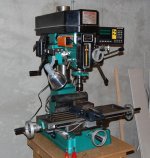
My first machine was a Harbor Freight benchtop mill:

https://www.harborfreight.com/1-1-2-half-horsepower-heavy-duty-milling-drilling-machine-33686.html

Don't let the naysayers scare you about the round column.

I learned a lot, used it happily for 15 years then sold it for what I paid, then bought a used Bridgeport. Still have soft spot in my heart for that machine. If I had to downsize I'd consider buying another one.

You should also check out the amateur machinist web sites such Homeshop Machinist and Hobby-Machinist. There are numerous amateur machinists on Youtube as well.
 
Last edited:

Lassen Forge

Well-known member
Joined
Apr 26, 2014
Messages
15,387
Location
The romantic hills of central Umbria, Italy,
CNC requires a "fancier" machine, and you have to program every "project". Not practical for one-offs.

DRO's tell you the exact spot you are drilling or milling. Essential equipment in my opinion.

My first machine was a Harbor Freight benchtop mill:

https://www.harborfreight.com/1-1-2-half-horsepower-heavy-duty-milling-drilling-machine-33686.html

Don't let the naysayers scare you about the round column.

I learned a lot, used it happily for 15 years then sold it for what I paid, then bought a used Bridgeport. Still have soft spot in my heart for that machine. If I had to downsize I'd consider buying another one.

You should also check out the amateur machinist web sites such Homeshop Machinist and Hobby-Machinist. There are numerous amateur machinists on Youtube as well.

Wow, for the money that seems like a pretty sweet machine, do you remember any issues you had with it when you had it? 1.5 hp 120v 1 phase... that's going to be hard not to like...
 

king nero

Well-known member
Joined
Dec 27, 2010
Messages
1,469
Location
Belgium
I have had the exact same one, but sold under another name in Europe. It got me hooked on milling at home (of course it can't compare with the conventional and cnc mills at the place I used to work). Can't say a bad word about those, it's a very capable machine within its limitations.
 

Attachments

  • DSC_0006.jpg
    DSC_0006.jpg
    148.5 KB · Views: 61
Last edited:
To avoid these ads, REGISTER NOW!

ClappedOutBport

Well-known member
Joined
Mar 30, 2016
Messages
998
Hi and welcome to GJ! Most of us here work on a little larger things and mini mills aren't quite capable of handling the heavier work. Even so we all wish we had a bigger mill than what we've got. Going too small can limit what you can work on down the road and it won't cut deep so you spend more time making more passes. I'm no expert so I'll stop there.

I'll add that once you own a mill you'll spend a lot of money on tooling so it's worth buying the right mill right off the line so your tooling is a long term investment.

Some more knowledgeable folks should chime in shortly. There's lots to it but it's very enjoyable and worthwhile.

Ain't that the truth!

From hard experience, those clapped out machines are either museum pieces or scrap iron. If they have slop they are highly frustrating as machine tools. Those used deal don't look so good when you factor in Richard King's scraping lessons, straight edges ,surface plate and tools.

Bah! Many an accurate part has been made on machines well past their time. Generally the user is the limiting factor, not the machine.
 

jmarkwolf

Well-known member
Joined
Jan 15, 2013
Messages
1,820
Location
Southeast Michigan
Wow, for the money that seems like a pretty sweet machine, do you remember any issues you had with it when you had it? 1.5 hp 120v 1 phase... that's going to be hard not to like...

When I bought the machine HF offered free shipping, even return shipping if I didn't like the machine. I figured I had nothing to lose.

I think I paid $750 in 1998.

I instrumented the machine while it was still on the pallet in my garage, and ran the table back and forth and was happy to find there was only a couple thousandths variance across the entire 19inch x-axis travel. I decided to keep it. Me and a buddy partially dismantled it to get it down the basement steps. It's heavy, almost 750lbs as I recall.

The only issue I ever had with that machine was the spindle index pin was a little too long for some R8 tooling to slide into spindle. As I recall I filed it down a little and never had any more issues.

I blinged it up with a nice DRO, kept it lubricated and clean, and it never gave me a lick of trouble.

The round column means you have to be careful about re-registering your tool if you raise or lower the head, but the "mark" will always be on the "arc" of the head swing, so it's easy to find again.

I can't guarantee they are all as nice, particularly since I bought it 20 years ago, but mine was a very positive experience. I used it trouble free for 15 years then sold it for what I paid. I don't think they offer free shipping any more.


Pics below:

attachment.php


attachment.php
 

Attachments

  • HF_Tabletop_Mill1.jpg
    HF_Tabletop_Mill1.jpg
    119.6 KB · Views: 391
  • HF_Tabletop_Mill2.jpg
    HF_Tabletop_Mill2.jpg
    91.8 KB · Views: 389
Last edited:

bimmer1980

Well-known member
Joined
Feb 5, 2009
Messages
2,105
Location
York, PA
Lot of good advise in this thread....

Before you buy anything, I would encourage you to take a vocational class. They have the equipment and you would learn what works for the type of projects you want to do....

I was lucky that our high school had a vocational class of welding and machining that gave me a intro before later buying some of my equipment......
 

poppinjohnnies

Well-known member
Joined
Dec 10, 2014
Messages
342
Location
Kansas
Lot of good advise in this thread....

Before you buy anything, I would encourage you to take a vocational class. They have the equipment and you would learn what works for the type of projects you want to do....

I was lucky that our high school had a vocational class of welding and machining that gave me a intro before later buying some of my equipment......


They were supposed to start a machining class at the local community college about a year ago, and I put my name on the list. Unfortunately, that program never started. I did get acquainted with a gentleman who is a retired high school machine shop teacher. He is going to give me some one on one classes.


Sent from my iPad using Garage Journal
 

gte718p

Well-known member
Joined
Mar 12, 2009
Messages
3,977
When I bought the machine HF offered free shipping, even return shipping if I didn't like the machine. I figured I had nothing to lose.

I think I paid $750 in 1998.

I instrumented the machine while it was still on the pallet in my garage, and ran the table back and forth and was happy to find there was only a couple thousandths variance across the entire 19inch x-axis travel. I decided to keep it. Me and a buddy partially dismantled it to get it down the basement steps. It's heavy, almost 750lbs as I recall.

The only issue I ever had with that machine was the spindle index pin was a little too long for some R8 tooling to slide into spindle. As I recall I filed it down a little and never had any more issues.

I blinged it up with a nice DRO, kept it lubricated and clean, and it never gave me a lick of trouble.

The round column means you have to be careful about re-registering your tool if you raise or lower the head, but the "mark" will always be on the "arc" of the head swing, so it's easy to find again.

I can't guarantee they are all as nice, particularly since I bought it 20 years ago, but mine was a very positive experience. I used it trouble free for 15 years then sold it for what I paid. I don't think they offer free shipping any more.


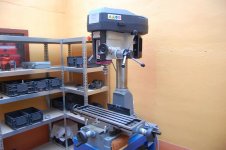
Pics below:
attachment.php


attachment.php


I have the same mill except mine is white. I converted it to be able to do CNC as well as manual machining. The round column mills are not ideal, but mine has turned out enough parts to pay for itself many times over. I expect I will sell it for what I have in it at some point in the future.
 

Richard D

Well-known member
Joined
Jan 19, 2007
Messages
1,923
Location
Texas City, between Houston and Galveston
What ever machine you get, like others have said, get one with a popular size spindle, like R8. Then when you upgrade to a bigger machine, you can still use all your tooling.

Some guys have had positive experiences with round column mill-drills, but I'd venture that is the exception. Might be so frustrating as to turn you off to machining. I gave mine away and got a 50 year old Millrite, kinda a mini-Bridgeport. Mill-drills make really good drill presses, however...
 
To avoid these ads, REGISTER NOW!
Top Bottom