To avoid these ads, REGISTER NOW!

Mini-split worth it without insulation?

madcoder

Member
Joined
Aug 9, 2013
Messages
24
Location
North Carolina
Moved into a new house recently and it has a finished 20'x30' attached garage with 15' tall ceilings. I'm planning on using it for a workshop, mostly woodworking, and would like to better control the temperature and moisture with a mini-split, however I'm worried it won't be worth it without insulation. Another possible issue with this is that the bottom part of the wall is block. It already seems like moisture is making it's way through from the outside.

Ripping out all the drywall and starting over would be a costly nightmare since I can't do the work myself. Are there any other suggestion on how to tackle this? Could I get someone to come in and spray foam the cavities in-between the studs or is it better to just bite the bullet and rip out the drywall?

Thanks
 
To avoid these ads, REGISTER NOW!

mike93lx

ALLIANCE MEMBER
Joined
Dec 9, 2013
Messages
37,356
Location
Richmond, VA
Blow in insulation. The crew will cut holes about 2" diameter in each stud Bay and then dense pack with cellulose or fiberglass.

The a/c will cool the place down, but without insulation, it won't stay cool for long once it shuts off
 

jack stand

Well-known member
Joined
Feb 29, 2012
Messages
3,302
Location
Lakes Region Maine
Bite the bullet, rip that **** out and insulate properly. Wait for material prices to come back to earth and finish the interior. Drywall is a poor choice for a shop anyway.
Add gutters and correct any grading problems that doesn't direct water away from the building. White "barn metal" makes for a nice bright one step inside finish. It's high right now also.
 

loganb

ALLIANCE MEMBER
Joined
Dec 29, 2011
Messages
5,495
Location
Omaha, NE
Pictures of space?

Ripping out is unnecessary if it's just to insulate and the existing drywall is in good shape. As mentioned you can do blown in insulation into existing spaces like this by punching a hole in the top of the wall cavity with a hole saw to use as a fill hole for the blower hose. It's an easy but messy 2 person job and the blower is generally a free rental where you buy the insulation. Check my build thread in the sig, I did it on my current attached garage and still need to finish the job with installing the rest of the plywood "trim" around the top to cover the access holes.

For 15' tall walls, I'm assuming it's not framed with 2x4's so either metal, pole barn style construction or 2x6 framing(or larger) but either way you will need to do some "sleuthing" to make sure the cavity is clear of any "impediments" across the framing that would prevent you from filling it in a single shot from the top. Fire blocking or other items in that cavity would mean you'd have to put 2(or more) fill holes

"Pour In" foam is also an option, will be dramatically more expensive but should offer superior air sealing

Opinions vary on vapor barrier or no vapor barrier, but with it being un-insulated right now there is likely no vapor barrier between the studs and the drywall. If that bothers you there are paints specifically designed to be a vapor barrier that could be put on the existing drywall and remedy that concern. You'll likely need to get if from a "Industrial" paint dealer, the "retail focused" Sherwin Williams in my area don't have it but their professional/industrial targeted store had it in stock in 5 gal's:

https://www.sherwin-williams.com/painting-contractors/products/moisture-vapor-barrier

If you've got other moisture problems, removing drywall may be necessary to find and fix those issues. If there is moisture coming thru the walls post pictures of the exterior

Regardless of what you do with the walls, air movement is going to be important to have a comfortable space with that high of ceiling. Without air movement you'll get "stratification" in that space so your expensively conditioned air will likely be hanging out where you're not...no bueno! The "cadillac" of workshop/industrial grade fans is Big *** Fans, remember though I did say "Cadillac" so have that in mind price wise. They're getting popular enough there are a number of other large diameter fans designed to move volumes of air slowly(which is what you want in a woodshop to minimize stirring back up dust) at lower price points

As to what to put on the interior, the "schools of thought" between what should cover the interior of a garage/workshop generally pit the camps of drywall, plywood/OSB and metal against each other. Each has it's benefits and each has it's detractors and what's right for one shop or scenario may not be right for another so read up and ask questions

When you get a moment if you'd also add your location to your profile it'll help get more targeted answers to questions like this as insulation or HVAC needs vary dramatically based on location.
 
OP
M

madcoder

Member
Joined
Aug 9, 2013
Messages
24
Location
North Carolina
The other PITA thing about how this garage is setup is that concrete wall forces all the outlets to be up high.

For reference the concrete portion is 42" tall and the outlets are 7'

Also, the ground outside is level with the top of the concrete wall.
20210809_061040.jpg

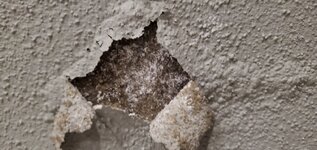
Close up shots of this section of wall from the pic above. Had this wall painted when we had the floor epoxied(2 yrs ago). This is the only section of wall that has the paint bubbling up and staining. You can also see where the floor and wall meet appears to be deteriorating.
20210809_061058.jpg20210809_061104.jpg
 
OP
M

madcoder

Member
Joined
Aug 9, 2013
Messages
24
Location
North Carolina
Bumping this thread as water is still coming in through the walls.

I fixed the drainage issue outside, sealed every crack I could find, replaced all weatherstripping on my garage door, and run a dehumidifier 24/7.
The humidity in there is great but the wall is still absorbing water from outside. I'm guessing this is because the ground water is going to be there no matter what and the outside wall isn't waterproofed.

I've read a solution is painting the interior wall with a "slurry" that's made for waterproofing. Will this cause problems with water getting trapped in the wall since it has no place to escape now?

Thanks all
 
To avoid these ads, REGISTER NOW!

PoorUB

Well-known member
Joined
Mar 29, 2021
Messages
11,616
Location
Fargo, ND
Bumping this thread as water is still coming in through the walls.

I fixed the drainage issue outside, sealed every crack I could find, replaced all weatherstripping on my garage door, and run a dehumidifier 24/7.
The humidity in there is great but the wall is still absorbing water from outside. I'm guessing this is because the ground water is going to be there no matter what and the outside wall isn't waterproofed.

I've read a solution is painting the interior wall with a "slurry" that's made for waterproofing. Will this cause problems with water getting trapped in the wall since it has no place to escape now?

Thanks all
I would dig down to the footing, put in drain tile and drain to a low spot or a sump pump. While the dirt is pulled away, clean the foundation well and seal it properly on the outside..
 
Last edited:

theoldwizard1

Well-known member
Joined
Feb 22, 2011
Messages
43,076
Location
SE MI
Insulation in the ceiling, at least 6", 12" would be better, will make a big difference ! It can easily/cheaply be blown in.

As for the walls and moisture, you will have a battle, but a properly sized mini-split will handle the job. With that much area and high ceiling, 2 air handlers would be the best. If not, you will need a couple of fans to get the air circulating.
 

jjrbus

Well-known member
Joined
Dec 8, 2018
Messages
605
Location
Florida
I live in a concrete block stucco house in Florida, there is 3/4" fiberglass batt in the walls and about 6 inch in the ceiling. I would say walls are almost no insulation. I cool the house with mini's. Heat also sometimes as much at 10 days a winter LOL
 

WisJim

Well-known member
Joined
Dec 20, 2010
Messages
2,259
Location
Menomonie, WI
What @PoorUB said--and also add some outside insulation while the wall is exposed. Use styrofoam with the applied gravel finish for the exposed part of the insulation. Then insulate the rest of the building. Heating/cooling without insulation is throwing money at a problem.
 

Notgrownup

Well-known member
Joined
May 5, 2014
Messages
5,847
Location
Snow Hill NC
It will heat and cool pretty good but you will lose some energy. The drywall will act as an insulated barrier of sort but just not effectively. Get it blow in. Me I would rather tear out the drywall and redo it. Do it in phases. I guess blowing it in would be fine. I would be afraid of trapped moisture?.. maybe im overthinking it. We get so much humidity here. I’m in Eastern NC and moisture is brutal.
 
To avoid these ads, REGISTER NOW!
Top Bottom