Dave455
Well-known member
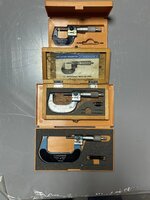
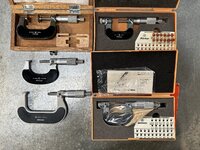
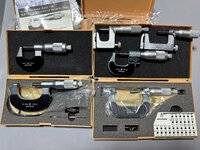
Wow!0-1" thread mic w/ interchangeable anvils


That instrument is pure class!


Wow!0-1" thread mic w/ interchangeable anvils
Oh no! I feel your pain.Nice Dark, I have the exact same micrometer, but sadly I recently pulled it out after sitting in a drawer for the last four years and found that a lot of the anvils were completely deteriorated and eaten beyond repair by the black foam in the case that crumbled, falling onto the mic and anvils eating the metal leaving large eaten pitted voids in the metal, it's not rust.
I’ve been meaning to make a general post about warning other MIT. tool owners (or potential buyers) to look out for this issue that seems to be fairly common in the older orange cases. It's the black open cell foam that is on the roof of the cover or the lining layer on the bottom of the case. When I have time I'll pull it out and take some pics of my interchangeable anvil; its rather sad and I'm in denial thinking it will be just fine with a little little cleaning.
Here's a pic I already had of my inside mic., luckily it doent effect performance and most of it is on the backside. I changed out the case so it's not the one in the background. I've actually come across quite of few Mit's with this issue, again sadly I myself have quite a few like this.
PS> Thats a nice Royal spindle live center you have.

Ah might as well add one more for today....Oops I missed a few Mondays.
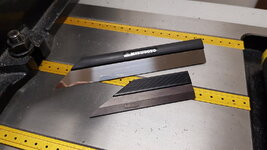
I’ve never seen anything like that, what are these used for? I assume for checking flatness? But to what extent? Scraping?Ah might as well add one more for today....
4" & 6" knife straight edges.
Yes, precision straight edges are used for quick visual checks for flatness. Not necessarily for checking scraping work, they usually use bluing with surface plates methods for that.I’ve never seen anything like that, what are these used for? I assume for checking flatness? But to what extent? Scraping?
edit: I mean like checking your scraping, not actually usino them to scrape with


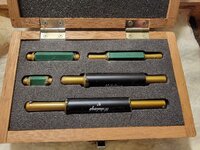


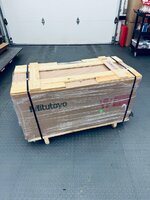

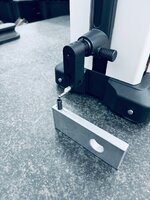
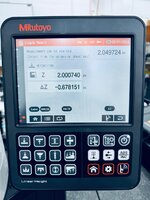


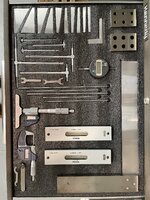
 I have a couple sets of these from a later period where they were still making them in Japan but were a different paint scheme.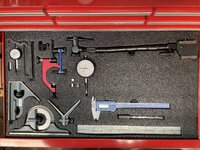

New as in brand new or new to you? Does the needle not land near 12 o'clock when the jaws are fully closed?Below is a new Mitutoyo 150mm dial caliper. The only way to adjust is to rotate the head til 0 hits the needle.
The metric caliper is either new or NOS. It's a cheaper model off Amazon but authentic as far as I can tell. The needle does not hit straight up 12 o'clock at fully closed, it is off by maybe 1.5 to 2 degrees. So you rotate the dial to make the needle hit 0 at fully closed. I read about disassembling them but It sounds like I could easily FUNG it without absolutely knowing what I'm doing. Long Island Indicator Service indicates due to their low cost these are not worth the price to professionally calibrate, and they don't work on dial calipers anyhow. Both of mine will be far more accurate than anything I very infrequently need them for.New as in brand new or new to you? Does the needle not land near 12 o'clock when the jaws are fully closed?
If they are not brand new never used, dial calipers can skip teeth on the rack & pinion. Can take them apart to "reset" them. But I don't own any dial calipers myself h have never done it personally.