To avoid these ads, REGISTER NOW!

Monolithic slab questions

laurie71

Well-known member
Joined
Apr 20, 2016
Messages
181
Location
Centerville, Ohio, USA
So I decided for my upcoming garage build that I'd rather not have stem walls, and so I've been looking into doing a monolithic slab. I was looking into an insulated shallow foundation but (a) it doesn't sound like it would be permitted here and (b) I worry about termites and other critters.

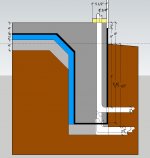
A sample drawing from the local building inspector's office shows the details they need to see to issue a permit (I just have to provide site plan, dimensions and a wall cross section like this to get my zoning and building permits):

typical-wall.jpg

Does the frost wall have to be formed, or can I excavate an appropriate size trench and just form the above-grade perimeter with 2x8 boards? If either is permissible, is one way preferred over the other?

Also, I'd want to place poly, foam insulation, and about 4" of gravel below the slab, with PEX in the slab; how should I handle the transition between the slab and the frost wall / thickened edge? Even if I place gravel first, it's going to be difficult to prevent it falling into the trench and tough to compact well.

What about supporting mesh/rebar and the PEX over the transition area? I'm guessing I can just tie it in to the rebar at the top of the perimeter?

Planning on going 36' x 58' and will be framing 2x6 @ 24 OC if it makes any difference...
 
Last edited:
To avoid these ads, REGISTER NOW!

seanc_mt

Well-known member
Joined
Jul 20, 2015
Messages
285
These are really basic questions. Not to be rude. But please hire someone to do your concrete.
 
OP
L

laurie71

Well-known member
Joined
Apr 20, 2016
Messages
181
Location
Centerville, Ohio, USA
These are really basic questions. Not to be rude. But please hire someone to do your concrete.

Not to be rude, but no. My goal is to do it myself. My objective is to learn how to do it right. My questions will get less "basic" as I learn.

I've done my research on how to DIY a traditional footer / block wall / floating slab foundation and if I end up going that route I still have questions to ask. Those may seem "basic" too.

I've had quotes, and can (and will) pay to have the work done if I have to, but I want to do as much as I can DIY. It's a project. I want to be able to say, "I did that!"

Thanks for posting; you clearly know more than me in this field so you can probably provide a lot of help.

Cheers!
 

Leaflessshadetree

Well-known member
Joined
Aug 1, 2013
Messages
7,145
Location
Don't ask.
Let me start by saying that I couldn't open your attachment. Also I am not sure of the terminology. Frost wall and stem wall seem to be the same thing per google.

For thickened edge (monolithic):
Remove topsoil/organic materials.
Place and compact gravel for the middle areas then trench for the thickened edge (or footer) place and compact gravel.
Vapor barrier, forms, insulation, reinforcement, pex. (you might switch up the order of these a little).

If doing any type of a wall I'd make it 3 pours. Footing then walls and floor.
 

matt_i

Well-known member
Joined
Mar 14, 2008
Messages
10,722
Location
SE Michigan
I can't see your attachment either.

Man, for a 36x58 = 2088 sq feet you are hanging a lot of money out on the hope that a non-insulated thickened edge floating slab won't heave and wreck your entire investment. The FSPS has a HUD document out there that has formulas on how to design this to encompass the entire US. I would press your building dept on that until they submit.

As far as termites I would prep the soil first (likely hire a contractor, they used to put down Dursban but I think it has side effects that crossover into people). Then hire a termite monitoring company.
 

finn

Well-known member
Joined
Mar 27, 2005
Messages
16,187
Location
The UP, God's country
I built a 32x54 w/pex and a floating slab in 2003 and it's holding up fine.

Our climate is a lot more severe than yours, too.
 

casmurbax

Well-known member
Joined
Sep 25, 2012
Messages
2,756
Location
Wilton, NY
I just had my 18x24 monolithic slab done last Friday.

I apologize for the long rant but having just gone through this please bare with me.

From the sounds of this post and your Ever evolving garage plans post you have spent quite a bit of time researching this and thinking about this.

I do not know your abilities but as many others have said long prior to me, "the foundation is the core of any building". That is not something that you really want to learn on doing your first time, especially the size you are talking about. There is quite a bit of work that goes into not just the preparation of a monolithic slab but the pouring of the concrete, troweling of the slab etc as well.

I listened to no less than 10 masons and 2 engineers advise me what they would do.

I spent months late last year getting quotes and researching on whether to do a monolithic slab, poured stem well or block wall. I questioned my ability if I went with a monolithic slab could I do it myself with some help from my friends?

I ultimately decided to do a monolithic slab and did all the prep work myself, "all" the mason had to do was; form it, rebar, wire mesh pour it and trowel it out. Funny that is all they had to do, even that was quite a bit of work. The forming of it alone took 6 guys two hours do. They formed it to the 18 in depth around the perimeter with 6 inch center slab. When it came time to pour, it was two guys running buggie's and 4 pushing the mix around till all the mix was in, then it was just 3 guys to trowel it out.

The prep work was a pain but well worth it. After watching these guys do the forming, pouring and troweling, I was happy to pay them. 14 yards of concrete... ugh glad I decided not to do that part of it, and I can say yup I made the call to the mason.... In the end I didn't care that I didn't physically do it all and I was glad i had the mason do it.

I strongly suggest that you get some mason's on site and give you a proper quote. it is not as easy as some people make it out to be.

just my opinion
best of luck to you.
forms.jpg
 

GYPSY400

Well-known member
Joined
Mar 21, 2013
Messages
517
Location
Naughton Ontario
So I decided for my upcoming garage build

Planning on going 36' x 58' and will be framing 2x6 @ 24 OC if it makes any difference...


Something that big, I would be hiring someone to do it.

Do you not need engineered drawings for your foundation.? The drawing would show all that is required for rebar and forming.

In my area any building over 700 sqft requires engineered foundation and roof.


Sent from my SM-G903W using Tapatalk
 

matt_i

Well-known member
Joined
Mar 14, 2008
Messages
10,722
Location
SE Michigan
I built a 32x54 w/pex and a floating slab in 2003 and it's holding up fine.

Our climate is a lot more severe than yours, too.

Imo its more dependent on whether your soil holds/entrains water that can then freeze and rack the ground out of proportion (and that is unknown until you build it)...a big portion of the FPSF design is compacting gravel in a ~8" layer to break surface tension and give water a path of less resistance.

The 25psi insulation (3600psf) is theoretically a more compression-resistant material than the undisturbed ground...

My free suggestion whatever design you choose is to do the ground prep and set the forms, spread and compact gravel, install vapor barrier, install reinforcement, setup pump truck. Hire a crew for a 1 day job to place and finish the slab. You can seal the surface as soon as you can walk on it with socks. Have the crew come back and cut the control joints first thing the next morning. Then it can be a cash job, one day (except for the saw cuts) for your crew. Imo there's too much at stake and not enough time to learn to level and finish the floor on a slab that big and expect good results. At risk is $$$$ worth of concrete and prep work.
 
Last edited:
OP
L

laurie71

Well-known member
Joined
Apr 20, 2016
Messages
181
Location
Centerville, Ohio, USA
Let me start by saying that I couldn't open your attachment. Also I am not sure of the terminology. Frost wall and stem wall seem to be the same thing per google.

Fixed the attachment I hope. Yes, frost wall / stem wall are pretty much the same thing AFAIK.

For thickened edge (monolithic):
Remove topsoil/organic materials.
Place and compact gravel for the middle areas then trench for the thickened edge (or footer) place and compact gravel.
Vapor barrier, forms, insulation, reinforcement, pex. (you might switch up the order of these a little).

If doing any type of a wall I'd make it 3 pours. Footing then walls and floor.

Hopefully the attachment is showing up now and making things clearer. What they want is like a thickened edge slab, but where the thickened edge still extends down to the frost line...

I can't see your attachment either.

Man, for a 36x58 = 2088 sq feet you are hanging a lot of money out on the hope that a non-insulated thickened edge floating slab won't heave and wreck your entire investment. The FSPS has a HUD document out there that has formulas on how to design this to encompass the entire US. I would press your building dept on that until they submit.

As far as termites I would prep the soil first (likely hire a contractor, they used to put down Dursban but I think it has side effects that crossover into people). Then hire a termite monitoring company.

My fear is that if I try to push for a shallow foundation design they might require engineer stamped drawings. I'm trying to stay within the bounds of what they're used to seeing and approving. Of course at the size I'm building they may decide they need to be more stringent than they usually are for a garage...

My house has had termites a few times in its past, and my barn had termites when I bought the property. I had the barn treated, and have both the barn and house monitored. The garage would have to be too.

I built a 32x54 w/pex and a floating slab in 2003 and it's holding up fine.

Our climate is a lot more severe than yours, too.

Yeah, I'm sure that a floating / shallow foundation would be structurally sound, but it's not worth a fight with the building inspector to get it approved... :eyecrazy:

I just had my 18x24 monolithic slab done last Friday.

I apologize for the long rant but having just gone through this please bare with me.

...

I strongly suggest that you get some mason's on site and give you a proper quote. it is not as easy as some people make it out to be.

just my opinion
best of luck to you.

Sounds like you went through exactly the research and decision making process I'm going through. Thanks for the feedback, that's all very helpful. Realistically I'll probably end up doing as you did, getting the prep work done and hiring a crew to do the actual pour and finish work.

Something that big, I would be hiring someone to do it.

Do you not need engineered drawings for your foundation.? The drawing would show all that is required for rebar and forming.

In my area any building over 700 sqft requires engineered foundation and roof.


Sent from my SM-G903W using Tapatalk

They told me I didn't need engineered drawings or full plans or anything more than a sample wall cross-section like shown in my original post (if the attachment is showing up now).

Imo its more dependent on whether your soil holds/entrains water that can then freeze and rack the ground out of proportion (and that is unknown until you build it)...a big portion of the FPSF design is compacting gravel in a ~8" layer to break surface tension and give water a path of less resistance.

The 25psi insulation (3600psf) is theoretically a more compression-resistant material than the undisturbed ground...

My free suggestion whatever design you choose is to do the ground prep and set the forms, spread and compact gravel, install vapor barrier, install reinforcement, setup pump truck. Hire a crew for a 1 day job to place and finish the slab. You can seal the surface as soon as you can walk on it with socks. Have the crew come back and cut the control joints first thing the next morning. Then it can be a cash job, one day (except for the saw cuts) for your crew. Imo there's too much at stake and not enough time to learn to level and finish the floor on a slab that big and expect good results. At risk is $$$$ worth of concrete and prep work.

I have high-clay soil that doesn't drain well at all. The termite bait stations around my barn were sticking up two inches out of the ground come spring thaw last year. I'm assuming that's why they don't allow shallow foundations here.

Agreed on paying for the pour and finish work. I need to understand what needs to be there before the pour, and exactly what I will (and wont) be hiring out.
 

seanc_mt

Well-known member
Joined
Jul 20, 2015
Messages
285
so i decided for my upcoming garage build that i'd rather not have stem walls, and so i've been looking into doing a monolithic slab. I was looking into an insulated shallow foundation but (a) it doesn't sound like it would be permitted here and (b) i worry about termites and other critters.

A sample drawing from the local building inspector's office shows the details they need to see to issue a permit (.i just have to provide site plan, dimensions and a wall cross section like this to get my zoning and building permits):

typical-wall.jpg

does the frost wall have to be formed, or can i excavate an appropriate size trench and just form the above-grade perimeter with 2x8 boards? If either is permissible, is one way preferred over the other?

many people do just dig and pour the footings which i think is sloppy work. A stem wall you always form along with the 4" forms above grade. What you have pictured is a thickened edge slab. No stem walls there because there is no proper "footing." which is fine mono slabs are very popular.


also, i'd want to place poly, foam insulation, and about 4" of gravel below the slab, with pex in the slab; how should i handle the transition between the slab and the frost wall / thickened edge? Even if i place gravel first, it's going to be difficult to prevent it falling into the trench and tough to compact well.

you want gravel everywhere below the concrete. Under the thickened part and the slab itself. The transition occurs just like your picture with a little slope.

what about supporting mesh/rebar and the pex over the transition area? I'm guessing i can just tie it in to the rebar at the top of the perimeter?

do not what ever you do put mesh in. Minimum #3 rebar at 2 foot centers. There should be vertical rebar in the thickened section that is bent and ties to the horizontal rebar in the slab.


planning on going 36' x 58' and will be framing 2x6 @ 24 oc if it makes any difference...
please dont frame 24" on center to save a few bucks its not worth it. Again these were very basic answers and there is a lot more to it.

1234
 
OP
L

laurie71

Well-known member
Joined
Apr 20, 2016
Messages
181
Location
Centerville, Ohio, USA
Rebar in the thickened section for sure; rebar vs. mesh in the slab is more open to debate... Framing 24" OC is more about thermal efficiency than cost savings.

I have a lot more research into how to do a traditional footing / block or poured stem wall / floating slab type foundation. I'm just starting the learning process on this thickened edge slab style construction. Most of what I see of this construction method doesn't involve going anywhere near so deep in the thickened portion...

I have zero construction experience / expertise, so I start with the basics when researching something new! :beer:
 

kbs2244

Well-known member
Joined
Nov 11, 2006
Messages
14,065
Concrete is one of those tings that look simple, but are not.
In addition to tech details like you are asking there is the fact that is just plan man killing work.
And any mistakes are permiment.

I went with an experienced contractor that knew the inspector and what he wanted to see.
He had equipment I didn't even know about, and experienced men to call on.
He took it from a one time, above ground, pool site to a finished slab.
He even moved some bushes with his bobcat for free.
(Well, there was some beer involved for the whole crew. Like I said, it is man wrecking work. By the end of the day they deserve a can or two.)
 

jack stand

Well-known member
Joined
Feb 29, 2012
Messages
3,305
Location
Lakes Region Maine
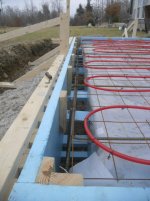
I just did a similar small foundation for a room addition, but I wanted to go crazy with the foam to see...... well let's just call it "educational". It is a shallow foundation but you could do the same with a traditional frost depth wall. In my gravel/sandy soils, a simple footer ditch would cave in and I wanted 2" of foam completely around & under the slab & wall. The pic's should make it clear, but I ended up dry stacking 8" block with the cores filled to handle the transition from slab to wall, while having a very nice insulation detail and saving some concrete.
The small foam blocks you see between the insulation on the "walls" are just hold the insulation (against the block) in place and were removed during the pour. This type of "Shallow frost protected foundation" are really not that new and have been used for years in northern climates. It might not be that foreign to your local building dept. for approval, esp for non living space. Google (image) it and there's a insulation detail where it extends horizontally out from your wall.
I have radiant in the rest of the building and did not go to these insulation extremes, particularly on the exterior frost wall perimeter. The edges can be cold and **** a good bit of heat.
 

Attachments

  • DSCN8310.jpg
    DSCN8310.jpg
    85.4 KB · Views: 120
  • DSCN8309.jpg
    DSCN8309.jpg
    100.3 KB · Views: 132
  • DSCN8288.jpg
    DSCN8288.jpg
    109 KB · Views: 129
  • DSCN8281.jpg
    DSCN8281.jpg
    147.5 KB · Views: 134
OP
L

laurie71

Well-known member
Joined
Apr 20, 2016
Messages
181
Location
Centerville, Ohio, USA
Concrete is one of those tings that look simple, but are not.
In addition to tech details like you are asking there is the fact that is just plan man killing work.
And any mistakes are permiment.

Very true! I'll be getting quotes for the job too before I decide how of the prep work to do myself. The actual pour and finish will definitely be sub'd out.

I just did a similar small foundation for a room addition, but I wanted to go crazy with the foam to see...... well let's just call it "educational". It is a shallow foundation but you could do the same with a traditional frost depth wall. In my gravel/sandy soils, a simple footer ditch would cave in and I wanted 2" of foam completely around & under the slab & wall. The pic's should make it clear, but I ended up dry stacking 8" block with the cores filled to handle the transition from slab to wall, while having a very nice insulation detail and saving some concrete.
The small foam blocks you see between the insulation on the "walls" are just hold the insulation (against the block) in place and were removed during the pour. This type of "Shallow frost protected foundation" are really not that new and have been used for years in northern climates. It might not be that foreign to your local building dept. for approval, esp for non living space. Google (image) it and there's a insulation detail where it extends horizontally out from your wall.
I have radiant in the rest of the building and did not go to these insulation extremes, particularly on the exterior frost wall perimeter. The edges can be cold and **** a good bit of heat.

Thanks for the details! I'll probably only insulate under the slab and at the top of frost wall. I know SFPFs have been in use for decades, and code approved for some time. It could just be that none of the concrete guys I've talked to is comfortable with building one... really need to talk to the inspector and confirm, but he doesn't respond to email and he's out of the office on inspections whenever I try calling :-/
 

ard

Well-known member
Joined
Feb 16, 2015
Messages
4,391
Location
Sierra Foothills... California
So I decided for my upcoming garage build that I'd rather not have stem walls,

Really? Why?

For a garage, I'd strongly prefer a stem wall of a few inches- puts the wood above grade, above termites, away from water- let you hose out the garage.

Conventional footing, stem wall- then isolated slab with insulation. Much easier DIY
 
OP
L

laurie71

Well-known member
Joined
Apr 20, 2016
Messages
181
Location
Centerville, Ohio, USA
Really? Why?

For a garage, I'd strongly prefer a stem wall of a few inches- puts the wood above grade, above termites, away from water- let you hose out the garage.

Conventional footing, stem wall- then isolated slab with insulation. Much easier DIY

Guess I should have explained that! I'm building a mixed-use parking / workshop garage with an interior wall separating the parking area from the shop area. In the shop area I want to be able to put shelves and cabinets against the wall, and have them sit flush up to the wall, not held off from it by the curb wall.

I also think raising the walls might be more straight forward with a flat slab, but in the end it's probably more of a personal preference thing.
 

ard

Well-known member
Joined
Feb 16, 2015
Messages
4,391
Location
Sierra Foothills... California
Guess I should have explained that! I'm building a mixed-use parking / workshop garage with an interior wall separating the parking area from the shop area. In the shop area I want to be able to put shelves and cabinets against the wall, and have them sit flush up to the wall, not held off from it by the curb wall.

I also think raising the walls might be more straight forward with a flat slab, but in the end it's probably more of a personal preference thing.

Then float the slab level with the top of the stem.... still is an easier DIY to break it into 3 pours...


Not sure what kind of cabinets, but if it is a conventional cabinet with a base that forms a kickspace, just keep the stem under that height- 4", 3" 2" etc, and it will be hidden (just slide the base out and the cabinet flush to the wall).

And interior partitions can sit on the slab, no need for stem there (assuming not bearing)

As they say, knock yourself out!

;)
 
To avoid these ads, REGISTER NOW!

Firebrick43

Well-known member
Joined
May 12, 2015
Messages
13,989
Location
West central Indiana
I did a small Shed as a monolithic pour. I excavated the hole completely out to the bottom of the "footer" and then 12" deeper around the perimeter. I filled in (#8 stone) and compacted the trench in 4" lifts. I then placed #8 in the center in 4" lifts and compacted. It formed the center mound very nicely. After compacting I would walk the footer area and shovel up any stone that came off back up onto the mound. Would repeat how ever many times it took to build the center mound up. I think it was 18". I used a jumping jack for compaction and found that even though their we're not fines the stone had locked together and the mound was solid.

By building the center mound out of stone there was no worries about freezing or expansive soils lifting or blowing out the skirt.


I lined the walls with plastic to keep the soil from wicking moisture from the curing concrete(weakening it) and formed with 2x8 above grade. Placed plastic over the mound, laid and tied all my rebar and sub the pour/finshing out.
 
Last edited:
OP
L

laurie71

Well-known member
Joined
Apr 20, 2016
Messages
181
Location
Centerville, Ohio, USA
Then float the slab level with the top of the stem.... still is an easier DIY to break it into 3 pours...


Not sure what kind of cabinets, but if it is a conventional cabinet with a base that forms a kickspace, just keep the stem under that height- 4", 3" 2" etc, and it will be hidden (just slide the base out and the cabinet flush to the wall).

And interior partitions can sit on the slab, no need for stem there (assuming not bearing)

As they say, knock yourself out!

;)

Perhaps lack of experience is leading me to see problems that aren't really there... :willy_nil Assuming I sub out the pour itself, a monolithic pour would save me money in delivery costs but might cost more in materials used. I'm thinking that if I went with block walls and wanted to fill them, though, the materials difference might not actually be that much...
I did a small Shed as a monolithic pour. I excavated the hole completely out to the bottom of the "footer" and then 12" deeper around the perimeter. I filled in (#8 stone) and compacted the trench in 4" lifts. I then placed #8 in the center in 4" lifts and compacted. It formed the center mound very nicely. After compacting I would walk the footer area and shovel up any stone that came off back up onto the mound. Would repeat how ever many times it took to build the center mound up. I think it was 18". I used a jumping jack for compaction and found that even though their we're not fines the stone had locked together and the mound was solid.

By building the center mound out of stone there was no worries about freezing or expansive soils lifting or blowing out the skirt.


I lined the walls with plastic to keep the soil from wicking moisture from the curing concrete(weakening it) and formed with 2x8 above grade. Placed plastic over the mound, laid and tied all my rebar and sub the pour/finshing out.

Sounds about like the process I have in my head, except I'd add insulation foam and in-slab heat. Did you do anything after the fact to add drains at the bottom of the "footer"?
 

Stuart in MN

Well-known member
Joined
Sep 8, 2005
Messages
23,000
Location
Minneapolis
I'm no expert, just asking a couple observations:

To clarify, the drawing in the first post shows a 30" deep frost wall, but you're thinking about using just a floating slab with thickened edges?

If that is the case, my understanding is at least some localities limit the square footage of the building that can be built on a floating slab, so you may need to confirm what your area requires.
 

Firebrick43

Well-known member
Joined
May 12, 2015
Messages
13,989
Location
West central Indiana
Perhaps lack of experience is leading me to see problems that aren't really there... :willy_nil Assuming I sub out the pour itself, a monolithic pour would save me money in delivery costs but might cost more in materials used. I'm thinking that if I went with block walls and wanted to fill them, though, the materials difference might not actually be that much...


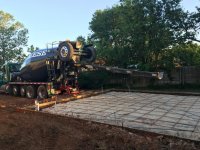
Sounds about like the process I have in my head, except I'd add insulation foam and in-slab heat. Did you do anything after the fact to add drains at the bottom of the "footer"?

Field tile around perimeter
 
OP
L

laurie71

Well-known member
Joined
Apr 20, 2016
Messages
181
Location
Centerville, Ohio, USA
I'm no expert, just asking a couple observations:

To clarify, the drawing in the first post shows a 30" deep frost wall, but you're thinking about using just a floating slab with thickened edges?

If that is the case, my understanding is at least some localities limit the square footage of the building that can be built on a floating slab, so you may need to confirm what your area requires.

No, a floating slab is what I was considering but I've been advised I wouldn't be allowed to do that here. I would have to do as shown in the drawing, with the 30" frost wall.
 
OP
L

laurie71

Well-known member
Joined
Apr 20, 2016
Messages
181
Location
Centerville, Ohio, USA
So allowing 2" overlap of sheathing onto foundation and 6" from sheathing to grade, that puts the surface of the slab 8" above grade, which is a bit much for a gravel driveway; guess I'll need to account for pouring approach aprons and a step/pad for the man door. I'm assuming it wouldn't be a good idea to form those as part of the monolithic pour... :lol:

If frost depth is 30", and water supply / sewage lines need to be below that (by how much?...) then filling in the trench over those lines with the footer trench open is going to be a problem.

Would this work: dig the footer, then punch a short "sleeve" of larger OD pipe into the side of the trench wall, and install capped PVC into the sleeve from the trench; later, after concrete has set, dig to expose the capped, sleeved lines, cut away sleeve to access capped line, then trench and extend the lines from there?

[Editted to add:] if my question isn't clear: I'm asking how to get the rough plumbing, electrical conduit, etc. into the trench (or out of it, if you want to look at it that way) whilst keeping the wall of the trench above intact? Picture might help too:

cross-section.jpg
 
Last edited:

BACAGrizz

New member
Joined
Jun 21, 2011
Messages
2
Location
Oklahoma
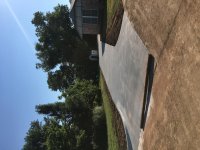
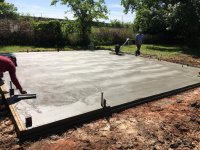
I just had a 24'x25' slab poured along with 100' of 10' wide driveway. The slab is a monolithic pour with 12"x18" footings and the floor is 4" thick. Footings are reinforced with 5/8" rebar and the slab has 1/2" rebar on an 18" grid. After watching 6 guys do the work in two days I am glad I didn't try to DIY it. Well worth the money to have it done.

I am putting in a bathroom and had the plumber set the drain and water line and an electrician set some pvc in the slab for wiring.

I hope you can open the attachments.
 

Attachments

  • IMG_3460.jpg
    IMG_3460.jpg
    146 KB · Views: 65
  • IMG_3448.jpg
    IMG_3448.jpg
    149 KB · Views: 68
  • IMG_3443.jpg
    IMG_3443.jpg
    149.8 KB · Views: 84
Last edited:

larry4406

Well-known member
Joined
Jan 27, 2006
Messages
19,039
Location
Northern Virginia
I just had a 24'x25' slab poured along with 100' of 10' wide driveway. The slab is a monolithic pour with 12"x18" footings and the floor is 4" thick. Footings are reinforced with 5/8" rebar and the slab has 1/2" rebar on an 18" grid. After watching 6 guys do the work in two days I am glad I didn't try to DIY it. Well worth the money to have it done.

I am putting in a bathroom and had the plumber set the drain and water line and an electrician set some pvc in the slab for wiring.

I hope you can open the attachments.

Nice - I hope to be pouring a 24x26 monolithic slab soon as well similar to yours. What did yours cost if you don't mind?
 

Tj-gord

Active member
Joined
Jan 26, 2017
Messages
26
Location
Northern alberta
Dont post much but can help a bit on this subject. I will highly suggest having the floor poured by a crew. We are building our 30x40 shop right now. I did pour the foundation wall myself with buddies (have concrete experience when i was younger), but i will have the floor placed by a crew. I know what im doing pouring concrete.. but my buddies dont, and concrete can get away from u fast. The last thing u want is a poorly finished floor in your shop or garage..it is money well spent.
 
OP
L

laurie71

Well-known member
Joined
Apr 20, 2016
Messages
181
Location
Centerville, Ohio, USA
I've had trouble finding good how-to info on DIY-ing this so I'm leaning back toward a poured footing / block / floating slab construction, just because I understand how to do it better (and therefore how to spec it if I sub it out). As I see it, I have the following options in order of ease of dummy DIY:

a) monolithic single-pour frost wall and slab [dummy DIY: excavate & trench to frost depth, simple forms above grade, pack hard fill in slab area, bring in a crew to pour/finish concrete, then re-dig after cure for foundation drains]

b) poured footer / block wall / floating slab [dummy DIY: excavate and form, pour footing, lay block, install foundation drain, back fill, then prep for slab and bring in a crew to pour / finish]

c) three-pour concrete foundation [dummy DIY: excavate for footing and frost wall, prep under-slab area, bring in a crew to handle all forming and concrete placement, install foundation drain and back fill before slab pour]

I wanted to look into the monolithic slab because I like the idea of having a flat concrete platform to build on, without curb walls; but the dummy DIY approach doesn't let me water barrier the foundation at all (even if I dig to install drains, the exposed concrete would likely be too rough to seal up). Over excavating then fully forming from frost depth up is the right way to do it, and that's more than I can DIY!

Same for three-pour concrete construction: I'd have to rent forms, DIY site built isn't practical for 3-4' walls, I'd be doing as much excavation work as for block walls but way more prep for concrete placement and more chance of it all going wrong.

I'm assuming this is why everyone I've talked to about getting this done wants to go with block frost walls: it's quicker and cheaper and easier, which would hold for me doing it myself too.

Ultimately I hope to sub out all of it, but I want to ensure I pay for the right result and get what I want for the money. My preference would be to pay for a properly installed monolithic foundation and do whatever I can myself to save on labour. In reality I'll probably sub out the whole job and take what I can get for a price I can stomach, and probably still end up doing some of the work myself to save money.

Per my build thread, I'm in analysis paralysis again. What would you guys do, given that money is not unlimited? As was pointed out early in this thread, I don't have any expertise here; I wish I had the know-how to just do it already!

Goal summary: detached 36' x ~56' divided parking / shop structure with attic, provisions for future radiant heat and auto lift, fully finished (insulated and drywalled) on the shop side, preference for no curb wall.

Yep, I want quick, easy, cheap, "my monkey could knock that out in a weekend, you can borrow him if you want?" :lol_hitti
 

ddawg16

Well-known member
Joined
Jul 11, 2008
Messages
21,005
Location
S. California
My garage has stem walls. I used 2x6 studs for the walls. Stem wall is 6" wide. Drywall is flush on the inside, OSB shear wall on the outside sticks out. In retrospect, I wish I had made the stem wall 6.5" wide.

My cabinets 'could' go all the way to the floor if I wanted, but I like everything off the floor. It's easier to clean. And, I don't like bending down that far.

Pics are in the link in my signature
 

matt_i

Well-known member
Joined
Mar 14, 2008
Messages
10,722
Location
SE Michigan
Same for three-pour concrete construction: I'd have to rent forms, DIY site built isn't practical for 3-4' walls, I'd be doing as much excavation work as for block walls but way more prep for concrete placement and more chance of it all going wrong.

You can easily DIY a 3 pour if you buy ICFs. Form the footer from 2x10s or -12s. Build the ICF forms on top, pump the ICFs up to your desired wall height, then backfill & compact dirt. Install washed stone and compact. Install reinforcement, and pour slab. The walls you built are the forms for the floor. I did this, I only used a crew to place + finish the floor, I did all of the rest with some helpers when pouring. I am very happy with the concrete work thus far, some testing with heavy machinery to come.

The concrete gets going at the bottom of page 1.
http://www.garagejournal.com/forum/showthread.php?t=319602

If you did choice a) I would never re-excavate for drains. The concrete doesn't care if it gets wet. There's nothing on the inside of the wall to collect and hold water that won't equalize thru the ground unless you build it on a spring :). Imo your job is to put down a vapor barrier for the slab part of the build.
 

yeldogt

Well-known member
Joined
Jan 2, 2012
Messages
18,184
I am surprised the building department does not want stamped plans for the foundation --- I wanted to do a mono on my last small addition and had problems with the building department ... as I had previously in another state when I wanted to do a mono.

Actually, getting a conventional footer/ block wall and slab was cheaper ... as that's what they do around me. It also made the insulation easier.

The block wall came up the level we needed and we poured the floor inside as typical -- In my case I needed to do put the insulation on top of the slab -- warmboard and wood floor over. But, in a garage situation it would be level ... as others have said ..... having the block or concrete extend above the floor is a benefit.

In my current build the concrete above is cut back so the look side is flush with 2x6 walls.
 
OP
L

laurie71

Well-known member
Joined
Apr 20, 2016
Messages
181
Location
Centerville, Ohio, USA
My garage has stem walls. I used 2x6 studs for the walls. Stem wall is 6" wide. Drywall is flush on the inside, OSB shear wall on the outside sticks out. In retrospect, I wish I had made the stem wall 6.5" wide.

My cabinets 'could' go all the way to the floor if I wanted, but I like everything off the floor. It's easier to clean. And, I don't like bending down that far.

Pics are in the link in my signature

Curious why you'd prefer the walls thicker? The reason I'm drawn to the mono slab is so that tool carts etc. could roll up flush to the wall so things don't fall off the back of them! :eyecrazy:

You can easily DIY a 3 pour if you buy ICFs. Form the footer from 2x10s or -12s. Build the ICF forms on top, pump the ICFs up to your desired wall height, then backfill & compact dirt. Install washed stone and compact. Install reinforcement, and pour slab. The walls you built are the forms for the floor. I did this, I only used a crew to place + finish the floor, I did all of the rest with some helpers when pouring. I am very happy with the concrete work thus far, some testing with heavy machinery to come.

The concrete gets going at the bottom of page 1.
http://www.garagejournal.com/forum/showthread.php?t=319602

If you did choice a) I would never re-excavate for drains. The concrete doesn't care if it gets wet. There's nothing on the inside of the wall to collect and hold water that won't equalize thru the ground unless you build it on a spring :). Imo your job is to put down a vapor barrier for the slab part of the build.

I've read that ICFs can be tricky to work with if you aren't experienced with them. Backfilling before pouring certainly helps with avoiding blow-out. What did you do about the exposed foam form at the edge of the slab?

I have a high water table and poorly draining clay soil. The concrete in my barn is often moist from water wicking up from underneath. Having the slab surface 6-8" above grade with plenty of gravel underneath should help that, but I'd be worried about moisture wicking in from the sides with a mono slab... :dunno:

I'll check out your build, thanks!

I am surprised the building department does not want stamped plans for the foundation --- I wanted to do a mono on my last small addition and had problems with the building department ... as I had previously in another state when I wanted to do a mono.

Actually, getting a conventional footer/ block wall and slab was cheaper ... as that's what they do around me. It also made the insulation easier.

The block wall came up the level we needed and we poured the floor inside as typical -- In my case I needed to do put the insulation on top of the slab -- warmboard and wood floor over. But, in a garage situation it would be level ... as others have said ..... having the block or concrete extend above the floor is a benefit.

In my current build the concrete above is cut back so the look side is flush with 2x6 walls.

Yeah, I suspect the conventional build with block would be cheapest to have done as it's typical construction here. Not sure what you mean about cutting the concrete back; do you mean you have poured stem walls that were cut back in thickness after being poured?

Thanks!
 

ddawg16

Well-known member
Joined
Jul 11, 2008
Messages
21,005
Location
S. California
Curious why you'd prefer the walls thicker? The reason I'm drawn to the mono slab is so that tool carts etc. could roll up flush to the wall so things don't fall off the back of them! :eyecrazy:

My garage is 2-story.

If you are thinking of walls taller than 8', then you would be better off with 2x6 walls. And, you can get in more insulation. It would make a difference in your neck of the woods.

A stem wall also gets your outside walls well above grade and possible water damage.

Even if you go with 2x4 construction, your stem wall would still be almost 5" wide.
 
OP
L

laurie71

Well-known member
Joined
Apr 20, 2016
Messages
181
Location
Centerville, Ohio, USA
My garage is 2-story.

If you are thinking of walls taller than 8', then you would be better off with 2x6 walls. And, you can get in more insulation. It would make a difference in your neck of the woods.

A stem wall also gets your outside walls well above grade and possible water damage.

Even if you go with 2x4 construction, your stem wall would still be almost 5" wide.

Sorry, I wasn't clear. I'm planning to frame 2x6 @ 24 OC. 6 inch poured stem walls with 1/2 inch drywall would get me the flush wall surface I want, vs the couple inches of shelf I'd have with a block stem wall. I was curious about why you would prefer your stem wall at 6.5 instead of 6 inches?
 
OP
L

laurie71

Well-known member
Joined
Apr 20, 2016
Messages
181
Location
Centerville, Ohio, USA
My garage has stem walls. I used 2x6 studs for the walls. Stem wall is 6" wide. Drywall is flush on the inside, OSB shear wall on the outside sticks out. In retrospect, I wish I had made the stem wall 6.5" wide.

My cabinets 'could' go all the way to the floor if I wanted, but I like everything off the floor. It's easier to clean. And, I don't like bending down that far.

Pics are in the link in my signature

I read your build thread and learned a lot; thank you for documenting your work so thoroughly! I thought there was a snafu when you ordered your ICFs that resulted in an 8" stem wall instead of 6" though?

I noticed that your slab was poured to overlap the stem walls at the door openings. Granted you went full bore with the rebar, but what happens there if the slab moves (settlement / frost heave / etc)?

I'm definitely going to put more thought and research into ICFs, you made it sound quite easy to use them. :beer:
 
To avoid these ads, REGISTER NOW!
Top Bottom