To avoid these ads, REGISTER NOW!

Motor Over Current Help Needed

Rick_Br

Well-known member
Joined
Apr 8, 2014
Messages
408
Location
Winston Salem, NC
Not sure where this may belong - please feel free to move if necessary

Sorry for the long post - I am working on 3/4 HP, 3 phase, 1750 RPM, 2.8 FLA, dual voltage Delta motor. To date I have disassembled, cleaned, painted and replaced bearings. The motor came to me with no spacers or spring washers in either end and it had 5/64" end play. I used a spring washer in each end when assembling - no discernible end play now. The same problem exists with or without spring washers.

I am using an AB 160 series C VFD to power with single phase input. I have tried two different VFD's with different HP and both showed the same problem.

OK - the problem. When I initially powered up the motor it started and ran fine but after 2/.5 minutes in shut off with a VFD error of 7 - current over load. I checked all parameters and connections and tried again - same result/. Tried another VFD - same result. These VFD's have a set of non programmable parameters that display a series of data - one is VFD output in amps. I set that and observed output of 3.1 amps - so an over current situation did exist and the VFD appropriately shut down. I tested again and measured the current with a Sperry SNAP meter - it also showed 3.1 amps on all three leads and zero on the ground. BTW - this testing was done before adding an wavy washers. I proceeded to add a wavy washer in the fan end - same result. Added another to the opposite end - same result. I bumped up the VFD parameter for max current

42 [Motor Overload Current]Set to motor nameplate Full Load Amps (FLA).

I bumped it from 2.8 to 3.3 - motor ran fine (VFD did not shut off). I let it run 45 minutes - no smoke or smells and it only got a bit warm on the non fan end. I could easily put my hand on it and leave it there comfortably. Then I started adding wavy washers - after the first the operating amps on the VFD jumped up to 3.4 (adjusted VFD parameter to 3.5) - let it run and got the same as above. With two wavy washers the amps jumped up to 3.65 (adjusted VFD parameter to 4) - no adverse affects after 45 minutes although it did feel a bit warmer - again not hot.

I did measure the input volts - 250 as measured with a Sperry digital multimeter and 230 measured with a S[perry analog meter. I'm not sure which one is right or if it even matters.

So that is where I am at - even though there were no significant affects of the over current - I am concerned. This motor is destined for a Delta 17" VS drill press so I'm thinking as load is put on the motor the over current will get worse. Truth be known I have never looked at the operating amps dis[play on a VFD before so this may be normal but I don't think so? Questions

1. What are the potential causes of a motor running over the name plate FLA?
2. Should I be concerned about using this on a drill press?
3. What would the typical unloaded motor current draw be?
4. Is incoming voltage an issue and how can I validate my multimeter voltage readings
5. Given this motor came to me with no washers - should I remove them and live with the 5/64 end play. Ever Delta motor I have seen had spacers and/or spring washers

I guess that is it for now. Thanks for any ideas you may have

Rick
 
To avoid these ads, REGISTER NOW!

wyliesdiesels

Well-known member
Joined
Aug 14, 2012
Messages
19,994
Location
Modesto, CA
post a pic of the nameplate. what is the SF rating?

motor unloaded should be under the FLA

250v is a bit high but still within 5% of usual PoCo tolerance... amps should be even lower with the higher supply voltage

are you sure you put it back together correctly? does it spin freely by hand? no drag?
 
OP
R

Rick_Br

Well-known member
Joined
Apr 8, 2014
Messages
408
Location
Winston Salem, NC
Here is the name plate

Delta Motor 1.jpgDelta Motor 2.jpg

I currently have it wired for low voltage - 9 lead motor. 4-5-6 tied together, 1-7-lead, 2-8-lead and 3-9-lead.

Not sure what service factor might be. IO am confident it is assembled correctly - ashaft spins freely by hand, no noise when running, no smoke and no smells

Rick
 

wyliesdiesels

Well-known member
Joined
Aug 14, 2012
Messages
19,994
Location
Modesto, CA
strange nameplate

the FLA listing is odd 2.8/1.4-3.4/1.7a

should read x.x-x.x/x.x

not sure which voltages those FLA numbers would apply to

I may have missed it but do you have a clamp meter?
 

Jlanciani

Well-known member
Joined
Jun 7, 2020
Messages
164
Location
Home
strange nameplate

the FLA listing is odd 2.8/1.4-3.4/1.7a

should read x.x-x.x/x.x

not sure which voltages those FLA numbers would apply to

I may have missed it but do you have a clamp meter?
Motor is rated for 60/50hz. 3.4/1.7a is 50hz.
 

larry_g

Well-known member
Joined
Apr 28, 2007
Messages
16,872
Location
oregon
strange nameplate

the FLA listing is odd 2.8/1.4-3.4/1.7a

should read x.x-x.x/x.x

not sure which voltages those FLA numbers would apply to

I may have missed it but do you have a clamp meter?
The currents are for the hi/lo voltage and 60 or 50 hz. So the question remains to the OP what frequency are you delivering to the motor?
 
OP
R

Rick_Br

Well-known member
Joined
Apr 8, 2014
Messages
408
Location
Winston Salem, NC
I am running the motor at 60 hz. Input voltage 250. I think the name plate amoshave been explained.

I do have a clamp meter - each lead showed the same amps as the VFD display parameter.

The VFD display for output voltage is reading 217

Rick
 

Jlanciani

Well-known member
Joined
Jun 7, 2020
Messages
164
Location
Home
Any chance you put the motor together backwards? Im wondering if the rotor is not centered left to right in the stator?
 

PCustoms

Well-known member
Joined
Jul 23, 2011
Messages
22,387
Location
VT
I am running the motor at 60 hz. Input voltage 250. I think the name plate amoshave been explained.

I do have a clamp meter - each lead showed the same amps as the VFD display parameter.

The VFD display for output voltage is reading 217

Rick

I may be wrong, but why so low?
 

American Locomotive

Well-known member
Joined
Jan 8, 2017
Messages
10,935
Location
Rhode Island
I am running the motor at 60 hz. Input voltage 250. I think the name plate amoshave been explained.

I do have a clamp meter - each lead showed the same amps as the VFD display parameter.

The VFD display for output voltage is reading 217

Rick
Does the motor spin freely? I would only add juuusssst enough spring washers to take out the end play, and no more. You don't really want to be unnecessarily preloading the bearings. The shaft needs to be able to grow and expand as it heats up. As Jlanciani said, make sure you assembled the motor in the right direction, and that the rotor is centered in the stator properly. Most 3 phase motors will go together incorrectly.

Personally, I would just setup the VFD for 220v output @ 60Hz with a 3.4A current limit and call it good. With those voltage ratings, that is a VERY old motor - probably not any newer than 1950s. As a result, it's not going to be very efficient and it will probably have very poor power factor. It wouldn't surprise me if always draws close to nameplate current loaded or unloaded.
 

mm08822

Well-known member
Joined
Jan 13, 2012
Messages
5,872
Location
NJ
What are the following set-up param values:
32
33
35
36
37
42

What are these read only param values when you think you are running at 60hz:
01
02
03
04
05

And these once faulted
17
18
19
 
Last edited:
OP
R

Rick_Br

Well-known member
Joined
Apr 8, 2014
Messages
408
Location
Winston Salem, NC
OK - motor spins freely by hand - no restriction and no noise. It is possible that I have the rotor in backwards. I know the end bells are right - the were marked to the stator case when disassembled. I do believe the rotor can go in either way.

I'll get the requested parameter values in the AM

These VFD's are old but I have used probably a dozen of them successfully. Here is a link to the manual https://literature.rockwellautomation.com/idc/groups/literature/documents/um/160-um009_-en-p.pdf
Rick
 
OP
R

Rick_Br

Well-known member
Joined
Apr 8, 2014
Messages
408
Location
Winston Salem, NC
What are the following set-up param values:
32 - 0
33 - 90
35 - 60
36 - 220
37 - 230
42 - 2.8, 3.5. 3.7 Reset to 2.8 FLA for testing

What are these read only param values when you think you are running at 60hz:
01 - 60
02 - 217
03 - bounces 3.54 to 3.65
04 - bounces .16 to .21
05 - 334

And these once faulted - faults at 2.5 minutes
17 - 7
18 - 4
19 - 7
Another member has the same motor and messaged me that on his the fan is on the left when you are facing the data plate in an upright position. Mine is on the left. Not sure how big an issue that is?

Rick
 

PCustoms

Well-known member
Joined
Jul 23, 2011
Messages
22,387
Location
VT
Not sure what you are asking - I think they are the same but I would need to disassemble to be sure.

Rick

You said his is on the left.

You then said yours is on the left.

Then you asked if this was an issue.

Not sure what you think is an issue or why his being the same would indicate it is
 
To avoid these ads, REGISTER NOW!

Jlanciani

Well-known member
Joined
Jun 7, 2020
Messages
164
Location
Home
To clarify; mine is on the right, opposite of OPs. My suspicion is that the rotor is not symmetric and his motor is assembled incorrectly.
 

BillK

Well-known member
Joined
Aug 24, 2006
Messages
9,306
Location
Beautiful Southern Maryland
How does the motor spin when it is hot ? Any chance the rotor is expanding and tightening up when it warms up ? I dont know that I have ever had an electric motor that didnt have some end play.
 
OP
R

Rick_Br

Well-known member
Joined
Apr 8, 2014
Messages
408
Location
Winston Salem, NC
How does the motor spin when it is hot ? Any chance the rotor is expanding and tightening up when it warms up ? I dont know that I have ever had an electric motor that didnt have some end play.
After 45 minutes of running the motor had no change. It was spinning fine. Somewhat warm on non fan end but not hot

Rick
 

Jlanciani

Well-known member
Joined
Jun 7, 2020
Messages
164
Location
Home
You are misreading the nameplate. The 3.4A is for 208-220V and the 1.7A is for 440V.

James
Did you notice that there ard four current values and two frequencies listed on that nameplate?? First two currents are 2.8/1.4 at 60hz, second two currents of 3.4/1.7 are 50hz. The motor also has two temp ratings and speed ratings for 60/50hz.
 

kngelv

Well-known member
Joined
May 25, 2011
Messages
2,216
Location
Detroit, MI
Did you notice that there ard four current values and two frequencies listed on that nameplate?? First two currents are 2.8/1.4 at 60hz, second two currents of 3.4/1.7 are 50hz. The motor also has two temp ratings and speed ratings for 60/50hz.
You are correct.

James
 

mm08822

Well-known member
Joined
Jan 13, 2012
Messages
5,872
Location
NJ
To clarify; mine is on the right, opposite of OPs. My suspicion is that the rotor is not symmetric and his motor is assembled incorrectly.
Good catch! Worth checking out.

Rotor or stator not being symmetrical relative to the ends of the motor housing "tube". The tube being what each end bell seats in. If they aren't symmetrical, then all the lines of flux between the stator poles aren't being cut by the rotor b/c the rotor is flipped end-end.
 
OP
R

Rick_Br

Well-known member
Joined
Apr 8, 2014
Messages
408
Location
Winston Salem, NC
Did you notice that there ard four current values and two frequencies listed on that nameplate?? First two currents are 2.8/1.4 at 60hz, second two currents of 3.4/1.7 are 50hz. The motor also has two temp ratings and speed ratings for 60/50hz.
Yes I did see that - but thanks for bringing it up

Rick
 
OP
R

Rick_Br

Well-known member
Joined
Apr 8, 2014
Messages
408
Location
Winston Salem, NC
Many thanks to JLanciani for the tip on rotor orientation. I took the whole motor apart again. The stator is not symmetrical in the casing.

Stator Left End.jpgStator Right End.jpg

I have been testing with the fan end of the rotor inserted in the stator from the wide side (first picture) - thinking that was wider to accommodate the fan. I turned it around and the operating amps dropped to 2.1 to 2.2 - well under the 2.8 FLA. This was cold - I have not let it run for more than a few minutes yet. I'm hoping as it warms up the amps will drop a little more. I was initially concerned because I could hear a faint tick - further investigation revealed a bent fin on the fan - straightened that and tick disappeared. On my last test I had a wavy washer in each end of the rotor. Not sure that is right as there is no end play that I can feel at this point.

Rotor.jpg

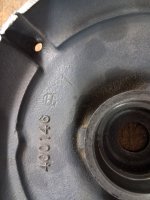
The end bells are identical and are numbered 400146

End Bells.jpg

However one of them has a 1 and one has a 2

End Bell Marked 1.jpgEnd Bell Marked 2.jpg

I'm guessing that is an indicator of which end they go on - I did mark them when disassembling so I feel comfortable that 1 is the shaft end and 2 is the fan end.

I think at this point the problem may be resolved but am interested in any comments/cautions folks might have

Rick
 
Last edited:

American Locomotive

Well-known member
Joined
Jan 8, 2017
Messages
10,935
Location
Rhode Island
Seems like you have the issue resolved. The rotor needs to be centered in the stator.

I do not expect the motor current to drop much lower than that. Unloaded motors have high reactive currents and poor power factor. The easiest way to explain it is that they are consuming a lot of current, and then returning it back. As the load increases, more of that current starts doing actual work. The current will go up marginally as you apply load.
 

larry_g

Well-known member
Joined
Apr 28, 2007
Messages
16,872
Location
oregon
Have you ever noticed a motor shaft move in or out when power is applied? This is the rotor aligning with the field. Some end play allows the rotor to align to the magnetic field in the most efficient position. So a bit of end play is not a bad thing. If you want to eliminate most of the end play then set the motor up without out any shims, Power it up and measure the shaft position from the end bell to the end of the shaft. Then shim it till the shaft position is where it naturally went to without shims while it was running.

lg
no neat sig line
 
OP
R

Rick_Br

Well-known member
Joined
Apr 8, 2014
Messages
408
Location
Winston Salem, NC
Larry - with no shims I could manually move the shaft 5/64" and it was a bit noisy. With one shim I could move it about 1/32 and the non shimmed end was still giving some noise. With a shim in each end I could not move the shaft manually and most of the noise was gone. This is going to be mounted vertically if that matters at all.

Speaking of mounting - is there a convention or best practice regarding whether the fan should be up with the pulley or down?
 

mm08822

Well-known member
Joined
Jan 13, 2012
Messages
5,872
Location
NJ
First picture 2-13/64
Second picture 1-11/32
Rotor Fan End 2-3/8
Non Fan End 2-55/64

Not sure what you may be doing with these numbers but please understand they are not precise.

Rick
All good. It was to be able to make a swag. I was trying to get an idea of how much the rotor core may have been outside of the stator field.......possibly 1/2" - 3/4" is my guess flipping it end for end.
 
To avoid these ads, REGISTER NOW!
Top Bottom