FWIW, here's an article I wrote on this very topic. This is not a boring-*** list of tools and loving close-ups, it's more a framework for deciding what to pack for any given motorcycle, rider, and ride:
Motorcycle tool set picks can make or break a ride. Riders who carry a plug kit, a pump and basics turn breakdowns into quick pit stops.

tro.bike
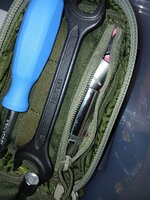
My kit is perhaps more comprehensive than most, for a few reasons.
1) I move my kit between three bikes. They're all Japanese brands with very different purposes. Most things overlap, but there are a few added odds and ends needed, especially for dual-sport riding. I have a vintage Suzuki, a dual-sport Kawasaki with tubed tires, and a modern Yamaha sport-tourer. Maybe I should put together three kits, but it would cost a fair bit and would save very little space or weight, and have little effect on convenience.
2) I ride solo most often, but I often ride with people on European brands. A few added things like 13mm sockets and Torx bits help cover these machines without adding much weight. I rarely, if ever, ride with people on Harleys, so I don't carry inch tools. (BMWs generally come with decent tool kits, but torx bits with a ratchet can save a lot of time over using the L-keys in the kit.)
3) When a bike falls silent, all eyes seem to swivel my way... I'm almost always the "fixer" in any given group of riders, so I have a more comprehensive tool set than most because I most often end up using it on other people's motorcycles.
I would disagree with the notion that wheel removal tools aren't needed, but I can see the point as well; on a bike with tubeless tires, situations where you'd need to remove the wheel are fairly rare. Obviously, wheel removal tools are a must on a bike with tube tires.
I think the absolute minimum for bikes with tubeless tires would include a tire puncture plug kit and a means to get air back into the tire. Tire punctures are by far the most common show-stopper on the road. Sticky string plugs are simple, cheap, and reliable, and I'm partial to
Nealey kits; they're compact and installed a little differently, and don't require glue, and in my opinion work a little better than the usual stickies.
As to air replacement, there are now some excellent self-contained battery-powered pumps. However, they're limited by the built-in battery's capacity and take a while to recharge, so at the moment I still prefer electric pumps powered via the bike's battery. There are cheap ones in any Wally World, but the
MotoPumps Air Shot 2.1 is a distinct cut above.
Other than that, it depends on what you're comfortable tackling, what the odds are, and what scares you the most.
Tools to remove the bodywork and tank. and adjust the controls are a minimum, I think. If a bike gets dropped, it's quite often rideable if you can tweak the controls back into place, and of course any number of simple issues can be handled if you can get under the bodywork. (For example, I've replaced several dead/dying batteries in auto parts store parking lots.)
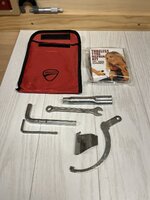
The stock tool kit usually contains a spark plug wrench (sometimes this is the only thing that will work on certain bikes) and super-janky wheel removal tools. Whether to tote these or replace them is a personal decision. It's very rare to have to touch the spark plugs on modern fuel-injected bikes between scheduled replacements.
A decent simple, compact multi-tool serves several purposes (obviously); many are over-burdened with useless stuff, so keep it as light and simple as you can, but invest in name brand quality, like Leatherman, SOG, Gerber, etc.
I also carry a small digital multimeter, and a few bits of wire, and some Posi-Lock and Pos-Tap connectors. This is mainly to address known weaknesses in the vintage side of my riding, but a small multimeter really can come in handy for things like assessing batteries, lighting, relays, charging systems, etc. on modern bikes as well.
It's also nice for at least one rider in a group to carry a jump pack or compact jumper cables; this can certainly save the day. And if you're riding in a group, you shouldn't need more than one tire repair kit or air pump.