To avoid these ads, REGISTER NOW!

Moving panel within the garage

diggler306

Well-known member
Joined
Jan 25, 2012
Messages
227
Location
Saskatoon, SK
Hey there,

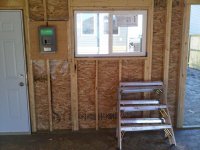
When my garage was built, they ran the service wire to a non-ideal location in the garage, so now the panel takes up prime wall real estate! (see my beautiful MSPaint drawing) My work bench will be right in front of the windo so I wanted to use the wall space on either side as tool hanging storage.

I'd like to move the panel to behind the man door (on the adjacent wall). How do I accomplish this? The wire coming into the garage only makes it half way up the wall... so can I extend it? Junction box? How do I finish it cleanly because I thought I've seen you can't hide a junction box behind drywall. My walls are fully open currently.

It is a 30a service.

Thanks!
 

Attachments

  • panel.JPG
    panel.JPG
    10.4 KB · Views: 27
Last edited:
To avoid these ads, REGISTER NOW!

pattenp

Well-known member
Joined
Jun 4, 2008
Messages
10,175
Location
Virginia - USA
You can extend it using a junction box, but the junction box cannot be buried in the wall. It has to be left exposed for access. Can you pull new wire from the main panel?
 
OP
D

diggler306

Well-known member
Joined
Jan 25, 2012
Messages
227
Location
Saskatoon, SK
No the wire is direct buried and I just finished digging (and filling) a network trench so I'm not really up for that!

I suppose I could terminate it down low (beneath the bench) and just leave the junction box exposed so that it's less of an eye sore. Then run the new wire up over the door and around the corner to the new location?
 

Stuart in MN

Well-known member
Joined
Sep 8, 2005
Messages
22,995
Location
Minneapolis
I don't know what's outside that wall, but could you dig up just the last few feet of the direct bury cable and reroute it to the other side of the man door?
 

Falcon67

Well-known member
Joined
Jun 11, 2009
Messages
18,371
Location
Merkel, TX
I suppose I could terminate it down low (beneath the bench) and just leave the junction box exposed so that it's less of an eye sore. Then run the new wire up over the door and around the corner to the new location?

That's what I'd do if (as above) I didn't think there was enough cable to move it to the other side of the door. If you dig it up a short ways back from the wall and pull it all out of the panel, you might have enough wire to come in at the bottom of the wall on the left of the door to a J-box, then splice in cable up to your breaker box.
 
OP
D

diggler306

Well-known member
Joined
Jan 25, 2012
Messages
227
Location
Saskatoon, SK
I don't know what's outside that wall, but could you dig up just the last few feet of the direct bury cable and reroute it to the other side of the man door?

That could very well work.

That's what I'd do if (as above) I didn't think there was enough cable to move it to the other side of the door. If you dig it up a short ways back from the wall and pull it all out of the panel, you might have enough wire to come in at the bottom of the wall on the left of the door to a J-box, then splice in cable up to your breaker box.

Also a good suggestion.

My hesitation comes at having to rent a trench digger or something for such a short distance, as the ground is very hard around the garage. It's all just dirt though so no landscaping to worry about. I dug 40', 18" down by hand and will never do that again. My wife thought I was crazy. I told her you're welcome for being cheap. :)
 

pattenp

Well-known member
Joined
Jun 4, 2008
Messages
10,175
Location
Virginia - USA
Is your garage a detached? I was assuming it was attached. I have some other questions but I don't want to open Pandora's box.
 

pattenp

Well-known member
Joined
Jun 4, 2008
Messages
10,175
Location
Virginia - USA
Detached. Ask away.

Okay.. I warned you. What type of direct bury cable is it and how many conductors? Is it in conduit to the panel in the garage? The reason I ask is feeders that are direct bury cable are installed a lot of times wrong by using a cable that is not fire resistant rated for indoor use and not placing it in conduit. I'm not familiar with Canadian code but in the US the wire has to have the fire resistant insulation to be inside of a structure and be in conduit.
 
OP
D

diggler306

Well-known member
Joined
Jan 25, 2012
Messages
227
Location
Saskatoon, SK
Good questions - I will check the cable conductors tonight when I am home. The rest can be said via photos. (The open LB box is my new network run, and the other photo is before all the wiring was done)
 

Attachments

  • IMG00904-20120824-1553.jpg
    IMG00904-20120824-1553.jpg
    143.8 KB · Views: 89
  • IMG00453-20111022-1450.jpg
    IMG00453-20111022-1450.jpg
    143.8 KB · Views: 109

pattenp

Well-known member
Joined
Jun 4, 2008
Messages
10,175
Location
Virginia - USA
That cable looks like type NM-B because it has an overall outer sheathing. I assume that cable is run all the way to the house and is not spliced to a direct bury cable at the LB. If you see that the outer sheathing is marked NM and the cable goes to the house then you have a potential problem.
 
Last edited:

Stuart in MN

Well-known member
Joined
Sep 8, 2005
Messages
22,995
Location
Minneapolis
The cable sheathing is black, which to me sounds like UF cable which is rated for underground use. However, you'll have to check to see what's stamped on it to make sure.

Looking at the photo of the outside of the garage, I don't think you have enough slack to repull the wire into the building on the other side of the door. So, I'd go back to the idea of adding a junction box inside the garage, and then extending new wire from there to the relocated panel. the junction box can be made flush with the studs (I assume you're eventually going to insulate and sheath the walls) so it should be pretty inconspicuous.
 

pattenp

Well-known member
Joined
Jun 4, 2008
Messages
10,175
Location
Virginia - USA
diggler, this is the downside of asking questions on wiring stuff, you open yourself up to all kinds of scrutiny.
 
OP
D

diggler306

Well-known member
Joined
Jan 25, 2012
Messages
227
Location
Saskatoon, SK
Hey that's alright with me - I'd rather things be done correctly. The home builder did everything before we took possession of the house and garage, so this is just what I have to work with.
I will check the cable tonight and report back. I don't know Canadian codes so maybe someone that does could chime in? So basically, if it's UF cable, it shouldn't be run inside the basement all the way to the panel (which it is). OR run inside the walls up to the subpanel in the garage. BUT, if it's NM-B, then it shouldn't be buried directly, without conduit, in the first place (which it is)?
 

Mudbone

Well-known member
Joined
Apr 18, 2012
Messages
92
Here is how I would fix it, pattenp can correct me if this is wrong.

I would put a water proof junction box on the outside of the building, in place of the conduit L that is going into the building. Pull your service cable from the panel back down to that point and make a junction with what ever the correct type of wire is for continuing into the building. Then run that cable out the back of the junction box and into the building and to where ever you want your panel to be.
 
Last edited:

pattenp

Well-known member
Joined
Jun 4, 2008
Messages
10,175
Location
Virginia - USA
Hey that's alright with me - I'd rather things be done correctly. The home builder did everything before we took possession of the house and garage, so this is just what I have to work with.
I will check the cable tonight and report back. I don't know Canadian codes so maybe someone that does could chime in? So basically, if it's UF cable, it shouldn't be run inside the basement all the way to the panel (which it is). OR run inside the walls up to the subpanel in the garage. BUT, if it's NM-B, then it shouldn't be buried directly, without conduit, in the first place (which it is)?

UF can be use in wet locations, indors/outdoors, and buried. The NM-B can be used in dry locations indoors; but cannot be used in wet locations, outdoors or buried.
 
Last edited:

pattenp

Well-known member
Joined
Jun 4, 2008
Messages
10,175
Location
Virginia - USA
Here is how I would fix it, pattenp can correct me if this is wrong.

I would put a water proof junction box on the outside of the building, in place of the conduit L that is going into the building. Pull your service cable from the panel back down to that point and make a junction with what ever the correct type of wire is for continuing into the building. Then run that cable out the back of the junction box and into the building and to where ever you want your panel to be.

The thing is the black wire I see looks like NM-B to me. If it is, then that wire is okay for the run from entering the garage to the panel. Same goes for inside the house. If the wire is NM-B from panel to panel then the part from outside of the house to the outside of the garage needs to be changed to UF.
 
Last edited:

Stuart in MN

Well-known member
Joined
Sep 8, 2005
Messages
22,995
Location
Minneapolis
UF is grey and flat. Never seen it in black. Even if it's UF, it can't be used indoors, at least in the US.

The UF cable running out to my garage is black. I imagine the color will depend on the manufacturer.

I just looked at NEC 2011, Article 340 which covers UF cable, and didn't see anything that prohibits its use indoors for residential; in fact it's specifically allowed for use as nonmetallic sheathed cable. It's possible there are local regulations against it in some parts of the US.

To the original poster - since you're in Canada this stuff may or may not apply.
 

pattenp

Well-known member
Joined
Jun 4, 2008
Messages
10,175
Location
Virginia - USA
The UF cable running out to my garage is black. I imagine the color will depend on the manufacturer.

I just looked at NEC 2011, Article 340 which covers UF cable, and didn't see anything that prohibits its use indoors for residential; in fact it's specifically allowed for use as nonmetallic sheathed cable. It's possible there are local regulations against it in some parts of the US.

To the original poster - since you're in Canada this stuff may or may not apply.

You are right. UF can be used inside. I don't know why I keep saying it can't. Someone corrected me on this before. I'll correct my post. I'll blame it on old age. Someone on this forum made the comment "You only know what you think you know". Well this proved that comment true.
 
Last edited:
To avoid these ads, REGISTER NOW!

Stuart in MN

Well-known member
Joined
Sep 8, 2005
Messages
22,995
Location
Minneapolis
A person wouldn't want to use it for general wiring inside a building (it's a bear to pull and to strip) but for the initial run into the panel it's okay. :) The original poster does need to confirm it is UF cable (or whatever is correct for CA.)
 

pattenp

Well-known member
Joined
Jun 4, 2008
Messages
10,175
Location
Virginia - USA
A person wouldn't want to use it for general wiring inside a building (it's a bear to pull and to strip) but for the initial run into the panel it's okay. :) The original poster does need to confirm it is UF cable (or whatever is correct for CA.)

It will be interesting as to what wire the OP has. I did some looking on the net and can only find the UF in grey. NM-B is color coded and black is #8 & #6. The wire being black was one reason I said the wire looked like NM and another was the wire looks to have twisted conductors under the sheath. The picture is far from clear and it could just be a light reflection thing making it look that way to me.
 
OP
D

diggler306

Well-known member
Joined
Jan 25, 2012
Messages
227
Location
Saskatoon, SK
Hey thanks guys, great info - I will be checking the cable tonight and will follow up with you on it. Let's hope for UF! :bowdown: Although from what I remember, pattenp could be right about the twisted conductors under the sheath.... :( To be continued...

 

wyliesdiesels

Well-known member
Joined
Aug 14, 2012
Messages
19,983
Location
Modesto, CA
It will be interesting as to what wire the OP has. I did some looking on the net and can only find the UF in grey. NM-B is color coded and black is #8 & #6. The wire being black was one reason I said the wire looked like NM and another was the wire looks to have twisted conductors under the sheath. The picture is far from clear and it could just be a light reflection thing making it look that way to me.

I too have only seen UF-B in grey! And all the #6 and #8 NM-B I've run was black as well! Its just like #14, #12, and #10 NM-B is color coded- white, yellow, and orange!
 

wyliesdiesels

Well-known member
Joined
Aug 14, 2012
Messages
19,983
Location
Modesto, CA
Hey thanks guys, great info - I will be checking the cable tonight and will follow up with you on it. Let's hope for UF! :bowdown: Although from what I remember, pattenp could be right about the twisted conductors under the sheath.... :( To be continued...

If the wrong wire was indeed installed, you might be able to get the contractor to make it right by letting him know that you will file a complaint with the contractor's licensing board! But I'm not sure if there's something like that up there in CA!
 
OP
D

diggler306

Well-known member
Joined
Jan 25, 2012
Messages
227
Location
Saskatoon, SK
If the wrong wire was indeed installed, you might be able to get the contractor to make it right by letting him know that you will file a complaint with the contractor's licensing board! But I'm not sure if there's something like that up there in CA!

What I would probably do is check what kind of coverage we have for electrical under the New Home Warranty program. Things like windows/doors are covered for 2 years, foundation for 5, etc. Electrical must be in there somewhere.
 

pattenp

Well-known member
Joined
Jun 4, 2008
Messages
10,175
Location
Virginia - USA
Yep.. looks likes it's NMWU. New to me, must be a Canadian thing. Sorry if we had you worried.

http://www.cathelle.com/en/wire/6-3-nmwu-underground-wire-300v.html
90341.jpg
 
Last edited:
OP
D

diggler306

Well-known member
Joined
Jan 25, 2012
Messages
227
Location
Saskatoon, SK
I'm a high class guy, thanks.

Just looked at the wire, and that's exactly it.

No worries pattenp - almost everything is fixable. :) AND I learned something new today, so thank YOU.

Back to my original question, I went and gauged the length of wire that I had coming up into the panel and it doesn't look like it would be enough to make it to where I'd ideally want it located. That is, if I dug up the feeder and rerouted it. So I think I'll go with flush mounting a jbox where it comes in, and running a new wire up over the door.
 

pattenp

Well-known member
Joined
Jun 4, 2008
Messages
10,175
Location
Virginia - USA
Well not knowing wiring types used in Canada, I won't add any more confusion by suggesting what wire to use for the extension.
 

Mudbone

Well-known member
Joined
Apr 18, 2012
Messages
92
diggler, I have two questions about the pics in post #10.

First, in the outside pic the conduit for your power is the one on the right? Not the one with the open trench. If so, it looks to me like there is a smaller conduit coming out of the LB that is run into a larger conduit without a water tight fitting. Is that right?

Second, where is the ground wire from your panel to your ground rod, the GEC if you will? I just dealt with with having to drill a hole to run a GEC separate from my conduit for the main conductors and ground wire(EGC).
 
OP
D

diggler306

Well-known member
Joined
Jan 25, 2012
Messages
227
Location
Saskatoon, SK
Yes, the conduit on the right is my power. However, the conduit it only run to the bottom of the trench, then the feeder exits the conduit and goes to the house where it does the same thing.

I don't know how to answer your second question unfortunately.
 

wyliesdiesels

Well-known member
Joined
Aug 14, 2012
Messages
19,983
Location
Modesto, CA
....I don't know how to answer your second question unfortunately.

What he's getting @ is there should be a bare ground wire(#6 if not in conduit) coming out of your panel and going to a buried copper ground rod! This ground wire is your GEC and the wire and rod together is your GES- A detached building with an electrical feed must have its own GES! If you don't have a ground rod bonded to the panel you're moving, u should put one in!
 
To avoid these ads, REGISTER NOW!
Top Bottom