raferguson
Well-known member
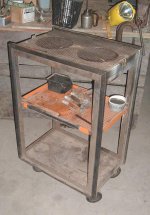
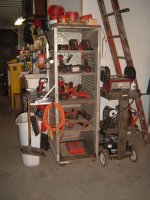
I am fishing for ideas and comments. My goal for my new shop is to have everything on wheels, more or less. I am probably halfway there right now. I was talking about shop design with a friend, and he said he has 80% of the tools in his shop on wheels.
I am thinking about the question of whether it makes sense to put wheels on everything in the shop, vs. some other way of moving things around. Or maybe only some things should have wheels.
For example, I have a small propane forge. Right now I pick it up and put it on a metal bench, due to space limitations. Should I build a base and put wheels on it? Four casters? Two fixed wheels and then tilt it to move it? Just design the stand so that I use a two wheel dolly to move it? A similar story for my wood planer, which is heavy to pick up and move around.
The large toolboxes, and full sized benches, sure, they should have four wheels. I am mostly thinking about things that are smaller.
I have seen setups that have two wheels that mount to the side of the leg, where the wheel is not really touching until you tilt the unit. That would be like a two wheel dolly permanently installed on the legs. But I could imagine hitting the wheels, which would stick out, so perhaps the regular two wheel dolly is a better way to go. A variation on that theme is to have two non-swivel wheels on one end, with feet and a handle on the other end. To move it, you pick up on the handle. Or perhaps tilt it back like a two wheel dolly. OK if it is not too heavy
My friend has a large table saw, placed on a mobile base, such that you step on a pedal and the weight transfers from feet to wheels. No loss of stability, but of course the mobile base extends beyond the base of the tool.
On a related question, if there are four casters, how do you keep a tool or bench from moving? Most caster locks don't keep the caster from swiveling. I have seen floor locks that look like they would be stable, push on a pedal and a foot goes down.
Of course, if you have a large shop and a forklift, you can move things on a pallet, or machines designed to be lifted that way, but I don't see me needing a forklift. The heavier and larger the thing is, the more sense the forklift makes. A pallet jack is the poor man's forklift, more maneuverable, takes up less space.
The furniture movers use furniture dollies. One could jack up a heavy load, and then put a furniture dolly under it. I moved a large cabinet that way, used a scissor jack to get it high enough, and then slid the furniture dolly under it. It sure was an elegant and easy way to move something that was quite large and heavy.
Perhaps the most important thing is to consider how you will move something, as part of the design. In other words, you need a plan before you start. ;-)
Thanks in advance for your thoughts.
Richard
I am thinking about the question of whether it makes sense to put wheels on everything in the shop, vs. some other way of moving things around. Or maybe only some things should have wheels.
For example, I have a small propane forge. Right now I pick it up and put it on a metal bench, due to space limitations. Should I build a base and put wheels on it? Four casters? Two fixed wheels and then tilt it to move it? Just design the stand so that I use a two wheel dolly to move it? A similar story for my wood planer, which is heavy to pick up and move around.
The large toolboxes, and full sized benches, sure, they should have four wheels. I am mostly thinking about things that are smaller.
I have seen setups that have two wheels that mount to the side of the leg, where the wheel is not really touching until you tilt the unit. That would be like a two wheel dolly permanently installed on the legs. But I could imagine hitting the wheels, which would stick out, so perhaps the regular two wheel dolly is a better way to go. A variation on that theme is to have two non-swivel wheels on one end, with feet and a handle on the other end. To move it, you pick up on the handle. Or perhaps tilt it back like a two wheel dolly. OK if it is not too heavy
My friend has a large table saw, placed on a mobile base, such that you step on a pedal and the weight transfers from feet to wheels. No loss of stability, but of course the mobile base extends beyond the base of the tool.
On a related question, if there are four casters, how do you keep a tool or bench from moving? Most caster locks don't keep the caster from swiveling. I have seen floor locks that look like they would be stable, push on a pedal and a foot goes down.
Of course, if you have a large shop and a forklift, you can move things on a pallet, or machines designed to be lifted that way, but I don't see me needing a forklift. The heavier and larger the thing is, the more sense the forklift makes. A pallet jack is the poor man's forklift, more maneuverable, takes up less space.
The furniture movers use furniture dollies. One could jack up a heavy load, and then put a furniture dolly under it. I moved a large cabinet that way, used a scissor jack to get it high enough, and then slid the furniture dolly under it. It sure was an elegant and easy way to move something that was quite large and heavy.
Perhaps the most important thing is to consider how you will move something, as part of the design. In other words, you need a plan before you start. ;-)
Thanks in advance for your thoughts.
Richard
Last edited: