bradpac
Well-known member
Beautiful, inspiring work

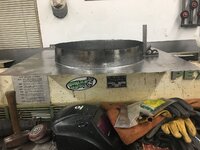
Thanks for all the good update stuff! Nice to see engine fire up!More progress on the (second) fan shroud, but I had a request to show the process in greater detail.. So we'll start with the beginning.
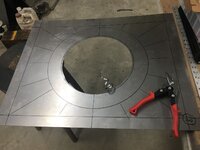
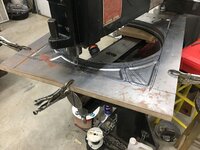
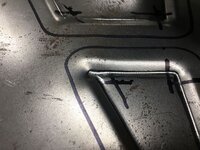
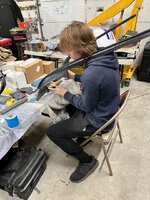
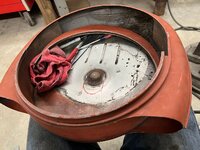
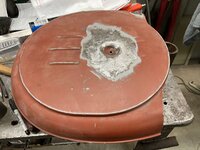
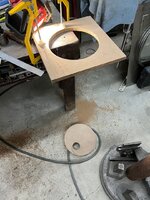
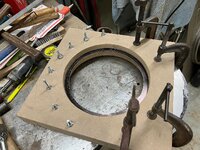
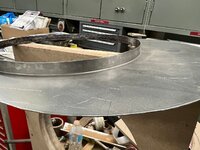
First was the layout of the bend line, and then the cut line was located about 3" inside of that. (I'm using some of the pictures from our first attempt as our shop photographer missed some the second time around)
The initial stretch was done using a blocking hammer on the top (flat area) of the stump, primarily at the inside edge as that needed the most stretch.
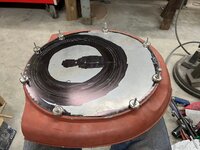
On our first attempt we had a hammer form that was used to "set" the bend line with a crowned body hammer as we added the first bit of stretch.

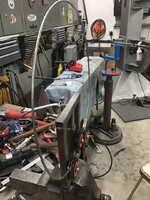
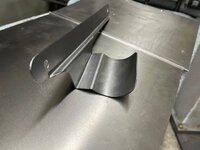
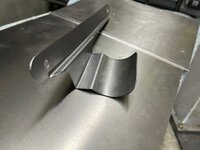
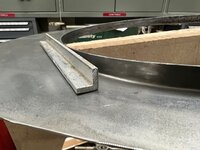
This seemed a bit cumbersome, and the second version I used a bent portion of round stock that was in the scrap pile, added a piece of pipe for a handle, and the band saw added a slice for a new tipping tool. The bend in the tipping tool gave it a built in fulcrum. Normally a tipping operation tries to pull the adjacent material along as the bend forms. In this case we set the panel on a table and used the bend (fulcrum) of the tipping tool against the table to pull the stretched area downward. This allows us to push down on the handle to elevate the panel off the table, and to push downward on the flat panel outside the bend line with the palm of your hand. This does a good job of placing the bend where needed without pulling adjacent metal along for the ride. Even though the pictures show the stretched area upward, the panel was placed with this area downward when using the tipping tool..

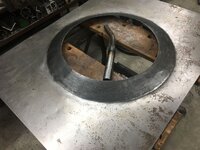
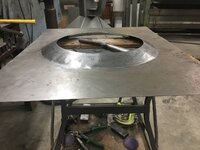
This worked much better at setting the bend line than the hammer form, and it was surprisingly accurate.
Much of the stretch was done using linear stretch dies on the power hammer, but we also reverted back to the blocking hammer and stump to better focus the stretch locations.
The other issue to overcome with both hammer operations was that they didn't play nice with keeping the shroud in a flat vertical. So the next tool used was a 90 durometer pad of polyurethane and the Model A leaf spring hammer. The hammer face was too short to match the shroud height (approx 3") so three passes were done to cover the entire height and with each pass the hammer hits were about 1/8" or so apart.


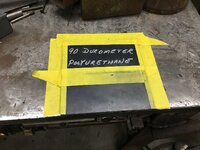

The bulk of the stretch was done on the power hammer, and the front of the lower die holder is missing quite a bit of paint from this job...

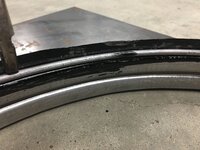
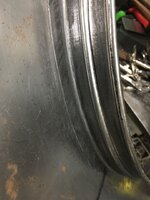
The completed bend, we started with .044 thickness (18 gauge) and it was thinned to .029 thick, or lost about 1/3 thickness to turn the 90...



I want those cabinets




I think there is one major thing I have learned reading through this thread specifically. The end result is often the result of the time spent building the special tool needed for the job. I'm usually in such a hurry with getting to the end zone that I don't take the time to build the right jig or fitting to make the end result I'm after. Now that I am more likely to slow down and enjoy building the tools to finish the job I'm often more proud of the tool than the original project.
Excellent work and I really appreciate your photos and description on how you were able to accomplish the tasks.
Even the details on the fan shroud are incredible. I’m pretty certain nobody will realize the time and effort put into that by just looking. I would bet they think you just bought it. Great work and really appreciate the documentation!!
Thanks Dave!Wow, just wow.
Your bead roller looks like it needs a new motor. That one takes a lot of breaks.

















Nice find, Robert! That’s a pretty pristine example. Hard to find one without “The arc of shame”Ever since I got rid of my radial arm drill press years ago to make room for a band saw, I’ve been searching for the more compact replacement. Yesterday was that day. Small enough to hide in a corner, yet big enough to do the job. Nice and quiet too. Got to love quality tools/machinery








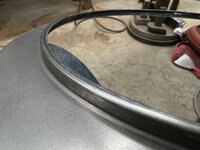

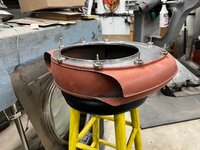
Teach me something….what is the first step on that hammer form process for initiating the turning up of that inside lip. I cannot tell from the vids(or missed it). in other words…do you just pound that bend into it…
thanks…great thread as well…been following for quite a while.
Thank you…as with most things…patience is a virtue…Thanks for the question!! So we are trying to tip the flat over to a perpendicular (90*) so the first concern is that a flat body hammer has sharp edges and will leave excessive marks in the metal. So you want a radius faced hammer but not one so round it puts in dents.. So the hammer shown in the first video is a small blocking hammer which did a good job. I would add, this process is done incrementally. Start hitting the innermost part as it will need the most stretching, and then continue to reposition with each successive round in an attempt to keep what you're hammering over "flat". The more distorted you make it, the more difficult the task of getting things smooth in the end, so finesse normally wins over heft. As with anything metalshaping, our efforts shouldn't add extra work to clean up what we just did. IE: refine the process as needed.