To avoid these ads, REGISTER NOW!

MRCOOL DIY Mini Split, Seriously, I Think...

Browneye

Well-known member
Joined
May 29, 2018
Messages
311
Location
So-Cal
I wrote Mrcool for tech support on fused vs non-fused disconnects...and why their UL placard says 'fuse' in the power supply:


Rick Castleberry (MRCOOL)
Jul 29, 15:57 -05
fuses are very much still in style.it is just a form of a way for better protection especially with HVAC equipment.
If you use an HVAC rated breaker in the house panel you can use just a non fused disconnect switch if your local code allows it. Both meet the NEC but the "Authority having Jurisdiction" is the final word.


EDIT: Now what is really interesting is that the HACR rating is no longer required by NEC for breakers used in HVAC equipment: https://iaeimagazine.org/magazine/2006/11/16/what-do-the-markings-on-circuit-breakers-mean/

HACR type –This marking indicates the circuit breaker is suitable for use with the group motor installations typically found in heating, air conditioning and refrigeration equipment. TheNEC2005 no longer has this marking requirement. The electrical industry determined that circuit breakers are considered suitable for use with such equipment without any further testing, therefore, the HACR marking is no longer required on air conditioning and refrigeration equipment or on circuit breakers for use in these applications. The requirement for this marking has also been removed from the UL 1995 product standard for HVAC equipment (see item 3 in photo 1).

Here is another document from Schnieder Electric on the HACR breaker rating (no longer required for HVAC equipment - all breakers meet the original requirement)
https://www.schneider-electric.com/...239.790740779.1564436231-241394369.1564436231


I have two Frederich Breeze models that do not require an electrical box on the outside of the home for power to the unit. The power comes from the inside unit, which is plugged into a wall outlet and travels down with the refrigerant and drain lines in a plastic sheath. I want to add another unit but the Breeze units are not sold anymore and I was wondering if anyone has run wire to their Mr Cool outside unit in the above fashion. I cannot run wire to an outside box without major work I was told by a couple of experts but wall plugs are everywhere.

Only the 12K BTU MrCool DIY unit is 110-125v, the other three larger capacity models require 220/240.

If you review electrical code for your locale it's highly likely a dedicated 20a circuit is required, and also a disconnect within reach of the unit for servicing.

We are seeing now that a fuse somewhere in the circuit, or HVAC rated breakers in the panel for said circuit or disconnect box, is required.
 
Last edited:
To avoid these ads, REGISTER NOW!

Browneye

Well-known member
Joined
May 29, 2018
Messages
311
Location
So-Cal
And this from Mike Holt's forum. Even MrCool isn't sure what or why. They probably sell so many into third-world countries that they submitted to UL for listing with a fused disconnect, and hence the wording on their placard.
BTW, the main board IS fused for over-current as well - it's in the installation manual for MrCool DIY.

Sorry guys, I'm not losing any sleep over this. The condescension and insults simply don't belong here.


We're hitting on a policy change at UL. No, I can't 'document it,' so you'll have to trust my memory.

UL tests things 'as submitted.' If an air conditioner came with a fused disconnect, UL had the nameplate specify 'maximum fuse,' and you were supposed to derive from that that there HAD to be a fuse somewhere in the circuit. Part of this was a carry-over from 'the old days,' where it was assumed that the final overcurrent protection would be a fuse.

After all, UL maintained, it wasn't evaluated with a breaker.

Well, sometimes even UL can 'see the light.' UL finally figured out that the folks who make the air conditioners are not the ones supplying the disconnecting means- and there are plenty of disconnects out there that take breakers. Breakers are also readily available to match most any fuse size.

Thus, about five years ago, UL changes its' marking requirements to have the nameplate simply read 'max overcurrent protection.' Fuse or breaker, it doesn't matter.

Older equipment, with the older marking? While there might be a 'paperwork' violation, were one to use breakers alone on an air conditioner marked "Max Fuse," I would sleep perfectly fine with such a unit outside my window.
 

LS6 Tommy

Well-known member
Joined
Dec 27, 2013
Messages
26,162
Location
Northern NJ
UL is not a government entity. They're an independent testing organization, one of many that are Nationally Recognized Testing Laboratories. None of them make or enforce code. They just test and "list" items they find meets their standards. When the NEC states an installation has to be "Approved" by the AHJ, it just means the AHJ has the final say on anything that falls under the NEC. AHJ's commonly require "Listed" equipment and materials because it makes it easier for them to decide if they should "Approve" the work. Not everything that is "listed" is required to be by the NEC. Another thing is that just because something is "listed" does not mean it is automatically NEC compliant.

Tommy
 
Last edited:

MattT

Well-known member
Joined
Feb 20, 2010
Messages
3,201
Shouldn't the Mr Cool have a fuse inside?

Had to tear into one of my 120v 12K 15 SEER IRP minis tonight which I think is a twin to the 15 SEER Pioneers and 1st gen Mr Cools. It does have some kind of fuse on the outdoor units board. 30A printed on the board and it hadn't blown though the 20A breaker feeding the unit had tripped. One other thing I noticed was the indoor unit is fed direct from the incoming terminal strip so it definitely isn't protected by this fuse. Will post more tomorrow if I can figure out what, if anything, this fuse is protecting..............

One other thing I noticed looking through the service manual is only one fuse is shown for the 240v units. That's normal for the rest of the world but a North American 240v unit should have both legs fused. That may be why the importer specifed external fuses.
 
Last edited:

jjrbus

Well-known member
Joined
Dec 8, 2018
Messages
608
Location
Florida
I read these forums to learn what I will need to know for repairing units. The service manual is like the guide to understanding women. So for me any feedback would be appreciated.

Should be noted that there is very little on the net on fixing mini's. I see 2 possible reasons for his. Being more computer than AC they are very dependable (when is the last time you had a TV repaired) Or they are pretty much unserviceable and units are being replaced. When I say unserviceable I am talking about paying a tech $100 hour to fix unit, does not seem cost effective.
 

MattT

Well-known member
Joined
Feb 20, 2010
Messages
3,201
I read these forums to learn what I will need to know for repairing units. The service manual is like the guide to understanding women. So for me any feedback would be appreciated.

The service manual for mine really isn't bad considering the COO and cost of the units. Link to the download below. Pages 52 & 53 if you want to see what I'm dealing with.

https://www.irproducts.biz/support/...service-manual?highlight=WyIxMmg0NXlvbWkiXQ==

As mentioned earlier I came home yesterday to the unit off and found the breaker feeding it tripped. Powered the unit back up and after a few minutes the indoor unit faulted out with an E1 error code which is no communication between it and the outdoor unit.

I did the DC voltage test shown on P53 and it was moving in the 0v to +50v range which indicated a problem with the outdoor unit. I also checked for low mains voltage while I was in there and it was good.

Next I removed a two screws and popped a couple plastic clips to lift the outdoor circuit board up to gain access. At that point I checked the internal 30A fuse and it hadn't blown. Also checked the line reactor and the external capacitor which are both good.

attachment.php


Then I disconnected the compressor to ohm it out which is when I found the wire insulation had worn through on the red leg and shorted to ground. Also ohmed out the compressor and it's OK. Will megger it later just to be sure but that's mostly me being overly thorough.

attachment.php


Then back to the circuit board to look for obvious damage which is when I found the blown IGBTs. So the board is definitely shot and everything else appears to be OK.

attachment.php


Being more computer than AC they are very dependable (when is the last time you had a TV repaired) Or they are pretty much unserviceable and units are being replaced. When I say unserviceable I am talking about paying a tech $100 hour to fix unit, does not seem cost effective.

Both statements are true IMO. The problem with mine is a wire being routed/secured incorrectly by the manufacturer, which caused it to fail after 18 months. It's twin has been running four years with no problems. I checked it this morning and it's wiring is routed properly. So long as they're built right and installed properly they're generally pretty reliable unless they're made by lg.

US labor rates certainly effect the serviceability. I would've been charged a few $$$ just to find out what was wrong with it. And another $$$ervice call + parts to fix it. Could easily be pushing the price of replacing the unit. Depending on how the conversation with IRP goes tomorrow I might replace it anyways.........................................
 

Attachments

  • 12H45YOMI_Comp_Wiring2.jpg
    12H45YOMI_Comp_Wiring2.jpg
    134 KB · Views: 894
  • 12H45YOMI_Comp_Wiring.jpg
    12H45YOMI_Comp_Wiring.jpg
    84.4 KB · Views: 891
  • 12H45YOMI_IGBT.jpg
    12H45YOMI_IGBT.jpg
    76.2 KB · Views: 890

jjrbus

Well-known member
Joined
Dec 8, 2018
Messages
608
Location
Florida
Thanks appreciate the response. I do not have warranty and am pretty sure for other than a simple repair, tossing the unit and replacing will be an option. Not only the cost of service, but finding a tech that actually knows mini's is going to be an issue in this area.
 

QwikKotaTx

Well-known member
Joined
Aug 10, 2013
Messages
967
Location
Seabrook, TX
Thanks everyone for all of the info. Unfortunately it looks like the price has jumped up a good bit on these units since the thread first started. Most likely due to popularity and not inflation. I would need to do a ton of shelving and tools/equipment removal to be able to insulate and drywall my garage in order to make this a reality. Maybe one day.
 

Browneye

Well-known member
Joined
May 29, 2018
Messages
311
Location
So-Cal
Thanks appreciate the response. I do not have warranty and am pretty sure for other than a simple repair, tossing the unit and replacing will be an option. Not only the cost of service, but finding a tech that actually knows mini's is going to be an issue in this area.

MrCool the importer is there in Miami - perhaps they could recommend someone to take a look at it. My take is they're not as big of a company as one might think. AFAIK they bring container-loads into the port and ship them out all over the country.

You might also check the 'scratch-n-dent' section at Ingrams - I got a 12K DIY unit for about $800, chronicled up thread here. Has been perfect. A compressor unit may only be $500 or so. A field-tech could eat that much up in one service call from what I've seen. I just love those 'free tune-up' come-ons. :bounce:
 

jjrbus

Well-known member
Joined
Dec 8, 2018
Messages
608
Location
Florida
MrCool the importer is there in Miami - perhaps they could recommend someone to take a look at it. My take is they're not as big of a company as one might think. AFAIK they bring container-loads into the port and ship them out all over the country.

You might also check the 'scratch-n-dent' section at Ingrams - I got a 12K DIY unit for about $800, chronicled up thread here. Has been perfect. A compressor unit may only be $500 or so. A field-tech could eat that much up in one service call from what I've seen. I just love those 'free tune-up' come-ons. :bounce:

Thanks but i do not have Mr Cool and am on the west coast on the other side of the state. After my last fiasco with a service tech and watching what they did to a friend, I will not be calling anymore. If I cannot repair I will toss and buy new.
 

Perry H

Well-known member
Joined
Dec 19, 2008
Messages
69
What is the optimal install height for the indoor unit of a mini-split?

I have a Mr. Cool on the way and am going to be mounting it on the wall of my 3 car garage with 12 foot ceilings. The manual I read online only mentions that it needs 6 inches of clearance from the ceiling and be at least 7.5 feet off the ground. That gives me 4 feet of discretion.

Should I shade toward the top, bottom, or middle of that 4 feet?

Edit: I found an updated manual...
"For Ceilings GREATER
Than 9 Foot, Suggested
Floor Clearance is
230cm(90.55in)

For Ceilings LESS
Than 9 Foot, Suggested
Floor Clearance is
200cm(78.55in)"

The word "suggested" seems to indicate that I should put it at the 7.5 foot height - or at the lower end of my range of discretion.
 
Last edited:

jjrbus

Well-known member
Joined
Dec 8, 2018
Messages
608
Location
Florida
In my humble opinion they are a PIA to service so the lower the better. My opinion and worth what you are paying for it.
 

Browneye

Well-known member
Joined
May 29, 2018
Messages
311
Location
So-Cal
What is the optimal install height for the indoor unit of a mini-split?

I have a Mr. Cool on the way and am going to be mounting it on the wall of my 3 car garage with 12 foot ceilings. The manual I read online only mentions that it needs 6 inches of clearance from the ceiling and be at least 7.5 feet off the ground. That gives me 4 feet of discretion.

Should I shade toward the top, bottom, or middle of that 4 feet?

Edit: I found an updated manual...
"For Ceilings GREATER
Than 9 Foot, Suggested
Floor Clearance is
230cm(90.55in)

For Ceilings LESS
Than 9 Foot, Suggested
Floor Clearance is
200cm(78.55in)"

The word "suggested" seems to indicate that I should put it at the 7.5 foot height - or at the lower end of my range of discretion.

A lot of people think they're gonna mix up the air a lot in any room with high ceilings, even with fans and such. The truth is that cold air sinks and will stratify in a room if you let it, providing for much comfort in the living area with hotter air up near the ceiling.

So you don't need it up high, although it won't hurt anything. My cileing is about 15-18', the unit sits up at about 9-10'. Servicing, what little there is, is done on a step ladder. The most difficult part of the install on this one was hanging that air handler - it's heavy up above your head (if you're old LOL) and the line set is rigid coming out of the back of the unit. A real trick to feed everything through your hole and hang it on the bracket.


CentexGolfer

New member
Joined
Aug 19, 2019
Messages
2
Location
Texas
Hey guys, great thread here! I'm kicking tires on a DIY mini split and need some help determining the size of unit I need. I'm in Texas so it's HOT and want a unit in my garage where I have a golf simulator setup. It's about 750 square feet with a 12' ceiling. I have living space above, so that helps. But we park two cars in the garage, so that hurts. Two garage doors - one double and one single. Would love to hear thoughts on sizing and thank you in advance.
 

Browneye

Well-known member
Joined
May 29, 2018
Messages
311
Location
So-Cal
Hey guys, great thread here! I'm kicking tires on a DIY mini split and need some help determining the size of unit I need. I'm in Texas so it's HOT and want a unit in my garage where I have a golf simulator setup. It's about 750 square feet with a 12' ceiling. I have living space above, so that helps. But we park two cars in the garage, so that hurts. Two garage doors - one double and one single. Would love to hear thoughts on sizing and thank you in advance.

They're a great solution for a garage space. Sizing really depends on how much insulation the building has, how much heat infiltration you get with doors and windows.

A 2-ton unit is supposed to be good up to about that size, that's what I have for our main living space, a lot of it has 15' ceilings. For a large shop though, with outside temps over 100, and for faster cool-down, I might seriously consider a 3 ton.

This is just based on experience with them, no technical load-calcs employed. Some 'experts' have extensive data input calculators to arrive at a BTU requirement. You may even find one on the internet.

The added bonus is some heating over winter if you need it as well.
 

CentexGolfer

New member
Joined
Aug 19, 2019
Messages
2
Location
Texas
They're a great solution for a garage space. Sizing really depends on how much insulation the building has, how much heat infiltration you get with doors and windows.

A 2-ton unit is supposed to be good up to about that size, that's what I have for our main living space, a lot of it has 15' ceilings. For a large shop though, with outside temps over 100, and for faster cool-down, I might seriously consider a 3 ton.

This is just based on experience with them, no technical load-calcs employed. Some 'experts' have extensive data input calculators to arrive at a BTU requirement. You may even find one on the internet.

The added bonus is some heating over winter if you need it as well.

Yeah I was thinking 2-ton as well, but could pretty easily talk myself into a 3-ton. The main issue is that the double door is our primary door and it gets opened/closed 5 times a day or more. The doors are insulated and walls are too, so that helps. But you park two huge thermal masses in there that roll in at 200 degrees or whatever.

In my mind I thought that I'd only turn the unit on when I'm going to be in the garage, but it sounds like many on this thread had that same idea too until they realized it was better to just keep it on continuously. There's a pretty good price jump from 2 tons to 3 tons though, so that is a consideration too. Decisions, decisions.
 

shade

Well-known member
Joined
May 5, 2010
Messages
334
Location
Phoenix, AZ
Hey guys, great thread here! I'm kicking tires on a DIY mini split and need some help determining the size of unit I need. I'm in Texas so it's HOT and want a unit in my garage where I have a golf simulator setup. It's about 750 square feet with a 12' ceiling. I have living space above, so that helps. But we park two cars in the garage, so that hurts. Two garage doors - one double and one single. Would love to hear thoughts on sizing and thank you in advance.

Your garage is similar in size to mine.
Attic above mine
Fully insulated all walls and above the garage.
I went with 4 tons
2 units on a 37 foot long wall spread the cool air out great.
I run IT equipment in the garage along with cars in and out so rapid cool down is very important.
So glad I went this route
 
To avoid these ads, REGISTER NOW!

alxmlr789

Well-known member
Joined
Jan 1, 2016
Messages
62
Little bit of follow up on my unit. I am in central florida and we had a brutal July and August has been humid as heck too.

As a few of you know, i installed a 24k DIY in a 1000ft garage. Has 12' ceilings, open-cell R19 on the roof (yes i know it is underinsulated, however, it's been doing a great job, keeps heat out very well according to my thermal imager), R19 in the walls, and R11 poly board (i think) on the doors. I also have green hinges.

I have had my unit installed since the last week of June, and it's been running flawlessly. I keep it around 84 set temp and my Fluke 922 reads about 82-83 with 40%-45% humidity at all times, it has been doing a fantastic job. I never catch it running hot in there or catch the unit struggling to keep up.

I installed the head at 8.5' to the vent, and i can definitely see how any higher could cause problems, since it uses a thermistor in the unit, rather than a termostat at working height. If i went up to 9.5-10 ft, it would be pulling in hotter air causing the unit to read higher and run more. I would put the head unit as low as possible above 7ft, in case Shaq is over

Anyhow, really pleased with my choice. I had a power analyzer hooked up to it for a week (without the doors insulated yet) and it took about 24WKH @ .13 cents to run and keep at 82 degrees. I bumped it up to 84, and will do another logging session with insulated doors to compare different costs. If anyone has any questions feel free to ask.
 

Browneye

Well-known member
Joined
May 29, 2018
Messages
311
Location
So-Cal
Little bit of follow up on my unit. I am in central florida and we had a brutal July and August has been humid as heck too.

As a few of you know, i installed a 24k DIY in a 1000ft garage. Has 12' ceilings, open-cell R19 on the roof (yes i know it is underinsulated, however, it's been doing a great job, keeps heat out very well according to my thermal imager), R19 in the walls, and R11 poly board (i think) on the doors. I also have green hinges.

<snip>

Just outstanding. :thumbup:

My two went a year before I had to clean the air-handler screens, and even then they were hardly dirty. The bedroom had more dust and fuzz than the living area - mine sits about 9' high.

Very easy to hose off with a garden hose, dry and reinstall. Very painless.

And yes, we've had a straight month of 90 or so and the house sits at about 78 and 35%RH. Very comfortable.

I asked wife what our electric bill was, if it had gone up, and she hadn't noticed. I would have to look to compare. Frankly I think the pool pump uses WAY more juice. :beer:
 

Slowbra

Well-known member
Joined
Jun 5, 2012
Messages
276
Location
NC
Anyone know the trick to connect MrCool to Amazon? I’ve got the smart kit/system and it works great, but the video on how to setup the system with Amazon makes no sense.
 

alxmlr789

Well-known member
Joined
Jan 1, 2016
Messages
62
Just outstanding. :thumbup:

My two went a year before I had to clean the air-handler screens, and even then they were hardly dirty. The bedroom had more dust and fuzz than the living area - mine sits about 9' high.

Very easy to hose off with a garden hose, dry and reinstall. Very painless.

And yes, we've had a straight month of 90 or so and the house sits at about 78 and 35%RH. Very comfortable.

I asked wife what our electric bill was, if it had gone up, and she hadn't noticed. I would have to look to compare. Frankly I think the pool pump uses WAY more juice. :beer:

Are the filters in this thing replaceable or what? I know mine must be due for a cleaning, or replacing.
 

shortymgee

Member
Joined
Jul 9, 2012
Messages
24
I've went threw 90% of this thread and and i ve got so much information from it. Wow! I've realized I now
need 36000 BTU mr cool diy for my 32x45x12 shop with 1 18x12 door and 1 8x10 door. On another note. I'm wondering what the sfm of these split systems are. 1.5 2 and 3 ton. Please someone help me!!!
 

jjrbus

Well-known member
Joined
Dec 8, 2018
Messages
608
Location
Florida
I use a vacuum with a black nylon, to catch the dust to see how often I should clean. 1 of my 3 gets a huge amount of **** on the blower wheel and the wheel must be removed to clean it.

I spent too much time cleaning it on the wall and when I turned it back on the wheel was out of balance. Could not see or hear it was out but could feel it by putting hand on case. Removed wheel and a large amount of crud came out that could not be reached inside the blower wheel!
 

riceaterSLC

Well-known member
Joined
Jun 23, 2011
Messages
89
Where to mount Mr. Cool

Referencing the photo below, I would like to mount the indoor unit directly to the left of the people door. The white line represents the line set, and the white box on the left represents the outdoor mounting location for the condenser.

1) Does anyone see any issues with this mounting? I'd like to reduce the total amount of coiled line set outside and also have as much continuous wall space for shelving within the garage.
2) I'm using a Siemens WF2030 30 Amp Fusible AC Disconnect to run power to the condenser. I would like to run the wire right into the box without any other boxes/tubing. What's the best way to run wire into the box when it's surface wall mounted? I have access to both sides of the wall (the non-insulated wall on the left side of the photo).
Thanks in advance:beer:
 

Attachments

  • mrcool.jpg
    mrcool.jpg
    129.9 KB · Views: 139

GRivera

Well-known member
Joined
Mar 27, 2017
Messages
529
Location
20 mins south of Baltimore
I just ordered the 24K from Costco ($1500). I'm doing R19 in the walls and R30 bat or R38 blown in insulation in ceiling.

The ceiling issue is pending more research since I have scissor trusses - 4/12 pitch roof with 2/12 pitch ceiling . Not sure insulation contractor can achieve required thickness from one access panel in center of metal ceiling.

Pole Barn is 30x40x12
 
Last edited:

Overhaulin63

Well-known member
Joined
Feb 22, 2012
Messages
103
Location
Akron, Ohio
I just purchased a Pioneer min and love it. I also purchased the wifi for access to turn on or adjust from phone.

I looked at the MrCool first but I saw they didn't offer in the coolant line in less than a 25' roll and I didn't want to start cutting and flaring new ends if I didn't have too. Pioneer does offer a wide variety of units with 16' length lines and it made for a perfect install.

The unit is installed and works great and its hard to believe how much water comes out of the condensation piping.

Good luck!
 

Browneye

Well-known member
Joined
May 29, 2018
Messages
311
Location
So-Cal
Re: Where to mount Mr. Cool

Referencing the photo below, I would like to mount the indoor unit directly to the left of the people door. The white line represents the line set, and the white box on the left represents the outdoor mounting location for the condenser.

1) Does anyone see any issues with this mounting? I'd like to reduce the total amount of coiled line set outside and also have as much continuous wall space for shelving within the garage.
2) I'm using a Siemens WF2030 30 Amp Fusible AC Disconnect to run power to the condenser. I would like to run the wire right into the box without any other boxes/tubing. What's the best way to run wire into the box when it's surface wall mounted? I have access to both sides of the wall (the non-insulated wall on the left side of the photo).
Thanks in advance:beer:

Maybe I'm misunderstanding, but personally I would not run the lineset inside the wall. They recommend a 3" hole to pass it although may fit through a smaller space - but you have the couplers on the line ends and you need room to feed them through. If those are 2x4 studs you don't really have room. You can run it inside or outside the wall - out is preferred as it's very easy to pass the lines out the back of the air handler.

If you read your installation manual I think the disconnect has a lower amp rating - might want to double check that. Air handler is powered by the outdoor compressor unit. You need your disconnect in the same locale as your outdoor unit. Flexible conduit - waterproof - is used to connect power from your disconnect box to the outdoor compressor unit.

You also need at least 12" on back and sides of the outdoor unit for air flow. It makes sense to make it easy to get to, to install and service, so I don't see a benefit of mounting it up high.

Excess lineset should really be run horizontally, not coiled up in vertically - it sets up a place where compressor oil can collect/be trapped.

Mr. Cool recommendeds situating your outdoor unit where your lineset would be the right length to reach it.

Maybe I just misinterpreted your whole diagram, but that's what I got out of it.
 

Slowbra

Well-known member
Joined
Jun 5, 2012
Messages
276
Location
NC
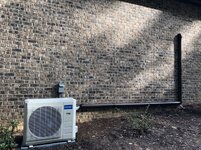
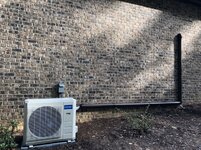
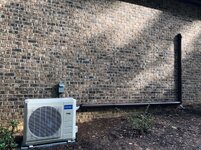
I juggled with the lineset dilemma for months. I didn’t want to coil it up outside either and looked at all methods of running it to avoid that. However, I finally just ran it outside and placed the condenser far enough away to avoid the coil.

I’ll put a few bushes up and will never think about it again.

I did raise the unit off of the pad a bit higher than shown in the picture below to ensure there was plenty of airflow.

78c23a6eb0662540e66ed604364098c5.jpg
 

Attachments

  • 78c23a6eb0662540e66ed604364098c5.jpg
    78c23a6eb0662540e66ed604364098c5.jpg
    647.7 KB · Views: 4

Fueler

Well-known member
Joined
Jun 22, 2006
Messages
1,620
Location
Urbana, IL
Browneye,
I don't know how high a mount is in your post but if snow and blowing leaves are involved getting the outside unit off the ground is a benefit.
Mine are up just high enough that I don't have to bend over or squat to do any maintenance.
 

Browneye

Well-known member
Joined
May 29, 2018
Messages
311
Location
So-Cal
Browneye,
I don't know how high a mount is in your post but if snow and blowing leaves are involved getting the outside unit off the ground is a benefit.
Mine are up just high enough that I don't have to bend over or squat to do any maintenance.

Makes perfect sense.
From the image posted, it looked like it was going to be just under the eve, or about 8' up. But perhaps I simply misunderstood. It was a little curious that the route of the lineset wasn't clear either, whether that was to be inside or outside the wall, or within it. I have heard of people running a lineset within a studwall - I just think that's a really bad idea should you ever need to remove or change it. Perhaps it's considered permanent, like water piping or electrical conduit. [shrug]

EDIT: oh, and for MrCool, since the DIY unit has the lineset attached to the air handler as built, if you do your own replacement or R&R should it ever be needed, you would want to simply remove the whole thing as an assembly and replace it. Running the lines inside a wall may well preclude that.
 
Last edited:

riceaterSLC

Well-known member
Joined
Jun 23, 2011
Messages
89
Re: Where to mount Mr. Cool

Maybe I'm misunderstanding, but personally I would not run the lineset inside the wall. They recommend a 3" hole to pass it although may fit through a smaller space - but you have the couplers on the line ends and you need room to feed them through. If those are 2x4 studs you don't really have room. You can run it inside or outside the wall - out is preferred as it's very easy to pass the lines out the back of the air handler.

If you read your installation manual I think the disconnect has a lower amp rating - might want to double check that. Air handler is powered by the outdoor compressor unit. You need your disconnect in the same locale as your outdoor unit. Flexible conduit - waterproof - is used to connect power from your disconnect box to the outdoor compressor unit.

You also need at least 12" on back and sides of the outdoor unit for air flow. It makes sense to make it easy to get to, to install and service, so I don't see a benefit of mounting it up high.

Excess lineset should really be run horizontally, not coiled up in vertically - it sets up a place where compressor oil can collect/be trapped.

Mr. Cool recommendeds situating your outdoor unit where your lineset would be the right length to reach it.

Maybe I just misinterpreted your whole diagram, but that's what I got out of it.

thanks for the reply, i should have been more clear.

the lineset will be run on the outside of the wall. even if i could squeeze the linset in between the 2x4s, i wouldn't

acknowledge on the disconnect and outdoor wire. i'll throw a 20amp fuse in there, and the line is to a dedicated 20amp breaker in the sub panel. the power wire from the disconnect to the compressor is a self contained/sheathed deal i picked up off amazon.

the outdoor unit will be mounted ~5' above the ground on a wall bracket.

thanks again for the post, you confirmed what i was thinking, even though my photo diagram sucked :bounce::beer:
 

riceaterSLC

Well-known member
Joined
Jun 23, 2011
Messages
89
I juggled with the lineset dilemma for months. I didn’t want to coil it up outside either and looked at all methods of running it to avoid that. However, I finally just ran it outside and placed the condenser far enough away to avoid the coil.

I’ll put a few bushes up and will never think about it again.

I did raise the unit off of the pad a bit higher than shown in the picture below to ensure there was plenty of airflow.

78c23a6eb0662540e66ed604364098c5.jpg

that looks very nice. well done.
 
To avoid these ads, REGISTER NOW!
Top Bottom