

You are using an out of date browser. It may not display this or other websites correctly.
You should upgrade or use an alternative browser.
You should upgrade or use an alternative browser.
Multimeter suggestion
- Thread starter bratwurst
- Start date
ddawg16
Well-known member
The $5 HF one.
Sometimes they give them away for free if you buy something.
I have one...it still works. I wouldn't use it to calibrate some ISS equipment...but it will be in the ball park
Sometimes they give them away for free if you buy something.
I have one...it still works. I wouldn't use it to calibrate some ISS equipment...but it will be in the ball park
Bogie1632
Well-known member
I've got a Craftsman that's been in use for close to 16 years. Who ever made it for them did a good job.
That said, if your good with used you really can't beat a Fluke if you can find one that doesn't look like it was beat on too hard. If you want new Klein are good too. Hard to beat what you get for the money. A new Klein can be had for under $50. More features = a bit more money.
I recently bought a Klein CL380 AC/DC clamp meter for $83. Kinda the best of both worlds. I get DMM, amp clamp, and temp probe all in one. Been using it more than my regular meter lately.
V/R
Bogie
That said, if your good with used you really can't beat a Fluke if you can find one that doesn't look like it was beat on too hard. If you want new Klein are good too. Hard to beat what you get for the money. A new Klein can be had for under $50. More features = a bit more money.
I recently bought a Klein CL380 AC/DC clamp meter for $83. Kinda the best of both worlds. I get DMM, amp clamp, and temp probe all in one. Been using it more than my regular meter lately.
V/R
Bogie
A good budget DMM is a UNI-T UT139C for between $35-50. At that price it's a far superior choice to the $5 HF meter. You're not spending Fluke $'s but getting features found in the higher end Fluke models.
Cat III safety, NCV, Temp, Capacitance, True RMS, Backlit, etc, etc.
Upgrade to a Probemaster probe kit and you'll have a real nice affordable setup.

Cat III safety, NCV, Temp, Capacitance, True RMS, Backlit, etc, etc.
Upgrade to a Probemaster probe kit and you'll have a real nice affordable setup.
Last edited:
bczygan
Well-known member
Do NOT use the free HF meter on your vehicle!!!
See the reason below. Text is from a textbook I am using in Automotive Technician class in college.
TERMINOLOGY Digital multimeter (DMM) and digital voltohm-meter (DVOM) are terms commonly used for electronic highimpedance test meters. High impedance means that the electronic
internal resistance of the meter is high enough to prevent excessive
current draw from any circuit being tested. Most meters today have
a minimum of 10 million ohms (10 megohms) of resistance. This high
internal resistance between the meter leads is present only when
measuring volts. The high resistance in the meter itself reduces the
amount of current flowing through the meter when it is being used
to measure voltage, leading to more accurate test results because
the meter does not change the load on the circuit. High-impedance
meters are required for measuring computer circuits.
CAUTION: Analog (needle-type) meters are almost always
lower than 10 megohms and should not be used to measure
any computer or electronic circuit. Connecting an analog
meter to a computer circuit could damage the computer or
other electronic modules.
A high-impedance meter can be used to measure any automotive circuit within the ranges of the meter
See the reason below. Text is from a textbook I am using in Automotive Technician class in college.
TERMINOLOGY Digital multimeter (DMM) and digital voltohm-meter (DVOM) are terms commonly used for electronic highimpedance test meters. High impedance means that the electronic
internal resistance of the meter is high enough to prevent excessive
current draw from any circuit being tested. Most meters today have
a minimum of 10 million ohms (10 megohms) of resistance. This high
internal resistance between the meter leads is present only when
measuring volts. The high resistance in the meter itself reduces the
amount of current flowing through the meter when it is being used
to measure voltage, leading to more accurate test results because
the meter does not change the load on the circuit. High-impedance
meters are required for measuring computer circuits.
CAUTION: Analog (needle-type) meters are almost always
lower than 10 megohms and should not be used to measure
any computer or electronic circuit. Connecting an analog
meter to a computer circuit could damage the computer or
other electronic modules.
A high-impedance meter can be used to measure any automotive circuit within the ranges of the meter
Do NOT use the free HF meter on your vehicle!!!
See the reason below. Text is from a textbook I am using in Automotive Technician class in college.
TERMINOLOGY Digital multimeter (DMM) and digital voltohm-meter (DVOM) are terms commonly used for electronic highimpedance test meters. High impedance means that the electronic
internal resistance of the meter is high enough to prevent excessive
current draw from any circuit being tested. Most meters today have
a minimum of 10 million ohms (10 megohms) of resistance. This high
internal resistance between the meter leads is present only when
measuring volts. The high resistance in the meter itself reduces the
amount of current flowing through the meter when it is being used
to measure voltage, leading to more accurate test results because
the meter does not change the load on the circuit. High-impedance
meters are required for measuring computer circuits.
CAUTION: Analog (needle-type) meters are almost always
lower than 10 megohms and should not be used to measure
any computer or electronic circuit. Connecting an analog
meter to a computer circuit could damage the computer or
other electronic modules.
A high-impedance meter can be used to measure any automotive circuit within the ranges of the meter
Eh ? what exactly is that mean ?
what exactly is that mean on the HF meter ?
Wrench97
Well-known member
Home Depot sells a Commercial Electric branded meter for under $30 it pretty decent for the price bounces if dropped and pretty straight forward and easy to use.
In reality If I was the OP... I would get something that does few functions for the car these days...
I am not a brand or COO troll so I look for functions that I would need.
1) auto ranging
2) temp
3) amp (up to 10 is fine) anything over I would get a resistor shunt or a current transformer setup.
4) frequency both frequency counter and PWM % counter. these are useful in testing newer 3 pin sensors.
4) diodes, transistor , ohm , capacitance testing is good, if you find one that does Inductance would be great, most likely not in the Multi of the multimeters...
I am not a brand or COO troll so I look for functions that I would need.
1) auto ranging
2) temp
3) amp (up to 10 is fine) anything over I would get a resistor shunt or a current transformer setup.
4) frequency both frequency counter and PWM % counter. these are useful in testing newer 3 pin sensors.
4) diodes, transistor , ohm , capacitance testing is good, if you find one that does Inductance would be great, most likely not in the Multi of the multimeters...
A good budget DMM is a UNI-T UT139C for between $35-50. At that price it's a far superior choice to the $5 HF meter. You're not spending Fluke $'s but getting features found in the higher end Fluke models.
Cat III safety, NCV, Temp, Capacitance, True RMS, Backlit, etc, etc.
Upgrade to a Probemaster probe kit and you'll have a real nice affordable setup.
Good suggestions there, especially about the leads. Whatever meter you get grab some Probemaster leads, well worth the money.
https://probemaster.com/8000-series-kits/
My "simple/cheap" DMM is the Aneng 8009. Got it on eBay for less than $30 about 6 mos ago (I spent more on the Probemasters). Nice little meter.
https://www.amazon.com/Autoranging-Multimeter-Digital-Voltage-Electronic/dp/B078GQP1GS/ref=sr_1_1?crid=3CHGRJWE4H95L&dchild=1&keywords=8009+multimeter&qid=1590707894&s=hi&sprefix=8009+mu%2Ctools%2C160&sr=1-1

Last edited:
Uni-T B4Q094 UT210E True RMS AC/DC Current Mini Clamp M W Capacitance Tester https://www.amazon.com/dp/B00O1Q2HOQ/?tag=atomicindus08-20
Sent from my Pixel 4 XL using Tapatalk
I realy like this one for the clamp meter and min max.
Great for alternator and starter testing and general current testing.
I bought the one that does temperature with included probe before I knew there was one with min max.
I'm sure there are more accurate meters out there but I find the most applicable and compact.
Sent from my Pixel 4 XL using Tapatalk
I realy like this one for the clamp meter and min max.
Great for alternator and starter testing and general current testing.
I bought the one that does temperature with included probe before I knew there was one with min max.
I'm sure there are more accurate meters out there but I find the most applicable and compact.
Last edited:
ddawg16
Well-known member
Do NOT use the free HF meter on your vehicle!!!
See the reason below. Text is from a textbook I am using in Automotive Technician class in college.
TERMINOLOGY Digital multimeter (DMM) and digital voltohm-meter (DVOM) are terms commonly used for electronic highimpedance test meters. High impedance means that the electronic
internal resistance of the meter is high enough to prevent excessive
current draw from any circuit being tested. Most meters today have
a minimum of 10 million ohms (10 megohms) of resistance. This high
internal resistance between the meter leads is present only when
measuring volts. The high resistance in the meter itself reduces the
amount of current flowing through the meter when it is being used
to measure voltage, leading to more accurate test results because
the meter does not change the load on the circuit. High-impedance
meters are required for measuring computer circuits.
CAUTION: Analog (needle-type) meters are almost always
lower than 10 megohms and should not be used to measure
any computer or electronic circuit. Connecting an analog
meter to a computer circuit could damage the computer or
other electronic modules.
A high-impedance meter can be used to measure any automotive circuit within the ranges of the meter
I'm calling BULL **** on this.
I don't doubt the cheap HF meter might have a lower input impedance....I doubt it's less then 100K....I did check and couldn't find anything.....but I did find this link...
https://www.eevblog.com/forum/reviews/harbor-freight-cen-tech-90899-small-teardown/
I'm willing to bet the impedance is more like 1M...which means it would draw 0.000012 ma when connected to a ckt. I really doubt the OP is going to be probing points on the computer. By his own admission, checking the battery...alternator....maybe a fuse.
This meter will be fine. It will also work well for checking D, C, AA batteries...and the occasional outlet in his house.
2ndGearRubber
Well-known member
Do NOT use the free HF meter on your vehicle!!!
See the reason below. Text is from a textbook I am using in Automotive Technician class in college.
TERMINOLOGY Digital multimeter (DMM) and digital voltohm-meter (DVOM) are terms commonly used for electronic highimpedance test meters. High impedance means that the electronic
internal resistance of the meter is high enough to prevent excessive
current draw from any circuit being tested. Most meters today have
a minimum of 10 million ohms (10 megohms) of resistance. This high
internal resistance between the meter leads is present only when
measuring volts. The high resistance in the meter itself reduces the
amount of current flowing through the meter when it is being used
to measure voltage, leading to more accurate test results because
the meter does not change the load on the circuit. High-impedance
meters are required for measuring computer circuits.
CAUTION: Analog (needle-type) meters are almost always
lower than 10 megohms and should not be used to measure
any computer or electronic circuit. Connecting an analog
meter to a computer circuit could damage the computer or
other electronic modules.
A high-impedance meter can be used to measure any automotive circuit within the ranges of the meter
While they may teach that in schools, it's not particularly relevant. An analog meter, that's fair on ECU circuits (which will typically have protection anyways) but a digital volt meter will not hurt anything. The same people claim a 250ma test light will fry PCM drivers too. God knows how many modules I'd have replaced by now if that we true.

I really hope they're just saying that to keep the students using quality equipment, and not actually teaching troubleshooting like that.
Regardless OP mentioned a charging/battery system check. A free HF unit can do that. Granted they kind of **** to use.
_______________________________________
OP: Look for the following for a basic multimeter for automotive.
Auto-ranging DC
Ohms and Continuity with buzz/noise confirmation
That's really all you need. A back-lit screen is pretty nice. Get Silicone leads if you feel fancy, much nice than the cheapo rubber ones that move stiffly.
...........
This meter will be fine. It will also work well for checking D, C, AA batteries...and the occasional outlet in his house.
I wouldn't suggest using that HF meter on AC outlets...
 my fault for using it on an AMP setting for voltage ...****.... baby ... that thing should have better protection... Never seen a lead light up in fire so fast . I thought it was the cheap HF meter when that happened. then I realized Oh Shart, its on the wrong setting.. but still It's HF fault. Never Me .
Rabid Badger
Well-known member
- Joined
- Apr 2, 2018
- Messages
- 1,338
This meter will be fine. It will also work well for checking D, C, AA batteries...and the occasional outlet in his house.
When you're checking an outlet you're usually checking to see if it is live before you start working on it.
Did you honest-to-God just recommended people use a free HF multimeter to check whether or not they're at risk of getting electrocuted?
Because that would be some really bad advice.

2ndGearRubber
Well-known member
When you're checking an outlet you're usually checking to see if it is live before you start working on it.
Did you honest-to-God just recommended people use a free HF multimeter to check whether or not they're at risk of getting electrocuted?
Because that would be some really bad advice.
110 won't electrocute you, it will shock you. Pet peeve.
The correct procedure would be to measure the circuit, flip the breaker, and confirm the reading has changed before starting work. If you want to be all safety sally anyways. Many will just use a 110/220 "test light" found at home improvement stores. Or be like me, and kill the main, then confirm no power on the circuit.
When most people say "check an outlet" they typically mean:
Lamp doesn't work.
Change bulb, still doesn't work.
Use $5 volt meter to see if something resembling 110AC current is present.
BTL-A4
Well-known member
Stay away from HF! There was some thread on here, or maybe another board (sorry, I can't remember) about how their electronics are just junk. It was written by an electrical engineer.
I have an Innova 3340a. Works great for automotive applications.
I have an Innova 3340a. Works great for automotive applications.
ddawg16
Well-known member
When you're checking an outlet you're usually checking to see if it is live before you start working on it.
Did you honest-to-God just recommended people use a free HF multimeter to check whether or not they're at risk of getting electrocuted?
Because that would be some really bad advice.
That is a really bad response because you sound like you don't know what you are talking about.
I should add...I've used one many times in my house to check outlets to see if they are hot....
The ONLY issue I've had with the meter...are the POS test leads. But, I was able to use an old set of leads from my Fluke on the meter...
So....spare me the 'Harbor Freight is bad' comments....
That meter is no more dangerous than my Simpson 260. Put it in the wrong mode and you can get magic smoke escaping from it as well.
110 won't electrocute you, it will shock you. Pet peeve.
The correct procedure would be to measure the circuit, flip the breaker, and confirm the reading has changed before starting work. If you want to be all safety sally anyways. Many will just use a 110/220 "test light" found at home improvement stores. Or be like me, and kill the main, then confirm no power on the circuit.
When most people say "check an outlet" they typically mean:
Lamp doesn't work.
Change bulb, still doesn't work.
Use $5 volt meter to see if something resembling 110AC current is present.
Yes
OneDollarSaab
Well-known member
Some people really prefer auto-ranging meters, some people hate them. I went on eBay and picked out the specific Mastech model I liked the most (Harbor Freight sells Mastech for a significant markup).
Coach James
Well-known member
I used HF meters for years with my physics students. They were the exact same meters we could buy on state contract rebranded under a different name. The only difference was the HF meters cost the tax payers $5 or less while the state contract meters were $30+.
My students used them for all kinds of DC circuit work as well as testing AC outlets for their actual voltage.
Only problem they ever had was the test leads breaking.
I bought this one for my 14 year old;
https://www.amazon.com/gp/product/B00KXX2OYY/?tag=atomicindus08-20
It works fine for all the stuff he does.
Coach
My students used them for all kinds of DC circuit work as well as testing AC outlets for their actual voltage.
Only problem they ever had was the test leads breaking.
I bought this one for my 14 year old;
https://www.amazon.com/gp/product/B00KXX2OYY/?tag=atomicindus08-20
It works fine for all the stuff he does.
Coach
Flat Thunder Channel
Well-known member
I bought a fluke 362 last year. It is a clamp amp meter. I bought it specifically for this functionality, but it also has the standard multi-meter features. I recommend this unit. It isn't overly expensive and gives you the ability to clamp wires and read the current flow. I used it specifically to check alternator charge / discharge rates. I have a mid grade craftsman one that gets used regularly (maybe a $20 unit at the time). It has a rubber protective case with a built in stand. I only break out the fluke to clamp wires and for critical readings.
I also added a Fluke infared temperature gage. Its a handy tool. I believe in Fluke and will someday have a standard multimeter. Cheap electronics such as the harbor freight ones might work, but I tend to question their accuracy.
I also added a Fluke infared temperature gage. Its a handy tool. I believe in Fluke and will someday have a standard multimeter. Cheap electronics such as the harbor freight ones might work, but I tend to question their accuracy.
I bought a fluke 362 last year. It is a clamp amp meter. I bought it specifically for this functionality, but it also has the standard multi-meter features. I recommend this unit. It isn't overly expensive and gives you the ability to clamp wires and read the current flow. I used it specifically to check alternator charge / discharge rates. I have a mid grade craftsman one that gets used regularly (maybe a $20 unit at the time). It has a rubber protective case with a built in stand. I only break out the fluke to clamp wires and for critical readings.
I also added a Fluke infared temperature gage. Its a handy tool. I believe in Fluke and will someday have a standard multimeter. Cheap electronics such as the harbor freight ones might work, but I tend to question their accuracy.
LOL, precision ? what does it mean in a non-lab meter ?
Rabid Badger
Well-known member
- Joined
- Apr 2, 2018
- Messages
- 1,338
That is a really bad response because you sound like you don't know what you are talking about.
Oh boy, it's time for another one of these.
I should add...I've used one many times in my house to check outlets to see if they are hot....
It's adorable that you think "I've done it before" and "It's perfectly safe" are equivalent statements.
The ONLY issue I've had with the meter...are the POS test leads.
You're right, the leads are ****. You know what a broken lead can do? Make a meter read 0V instead of 120V or 240V.
But, I was able to use an old set of leads from my Fluke on the meter...
Welcome to the part where your ******** comes back to bite you in the ***.
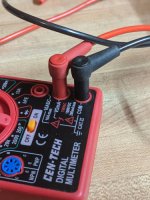
You absolutely did not use Fluke leads on a HF freebie. Do me a favor and take a look at the pictures attached to this post.
The first one shows what it looks like when you try to plug Fluke leads into one of these. The sockets are too shallow for the Fluke leads to seat properly.
The second picture shows me attempting to short the leads in the Ohms range, which should result in a zero being displayed on the screen. Instead, the meter is showing open circuit because the Fluke leads can't even reach the contacts in the sockets.
Now explain to me why you're in this thread giving spectacularly bad advice that could get someone hurt or killed and then lying when you get called out on it. I'll wait.
So....spare me the 'Harbor Freight is bad' comments....
I don't have anything against Harbor Freight. You'll see me defending their products in this forum on many occasions and as you can clearly see from the pictures I shop there myself.
What you won't see me doing is telling amateurs that they should put their lives at risk by relying on the lowest-quality multimeter on the planet to tell them if a circuit is live or not.
That meter is no more dangerous than my Simpson 260. Put it in the wrong mode and you can get magic smoke escaping from it as well.
Again, magic smoke isn't the issue. It's the relatively high likelihood of the meter telling its user that a circuit is safe when it isn't.
Now run along. The grown ups are discussing something you clearly don't understand.
Attachments

Rabid Badger
Well-known member
- Joined
- Apr 2, 2018
- Messages
- 1,338
110 won't electrocute you, it will shock you. Pet peeve.
220/240 sure will, though.
You know as well as I do the average person will flip a breaker, stick probes in the outlet, see a zero on the meter and go to work with their screwdriver.
So you'll have to excuse me if I take reality into account when I post advice on the internet where any noob DIY'er can read it.
2ndGearRubber
Well-known member
220/240 sure will, though.
You know as well as I do the average person will flip a breaker, stick probes in the outlet, see a zero on the meter and go to work with their screwdriver.
So you'll have to excuse me if I take reality into account when I post advice on the internet where any noob DIY'er can read it.
I suppose if one is not going to take before and after readings, you need to do a continuity check on the leads before proceeding. Just like connecting a test light across a battery before deciding if it is usable on a circuit.
When one mentions occasional Outlet checking, the implication is a simple 110 wall outlet in my example above. I would not touch anything 220 without either a before-and-after check or a piece of equipment you can trust. I'm certainly not advocating to go out and acquire Harbor Freight meter, $35 on Amazon can produce a much nicer product. Although I'm not sure how one can trust any meter implicitly besides maybe a fluke just based on the name. I just don't think it's fair to say that a cheapo voltmeter cannot accomplish a wall outlet check. Common sense obviously needs used anytime you're working with residential electricity regardless of voltage. People will always find ways to shock themselves no matter what advice is given or products are used.
Big thank you and shout out to Coach James, for having me remember my high school physics class. I believe ours were the state-issued official ones which were yellow. An off-color matte yellow with 0 brightness whatsoever. They were stored in a milk crate and all the leads we're always tangled in a giant ball.
Last edited:
dubdoc
Well-known member

We had 100 meters in training center environment. Half Fluke and dozen other brands.
The accuracy between brands in most automotive applications is not a concern. The device being measure +/- Spec is usually much higher than the meter accuracy.
METER LEADS ARE CONSUMABLES ..........no matter the brand ( Fluke included) leads break with use. Fluke leads are often 5 x the price. Durability and soft flexible leads are important features.
Knowing the meter and it’s capabilities is far more important than the brand.
Connect it wrong like measure amps in the ohms position the smoke leaves or the fuse blows or both. We purchased the Fluke internal fuses by the case $$$$$.
As far as analog meter that’s an old guy think........must guys under 40 never saw a needle meter other than at the flea market. I have a few analog meters that have not moved in 25 years.
The accuracy between brands in most automotive applications is not a concern. The device being measure +/- Spec is usually much higher than the meter accuracy.
METER LEADS ARE CONSUMABLES ..........no matter the brand ( Fluke included) leads break with use. Fluke leads are often 5 x the price. Durability and soft flexible leads are important features.
Knowing the meter and it’s capabilities is far more important than the brand.
Connect it wrong like measure amps in the ohms position the smoke leaves or the fuse blows or both. We purchased the Fluke internal fuses by the case $$$$$.
As far as analog meter that’s an old guy think........must guys under 40 never saw a needle meter other than at the flea market. I have a few analog meters that have not moved in 25 years.
Lprock
Active member
I use a Klein MM600, was under a $100. It's been very dependable and has a drop rating to 6ft.
softailgarage
Well-known member
Almost 10 years on this forum and I thought I could trust the info. apparently not when it comes to electricity. 110v can kill you just as easy or easier than 220v. 220v will likely knock you back causing you to released the object in your hand whereas 110v could make you "lock up" holding the offending object and a continuos flow of current. Dead. Formal electronics schooling and on the job experience taught me this. And why the cheap DMM? If you want an accurate reading and want it safely, for Gods sake spend a little money on something you can trust and if you're worried about "magic smoke" you obviously don't know what the hell you're doing.
A lot of people have angry pixies this morning, might be the virus, or some dumb tweet. Getting way off track of the OP's question.
LMFAO, I didn't know Ave have his own dictionary now till I google and found it.... WTF
https://avedictionary.com/
https://avedictionary.com/angry-pixies/
LMFAO, I didn't know Ave have his own dictionary now till I google and found it.... WTF
https://avedictionary.com/
https://avedictionary.com/angry-pixies/
theoldwizard1
Well-known member
There are a lot of decent meters in the $30-$50 range. They used to put a decent Craftsman model on sale for $20 at Christmas and Father's day.
If it is not too hard on the budget, I suggest spending a bit more and getting a meter with a "amp clamp" like a Uni-T UT210E.
If it is not too hard on the budget, I suggest spending a bit more and getting a meter with a "amp clamp" like a Uni-T UT210E.
Rabid Badger
Well-known member
- Joined
- Apr 2, 2018
- Messages
- 1,338
Another vote for the UT210e for a general use meter. Being able to get current readings from 1mA to 100A without breaking a circuit can be a huge time saver.
My other favorite general use meter is the Fluke 117. It's a little pricey but auto-ranges quickly and the bar graph is great to have.
My other favorite general use meter is the Fluke 117. It's a little pricey but auto-ranges quickly and the bar graph is great to have.
ovilla
Well-known member
I’d go on eBay and just buy the cheapest Fluke that you can afford. I have an Fluke 110 and I think I paid around $70 for it. What you want with a multimeter is the ability to add and use more test leads as you increase your electrical knowledge. There’s a ton of really great quality test leads available for Fluke meters.
ChaseIt
Member
Just recently bought a Southwire 14070T on eBay for $48. I have the same requirements for automotive work and general usage. So far, seems to cover all the bases for a reasonable price.
Mechanical Noise
Well-known member
The first one shows what it looks like when you try to plug Fluke leads into one of these. The sockets are too shallow for the Fluke leads to seat properly.
The second picture shows me attempting to short the leads in the Ohms range, which should result in a zero being displayed on the screen. Instead, the meter is showing open circuit because the Fluke leads can't even reach the contacts in the sockets.
I have some Fluke style leads. I trimmed the plastic tube over the banana plug so they fit my HF meters. Worked out well.
Fedwrench
ALLIANCE MEMBER
Probably more money than you want to spend but, I've had great luck with DMMs from electronic specialties and PDI. Powerprobe also has an excellent DMM that's inexpensive.
Here are some other recommendations:
https://www.carbibles.com/best-automotive-multimeter/
https://procarreviews.com/best-automotive-multimeter/
http://pdimeters.com/890.html
https://www.esitest.com/585.html
https://www.tooldiscounter.com/product/power-probe-power-probe-digital-multimeter-pprppdmm
Here are some other recommendations:
https://www.carbibles.com/best-automotive-multimeter/
https://procarreviews.com/best-automotive-multimeter/
http://pdimeters.com/890.html
https://www.esitest.com/585.html
https://www.tooldiscounter.com/product/power-probe-power-probe-digital-multimeter-pprppdmm
Rabid Badger
Well-known member
- Joined
- Apr 2, 2018
- Messages
- 1,338
I have some Fluke style leads. I trimmed the plastic tube over the banana plug so they fit my HF meters. Worked out well.
They aren't "Fluke style" they're just standard shrouded banana connectors. If you're willing to take the time and spend the money to buy and modify leads to use with a free meter, be my guest.