To avoid these ads, REGISTER NOW!

Multiple panels - generator wiring

DerStig

Well-known member
Joined
Jun 15, 2015
Messages
441
This is all hypothetical. Goal is to make design decisions now in the right way to reduce “rework/throw away work” in the future.

I currently have a 50amp interlock on a 200amp main (single) indoor panel. Meter is outside. So imagine meter -> 4/0 SER -> 200 amp panel indoors with 50 amp double pole interlock.

This was done properly with UL listed parts, permits were pulled, inspector signed off - all good.

Question : Imagine in far (or not so far) future I get a 400 amp service. Multiple ways this would work, but I think most practical is two parallel 200 amp lines from meter (double tap) into two indoor panels.

- In this system, are the inside 200 amp panels considered main or sub panels?
- How would one make the interlock work in this case? Can you simply wire a second interlock double pole in the second panel, then simply place a junction box on the existing 6-3 and splice the current generator cable and feed both panels?
- If I were to get a stand by generator (say generac), can I get the 22 kW version or am I now stuck with a much bigger 40 kW generator now that I have 400 amp service?

The reason why I am asking for all of these questions is because the more I think about my projects and future plans, the more I realize my 200 amp service now will be borderline load calc wise when my first set of tools arrive and I want to build things right the first time. That being said, we lose power at least 5-6 times/year and I love my generator and the ability of controlling which switches get power.
 
To avoid these ads, REGISTER NOW!

wyliesdiesels

Well-known member
Joined
Aug 14, 2012
Messages
20,071
Location
Modesto, CA
200a panels would be considered subs if there is a main breaker at the meter.

So this all depends on whether you get a 400a dual lug meter pan, or a 400a main service panel.

The standby generator would not need to be sized for the entire load since its not using an automatic transfer switch.
 
OP
D

DerStig

Well-known member
Joined
Jun 15, 2015
Messages
441
200a panels would be considered subs if there is a main breaker at the meter.

So this all depends on whether you get a 400a dual lug meter pan, or a 400a main service panel.

The standby generator would not need to be sized for the entire load since its not using an automatic transfer switch.

How does a stand by generator ensure it does not blow up if the load exceeds its supply power? If I draw 300A from a 22 kW generator, wouldnt it be a problem?

I thought these standby generators had to be sized for the service size?

Can you also tell me how interlock switch can work in this case? Can I splice the 6-3 cable coming from 50A power inlet and feed both 200A panels?
 

theoldwizard1

Well-known member
Joined
Feb 22, 2011
Messages
43,246
Location
SE MI
200a panels would be considered subs if there is a main breaker at the meter.

So this all depends on whether you get a 400a dual lug meter pan, ...
You are starting to get into some gray area that you need to check with local authorities.

Some jurisdictions will not allow "double tap" on the meter, which is different than a dual lug meter pan. It depends on the POCO and your building inspector.

If you ARE approved, your current setup (generator interlock on the current 200A panel) will NOT feed the second panel.
 

theoldwizard1

Well-known member
Joined
Feb 22, 2011
Messages
43,246
Location
SE MI
How does a stand by generator ensure it does not blow up if the load exceeds its supply power? If I draw 300A from a 22 kW generator, wouldnt it be a problem?

I thought these standby generators had to be sized for the service size?

Correct, IF it has an automatic transfer switch.

Generator of all sizes have internal breakers to protect themselves.
 
OP
D

DerStig

Well-known member
Joined
Jun 15, 2015
Messages
441
You are starting to get into some gray area that you need to check with local authorities.

Some jurisdictions will not allow "double tap" on the meter, which is different than a dual lug meter pan. It depends on the POCO and your building inspector.

If you ARE approved, your current setup (generator interlock on the current 200A panel) will NOT feed the second panel.

I understand it will not feed which is why I am asking if I can splice the 6-3 cable currently between 50A power inlet and the 200A panel and run a second 6-3 cable to the second 200A panel.

Yes, I will need to manually switch off whichever 200A panel (or both) I want to power and it will be several breaker switching but I’m fine with that. I want full flexibility.

Reality is both of these 200As are oversized but they do have circuits that you would need in an emergency. For example, one 200A system would have garage doors or lift. There was an instance before where we had lost power during a storm and my car was on a lift during an oil change. You see? And the interlock saved me. I want to continue having that flexibility when I have a detached garage.
 

ket-tek

Well-known member
Joined
Jan 28, 2009
Messages
1,289
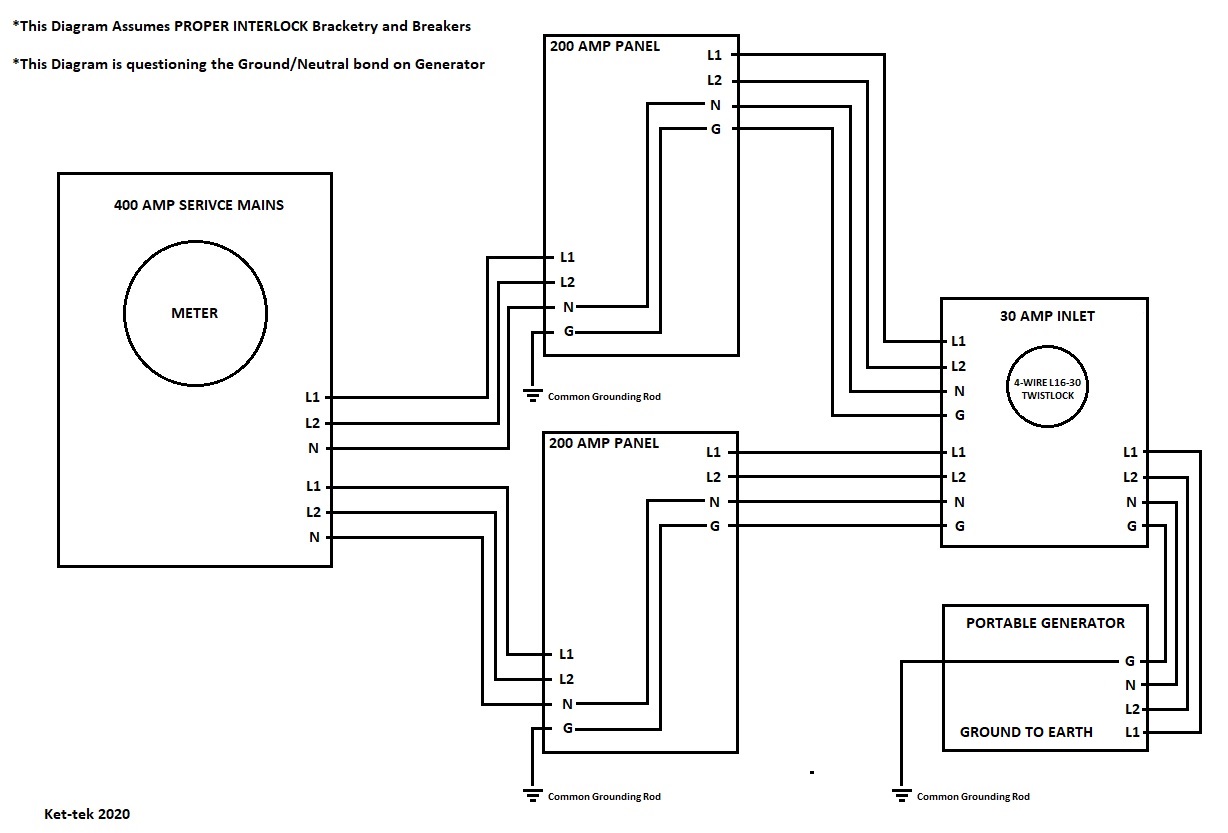
Funny I haven't logged on in a few months and today I was pondering the same questions, yet again. And had made couple diagrams to post in my original thread about the dual panel scenario.

I asked this exact question many years ago, here is the 4 page thread: https://www.garagejournal.com/forum/showthread.php?t=171549

The major outstanding issues and confusion discussed were:

- relating to the ground/neutral/frame bond of the generator and if it needed to be connected or removed, and if the generator need to be grounded separately

- relating to how the neutral connections are done between the 2 panels and the meterbase
 

ket-tek

Well-known member
Joined
Jan 28, 2009
Messages
1,289
There was questions of a possible issue that since the 2 panels could be interlocked separately, then one could be on a running generator and the other on the service feed, but the neutrals would be connected between the two power inputs, and they could somehow be some sort of issue with that? I do not know what effects that could have if any???

Here are some diagrams I made to show the 3 scenarios I interpreted from the above link thread, I would love to get any feedback from the experienced guys here that have been willing to discuss this in the past.

This shows as previously discussed how some generators have the Ground and Neutral Bonded which would also be connected to the Frame from what I understood, which is supposedly bad?

dual panel bonded by ...

This one shows a generator with no bond or the bond removed.

dual panel unbonded by ...

And this one with no bond and the generator grounded to the panel ground rod.

dual panel grounded by ...
 

theoldwizard1

Well-known member
Joined
Feb 22, 2011
Messages
43,246
Location
SE MI
DerStig;8432252Reality is both of these 200As are oversized but they do have circuits that you would need in an emergency.[/QUOTE said:
If there is a generator interlock installed on both panels, and they go to separate generator inlets, I think you would meet both the letter and the intent of the electrical code.

If you want to make up a "Y" generator feed cord, that may not be "code compliant" but it would work.

Generator interlocks do NOT "break" either the neutral or the ground from the original (POCO) source. (Remember, each of these 200A panels is effectively a sub off of the meter pan.) This is where things get "fuzzy". Depending on the POCO and your local inspector, I would not be surprised if they make you install a combination 400A meter pan breaker box with separate 200A breaker feeding your other panels.

I know a sparky who did it exactly that way at his house. No generator interlock/inlet.
 

wyliesdiesels

Well-known member
Joined
Aug 14, 2012
Messages
20,071
Location
Modesto, CA
How does a stand by generator ensure it does not blow up if the load exceeds its supply power? If I draw 300A from a 22 kW generator, wouldnt it be a problem?

I thought these standby generators had to be sized for the service size?

Can you also tell me how interlock switch can work in this case? Can I splice the 6-3 cable coming from 50A power inlet and feed both 200A panels?

The generator has a breaker to protect itself. no issue with overloading there

As to splicing the wire and feeding it to dual interlocks, I would have to check code but no issues are popping up in my head at the moment

You are starting to get into some gray area that you need to check with local authorities.

Some jurisdictions will not allow "double tap" on the meter, which is different than a dual lug meter pan. It depends on the POCO and your building inspector.

If you ARE approved, your current setup (generator interlock on the current 200A panel) will NOT feed the second panel.

umm go back and reread what I said. I didnt say DOUBLE TAP. I said DUAL LUG and 400a/320a meter pans have them.

Funny I haven't logged on in a few months and today I was pondering the same questions, yet again. And had made couple diagrams to post in my original thread about the dual panel scenario.

I asked this exact question many years ago, here is the 4 page thread: https://www.garagejournal.com/forum/showthread.php?t=171549

The major outstanding issues and confusion discussed were:

- relating to the ground/neutral/frame bond of the generator and if it needed to be connected or removed, and if the generator need to be grounded separately

- relating to how the neutral connections are done between the 2 panels and the meterbase

The neutral to ground bond needs to be removed at the generator. There should be only one neutral bond on a service.

Having the neutral bonded at the generator will cause some neutral current to flow on the EGC/equipment grounding conductor. This is not good.

If there is a generator interlock installed on both panels, and they go to separate generator inlets, I think you would meet both the letter and the intent of the electrical code.

If you want to make up a "Y" generator feed cord, that may not be "code compliant" but it would work.

Generator interlocks do NOT "break" either the neutral or the ground from the original (POCO) source.

Incorrect info here. PoCos do not distribute grounding conductors to services.

(Remember, each of these 200A panels is effectively a sub off of the meter pan.) This is where things get "fuzzy". Depending on the POCO and your local inspector, I would not be surprised if they make you install a combination 400A meter pan breaker box with separate 200A breaker feeding your other panels.

I know a sparky who did it exactly that way at his house. No generator interlock/inlet.

Incorrect again. Panels fed directly off a meter pan are NOT "effectively" subpanels. Totally incorrect. Why? Because a subpanel is any panel after the first means of disconnect on a service. A meter is not a disconnect. 2 panels coming straight off a meter are NOT subpanels. They are both main service panels.

The stuff youre posting here is just adding unnecessary confusion to the post.

BTW its only fuzzy because you've posted incorrect info.
 
To avoid these ads, REGISTER NOW!

ket-tek

Well-known member
Joined
Jan 28, 2009
Messages
1,289
The neutral to ground bond needs to be removed at the generator. There should be only one neutral bond on a service.

Having the neutral bonded at the generator will cause some neutral current to flow on the EGC/equipment grounding conductor. This is not good.

-Thank you for the insight, so a portable generator to be plugged to a house should be checked for continuity between Ground and Neutral before installation to make sure they are not connected, and if so separate them wherever it found to be combined in the generator?

-What about the comments others have made about grounding the generator, is this necessary to ground a portable generator to a grounding rod once the Neutral/Ground bond is broken, and if so must it be the same rod the panels are grounded to? Or is the ground from the generator outlet through to the breaker panels ground buss sufficient?

-If using the same portable generator for jobsite duty if needed must the Ground / Neutral connection/bond be reattached each time?

So basically which of these two diagrams would be the ideal way to leave the generator Ground?


dual panel unbonded by ...


dual panel grounded by ...
 
Last edited:
OP
D

DerStig

Well-known member
Joined
Jun 15, 2015
Messages
441
One thing that concerns with having 2x200 amp “main” panels is I dont ever want to touch my existing 200A panel as far as “unbonding” ground and neutral. Its a very crowded and old 40 breaker panel with lots of wingnuts. Some cables are original from 80 years ago. So if by upgrading my service to 400A, if I have to now remove that bond then thats not good.

And on that note, if you get a 400A service, you are bound to get 2 big 200A breakers in the box next to it which each will feed their respective 200amp panels. Now doesnt that mean those 2 panels cannot have their ground and neutral bonded?

There is “future proofing” and “oversizing” which I am happy to do. But then there is doing monumental amount of work that it becomes unpractical.

One other VERY important and unrelated question: This existing 200A panel I dont want to touch a lot right now has another problem in that it does not comply with NEC rules about the panel having certain amount of space in front and around it. Its basically right at the edge of the basement, behind the HVAC system. When you are facing it, its literally 3” from the brick wall on one side and the distance between itself and the HVAC is maybe 18” at the most. Its tight. And there is simply no way to move this panel without again doing lots of work.

So....

Can this 400A upgrade be done in a way that it meets these two important requirements:

- These two parallel mains can have their ground and neutral bonded (or at least the existing one)
- The existing panel which grandfathered its location and is sort of exempt right now continue to be that way without getting “red flagged”?

Thoughts?
 

wyliesdiesels

Well-known member
Joined
Aug 14, 2012
Messages
20,071
Location
Modesto, CA
Thank you for the insight, so a portable generator to be plugged to a house should be checked for continuity between Ground and Neutral before installation to make sure they are not connected, and if so separate them wherever it found to be combined in the generator?

Correct. The bond is usually easy to find.

Some people even make a special plug with a wire jumper between neutral and ground to allow for easy bonding when the generator is used as a stand alone unit (not connected to a house).

What about the comments others have made about grounding the generator, is this necessary to ground a portable generator to a grounding rod once the Neutral/Ground bond is broken, and if so must it be the same rod the panels are grounded to? Or is the ground from the generator outlet through to the breaker panels ground buss sufficient?

Those people are sadly confused & are misleading people. They are mixing up different things because they don't understand the difference between & function of grounding electrodes, grounding conductors, & neutral bonding. All 3 have separate, exclusive functions. Let's go over the purpose of each of them so we can gain a better understanding on the subject:

A grounding rod/electrode is for shunting lightning to earth. We want the lightning to go directly to earth rather than through some other pathway which would fry electronics(or people) on its way to earth. This is why phone & cable Co demarcs are bonded to the grounding electrodes at the service entrance. Grounding electrodes are also for limiting voltage potential to earth, & shunting PoCo high/primary voltage for when lines contact secondary lines. A grounding electrode is NOT for establishing a low impedance fault current pathway, which is what a grounding conductor/EGC/ground wire is for.

The EGC establishes this low impedance fault current pathway so that fault current, which could energize objects & pathways (motor or appliance frame, metal conduit, building steel, etc) that should NOT be energized, can be cleared by the breaker (meaning the breaker opens the circuit/shuts off the power).

The only way an EGC can be established is with a neutral to ground bond in the main service panel. Without this bond, there would be no line to neutral fault & thus no way for a breaker to see high energy line to line (neutral, which is just a center tap off the secondary coil in the transformer) current which triggers the magnetic mechanism in the breaker.

Now that we have a better understanding of the different functions of these 3 distinct electrical things, we can then understand why a grounding electrode is of no use at a generator for standby power hookup. Though, putting one in won't hurt anything other than maybe your wallet. The generator is connected to the buildings grounding electrodes via the EGC.

Now the reason we don't want a neutral bond at the generator is because having it would allow some neutral current, returning to the generator, to flow on the EGC in the power cord. This also creates a shock potential between the generator frame & a bonded object such as your electrical panel. Say you're leaning against your generator frame & then touch your electrical panel, while the generator is on. Some of the neutral current could flow from the panel through you & into the generator frame. This is dangerous! :shocking:

This is the same reason range & dryer circuits were required to be switched to 4-wire back in '96. Originally, the grounding of the appliance frame was allowed to be done through the neutral wire. However, if the neutral connection fails, it setups up a shock potential. Think of the scenario where someone is leaning against their dryer, the neutral has a poor connection(burned up in the panel due to loose lug connection) and the person touches the faucet at their wash tub. They have no created an alternate pathway for the current to flow on (from dryer frame, through person, to bonded plumbing). NOT GOOD! :shocking:

Hope that helps... :thumbup:

-If using the same portable generator for jobsite duty if needed must the Ground / Neutral connection/bond be reattached each time?

YES! Because we want the generator breakers to be able to clear any possible fault current. As explained above, without the bond, the breakers would not be able to clear the fault current. This is why some people make grounding plugs like i explained earlier
 
Last edited:

wyliesdiesels

Well-known member
Joined
Aug 14, 2012
Messages
20,071
Location
Modesto, CA
So basically which of these two diagrams would be the ideal way to leave the generator Ground?


dual panel unbonded by ...


dual panel grounded by ...

well the only difference between the 2 diagrams is a grounding electrode going to earth. There is not a neutral bond on the lower diagram which would be indicated with a ground symbol tied to the neutral terminal or a line from neutral to ground.

As I previously said, the ground rod is a waste of money.
 

wyliesdiesels

Well-known member
Joined
Aug 14, 2012
Messages
20,071
Location
Modesto, CA
One thing that concerns with having 2x200 amp “main” panels is I dont ever want to touch my existing 200A panel as far as “unbonding” ground and neutral. Its a very crowded and old 40 breaker panel with lots of wingnuts. Some cables are original from 80 years ago. So if by upgrading my service to 400A, if I have to now remove that bond then thats not good.

If the new meter pan does NOT have a disconnect, then the existing old 200a panel would remain a main service panel and can keep the neutral bond.

Remember, the key to whether a neutral bond can remain, is whether there's a disconnect ahead of the panel. No disconnect then neutral bond can remain.

And on that note, if you get a 400A service, you are bound to get 2 big 200A breakers in the box next to it which each will feed their respective 200amp panels. Now doesnt that mean those 2 panels cannot have their ground and neutral bonded?

Not all 400a service have main disconnects at the meter. So dont automatically think there would be 2 200a breakers.

But in answer to your question, YES, if there are disconnects ahead of the 200a panels, the panels would be subpanels and thus the neutral bond would need to be removed. This can prove challenging in retrofits on older panels.

There is “future proofing” and “oversizing” which I am happy to do. But then there is doing monumental amount of work that it becomes unpractical.

One other VERY important and unrelated question: This existing 200A panel I don't want to touch a lot right now has another problem in that it does not comply with NEC rules about the panel having certain amount of space in front and around it. It's basically right at the edge of the basement, behind the HVAC system. When you are facing it, it's literally 3” from the brick wall on one side and the distance between itself and the HVAC is maybe 18” at the most. Its tight. And there is simply no way to move this panel without again doing lots of work.

So....

Can this 400A upgrade be done in a way that it meets these two important requirements:

- These two parallel mains can have their ground and neutral bonded (or at least the existing one)
- The existing panel which grandfathered its location and is sort of exempt right now continue to be that way without getting “red flagged”?


Thoughts?

Question #1- yes they can both remain bonded as long as there is no main disconnect ahead either one of them. you would get a 400a meter pan. If you instead install a 400a meter MAIN service combination panel with breakers, then you're SOL and the existing panel will not only need to have its neutral bond removed, but will also need to have an EGC ran to it. Also, the grounding electrode conductors will need to be moved over to the new manin service panel.

Question #2- it may not have been installed to code in the first place. So grandfathering may not apply. Also, the building inspector may redflag you anyways depending on the level of work youre doing.

You would need to figure out when the panel was installed and when code requirements for clearance were adopted.
 
OP
D

DerStig

Well-known member
Joined
Jun 15, 2015
Messages
441
If the new meter pan does NOT have a disconnect, then the existing old 200a panel would remain a main service panel and can keep the neutral bond.

Remember, the key to whether a neutral bond can remain, is whether there's a disconnect ahead of the panel. No disconnect then neutral bond can remain.


Not all 400a service have main disconnects at the meter. So dont automatically think there would be 2 200a breakers.

But in answer to your question, YES, if there are disconnects ahead of the 200a panels, the panels would be subpanels and thus the neutral bond would need to be removed. This can prove challenging in retrofits on older panels.


Question #1- yes they can both remain bonded as long as there is no main disconnect ahead either one of them. you would get a 400a meter pan. If you instead install a 400a meter MAIN service combination panel with breakers, then you're SOL and the existing panel will not only need to have its neutral bond removed, but will also need to have an EGC ran to it. Also, the grounding electrode conductors will need to be moved over to the new manin service panel.

Question #2- it may not have been installed to code in the first place. So grandfathering may not apply. Also, the building inspector may redflag you anyways depending on the level of work youre doing.

You would need to figure out when the panel was installed and when code requirements for clearance were adopted.

I had a long phone conversation with our inspector today. Very nice gentleman, really helped me with all of my questions. The summary of our conversation which relates to this thread is as follows:

1- It is not possible to wire an interlock switch in parallel with 2 panels where the power inlet feeds both panels. There is no code compliant way. This is a big issue for me and it's probably why I can never be OK with 400amp setup.

2- For my particular situation (single family home, location of electrical pole, detached garage, etc), there is no way to NOT have 2x200 amp panels as sub panels. There is no way to setup a 400amp system with 2 panels where both panels serve as main panels. This is because I would want one panel to be where it is (next to the basement wall, next to the meter) and the second panel on the opposite end of the house. There is no way to have an "unfused" wire that long without a main disconnect. At the most 3-4 ft is how long the cable/wire can be from the main meter. This defeats the whole purpose for me.

3- The current panel which violates the "3 ft" rule is OK. Even if I were to completely replace that panel, I can continue keeping it where it is.

4- There is no practical way to "reuse" the existing 200amp panel, as one of the 200 amp panels, in a 400 amp setup as is. There is no way to keep the neutral/ground bonded there. The entire thing would have to be redone. There is no easy way to retrofit a ground bus bar because the panel doesnt accept one. Not to mention, lots and lots of pig tails required and it would be very ugly (and a lot of work).

5- In conjunction with #2 above, there is no way to have a 400 amp (or even a 320 amp) meter without main disconnects as part of the meter. This creates a lot of limitations around the types of generators (even stand by) I can use as well as not being able to use my Sense energy monitor (again went through all possible options).

The only way to have this 400 amp meter without a disconnect is if I keep all the wires in a conduit and dig trenches around my house. There is no cost effective way of doing this unfortunately unless I am okay with destroying my wife's flower garden as well as completely redoing my stone entryway. It would just be a monumental task.

My only option with a 400amp plan is to run a completely different meter from the street to the detached garage but thats not something I would like. I want a complete system where I can "on-demand" run any parts of the circuit with my portable generator. Things like compressor, garage doors, car lifts are all heavy equipment that 99% of the time you would not need to power with a generator but in an apocalypse situation, you might need to.
 

brewchief

Well-known member
Joined
Sep 20, 2008
Messages
2,370
Location
Michigan
Can you put a 200 disconnect near the current panel and then run a 4 wire feed to the other side of the house to the second 200 amp panel? It sounded like your current panel doesn't have the proper working room so might not be able to place a disconnect close enough to consider them grouped( I don't know how close they have to be to be considered grouped).

This would take care of part of the problem, for the generator issue is there anything that states that you cannot feed an interlock from another panel? Feed the first panel from the generator via interlock and then a circuit from that panel feeding the interlock in the second panel.

Sent from my SM-G965U using Tapatalk
 
OP
D

DerStig

Well-known member
Joined
Jun 15, 2015
Messages
441
Can you put a 200 disconnect near the current panel and then run a 4 wire feed to the other side of the house to the second 200 amp panel? It sounded like your current panel doesn't have the proper working room so might not be able to place a disconnect close enough to consider them grouped( I don't know how close they have to be to be considered grouped).

This would take care of part of the problem, for the generator issue is there anything that states that you cannot feed an interlock from another panel? Feed the first panel from the generator via interlock and then a circuit from that panel feeding the interlock in the second panel.

Sent from my SM-G965U using Tapatalk

so what you are saying:

- Keep your current panel as is without a disconnect before it. But put a disconnect right next to it such that the second panel has to deal with it, not first. First panel becomes its own disconnect (as is the case now) and second, newer panel essentially becomes a subpanel.

I think that will still have the same fundamental problem which is these panels are not part of the same system and that they are broken by disconnects. That basically means there is no one way to feed both of them by means of portable or standby generator. It's a lot of headache.

And tomorrow if I want to go solar or have battery wall, then it's even worse.

For me having a complete system (i.e. one big disconnect and everything downstream of it is one system as a whole) is number one priority. If I dont have that, then I might as well run a second 200amp meter to the garage. Much MUCH less work. No work in fact. Run the wires overhead and run SER through the wall inside the garage.

But again, that defeats the purpose.

Wow, we are so far advanced in so many things (technology wise) but we are so stuck with 200 amps:( It looks like this part of the technology didnt really advance at all. Going from 100 to 200 is not like going from 200 to 400. You are almost not going to 400, you are just duplicating your 200 which is like a fake 200:)

As for the interlock comment you made, the inspector did not think this is safe at all. Because he said you could have a case where one system can end up feeding the other system from neutral back into the utility lines. And at the end of the day, it doesnt matter what I think. If he thinks this is a no go, he is the judge, it is a no go. I have very little chance of convincing him as I dont posses any credentials
 
Last edited:

ket-tek

Well-known member
Joined
Jan 28, 2009
Messages
1,289
[/B]the inspector did not think this is safe at all. Because he said you could have a case where one system can end up feeding the other system from neutral back into the utility lines. And at the end of the day, it doesnt matter what I think. If he thinks this is a no go, he is the judge, it is a no go. I have very little chance of convincing him as I dont posses any credentials

So the issue is that one panel could be on genset and the other on mains, and the genset running could backfeed return power on neutral to the grid?

But this could still happen with a single panel tho? If the genset is running and backfeed breaker set to mains it's all always connected to the neutral in any senario, one panel or two panels.

You would have to have to transfer switch all the wiring from genset to panel, not just the 2 hots on a backfeed breaker.

If that is what he was meaning?
 

nadogail

Well-known member
Joined
Jan 23, 2009
Messages
32,041
Location
Coronado, CA
IMHO, Because there are local inspection authorities and not all authorities are using the same version of what ever code is applicable, I wonder if the original poster is aware of the difficulty in answering what appears to be, to this observer, a hypothetical ambiguous question that can not be definitively answered given the paucity of information provided.
 

wyliesdiesels

Well-known member
Joined
Aug 14, 2012
Messages
20,071
Location
Modesto, CA
As for the interlock comment you made, the inspector did not think this is safe at all. Because he said you could have a case where one system can end up feeding the other system from neutral back into the utility lines. And at the end of the day, it doesnt matter what I think. If he thinks this is a no go, he is the judge, it is a no go. I have very little chance of convincing him as I don't posses any credentials

The inspector's response shows his lack of understanding on basic electrical fundamentals and concepts. He doesn't know what he is talking about. Electricity returns to its source (the generator) NOT some other location (the utility lines).

The neutral return current wouldn't go back to the utility lines. It would go back to the generator.

Since both panels are connected to one meter, the neutral return current going back to the generator would flow through the neutral bar in the meter but it would still go back to the generator not up the service drop to the transformer.

Keep in mind interlocks are in use in thousands perhaps millions of locations with no issues....

So the issue is that one panel could be on genset and the other on mains, and the genset running could backfeed return power on neutral to the grid?

That's the inspectors theory but he is wrong. Both panels are connected to the same meter and neutral bar. The neutral return current going back to the generator isnt gonna magically go up the service drop going to the transformer. This defies known electrical concepts and theory. The neutral return current will go back to the SOURCE, the generator, through the meter panel. The generator is not on the other side of the transformer....

But this could still happen with a single panel tho? If the genset is running and backfeed breaker set to mains it's all always connected to the neutral in any scenario, one panel or two panels.

You would have to have to transfer switch all the wiring from genset to panel, not just the 2 hots on a backfeed breaker.

If that is what he was meaning?

Using the inspectors logic, yes. But the inspector is wrong. The neutral is not switched no matter how many panels there are. Think of all the interlock setups there are out there with just one panel. Even with one panel, the neutral return current still doesnt go back onto the utility lines...
 
To avoid these ads, REGISTER NOW!
Top Bottom