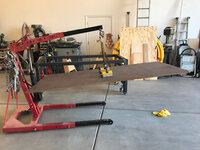
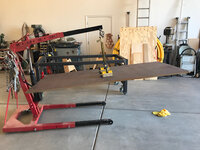
3/4” top with hydraulic jacks on both sides and wheels to let it down. Edge of the table was cut on a water jet to get a square edge and radius the corners slightly. 4’x8’ weighing in at just over 1000 lbs with the frame. Thanks for looking.
Jake

Nice table. I might recommend being very careful on what you roll the wheels over. Flat concrete is probably fine. But if you hit any bumps the threaded rod to caster interface may break.
What you have constructed is very similar in size and weight to a vibration isolation table. In that world the tables are not moved often, but on initial installation they may be moved from the loading dock thru the office building to the final destination. One of my suppliers had a similar (if not more conservative) design and they had no less than three redesigns to deal with breaking the casters off. There is nothing less fun than having a customer looking over shoulder as you hacksaw off a bent/broken caster assy on their $150K tool.
I found the most robust solution was to mount the caster fixed and raise/lower the feet. The reason is the vertical adjust mechanism (screw feet) only see static loads. Unlike the casters which see static and dynamic loads as you move it. The example swivel foot is rated for 7400 lbs. But deploying it is not as fast as your two hydraulic jack solution.