

You are using an out of date browser. It may not display this or other websites correctly.
You should upgrade or use an alternative browser.
You should upgrade or use an alternative browser.
My Compressor Aftercooler Install
- Thread starter Mr X
- Start date
sweetk30
Well-known member
why didnt you slope the coolers to let water drain out of the system . to me it looks like you mounted them flat .
otherwise good looking setup .
otherwise good looking setup .
Tim Kennedy
Well-known member
- Joined
- Oct 16, 2011
- Messages
- 368
dbr1976:
What source [air compressor/I presume] did you use to supply 300psi for the hydro test? Just curious -- I have an industrial I/R T-30 -- the gauge goes to 300 but I'm not sure I could get there.
What source [air compressor/I presume] did you use to supply 300psi for the hydro test? Just curious -- I have an industrial I/R T-30 -- the gauge goes to 300 but I'm not sure I could get there.
why didnt you slope the coolers to let water drain out of the system . to me it looks like you mounted them flat .
otherwise good looking setup .
Didn't need to. The velocities in the small tubing I used will easily push water droplets out to the air dryer which has a separator with auto drain. The few droplets that might exist after the compressor shuts off will be stuck in the bends.
dbr1976:
What source [air compressor/I presume] did you use to supply 300psi for the hydro test? Just curious -- I have an industrial I/R T-30 -- the gauge goes to 300 but I'm not sure I could get there.
I did hydro test. The term hydro implies water. I used a pressure washer to get up to the necessary pressure. Hydro tests are safer if vessel ruptures plus it's easy to get pressure needed with pressure washers.
Kaizen
Well-known member
Didn't need to. The velocities in the small tubing I used will easily push water droplets out to the air dryer which has a separator with auto drain. The few droplets that might exist after the compressor shuts off will be stuck in the bends.
So it goes from pump to two radiators then where? Cooler before the tank?
If you can post those flex line link it would be helpful.
Sent from my iPhone using Tapatalk
BCreekDave
Well-known member
dbr1976:
What source [air compressor/I presume] did you use to supply 300psi for the hydro test? Just curious -- I have an industrial I/R T-30 -- the gauge goes to 300 but I'm not sure I could get there.
You can use a grease gun with a check valve in the output line. Pre-fill the tank with water, thread the check valve and grease gun into the top of the tank and start pumping until you get to 300 on the gage. A grease gun can go to 1500 to 2000 psi.
Sent from my iPhone using Tapatalk
Tim Kennedy
Well-known member
- Joined
- Oct 16, 2011
- Messages
- 368
dbr1976:
For some reason when I read the original post, I thought you filled it with water & then turned the compressor on to get the pressure you wanted -- am familiar with hydro testing -- had my oxygen tank hydro checked several years back for re-certification. Strange -- when I asked about getting the acetylene tank tested -- the tech told me he couldn't do it & said he was unaware how they do it -- never have been able to get an answer on how they test acetylene tanks.
For some reason when I read the original post, I thought you filled it with water & then turned the compressor on to get the pressure you wanted -- am familiar with hydro testing -- had my oxygen tank hydro checked several years back for re-certification. Strange -- when I asked about getting the acetylene tank tested -- the tech told me he couldn't do it & said he was unaware how they do it -- never have been able to get an answer on how they test acetylene tanks.
Tim Kennedy
Well-known member
- Joined
- Oct 16, 2011
- Messages
- 368
BCreekDave:
Thanks for that bit of information! After reading a post here awhile back about injuries from hydraulic systems -- grease guns can be capable of far higher pressures than 1500 to 2000 psi! Bottom line --- be extremely careful doing any testing involving pressure.
Thanks for that bit of information! After reading a post here awhile back about injuries from hydraulic systems -- grease guns can be capable of far higher pressures than 1500 to 2000 psi! Bottom line --- be extremely careful doing any testing involving pressure.
larry4406
Well-known member
You can use a grease gun with a check valve in the output line. Pre-fill the tank with water, thread the check valve and grease gun into the top of the tank and start pumping until you get to 300 on the gage. A grease gun can go to 1500 to 2000 psi.
Sent from my iPhone using Tapatalk
BCreekDave:
Thanks for that bit of information! After reading a post here awhile back about injuries from hydraulic systems -- grease guns can be capable of far higher pressures than 1500 to 2000 psi! Bottom line --- be extremely careful doing any testing involving pressure.
Our plumbers use a hydrostatic pump to pressure test domestic water piping for inspection. System is filled with water then the hydrostatic pump is used to pressurize the system. Link to similar device below, but the grease gun with check valve is clever.
https://www.ferguson.com/product/wh...ostatic-pump-with-int-prv-w029200/_/R-2445569
BCreekDave
Well-known member
It probably can exceed 2000 psi. Just depends on how hard you pump it, which is actually the great advantage. The pumping volume is very low compared to the volume in the tank, so the pressure increase is very controlled. Even if the tank were to rupture, it is a very small spurt of water. Generally, it may not even be seen except by the pressure gage dropping. As always, wear appropriate PPE and stand a few feet away. In reality I would say this is overall less risky than a receiver charged with 175 psi of air rupturing.
Sent from my iPhone using Tapatalk
Sent from my iPhone using Tapatalk
Strange -- when I asked about getting the acetylene tank tested -- the tech told me he couldn't do it & said he was unaware how they do it -- never have been able to get an answer on how they test acetylene tanks.
Acetylene tanks are not hydro-tested.
Because they are filled with a porous 'solid' that is then filled with acetone and then the acetylene is then dissolved under pressure into the acetone.
Otherwise, the acetylene will destructively decompose at about 30 psig.

Acetylene tanks are given a detailed visual inspection and the porous mass is inspected with feeler gauges to check its integrity and the steel cylinder walls may be ultrasonically tested for thickness. No pressure testing (aka hydro test) is done once the porous mass is installed (cast) in the cylinder.
Pressure vessels are tested using a 'hydro test' because it is VASTLY safer to use an incompressible fluid to pressure test something than a compressible gas. A compressible gas in a pressure vessel has a LOT of stored (potential) energy in that pressurized gas. Under a failure event, that stored energy can be released catastrophically. With a pressurized liquid, if there is a break or failure of the pressure vessel then the liquid pretty much just leaks out. Much safer.
Standard test pressure is a minimum 1.3x the max allowable working pressure (MAWP) with temperature correction factors.
And now back to the topic ...

imjustdave
Well-known member
So hydro testing for DOT cylinders say a SCUBA tank, O2 tank, Argon, Fire extinguishers ETC is done by putting the tank being checked filled of water into a chamber that is also filled with water and then they pressurize the internal tank to test it, as the tank is being tested the expansion is measured buy the external chamber. It's sole purpose is to measure the expansion and not a safety device.
So tanks can fail the test if they expand too much, fail if they break, fail if they are dirty inside. FYI Test pressure is higher then normal use pressure.
So I would argue filling your air tank with water and then pressurizing it higher then normal is really only testing that it can hold a higher pressure VS verifying the body of the tank isn't bulging, It's better then nothing I guess but I feel like we are missing a key test in a true hydro test.
I'm no expert and maybe lower pressure vessels are different test procedures but what we are taking about here is not how higher pressure vessels are tested.
So tanks can fail the test if they expand too much, fail if they break, fail if they are dirty inside. FYI Test pressure is higher then normal use pressure.
So I would argue filling your air tank with water and then pressurizing it higher then normal is really only testing that it can hold a higher pressure VS verifying the body of the tank isn't bulging, It's better then nothing I guess but I feel like we are missing a key test in a true hydro test.
I'm no expert and maybe lower pressure vessels are different test procedures but what we are taking about here is not how higher pressure vessels are tested.
csp
Well-known member
BCreekDave:
Thanks for that bit of information! After reading a post here awhile back about injuries from hydraulic systems -- grease guns can be capable of far higher pressures than 1500 to 2000 psi! Bottom line --- be extremely careful doing any testing involving pressure.
The danger in a situation like this is minimal because the water doesn't compress and the grease gun/pressure washer isn't going to be able to sustain the higher pressure if there's a failure. If the vessel were compromised you might get wet shoes and that's about it.
Yes, hydraulic systems can do some serious damage, but it's not the case here.
Last edited:
Tim Kennedy
Well-known member
- Joined
- Oct 16, 2011
- Messages
- 368
MoonRise:
Thanks for the input -- most interesting! If I remember correctly -- if you transport the acetylene tank laying down -- you need to stand it up for a certain amount of time [1 hr?] prior to using it?
Thanks again for the info. Used to work in a hydraulic shop for a period of time -- more than aware of the potential energy involved.
Thanks for the input -- most interesting! If I remember correctly -- if you transport the acetylene tank laying down -- you need to stand it up for a certain amount of time [1 hr?] prior to using it?
Thanks again for the info. Used to work in a hydraulic shop for a period of time -- more than aware of the potential energy involved.
Markallgearedup
New member
I was wanting to do the same set but having a hard time finding 3/4” od soft copper in short lengths and compression firtings for 3/4” Anyone do this setup with 3/4” ?
restorick
Well-known member
It's a high temperature (750F) high pressure (750#) hose off Amazon that minimizes the vibrations on the air cooler. I originally had copper tubing in this spot but decided to switch to flex hose.
Hello - do you happen to have a link to this hose? For the life of me, I can't seem to locate it using Amazon search.
Thanks!
Rick
Ing3018
Well-known member
I was wanting to do the same set but having a hard time finding 3/4” od soft copper in short lengths and compression firtings for 3/4” Anyone do this setup with 3/4” ?
My pump had a 3/4" od copper discharge tube. I looked for fittings for that size and did not find them readily available. I went with 7/8" od type K hard pipe and flare fittings to make my new discharge line. I annealed the copper so that I could bend it and flare it.
I did not find compression fittings any larger than 5/8" od. Due to vibration, I understand that flared fittings are a more reliable joint than compression. If you can use 5/8" od for your discharge line, that size is easily found in flare fittings as well.
restorick
Well-known member
My pump had a 3/4" od copper discharge tube. I looked for fittings for that size and did not find them readily available. I went with 7/8" od type K hard pipe and flare fittings to make my new discharge line. I annealed the copper so that I could bend it and flare it.
I did not find compression fittings any larger than 5/8" od. Due to vibration, I understand that flared fittings are a more reliable joint than compression. If you can use 5/8" od for your discharge line, that size is easily found in flare fittings as well.
A buddy of mine in the HVAC biz had a chunk of 3/4 I used for a pump/compressor rebuild. I'd check with a local contractor and see if they have any short lengths they can get rid of.
Rick
csp
Well-known member
Hello - do you happen to have a link to this hose? For the life of me, I can't seem to locate it using Amazon search.
Thanks!
Rick
Probably not the hose used, but an example of one. https://www.amazon.com/dp/B004S4FEE6/?tag=atomicindus08-20
Google Air compressor braided stainless steel hose for more options.
imjustdave
Well-known member
Just about any hydraulic hose shop could make you up any line you like in just about any size and fitting you could ever want. temp, pressure you need is epic low. Tell them your application and 5-10 min latter you will have what you want.
Tim Kennedy
Well-known member
- Joined
- Oct 16, 2011
- Messages
- 368
MoonRise:
Kinda' off the original topic - what material is the 'cast porous solid' in the acetylene tank made of & what happens to it after a period of time? Does it slowly dissolve completely & then the tank is destroyed or can another be cast in the tank for continued use?
Thanks for the info.
Kinda' off the original topic - what material is the 'cast porous solid' in the acetylene tank made of & what happens to it after a period of time? Does it slowly dissolve completely & then the tank is destroyed or can another be cast in the tank for continued use?
Thanks for the info.
MrSurly
Well-known member
MoonRise:
Kinda' off the original topic - what material is the 'cast porous solid' in the acetylene tank made of & what happens to it after a period of time? Does it slowly dissolve completely & then the tank is destroyed or can another be cast in the tank for continued use?
Thanks for the info.
I don't know the answer on the life of the filler (but I THINK it doesn't go away).
Anyway, this bit from Wiki:"Most regulators and pressure gauges on equipment report gauge pressure, and the safe limit for acetylene therefore is 101 kPagage, or 15 psig.[44][45] It is therefore supplied and stored dissolved in acetone or dimethylformamide (DMF),[45][46][47] contained in a gas cylinder with a porous filling (Agamassan), which renders it safe to transport and use, given proper handling. Acetylene cylinders should be used in the upright position to avoid withdrawing acetone during use.[48]
Schurkey
Well-known member
Decades ago, I was building compressor discharge hoses using Dash 12 (nominally 3/4", actually slightly smaller ID) Aeroquip 2807 hose and "Little Gem" reusable hose ends.
This hose is a Teflon/PTFE liner with a single layer of stainless steel wire braid over the liner. The ends are ultra-easy to install. I've been making my own "hot-rod" hoses with various sizes of that kind of hose ever since.
The 2807 hose is the "industrial" name, it's sold as Aeroquip TFE Racing hose to the hot-rod people. Earls, Russell, and twenty other companies sell something equivalent.
This hose is a Teflon/PTFE liner with a single layer of stainless steel wire braid over the liner. The ends are ultra-easy to install. I've been making my own "hot-rod" hoses with various sizes of that kind of hose ever since.
The 2807 hose is the "industrial" name, it's sold as Aeroquip TFE Racing hose to the hot-rod people. Earls, Russell, and twenty other companies sell something equivalent.
Tim Kennedy
Well-known member
- Joined
- Oct 16, 2011
- Messages
- 368
MrSurly:
Thank-you for the info -- I appreciate it! I posted previously that if transported laying down, the tank should be upright for at least an hour or two before using the acetylene -- I think.
Thanks again
Thank-you for the info -- I appreciate it! I posted previously that if transported laying down, the tank should be upright for at least an hour or two before using the acetylene -- I think.
Thanks again
ArkTinkerer
Well-known member
- Joined
- Dec 29, 2010
- Messages
- 369
I'm impressed the cooler would handle that pressure. I never would have expected that. I'm planning on using the heat exchanger from an AC unit as a cooler since it is designed to handle higher pressures. But it brings a different concern--whether the unit is designed to handle the volume of air I expect from the compressor.
pcmeiners
Well-known member
"whether the unit is designed to handle the volume of air I expect from the compressor."
The cooler referred to and heat exchangers from small A/C units are not designed for the volume of air produced by a 5 hp or greater compressor.
The cooler referred to and heat exchangers from small A/C units are not designed for the volume of air produced by a 5 hp or greater compressor.
ArkTinkerer
Well-known member
- Joined
- Dec 29, 2010
- Messages
- 369
I am already planning on having to rework the smaller inlet pipe/manifold to enlarge and parallel more of the cooling lines thru the core. One of those things that may not work. Not unusual for a Tinkerer...
MacMcMacmac
Well-known member
https://www.eastwood.com/atk-ls3-415ci-620hp-base-ls02.html
Seems like not a bad price for something actually designed to cool a compressor. Looks like it has some usable bosses for mounting as well.
Seems like not a bad price for something actually designed to cool a compressor. Looks like it has some usable bosses for mounting as well.
Hello - do you happen to have a link to this hose? For the life of me, I can't seem to locate it using Amazon search.
Thanks!
Rick
https://www.amazon.com/gp/product/B078Z1T253/ref=ppx_yo_dt_b_search_asin_title?ie=UTF8&psc=1
pcmeiners
Well-known member
Search Ebay for.... stainless teflon hose.
All sizes of hose will come up, Teflon due to the chemical/oil vapor.
All sizes of hose will come up, Teflon due to the chemical/oil vapor.
ROBZ71LM7
Well-known member
What's a good source for a 120V or 240V fan for the Hayden cooler?
manoweb
Well-known member
Sorry Hchrist, but if you post on this forum , whatever you post is open to discussion, this is not a photo album forum, it is a discussion forum, we learn from each other, especially from the ones who already made mistakes.
Well but that is only relevant when the discussion or critique adds valid points to the discussion. The value added by an aftercooler is complementary to an air refrigeration system. The two are not exclusive, and in fact, if one uses a refrigeration system, an aftercooler is actually MORE important to have, not less! Now, the OP made a very "thick"
 build, with a lot of steel and expensive plumbing. I would have done something much more light-weight but that doesn't really matter: the concept of a passive system that allows to store dry, cool air directly in the tank has advantages that are so easily understated. Nowadays the Harbor Freight air cooler costs 399 + a bunch of plumbing and valves and space in the shop, and it uses energy when in use and needs some time to come down to temperature when first started. The Hayden radiator is still the same ~160 dollars price and the plumbing can be done cheaper, that translates in roughly half the cost, so if one on a budget had to choose *today* the best bang for the buck is likely to be the aftercooler solution.
Last edited:
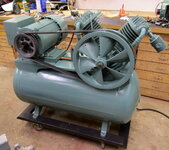
Super, super work. just joined this site (years later!) - I was looking for aftercooler ideas after I put together this set, and this one is really well presented. Thanks - will copy!
Attachments

Lumpy102
Well-known member
Also looking for 220 volt fans to fit my Hayden 1260 cooler, I see some axial electronics cooling fans, new are $125 to $200 USD, used for us in Canada isn't any cheaper as shipping cost increases have made shipping from the good old USA near prohibitive. The border can't open soon enough. Any suggestions for a remote fan setup are welcome.What's a good source for a 120V or 240V fan for the Hayden cooler?
BCreekDave
Well-known member
Something like thisAlso looking for 220 volt fans to fit my Hayden 1260 cooler, I see some axial electronics cooling fans, new are $125 to $200 USD, used for us in Canada isn't any cheaper as shipping cost increases have made shipping from the good old USA near prohibitive. The border can't open soon enough. Any suggestions for a remote fan setup are welcome.

EBM Pabst W2E142-BB01-01 Axial Cooling Fan 230V 38x172mm LOT OF 2 | eBay
<p></p> <ul> <li>In Good Working Condition.</li> <li>Lot Of 2 Fans.</li> <li>W2E142-BB01-01.</li> <li>230V. 28W. 230CFM.</li> <li>38 x 172mm.</li> </ul> <p></p>.
www.ebay.com
I borrowed a lot of ideas from this forum. Hope this helps someone else.
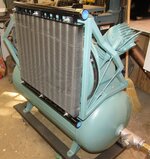
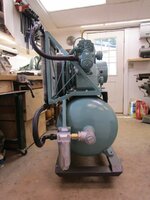
It helped me! Got my dream compressor finished; used your aftercooler plan - and the temp diff in and out is amazing.
Attachments
-
 IMG_3979.JPG239.9 KB · Views: 90
 -
 IMG_4026.JPG221.8 KB · Views: 84
 -
 IMG_4030.JPG218.1 KB · Views: 86
 -
 IMG_4031.JPG211.2 KB · Views: 83
 -
 IMG_4038.JPG298.3 KB · Views: 83
 -
 IMG_4040.JPG194.3 KB · Views: 88
 -
 IMG_4048.JPG287.1 KB · Views: 88
 -
 IMG_4049.JPG257.7 KB · Views: 98
 -
 IMG_4181.JPG252.6 KB · Views: 99
 -
 IMG_4185.JPG177.2 KB · Views: 113
tunerwithkids
Active member
Inspired by this post, I did my DIY Aftercooler using a Derale 15300. Definitely no where near the complexity or fab effort as others in this thread but great addition to my setup. Initial empty to full 60 gallon run saw peak temps of 200F at compressor discharge to 75F at tank inlet. Nice delta T for a $60 fin cooler, if you ask me.

Zip tied Derale 15300 to pulley shroud to use the natural pulley fan draft. I used this from Amazon: https://www.amazon.com/Derale-15300-Tube-Cooler-Core/dp/B004XONT3E

had to do a 5/8 to 1/2 step down compression fitting (no flare fittings in this size step down). These flares are pretty hard to find locally, I had to order a package but price wasn't bad. https://www.amazon.com/LTWFITTING-Compression-Reducing-COMPRESSION-FITTING/dp/B00CHHZU6I

Used 1/2” aluminum bendable tubing, slightly cheaper than copper. I got the tubing from here: https://www.amazon.com/Allstar-ALL40185-Diameter-Aluminum-Coiled/dp/B006K8JJN0
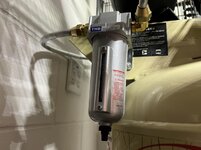
Used the THB aluminum 1/2” water separator with auto drain everyone is raving over these days. I used this one: https://www.amazon.com/Particulate-Filter-Moisture-seperator-Automatic/dp/B017GIGQOC

Used 1/2” flares into the 8AN males on the Derale 15300. Fits no issues. These fittings can be found at local big box home stores.

used a secondary water separator(dual) with regulator for output air. I bought this prior to learning about the Aftercooler. Used a Tekton 3’ rubber 1/2” fitting jumper line for output to this filter. These are the the items I used:
https://www.amazon.com/NANPU-DFR-04-NPT-Drying-System/dp/B07Z5Q52DN
https://www.amazon.com/TEKTON-46362-2-Inch-3-Foot-Rubber/dp/B00Z1K6YS6
Here the full DIY video I did on YouTube.
Zip tied Derale 15300 to pulley shroud to use the natural pulley fan draft. I used this from Amazon: https://www.amazon.com/Derale-15300-Tube-Cooler-Core/dp/B004XONT3E
had to do a 5/8 to 1/2 step down compression fitting (no flare fittings in this size step down). These flares are pretty hard to find locally, I had to order a package but price wasn't bad. https://www.amazon.com/LTWFITTING-Compression-Reducing-COMPRESSION-FITTING/dp/B00CHHZU6I
Used 1/2” aluminum bendable tubing, slightly cheaper than copper. I got the tubing from here: https://www.amazon.com/Allstar-ALL40185-Diameter-Aluminum-Coiled/dp/B006K8JJN0
Used the THB aluminum 1/2” water separator with auto drain everyone is raving over these days. I used this one: https://www.amazon.com/Particulate-Filter-Moisture-seperator-Automatic/dp/B017GIGQOC
Used 1/2” flares into the 8AN males on the Derale 15300. Fits no issues. These fittings can be found at local big box home stores.
used a secondary water separator(dual) with regulator for output air. I bought this prior to learning about the Aftercooler. Used a Tekton 3’ rubber 1/2” fitting jumper line for output to this filter. These are the the items I used:
https://www.amazon.com/NANPU-DFR-04-NPT-Drying-System/dp/B07Z5Q52DN
https://www.amazon.com/TEKTON-46362-2-Inch-3-Foot-Rubber/dp/B00Z1K6YS6
Here the full DIY video I did on YouTube.
Last edited: