Re: My Garage Shop
Last night I finally got the heaters finished and fired up.
Last Thursday and Friday I pulled in the thermostat and power wire for the heaters and installed twist lock receptacles for each heater. This makes it easy to service one heater without having to turn them both off, an important consideration if one requires maintenance in the depths of winter!
Then, over the weekend I installed the flues, converted the heaters to propane, installed the thermostats and finished up the installation.
Beacon Morris recommends using a section of B vent and using single-wall vent pipe for the rest of the installation, caulking and taping each joint. I didn't like the sound of that, so I ended up buying stainless steel Type 3 vent pipe, which is incredibly expensive but designed specifically for positive pressure venting as it has silicone gaskets in each section. Plus, being stainless it will never rust!
To vent the heaters I needed to drill two 4-1/8" holes though the filled and reinforced concrete block wall of my shop. To do that, I used my Hilti TE-60 which is a bear to hold over my head at 50-odd pounds:
After marking the hole location I drilled a 1/2" pilot hole clear though the wall. The purpose of this is locate the center of the hole on the other side. I usually core the inside hole about 1" deep and finish from the outside to reduce the amount of dust that ends up flying around in the shop. Also, coring from both sides prevents spalling the interior wall. When a core drill breaks though after working from only one side it knocks off a massive amount of material around the hole which looks awful. Here's the finished pilot with the interior wall coring finished:

I got lucky on the West heater and didn't hit any rebar, but I wasn't so lucky on the East heater as I hit a stick of #4 about dead center in the wall when drilling from the outside. Standard carbide core drills will not drill rebar, so I had to go back to the inside and drill though until I hit the other side of the rebar. After knocking out the core from the inside and doing a little air hammer work around the rebar here's what it looks like:
Fixing the problem consisted of torching out the rebar:
Here's the finished vent installation. The vent pipe slopes down at about 1/4" per foot to prevent the ingress of rain water. The exterior termination will eventually end in a wall hood when I stucco the exterior of the shop next year.
Since the heaters are shipped ready for natural gas, I needed to convert both of them over to propane. This is easily done with the supplied conversion kit which consists of a new regulator spring, main orifice, conversion stickers and instructions.
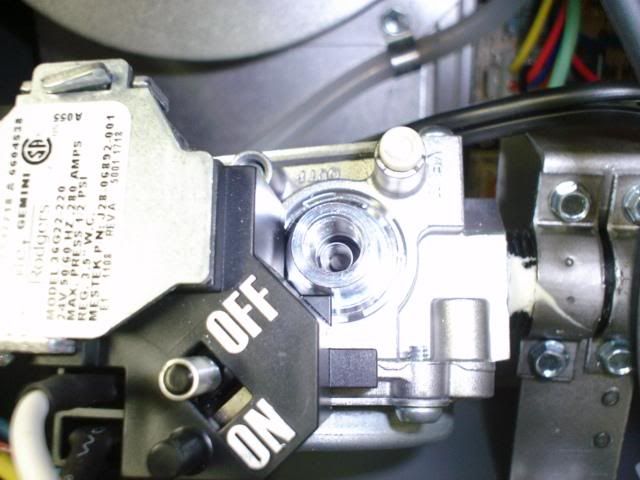
I began by removing the natural gas regulator spring and replacing it with the propane regulator spring. You can see the spring at the bottom of the spring adjusting screw bore in this photo:
Next, I installed the new propane orifice, which is about half the size of the natural gas orifice. This is a simple case of unscrewing one and screwing in the other:
After installing the new spring and orifice I turned the regulator adjusting screw in about halfway and hooked up my water manometer to the output pressure test port on the regulator:
With the heater running I adjusted the manifold pressure to specification, which is 10" of water for altitudes between sea level and 2000' MSL. Initially, I found I could not obtain sufficient manifold pressure even with the regulator screw turned all the way in.
It turns out my second stage delivery regulator pressure was set right at 11" of water, the minimum input pressure specified by Beacon Morris. I adjusted the second stage regulator outside the house up to 12-3/4" of water, which is right in the middle of the input range of 11" to 14" for most LP appliances. The regulator pressure sags down to about 12.5" of water with all the appliances turned on.
With the input pressure problem rectified I had no problem setting the manifold pressure up to 10" using my 2x4 and vinyl tubing manometer:
Closing up the heaters and sealing the flues into the wall with hydraulic cement completed the installation!
Hopefully this little post will help others with their Beacon Morris heater installations.


 Where's the 5120?