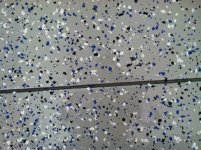
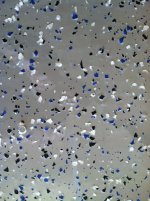
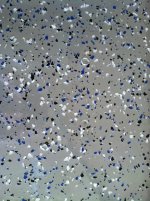
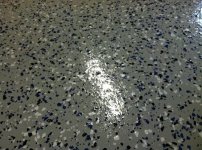
Hey everyone. Alright, after a lot of discussion about Epoxy-Coat and primers and whether or not to do it and if so what brand. etc etc (thanks to FamilyOf8Kids for being so kind as to allow the partial hijacking of his thread for that) I finally took the plunge myself.
First let me discuss what I did to prep the surface:
It was only a few years old of a concrete floor in my garage (previous owners had built the garage a few years back). No known sealant / etc on the floor. Wasn't very dirty.
I used Zep citrus degreaser to brush it down and then rinsed it down with my garden hose. Waited several days for it to dry (let's say 2 weeks. it just took me that long to get to the next part...)
I rented the Home Depot floor maintainer (what the everyman would call a floor buffer) for about $30 bucks. Also at HD I rented their Diamabrush "Concrete Prep" wheel for the maintainer for about $40 bucks. These are 4 hour rental times.. I kept it for longer so it wound up costing me ~$110 total.
That Concrete Prep wheel and floor maintainer sent me or a hell of a ride. I didn't know how to hold it right. The HD instructions said hold it at arms length - WRONG - hold it down and tight up against your waist / below your belly button.
Pull up to go one direction, push down to go the other direction. Do yourself a big safety favor and read the official producte guide. For the one I rented it was here:
http://www.clarkeus.com/~/media/Pro...shers/ClarkeUS/PDF/FM/OperatorsManual-FM.ashx
I ran the machine up and down the floor dry. It wasn't terribly dusty but I bought a $30 3M filter breather (yes it's way more expensive than the silly doctor's mask lookalike.. but these are my lungs I'm talking about here!!! comon!)
Dust didn't fly in the air too much but there was a lot of it on the ground when I was done. I took my time and just went up and down in sections until I got through all of it. If I did it again, I'd go even slower and grind down longer.
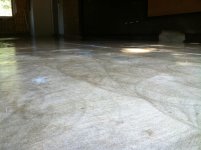
In the end I was left with a surface that felt like 100-120 grit sand paper. Nothing terribly rough but certainly not smooth.
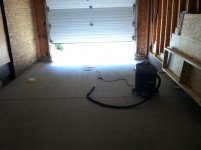
I vacuumed it up with my shop vac (cleaned off the filter a few times when I felt suction power was being lost). I used a flat floor attachment (no brushes on it) and it worked OK. I ended up vacuuming it about 4 or 5 times total over the course of a few weeks when I got bored.
If I did it over again I think I would just use a garden hose and flood it out -- but when this thought dawned on me I had already vacuued it several times and was determined not to use water on it. I swept / vacuumed a few times/ even mopped it once. After all that I even wet vac'ed it once.
I was happy with it once i got it to the point that when I passed my hand over the floor I barely had any white powder visible on my hand.
I did the vapor test (taped a clear plastic sheet (from a newspaper bag.. eh) down for 72 hours). No sign of darkened concrete or moisture. I also made sure during the wet vaccing and mopping steps where I would put water on the concrete that it would soak right in. It sure did and I didn't notice any spots that rejected the water.
Finally I was getting tired of this project not moving so I told myself "that's enough prep."
At this point the floor looked good and clean but I decided to put some Sika Flex material on two thin cracks in the floor.
Additionally I decided to put Sika Flex along the perimeter of the floor [\B] Why would I do something so crazy? Well the expansion material (the fibrous material that looks like 600 sheets of construction paper matted together) was clearly exposed along most of the perimeter wherever the floor met the foundation wall. I was worried that the fibrous expansion material would soak up water much more easily than the finished epoxy floor and that soaked up water would end up being absorbed by the concrete beneath the epoxy and that that would ultimately cause the epoxy to become detached all along the wall.
Well that was my thinking -- i'm sure many will argue against it and say I'm crazy or dumb for doing it but hey - whatever helps you sleep at night!
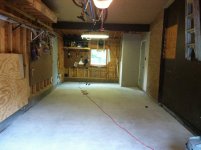
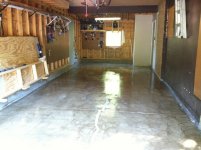
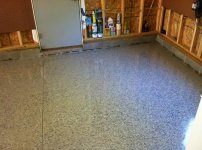
So after all that the picture below shows my prepped concrete ready to accept a coating of something.
First let me discuss what I did to prep the surface:
It was only a few years old of a concrete floor in my garage (previous owners had built the garage a few years back). No known sealant / etc on the floor. Wasn't very dirty.
I used Zep citrus degreaser to brush it down and then rinsed it down with my garden hose. Waited several days for it to dry (let's say 2 weeks. it just took me that long to get to the next part...)
I rented the Home Depot floor maintainer (what the everyman would call a floor buffer) for about $30 bucks. Also at HD I rented their Diamabrush "Concrete Prep" wheel for the maintainer for about $40 bucks. These are 4 hour rental times.. I kept it for longer so it wound up costing me ~$110 total.
That Concrete Prep wheel and floor maintainer sent me or a hell of a ride. I didn't know how to hold it right. The HD instructions said hold it at arms length - WRONG - hold it down and tight up against your waist / below your belly button.
Pull up to go one direction, push down to go the other direction. Do yourself a big safety favor and read the official producte guide. For the one I rented it was here:
http://www.clarkeus.com/~/media/Pro...shers/ClarkeUS/PDF/FM/OperatorsManual-FM.ashx
I ran the machine up and down the floor dry. It wasn't terribly dusty but I bought a $30 3M filter breather (yes it's way more expensive than the silly doctor's mask lookalike.. but these are my lungs I'm talking about here!!! comon!)
Dust didn't fly in the air too much but there was a lot of it on the ground when I was done. I took my time and just went up and down in sections until I got through all of it. If I did it again, I'd go even slower and grind down longer.
In the end I was left with a surface that felt like 100-120 grit sand paper. Nothing terribly rough but certainly not smooth.
I vacuumed it up with my shop vac (cleaned off the filter a few times when I felt suction power was being lost). I used a flat floor attachment (no brushes on it) and it worked OK. I ended up vacuuming it about 4 or 5 times total over the course of a few weeks when I got bored.
If I did it over again I think I would just use a garden hose and flood it out -- but when this thought dawned on me I had already vacuued it several times and was determined not to use water on it. I swept / vacuumed a few times/ even mopped it once. After all that I even wet vac'ed it once.
I was happy with it once i got it to the point that when I passed my hand over the floor I barely had any white powder visible on my hand.
I did the vapor test (taped a clear plastic sheet (from a newspaper bag.. eh) down for 72 hours). No sign of darkened concrete or moisture. I also made sure during the wet vaccing and mopping steps where I would put water on the concrete that it would soak right in. It sure did and I didn't notice any spots that rejected the water.
Finally I was getting tired of this project not moving so I told myself "that's enough prep."
At this point the floor looked good and clean but I decided to put some Sika Flex material on two thin cracks in the floor.
Additionally I decided to put Sika Flex along the perimeter of the floor [\B] Why would I do something so crazy? Well the expansion material (the fibrous material that looks like 600 sheets of construction paper matted together) was clearly exposed along most of the perimeter wherever the floor met the foundation wall. I was worried that the fibrous expansion material would soak up water much more easily than the finished epoxy floor and that soaked up water would end up being absorbed by the concrete beneath the epoxy and that that would ultimately cause the epoxy to become detached all along the wall.
Well that was my thinking -- i'm sure many will argue against it and say I'm crazy or dumb for doing it but hey - whatever helps you sleep at night!
So after all that the picture below shows my prepped concrete ready to accept a coating of something.