To avoid these ads, REGISTER NOW!

My New OOOOOLD Compressor

76 Regency

Member
Joined
Feb 15, 2017
Messages
19
Location
Connecticut
Hello,

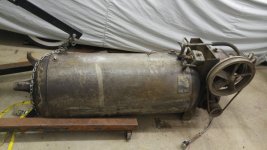
So long story short, I was given this compressor years ago and I finally have the space to use it in and so I brought it home from storage yesterday. Here are a few pics of it laying on the floor of my garage (my dad and I were too wiped out to try to lift it back up at the end of a long day).

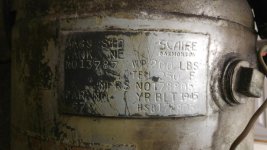
After wiping off the badges on it, I discovered it was manufactured in 1945! That explains a big part of why this thing is such a beast. It's built like a WWII tank! It's a Kellogg-American and I'm guessing the tank is 100 gallons but I haven't found a size marking yet.

Here's what I know I need to do to it at the bare minimum:

- Rewire it back to the correct 220V as a previous owner rigged it to 110V
- Fix the air line that broke off when the beast rolled over
- Clean the heck out of it and give it a nice coat of paint

I admittedly don't know a ton about compressors like this as I've only really had a 25 gallon Craftsman for the last 20 + years. Any input would be greatly appreciated it.

Thanks!
 

Attachments

  • 0305172044_resized.jpg
    0305172044_resized.jpg
    143.3 KB · Views: 182
  • 0305172044a_resized.jpg
    0305172044a_resized.jpg
    143.4 KB · Views: 199
  • Compressor.jpg
    Compressor.jpg
    96.9 KB · Views: 283
To avoid these ads, REGISTER NOW!

Strouty

Well-known member
Joined
Mar 21, 2010
Messages
38,213
Location
Southern Maine
Talking pressure vessels is almost as bad as talking about using PVC for airlines. You are going to get all kinds of advice. Hydrostatic testing of a tank is not something you can do with water and a grease gun, well you can physically do it, but it is not proper. Basically the tank is not worth doing a hydrostatic test, it will cost more than a new tank. I would inspect the inside, and make an educated guess, if you don't feel comfortable with what you see, get a new tank. If you are a gambler, use it as is. If you are like me, clean it out, then take measurements with an ultrasonic thickness gauge. If all this scares you, get a new tank. Pressure vessels are bombs if things go wrong. I am not saying things will go wrong, but they can and do, as long as you go into this with open eyes you should be fine. Another easy thing to do after your assessment is to back off the PSI so that the compressor doesn't build as much, essentially creating a safety factor on top of the original safety factor just to cover your ****.
 
OP
7

76 Regency

Member
Joined
Feb 15, 2017
Messages
19
Location
Connecticut
Talking pressure vessels is almost as bad as talking about using PVC for airlines. You are going to get all kinds of advice. Hydrostatic testing of a tank is not something you can do with water and a grease gun, well you can physically do it, but it is not proper. Basically the tank is not worth doing a hydrostatic test, it will cost more than a new tank. I would inspect the inside, and make an educated guess, if you don't feel comfortable with what you see, get a new tank. If you are a gambler, use it as is. If you are like me, clean it out, then take measurements with an ultrasonic thickness gauge. If all this scares you, get a new tank. Pressure vessels are bombs if things go wrong. I am not saying things will go wrong, but they can and do, as long as you go into this with open eyes you should be fine. Another easy thing to do after your assessment is to back off the PSI so that the compressor doesn't build as much, essentially creating a safety factor on top of the original safety factor just to cover your ****.

All good info Strouty. Like I said, I've only used a maintenance-free unit before so this is all unexplored territory for me. I emailed Kellogg to see what information they can provide for me.

Out of curiosity, what does a new tank tend to run?
 

Strouty

Well-known member
Joined
Mar 21, 2010
Messages
38,213
Location
Southern Maine
They can be expensive ($1000+), but the best way is to find a newer one that the compressor is junk, then you can use the newer tank. Even then, you will want to check things out, older tanks are generally thicker and the newer ones are engineered to be exactly what is needed for strength/safety. If the tank has been maintained, it may still be serviceable for you. Have you ever seen inside the tank? Did you drain the tank?
 

Dr Stan

Well-known member
Joined
Nov 17, 2016
Messages
496
Location
Owensboro, KY
2X on Strouty's post. Excellent advise.

As to a new tank Surplus Center has new 80 gallon tanks for
$350 + shipping. You could use these numbers as a starting point in the decision process.

http://www.surpluscenter.com/Air-Pn...0-GALLON-VERTICAL-200-PSI-AIR-TANK-4-1914.axd

Another comment. I much prefer vertical tanks as one typically will have less water in the air lines and of course it takes up less floor space. Make sure you have a high quality filter & separator system. For that I recommend Jeggs.
 

md21722

Well-known member
Joined
Nov 30, 2015
Messages
1,840
Location
Mt Juliet, TN
It might be a fun project. I would do a visual inspection of the innards of the tank for pitting, Cold War Era rust water pooling at the bottom, and ultrasonic thickness if you can. Air tanks start rusting the day they are made, so the presence of rust itself is not a problem. Chunks flaking off, etc are what you need to watch for. If it looks decent inside, go for it. I have seen more newer tanks leak and fail than old heavy industrial ones. I have a 1957 tank & on the inside it looks a lot better than a lot of others I've seen. You won't know until you look.
 

Strouty

Well-known member
Joined
Mar 21, 2010
Messages
38,213
Location
Southern Maine
To give you an idea, my tank was a 200 gallon horizontal tank. It was built in 1984 and I pulled out about 5 gallons of rust and nasty ****. After I got it all clean, I found one spot that was just under specifications that the tank manufacturer gave on the tag. It was still within specs based on the chart that pressure vessels are made by. I decided to use it, I have found another one that I will be inspecting, if it is better, I will be swapping to the newer tank. I don't trust pressure vessels, most people think that if it is rusty, it will just leak. That could happen, but it could also rupture and blow the side of your garage apart.
 

pstemari

Well-known member
Joined
Jan 7, 2012
Messages
903
Location
Seattle
I'm a bit surprised that hydro testing is prohibitively expensive. It gets done on gas cylinders all the time, and those hold a lot more pressure.

Sent from my Nexus 6 using Tapatalk
 
OP
7

76 Regency

Member
Joined
Feb 15, 2017
Messages
19
Location
Connecticut
They can be expensive ($1000+), but the best way is to find a newer one that the compressor is junk, then you can use the newer tank. Even then, you will want to check things out, older tanks are generally thicker and the newer ones are engineered to be exactly what is needed for strength/safety. If the tank has been maintained, it may still be serviceable for you. Have you ever seen inside the tank? Did you drain the tank?

This baby was given to me probably 15 years ago and it sat in storage since then...not even sure when it was used prior to that and I've yet to turn it on. The most I've done with it was load it on and off the trailer yesterday. I'll get it upright in a few days and then open the drain and see if anything comes out. I'm hoping the fact that this is built like a tank will be to my advantage and it will have lots of life left in it. The motor turns freely and the pump sounds smooth.

I believe the tank is rated at 200 PSI. Can I regulate the switch to turn on/off at a lower pressure?
 

md21722

Well-known member
Joined
Nov 30, 2015
Messages
1,840
Location
Mt Juliet, TN
This baby was given to me probably 15 years ago and it sat in storage since then...not even sure when it was used prior to that and I've yet to turn it on. The most I've done with it was load it on and off the trailer yesterday. I'll get it upright in a few days and then open the drain and see if anything comes out. I'm hoping the fact that this is built like a tank will be to my advantage and it will have lots of life left in it. The motor turns freely and the pump sounds smooth.

I believe the tank is rated at 200 PSI. Can I regulate the switch to turn on/off at a lower pressure?

Depends on the pressure switch, but probably yes. It's probably set to cut off at 175 PSI or so, which is really what you want anyway.
 
To avoid these ads, REGISTER NOW!

Strouty

Well-known member
Joined
Mar 21, 2010
Messages
38,213
Location
Southern Maine
I'm a bit surprised that hydro testing is prohibitively expensive. It gets done on gas cylinders all the time, and those hold a lot more pressure.


A true test has the tank submerged in water, it shows the distortion of the tank based on the displacement of the water. Big tank equals big bucks. When you just pump them with pressure you don't know what is happening and if it truly is safe, you just know that it held a certain amount of pressure that time, but what about next time? With a true test they see if the steel is too weak by how much it distorts, I am probably doing a terrible job explaining this. I am not an expert, but I did a lot of research.
 

redmondjp

Well-known member
Joined
Nov 25, 2014
Messages
2,318
Location
Redmond, WA
How exactly do you get inside the tank anyway to really inspect and clean it ?

You can use an inspection camera through one of the pipe ports on the tank. Some of the bigger tanks have larger pipe plugs in them which are usually rusted in place and require penetrant+heat+wrench+cheater pipe+way to hold tank from moving in order to remove. Some people just love a challenge!
 
OP
7

76 Regency

Member
Joined
Feb 15, 2017
Messages
19
Location
Connecticut
You can use an inspection camera through one of the pipe ports on the tank. Some of the bigger tanks have larger pipe plugs in them which are usually rusted in place and require penetrant+heat+wrench+cheater pipe+way to hold tank from moving in order to remove. Some people just love a challenge!

OK, that makes sense. There is a pretty big port on the side of the tank so I should be able to get in there that way.

Next question: Assuming it looks to be sound in there...what's the best way to clean it out? Do I fill it with a cleaning solution and drain it a few times over?
 

CNGsaves

Well-known member
Joined
Sep 26, 2012
Messages
13,233
Location
KS and OK
+1 to properly inspect and do your own hydro test with water/grease, as recommended by GJer's like Strouty above.

That tank IS built like a tank, back when steel quality was top notch. Remove the bung plug and put in a boroscope to inspect condition of inside tank.

Good luck with restoration.

. . . . AND . . . . do NOT turn that great compressor into BBQ grill !! ;)
 
OP
7

76 Regency

Member
Joined
Feb 15, 2017
Messages
19
Location
Connecticut
+1 to properly inspect and do your own hydro test with water/grease, as recommended by GJer's like Strouty above.

That tank IS built like a tank, back when steel quality was top notch. Remove the bung plug and put in a boroscope to inspect condition of inside tank.

Good luck with restoration.

. . . . AND . . . . do NOT turn that great compressor into BBQ grill !! ;)

Thanks! I will definitely do the boroscope inspection.

Does anybody have any instructions on performing a water/grease test?

I have NO plans of making this thing into a grill LOL. If all else fails, it's going to the scrap metal yard. With the weight of this beast, it has to be worth something!
 
OP
7

76 Regency

Member
Joined
Feb 15, 2017
Messages
19
Location
Connecticut
Some good news. My friend and I were able to get the compressor upright with the much needed help of an engine hoist. In the process, a tiny bit of water dripped out of the outlet port. I'm happy to say that the water was crystal clear and did not have a hint of rust. I plan on buying a borescope to get a good look inside but for right now, it's off the floor and when time allows, I can start playing around with it.

Question for you guys: Do any of you see any problem with the fact that it was laying on its side for a week? I'm hoping I won't have any issue with oil getting into the cylinders or anything along those lines.
 

bob15

Well-known member
Joined
Dec 8, 2011
Messages
6,863
Location
Northeasten, CT
Oil might have seeped, into the cylinder; but, standing it back up can also allow the oil to flow the other way as well. Turn the compressor over by hand will tell you if it is hydraulically locked or not.

I wouldn't be too concerned with the age of the tank, especially if it looks clean inside. the older tanks (including propane tanks) used heavier/thicker steel than that of today. My compressor tank is a 1944 model with the walls being .184" thick and the heads being .187" thick. That is just under 3/16" thick.

I would also like to know where a compressor of that output and American-made can be had for $400...new. Duckface, care to elaborate..........
 
OP
7

76 Regency

Member
Joined
Feb 15, 2017
Messages
19
Location
Connecticut
Oil might have seeped, into the cylinder; but, standing it back up can also allow the oil to flow the other way as well. Turn the compressor over by hand will tell you if it is hydraulically locked or not.

I wouldn't be too concerned with the age of the tank, especially if it looks clean inside. the older tanks (including propane tanks) used heavier/thicker steel than that of today. My compressor tank is a 1944 model with the walls being .184" thick and the heads being .187" thick. That is just under 3/16" thick.

I would also like to know where a compressor of that output and American-made can be had for $400...new. Duckface, care to elaborate..........

Thanks Bob,

I was thinking the same for the oil seeping back down and it does turn freely so it's definitely not locked. Like I've said, I will definitely get a scope to get a good look inside but from the clarity of the water that dripped out combined with the grade of steel this entire setup is made from, I'm getting more and more confident that it will be good to go. This is a project that's going to have to wait a little bit until I get through some others but at least it's in my garage now and mostly out of the way. I'll tinker with it in time and start cleaning it up.

Any idea how much the motor and pump might weigh? I would like to remove them for cleaning/painting and closer inspection but I'm afraid they're going to way a ton as I'm sure everything on this unit does.
 
OP
7

76 Regency

Member
Joined
Feb 15, 2017
Messages
19
Location
Connecticut
Here's a great perspective shot of the "new" compressor next to my Craftsman. Mind you, the Craftsman is about 6 inches off the ground on a platform (makes a great parking space for my floorjack!
 

Attachments

  • 0319172106_resized.jpg
    0319172106_resized.jpg
    144.8 KB · Views: 43
OP
7

76 Regency

Member
Joined
Feb 15, 2017
Messages
19
Location
Connecticut
I just picked up a scope that plugs into a smartphone or PC. I haven't broken it out yet to inspect the compressor but plan to very soon.

In the meantime, I did work up the courage to plug the compressor in and she fired right up. It sounds GREAT already! As I believe I mentioned before, somebody rewired it to 120V so it's not running on full power yet but even with only 1 (very worn and loose) of the 2 belts in place, the pump does turn. The outlet port on the side of the tank broke off when we were loading the compressor unfortunately so I'll have to take care of that but there was a bit of air coming out so I'm very optimistic that this baby will be running my Garage-Mahal in due time!
 

wagon

Well-known member
Joined
Oct 20, 2014
Messages
201
Location
calif
You can try your LWS to see if they'll do the hydro test on it. They, or whoever fills their cylinders, have to test their tanks routinely.
 
To avoid these ads, REGISTER NOW!
Top Bottom