To avoid these ads, REGISTER NOW!

Need advice on fixing a sagging/drooping roofline

F16CrewChief

Well-known member
Joined
Feb 14, 2013
Messages
104
Location
Kenova, WV
So I bought a fixer upper house. It has a sagging/drooping roofline on an addition. I talked with a neighbor who watched this addition get built in the 1970's and he even told the guy it would sag. So it has been sagging for the past 40 years! Now its my problem and I am needing a new roof, looking to go with a metal roof. Might as well fix it now versus later (instead of having to shim 6 inches in the middle!) here is some pictures
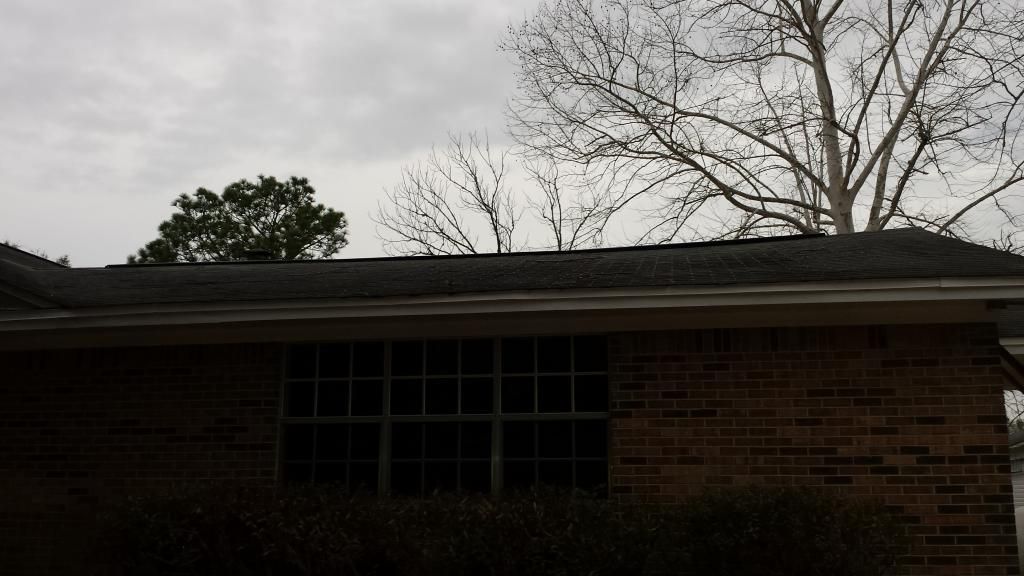


Yes these are probably poorly built homemade rafters. Here is a better design from paint.


Now, I have an idea on how I could fix it, but it might sound sketchy to professionals. Run multiple stinglines across the shingles for straightness. Then beginning on the endwall working inwards, begin one by one, take a floor jack with a 4x4 and fixture made to securely hold onto the sagging roof rafter, unscrew the braces, jack rafter up until it meets stringline outside, then measure and screw in a brace that goes between the rafters rather than nailed to the outside like the builder did.

I am sure this addition was done by the "6-pack" construction crew. This ceiling was an vaulted ceiling, but my wife wants to go with a tray ceiling, which would allow for lowering of the ceiling to allow more bracing installed. Any schematics added would be helpful!
 
To avoid these ads, REGISTER NOW!

Elginz

Well-known member
Joined
Dec 29, 2014
Messages
431
Location
Oconto, WI
If you insist, do your thing to get it straight, and then sandwich it with OSB or plywood, offsetting the joints, glue it and and nail it.
 

CNGsaves

Well-known member
Joined
Sep 26, 2012
Messages
13,233
Location
KS and OK
On episode of This Old House they were fixing old brownstone with structural problems similar to yours. They put in big LVL header across the span and attached to what was there.

In your situation, you'd knock hole in end of house and slide the LVL beam across and build supports on each end while jacking the whole thing up.

/{.02 idea for sagging roof}
 
OP
F

F16CrewChief

Well-known member
Joined
Feb 14, 2013
Messages
104
Location
Kenova, WV
But......the end wall has a 6 ft French door in the middle. I would think the door header would not be able to support a LVL beam. And to be able to install the LVL beam, I figured I would need to build temporary support walls 36" off center on both sides to support the ridgeline while I cut out the center to install the lvl beam, but even that doesn't fix the sagging 2x4 going sideways to the walls.
 
Last edited:

bczygan

Well-known member
Joined
Nov 4, 2009
Messages
22,002
Location
DETROIT! Arsenal of Scrappers
But......the end wall has a 6 ft French door in the middle. I would think the door header would not be able to support a LVL beam. And to be able to install the LVL beam, I figured I would need to build temporary support walls 36" off center on both sides to support the ridgeline while I cut out the center to install the lvl beam, but even that doesn't fix the sagging 2x4 going sideways to the walls.

The header over the french door is solved by installing a beam above it that carries and transmits the LVL loads around the french doors and down to support from the foundation.

Or you can replace the existing header with one sized to do the same thing.

The big question is do you need or want any kind of a vaulted ceiling.

You said your wife wanted a tray ceiling. For what purpose? How big? How tall?

How many layers of shingles do you have? And what type? What is the decking material?

Are you definitely going with metal?

Do you intend a ceiling? What material?

What use will this space have? Will the ceiling be insulated? Storage?

You know what you have, and that it's load carrying capacity is unknown. Plus the excessive deflection of that 2x4 rafter is telling.

Do you have any swayback in the ridge board? Do you have any bowing of the walls or fascia at the eaves? Sight along the fascia or place a straight edge along it.

What you are proposing can work. You are basically reworking the homemade scissors truss that was poorly constructed. You will need more intermediate members and more and better fasteners. Perhaps cladding one or both sides of each "truss" with glued and screwed plywood can aid in this.

Bill
 

nolimits76

Well-known member
Joined
Jul 11, 2013
Messages
959
Location
Oklahoma
The first house I bought had some weird issues like that. During the inspection I pointed it out and the inspector wrote in his report it had to be fixed. I forget the specifics now, but it came down to the trusses being undersized and not spaced close enough for the span it was supporting (inside was a very tall vaulted ceiling).

Since the unit had a new roof on it, the sellers opted to have a contractor come in and rip out the ceiling which exposed the trusses. They installed new larger sized trusses on the centering recommended by the engineer.

I really had my doubts it would work, but had the option to walk if I didn't like the repair work. When it was all said and done it came out perfect and fixed the sag. The sellers were PO'd they had to fix but I didn't really care. Rather it was me or someone else buying, it was still an issue that needed resolved.

Anyhow, I bought the house. I moved a couple years later and it was still good. Fast forward about 10 years down the road and I drove by the house just for memory sake and the roof was still solid.
 
OP
F

F16CrewChief

Well-known member
Joined
Feb 14, 2013
Messages
104
Location
Kenova, WV
The header over the french door is solved by installing a beam above it that carries and transmits the LVL loads around the french doors and down to support from the foundation.

Or you can replace the existing header with one sized to do the same thing.

The big question is do you need or want any kind of a vaulted ceiling.

We wanted to keep the vaulted ceiling for resale purpose "if it came to that because with such a big room and only an 8ft ceiling would be too simple?

You said your wife wanted a tray ceiling. For what purpose? How big? How tall?

The Tray ceiling would be an rectangle in size spanning the center for most of the length of the middle. Big enough to have ceiling fans in

How many layers of shingles do you have? And what type? What is the decking material?

One layer of shingles, standard type? Decking is most likely 3/8 plywood NOT OSB!

Are you definitely going with metal?

Yes due to wind resistance for hurricanes

Do you intend a ceiling? What material?

Sheetrock

What use will this space have? Will the ceiling be insulated? Storage?

This room is heated/cooled. It is a great room addition built onto the existing 1940's original structure. Looking at it, it would seem as an oversized garage that was enclosed, and fireplace installed.

You know what you have, and that it's load carrying capacity is unknown. Plus the excessive deflection of that 2x4 rafter is telling.

Do you have any swayback in the ridge board? Do you have any bowing of the walls or fascia at the eaves? Sight along the fascia or place a straight edge along it.

There is no sidewall deflection visibly seen. The sidewalls are wood structure with brick outside. Couldn't I simply run 4 cables across the top of the sill walls to hold the walls inplace so that when I lift up the sag it doesn't allow the walls to deflect outwards?

What you are proposing can work. You are basically reworking the homemade scissors truss that was poorly constructed. You will need more intermediate members and more and better fasteners. Perhaps cladding one or both sides of each "truss" with glued and screwed plywood can aid in this.

Cladding....Is this defined as placing plywood down the roof rafter and ceiling rafter together to form like an engineered beam? Using the strength of the plywood along the length to prevent one board from bowing?
 

Elginz

Well-known member
Joined
Dec 29, 2014
Messages
431
Location
Oconto, WI
The yellow tie in your drawing would be removed, shortened, and placed up a couple of inches to fit in just above the bottom cords. A sheet of plywood on each side cut to match the roof would be glued and screwed as they say. I would get a lot of use out of my nail gun. If you are not vaulting the ceiling leave the plywood hang down and put a tie at that point, and then to the shape of the tray. The idea is that the plywood is the truss plate. Yes Cladding. You will want to remove the shingles before re-roofing because of the weight.
If you are putting in an LVL, add in bigger top cords. How much do you want to do, of course the best thing would be to remove it all and put in real trusses.
 
Last edited:

Elginz

Well-known member
Joined
Dec 29, 2014
Messages
431
Location
Oconto, WI
"Do you have any swayback in the ridge board? Do you have any bowing of the walls or fascia at the eaves? Sight along the fascia or place a straight edge along it.

There is no sidewall deflection visibly seen. The sidewalls are wood structure with brick outside. Couldn't I simply run 4 cables across the top of the sill walls to hold the walls inplace so that when I lift up the sag it doesn't allow the walls to deflect outwards?"


If there is a bow in the ridge line there should be some in the eaves. I have jacked up cracked rafters, and floor joist laminating another cord to them, it will not work in a truss situation, and jacking them up with out rebuilding them would not solve the sag in the ridge line.

Support them, separate the bottom cord from the plywood, jack it up, put in the tie just above the bottom cord, put in a tie at the point of the highest ceiling part of the tray, Glue all members to the new plywood and nail or screw like crazy. Do not put a joint in the plywood at the same point as a joint on the truss members. The center piece of plywood would look similar to the one that is there.

The other option is to do as above on one side and add new cords on the other side. Plywood in the middle. Nailing the new cords though the plywood into the old cords, glued of course. I have done it, and seen it done both ways.
 

redmondjp

Well-known member
Joined
Nov 25, 2014
Messages
2,318
Location
Redmond, WA
I've just spent the past few hours doing online research on roof trusses (yes, you know it, trying to figure out how to raise the ceiling in the garage for my lift), and all I can say is wow! This rafter system (can't call it a truss design because it isn't, unless it was once and they were cut apart) appears to be seriously undersized! It's no wonder the roof is sagging.

I'd add an LVL ridge beam if you want to save what is there but that will be a lot of work and will require a proper structural design. I can't see the existing rafters (which appear to be 2x4s, are they?) working at all in their current configuration.

Otherwise (and I'm completely serious about this), I would strip the entire roof off down to the walls and have the truss company deliver some new, properly-designed engineered roof trusses to the rooftop with their crane. A good builder can have the trusses set in place and tacked in a couple of hours, and sheathing/tar paper over the whole thing on the same day. That's going to be way easier and faster than trying to properly fix the mess you have there IMO.

What about permits and local building inspectors? That is a key question.
 

rsanter

Well-known member
Joined
Dec 22, 2007
Messages
18,492
Location
visalia ca
I also think that the best option is replacing with engineered trusses. You said you want to keep the vaulted ceilings. You can order engineered trusses that are vaulted that will be better structured than what you have.

I like metal roofing. Be sure you get something that has a baked on cool,roof coating to help keep out the Suns heat. I would also so a foam spray in insulation while you are in there

Bob
 

jkwilson

Well-known member
Joined
Dec 5, 2012
Messages
758
Location
SW Indiana
I think you may be closer a tear down than you know.

When structural members are nailed together, if one of them changes shape, something else has to change too. Think of a square made of boards, You can't make one of them shorter or longer without changing the angles or lengths of the other boards.

Your first order of business should be to make sure that your walls are still plumb. If they are, you can proceed directly to fixing the roof. If they aren't, you need to weigh the cost of a complete rebuild with a repair.

The fact that the top chords have bowed and the roof is sagging means that the bottom chords are under significant tension. That assumes they haven't ripped the nails out of one end because of the tension. They are being pulled like a cable from the ends by the weight of the roof. They could fail in violent and dangerous ways. Since you know that the trusses weren't properly designed, you can't count on any feature of the trusses having been done properly.

I would be planning on pulling the whole roof off and putting in new and worry-free trusses. It is probably less of a job than you might imagine.
 

volleyball

Well-known member
Joined
Aug 29, 2011
Messages
4,127
Location
NY, not NYC
You are planning a new roof. You want to change the style of the roof. You have a french door in the middle on the endwall.
I agree to ripping off the roof and bad trusses. I had though of just sistering some 2 x 8 to the trusses and being done but with a metal roof, you don't want to disturb it if there is a future problem.
New trusses will solve that plus you can get them framed to work with your new ceiling. Something that won't flex and cause constant cracking that you will get with this poor attempt at trusses.
I would also put 4" foiled faced hi density foam panels on top of the trusses as insulation under the metal. You will be amazed at the difference.
Bite the bullet now, you will be glad you did.
 

David C

Well-known member
Joined
Mar 10, 2014
Messages
157
Location
Northern California
With shallow trusses the forces in the truss members and connections can become very high. Your trusses are shallow and the truss members are 1x material that is probably does not have a structural grade.

The connections appear to be nailed and nails do not have a very high value in think 1x material.

If this were my building I would run a calculation on the trusses and get the member forces and connection requirements and determine if a repair (that complies with codes) is even possible.

Alternate repairs are new trusses or a beam as someone else suggested. These solutions are likely onerous to you. While the objections to new trusses is obvious the beam solution presents these problems:

1. How to install the beam inside the trusses. (Your requirement was to keep the elevated ceiling height)

2. How to support the beam. The support could be a cross beam somewhere within the ceiling framing but ultimately the beam, or beam system, forces will need to go to ground. You would need posts and probably new foundation.

Someone else mentioned looking at your walls to see of the failing trusses are pushing your walls out of plumb. You would want to fix this because it could cause you more problems as the displacement increases.

You could get someone to make your truss calcs for you and make recommendations for site built repair but it will likely cost you. It isn't just the initial calculation but that you will want to vet each repair design and that takes the designer time to walk you through every option.
 

Chilliwack Murray

Well-known member
Joined
Dec 10, 2012
Messages
1,501
Location
Chilliwack BC
I agree with others who suggest replacing with engineered trusses. Too many unknowns with what's there now, you'll never know for sure if you can trust it.

If time with the interior exposed is an issue and you have the space, you can build the entire roof structure in one or more pieces on the ground ahead of time. Once it's ready, remove the old roof structure and have a crane truck lift the new one on. I'm pretty sure this would be the quickest repair and probably on par if not less than beams.

I put my shop up this way (new construction mind you) and placing the roof took only about 30 minutes.

I think you'd have a hard time getting a permit or getting the building inspector to buy into any other repair of what you have.

Just my opinion mind you, I'm a mechanic, not a builder.
 

volleyball

Well-known member
Joined
Aug 29, 2011
Messages
4,127
Location
NY, not NYC
You know, while you're at it, those famous last words, you could build the walls higher and make that a taller room, maybe a couple feet taller.
Being a slab on grade, and the room gutted it doesn't look like there would much to get damaged if you had the roof off and got a little water in it.
 

TLCObsession

Well-known member
Joined
Aug 30, 2011
Messages
328
Location
Bellingham, WA
You know, while you're at it, those famous last words, you could build the walls higher and make that a taller room, maybe a couple feet taller.
Being a slab on grade, and the room gutted it doesn't look like there would much to get damaged if you had the roof off and got a little water in it.

You would want to get a raised heel, scissor truss if you were doing this.
 

APEowner

Well-known member
Joined
Oct 2, 2009
Messages
4,164
Location
Sunny, New Mexico
You're replacing the ceiling, and the roof and the existing rafters need significant reinforcement so all you're saving by not tearing it all off is the sheathing.

Personally, I'd rip it all off and do it right.
 

Paul1956

Well-known member
Joined
Oct 22, 2013
Messages
488
Location
San Antonio, TX
Not enough structure supporting the span and after 40 years
the bow is set well in place.

Get an engineer to determine out what is needed for remedy
and follow that recommendation.

BTW, while you are at it make the garage bigger! :)
 
To avoid these ads, REGISTER NOW!

CNGsaves

Well-known member
Joined
Sep 26, 2012
Messages
13,233
Location
KS and OK
OP. . . . I overlooked you were in Florida so curious whether you have to meet "hurricane wind" build requirements that would require metal strapping from rafters/trusses to walls, etc.?? A whole roof tear off likely would force this on you if so. Not sure new standards would be forced on you with interior fix with beam . . possible grandfathered in?? You might do them anyway?? :dunno:

Also, in pictures I don't see any passive or rotary vents to remove heat from the roof?? Are there any on the back side?? Is there gap above the vaulted ceiling for both insulation and air gap?? Venting and insulation will play a part in how you ultimately fix your sagging roof.

Lastly, not sure I see a cricket on uphill portion of roof above the fireplace?? Do you have cricket to shed water around the fireplace??
 

David C

Well-known member
Joined
Mar 10, 2014
Messages
157
Location
Northern California
CNG brings up something else for you to consider.

Notice the cross section of your roof as you sketched it. It resemembles the shape of an airfoil, something you likely have experience with.

Wind across your roof would increase in velocity do to the pitch and a lower pressure over the upper roof surface would be the result. Lower pressure on the upper roof surface, standard pressure inside, lift.

If you keep your roof framing system you might explore the use of Simpson hurricane ties to attach your roof framing to your wall. Anthing you would add beyond the roof to wall attachments would be better.

Sorry you asked for advice yet?
 

why worry

Well-known member
Joined
Oct 3, 2014
Messages
301
As others have said the walls could be an issue, If they are then at some point this could become a total replacement including the foundation depending on what the AHJ had to say about bringing it up to current codes.
 
OP
F

F16CrewChief

Well-known member
Joined
Feb 14, 2013
Messages
104
Location
Kenova, WV
Errr.....a complete tear off was not really what I wanted to do. ;/ I was hoping on a quick fix. But I understand too do it right the first time. Im going to have to gather together a metal roof quote to see how much that's going to run me, so that when the roof structure is worked on one week, I can have metal roofers scheduled for the week following.

Um, yeah, I will most likely get screwed into having to comply with Hurricane regulations. But its sad because this place took a direct hit from Ivan in 2005 and only a few shigles flew off. I have only gotten half the ceiling down. I am working this week after work getting the other half torn off. Once I get all the old sheetrock off, ill post some more pics. ROOF IS ATTACHED WITH METAL STRAPS.....for CNG GUY

Next question is.....how do I check for straightness of a wood wall with brick outside? I mean visually it looks fine. Unless measure across the room at different areas to check for same measurement.
 

redmondjp

Well-known member
Joined
Nov 25, 2014
Messages
2,318
Location
Redmond, WA
Next question is.....how do I check for straightness of a wood wall with brick outside? I mean visually it looks fine. Unless measure across the room at different areas to check for same measurement.

Use at least a 4' long level (better if a 5' or 6' but I know those are harder to come by) to check the walls for out-of-plumb, inside and out (or hang a plumb bob and then measure from string to wall at top and bottom). Then, yes, use a tape measure to check side-to-side and also you can go from corner to corner (2x) to see if you have a rectangle or a parallelogram.

You can also run a horizontal string line from end to end in the room and measure from that to the wall. Lots of ways to skin a cat! I'm old-school, and I bet there are a dozen better ideas using newer technology as well (laser sights, etc) that I'm not proficient with.

Thanks for keeping us updated! Any word on what the local building inspector/AHJ requires, or have you contacted them for advice yet?
 

Orionrising

Well-known member
Joined
Nov 16, 2012
Messages
960
Location
Western Maine
meh if you are stripping it bare from the underside any it would take longer to pull the old roof then replace it really, trusses go in that fast, defiantly get some quotes on it.
 

volleyball

Well-known member
Joined
Aug 29, 2011
Messages
4,127
Location
NY, not NYC
So what kind and color metal roof are you going for? A lot of the colors they stock are bright and not really residence friendly. Even the darker colors are reflective. Are you doing the whole house?
 

bczygan

Well-known member
Joined
Nov 4, 2009
Messages
22,002
Location
DETROIT! Arsenal of Scrappers
Your decisions are going to be driven by budget, how long you intend to occupy the property, resale value, insurance considerations, whether you want to get permits etc.

Get an 8' level or one just a little shorter and check walls inside for plump everywhere. Put a long straightedge on the fascia on both sides. Take a straightedge to the underside of rafters and joists too.
some deflection is OK, say 1/240 of span.

One thing you can do to help when you put new drywall up, is to use the lightweight drywall.
 

jnkpile

Well-known member
Joined
Feb 13, 2014
Messages
154
Alright, I brightened up on of your pictures to better see the ridge line.
ImageUploadedByTapatalk1421196806.107052.jpg
To me, in this picture the soffit and fascia appear straight and unaffected, and the point at which the ridge meets the older roof appears to be lower than the gable end. This makes me question if the roof is really sagging at all? Maybe each rafter was cut slightly different/shorter, It's possible the builder didn't keep the original truss as a pattern and built the next truss off the last one he made? Effectively creating the "sag" we see..... Maybe?
 
Last edited:
OP
F

F16CrewChief

Well-known member
Joined
Feb 14, 2013
Messages
104
Location
Kenova, WV
Thats what I have been wondering......im going to try and fix whats there and worst case, ill just have to tear down the whole thing. I will be running string lines across and figuring stuff out. As to BCZYGAN question, it appears as the end truss and the #1 beside it were built fine, but as the builder downed some beers, tbe angles could have gotten sloppy resulting in the visual sag.

Im going to post a picture soon of the whole ceiling torn down and cleaned to visualize whats going on up there.

Oh someone asked about permits etc........I consider this a minor repair! Lol.
 
OP
F

F16CrewChief

Well-known member
Joined
Feb 14, 2013
Messages
104
Location
Kenova, WV
Metal roofing question.......ive still need to call and get quotes. Ive got 4 contractors to call, its just a matter of getting time at work to call
 

Criss

ALLIANCE MEMBER
Joined
Apr 21, 2012
Messages
262
Location
Western PA
There are a couple ways to go.
1. Just have new tray trusses engineer. Simple we do it everday.
2. It would take to long to type but if you go this route pm and we can talk. Cut new rafter that will run directly alongside of the sagging rafters these will ride above the current rafter and eliminate the sag, increase the load rating of the roof and really beef things up. Use your string method, cut a birds mouth at the wall, tie into the ridgeboard.
3. I would not recommend jacking up and making new osb plates. We do this on repairs of damaged trusses but it's not really applicable here.
4. Going with a tray ceiling is also going to structurally help you roof by increasing it's load handling and resisting future sagging.
 
Last edited:

CNGsaves

Well-known member
Joined
Sep 26, 2012
Messages
13,233
Location
KS and OK
OP . . . think you need to get up on roof and run stringline between the two ends of roof and see how much sag in reality.

Thinking outside box . . . since you sound intent on putting on full metal roof . . . . . maybe make your best efforts of jacking up sagging rafters and strengthen with rafter ties/gussets. If still inch or so sag left in middle of roof, then shim the sheeting on top to level everything up before you install the metal roof. I'm guessing your metal roof will be 50 year life and never need new one in your lifetime. This could be low cost workaround as sounds there won't be any new weight loads on underside of roof, especially if you use lightweight sheetrock for your ceiling.

Completely removing all roof, and even my LVL beam idea seem overkill if your house has already survived one hurricane. Honestly, I've seen much worse sagging roofs and they just kept using them as is, but of course only one layer of comp shingles. Good luck.
 

CTyankee

Well-known member
Joined
Jan 13, 2013
Messages
3,792
Location
CT
JMO, Since you intend on re-doing the roof, I'd rip it all off and reframe.

The valley where the addition meets the main roof looks really strange in the picture jnkpile posted. What's up with that?
 

bczygan

Well-known member
Joined
Nov 4, 2009
Messages
22,002
Location
DETROIT! Arsenal of Scrappers
Thats what I have been wondering......im going to try and fix whats there and worst case, ill just have to tear down the whole thing. I will be running string lines across and figuring stuff out. As to BCZYGAN question, it appears as the end truss and the #1 beside it were built fine, but as the builder downed some beers, tbe angles could have gotten sloppy resulting in the visual sag.

Im going to post a picture soon of the whole ceiling torn down and cleaned to visualize whats going on up there.

Oh someone asked about permits etc........I consider this a minor repair! Lol.

Just a note. If all the homemade pseudo trusses were constructed the same way, as they probably were, and all were inadequate to support the loads properly, then here is what happens to the structure.

All the roof framing tries to push the side walls out. Think of the side walls as beams in a horizontal plane, resisting these spaced point loads. Near the middle of the span of this beam and the middle of the wall, the deflection is greatest, and the walls pushed out the most. At either end, the deflection is the least, and the force is resisted by the end wall at the gable end.

So the roof develops a sway back and the side walls bow out. If the "trusses" aren't well fastened to the side walls, then they move out independently of the walls, creating a curve in the fascia instead.

I suspect that this is he case here.

The garage roof I see across the street out my side window has exactly the same problem, but the walls bow out with the rafters. And the ridge board has split as well.

Let me know what you find.
 

why worry

Well-known member
Joined
Oct 3, 2014
Messages
301
If your looking for outside the box thinking and the walls end up being straight or reasonably so, then you could string a new ridge, rafters and sheeting over the old one.

I did it on an exposed decking and beam ceiling. Came out really nice with a metal and was able to add an additional 4" of foam insulation to boot.
 

volleyball

Well-known member
Joined
Aug 29, 2011
Messages
4,127
Location
NY, not NYC
In the picture, where the bow is, you see a face nailed 1x so the lumber is not carrying the load, the nails are. Maybe you could turn them into a decent truss just like you can probably straighten out just about any smashed fender on a car but how much work and will it ever be as good? Not likely.
Use the old trusses as the purlins for the new metal roof. That's savings makes it an economical decision
 
OP
F

F16CrewChief

Well-known member
Joined
Feb 14, 2013
Messages
104
Location
Kenova, WV
Well I ran string lines....bout an 4" drop in the worst area. I tried working from one end towards the middle jacking. All I managed to do was push up on one section, the decking still bowed in between the rafters and also the rafter cracked. So I sistered in a 2x6 beside it and tried lifting the 2x6, all that did was push up past the ridge plate. So I called back the contractor who came by while I was at work and asked if I just left it alone, could he shim the sag and he said yes. So im just going to leave it like it is and put things back together.

Next question, for roughly 39 sq, does 13,500 seem steep for a metal roof install in Florida?
 
To avoid these ads, REGISTER NOW!
Top Bottom