To avoid these ads, REGISTER NOW!

Need help with some electrical work in shop...

OP
S

Smarthomes.Cal

Well-known member
Joined
Oct 27, 2023
Messages
47
Location
Seattle Wa.
This is a long shot and I've never seen it done...but if your main panel has less than six breakers in it, it's fine. It's called the six throw rule, meaning that everything can be shut off with six or fewer throws of handles. The sub panel needs a breaker, so if you currently have six breakers, that seventh will put you over. I can't see a main panel getting installed like that, that's why I stated it's a long shot, but anything is possible. Like I stated earlier, everything is speculation until pictures are up.
Yes sir, I've never seen a main panel wired up like this....
When I looked at it I felt something was wrong....
No disconnect.....anywhere.....No Earth Ground...Anywhere....Sub panel Jacked up off of the main lugs with no disconnect between them anywhere......neutral going to the ground, jumped over to the neutral bar inside the sub.....
Jeeeze......

I will get you pics. A.S.A.P. ...Thank You for all your help sir....
 
To avoid these ads, REGISTER NOW!

justsam

Well-known member
Joined
Aug 20, 2010
Messages
1,271
Location
Penngrove, California
How old is this building and what is the service being brought into it from the Power Company? Are there just the two panels, the main and the sub? Are you sure the main does not have some form of ground such as water pipe, rebar Ufer type ground etc?

As others have stated, you need to resolve the lack of ground in the main panel if it is not there.

If all you need is 240 at the sub, lift the bond from ground to neutral as you will have no neutral here. Use the old neutral wire as the ground conductor and connect to ground at the sub panel and to ground at the main. Neutral and ground should be bonded at the main only.
 

Bert_

Well-known member
Joined
Dec 24, 2016
Messages
9,856
Location
NW Iowa
This is what had me confused.....
If there was a fault...that would mean that it would go back through the neutral wire instead of the ground ( Which Ain't there", and from there back to the meter instead of the ground where it should go....

This is where I am or was maybe still confused about....What happens to the fault current now that there is no ground....

Need a little correction here. Fault current wants to go back to the neutral at the transformer. This is why the main panel is grounded. A ground rod, ect doesn't carry fault current.
 

Bert_

Well-known member
Joined
Dec 24, 2016
Messages
9,856
Location
NW Iowa
Yes sir the sub and the feeder wires are both shoved under the lugs together....along with the neutral wire coming from the meter...shoved under the lug sharing room for the sub panel wire as well.....with no disconnect anywhere...

Can you clarify this? The sub panel has no breaker/disconnect?
 
OP
S

Smarthomes.Cal

Well-known member
Joined
Oct 27, 2023
Messages
47
Location
Seattle Wa.
How old is this building and what is the service being brought into it from the Power Company? Are there just the two panels, the main and the sub? Are you sure the main does not have some form of ground such as water pipe, rebar Ufer type ground etc?

As others have stated, you need to resolve the lack of ground in the main panel if it is not there.

If all you need is 240 at the sub, lift the bond from ground to neutral as you will have no neutral here. Use the old neutral wire as the ground conductor and connect to ground at the sub panel and to ground at the main. Neutral and ground should be bonded at the main only.
Thank you very much...That clears up the question I was having going through my head....
Thais makes all the sense in the world now.... switch that neutral at the main to the grounding lug and lift the bonding jumper at the sub.....
Wow.....I am so grateful for the help, now maybe I won't look like a bumbling goof ball Monday....
You have a great weekend .....and Thank you once again....
 
OP
S

Smarthomes.Cal

Well-known member
Joined
Oct 27, 2023
Messages
47
Location
Seattle Wa.
Thank you very much...That clears up the question I was having going through my head....
Thais makes all the sense in the world now.... switch that neutral at the main to the grounding lug and lift the bonding jumper at the sub.....
Wow.....I am so grateful for the help, now maybe I won't look like a bumbling goof ball Monday....
You have a great weekend .....and Thank you once again....

Yes I'm sorry, the building is brand new....the service is new....No ufer...No pipes....

That message you just gave me cleared everything.....
Between everyone helping me and this last message from you, this put the Icing on the cake.....

I will be back in touch.....Thank you.....
 
OP
S

Smarthomes.Cal

Well-known member
Joined
Oct 27, 2023
Messages
47
Location
Seattle Wa.
Need a little correction here. Fault current wants to go back to the neutral at the transformer. This is why the main panel is grounded. A ground rod, ect doesn't carry fault current.
I know this might be a dumb question, but if fault current goes back on the neutral, why do we even have a ground wire, and ground rods...
Please if you would explain to where I can actually understand this....I would be grateful....
 

nadogail

Well-known member
Joined
Jan 23, 2009
Messages
32,205
Location
Coronado, CA
I know this might be a dumb question, but if fault current goes back on the neutral, why do we even have a ground wire, and ground rods...
Please if you would explain to where I can actually understand this....I would be grateful....
There is a Safety Advantage of having both an Equipment Grounding Conductor (Green Wire) and a Grounded Conductor, or Neutral, (White Wire) in our electrical installations.
 

Max

ALLIANCE MEMBER
Joined
Jun 16, 2018
Messages
3,384
Location
Georgia
I know this might be a dumb question, but if fault current goes back on the neutral, why do we even have a ground wire, and ground rods...
Please if you would explain to where I can actually understand this....I would be grateful....
Fault current should never go back through the neutral wire. Any fault current goes back through the ground wire only, and it should never carry any current in normal operation.

It may help for some background:

240V system only:
- Two hots on different phases to give you 240V. The return path for current for each hot wire is the other hot wire. Hey, welcome to alternating current on different phases. :)
- One ground wire for fault currents. For example, say inside your welder one hot wire gets shorted to the welder case. You'd much prefer to have that hot/ground short trip the breaker instead of electrocuting you when you touch the welder case.

120V system only:
- One hot (could be either phase) for 120V
- One neutral that serves as the return current for the 120V hot.
- One ground wire for safety.

Where things get interesting is that sub panels are generally 240V in, so two hot wires on different phases. A ground wire to the sub panel is also required. As noted earlier, a neutral is required for sub panels in the same building. However, if, and only if, you only have 240V breakers and equipment hooked up to that sub panel then the neutral is required by the NEC but it isn't used for your equipment.

Most panels (all?) will support 120V or 240V breakers. A 240V breaker will have two contacts so you can connect up each hot phase. A 120V breaker will have a single hot phase and it will rely on the neutral for the return current path.

If it was me, I'd replace the 30' of wire to the sub panel with the right gauge and type of wire. Use 4 wires (2 hots, neutral, ground) and hook them up appropriately at both ends.

I should add that if you're using the right type of metal conduit, you can use the conduit yourself for the ground connection. This is OK according to the NEC, but it does require that the conduit be installed and connected properly. Personally, I've seen enough damaged or poorly installed conduit in my life that I prefer to run a ground wire even if I am using EMT. YMMV.

Ground rods, ufers, etc are used for two reasons. The first reason is to provide some amount of lightning protection. Not direct strikes per se, but rather ground surges and currents due to nearby lighting hits. They also provide some amount of short circuit protection if something is shorted to the earth. Although in the latter case, the resistance of the ground connection is likely too high for that to help much for anything other than high voltages and currents.

There is also equipment that requires 240V and 120V at the same time. The classic example is a dryer that uses 240V for the heating coils but also uses 120V for the front panel and controls. In this case the outlet will be wired with two hot wires (different phases), a neutral, and a ground.
 
OP
S

Smarthomes.Cal

Well-known member
Joined
Oct 27, 2023
Messages
47
Location
Seattle Wa.
Fault current should never go back through the neutral wire. Any fault current goes back through the ground wire only, and it should never carry any current in normal operation.

It may help for some background:

240V system only:
- Two hots on different phases to give you 240V. The return path for current for each hot wire is the other hot wire. Hey, welcome to alternating current on different phases. :)
- One ground wire for fault currents. For example, say inside your welder one hot wire gets shorted to the welder case. You'd much prefer to have that hot/ground short trip the breaker instead of electrocuting you when you touch the welder case.

120V system only:
- One hot (could be either phase) for 120V
- One neutral that serves as the return current for the 120V hot.
- One ground wire for safety.

Where things get interesting is that sub panels are generally 240V in, so two hot wires on different phases. A ground wire to the sub panel is also required. As noted earlier, a neutral is required for sub panels in the same building. However, if, and only if, you only have 240V breakers and equipment hooked up to that sub panel then the neutral is required by the NEC but it isn't used for your equipment.

Most panels (all?) will support 120V or 240V breakers. A 240V breaker will have two contacts so you can connect up each hot phase. A 120V breaker will have a single hot phase and it will rely on the neutral for the return current path.

If it was me, I'd replace the 30' of wire to the sub panel with the right gauge and type of wire. Use 4 wires (2 hots, neutral, ground) and hook them up appropriately at both ends.

I should add that if you're using the right type of metal conduit, you can use the conduit yourself for the ground connection. This is OK according to the NEC, but it does require that the conduit be installed and connected properly. Personally, I've seen enough damaged or poorly installed conduit in my life that I prefer to run a ground wire even if I am using EMT. YMMV.

Ground rods, ufers, etc are used for two reasons. The first reason is to provide some amount of lightning protection. Not direct strikes per se, but rather ground surges and currents due to nearby lighting hits. They also provide some amount of short circuit protection if something is shorted to the earth. Although in the latter case, the resistance of the ground connection is likely too high for that to help much for anything other than high voltages and currents.

There is also equipment that requires 240V and 120V at the same time. The classic example is a dryer that uses 240V for the heating coils but also uses 120V for the front panel and controls. In this case the outlet will be wired with two hot wires (different phases), a neutral, and a ground.
Sir, Thank you very much for taking the time on your weekend to fully explain how A.C. works.... Using the other hot wire as the return...
The person who was teaching me is no longer around; however, I had asked him this question several times and I couldn't get any reasonable answer that would help me understand....You made it extremely easy....

The return is on the other hot wire..... Cool....

And the fact that 240 volts circuits sometimes require a neutral 120 .... wire for controls.....

Yes sir, I believe I need to run new wire to the sub....You said # 4 ....with 2 hots , ground , neutral.....
Should I connect it to a disconnect breaker also....
Whoever did this mess wired it straight to the top lugs....on the sub.....
There is no way to disconnect the power if something hits the fan.....
Actually the only way to disconnect the power to the shop period is to go outside to the meter and yank it off .....
(Very Carefully)

I don't know how dangerous that is either....

Its a single phase....

My cousin one time put some hack saw blades in the meter when his power went out....

I wasn't there and would not have sanctioned that, but the story was sparks flew across the street....

Lesson learned .....(the hard way)

Maybe he will pay his bill on time next time.....

What do you think about the feeders coming to the sub connected directly to the top lugs with no cut off breaker.....
 

sparky 1971

Well-known member
Joined
Oct 9, 2018
Messages
8,112
Location
Central Iowa
Where things get interesting is that sub panels are generally 240V in, so two hot wires on different phases. A ground wire to the sub panel is also required. As noted earlier, a neutral is required for sub panels in the same building. However, if, and only if, you only have 240V breakers and equipment hooked up to that sub panel then the neutral is required by the NEC but it isn't used for your equipment.
A neutral is NOT required in a 240 volt sub panel. A ground wire has always been required in the same building. Prior to the adoption of the 2008 NEC, a ground wire wasn't required in a separate building as long as there were no parallel metallic pathways between the buildings. The neutral was bonded, even though it was a sub panel.
 
Last edited:

Max

ALLIANCE MEMBER
Joined
Jun 16, 2018
Messages
3,384
Location
Georgia
A neutral is NOT required in a 240 volt sub panel. A ground wire has always been required in the same building. Prior to the adoption of the 2008 NEC, a ground wire wasn't required in a separate building as long as there were no parallel metallic pathways between the buildings. The neutral was bonded, even though it was a sub panel.
I appreciate the correction on the neutral. I avoided the prior to 2008 aspects as my response was already long enough. :)
 

mm08822

Well-known member
Joined
Jan 13, 2012
Messages
6,217
Location
NJ
Having two wires under a lug not approved for that is a code issue and could be a real safety issue.

Even if the "sub-panel" has less than 6 breakers, it won't meet the requirement that all service disconnects are grouped together. (I'm assuming there is some distance between the 2 panels.)

Also, unprotected service conductors need to be terminated into over-current protection as soon as practical entering the building. Again, assuming some distance, the sub-panel feed violates that requirement.

(didn't realize there was a 2nd page of responses when I wrote this.)
 

sparky 1971

Well-known member
Joined
Oct 9, 2018
Messages
8,112
Location
Central Iowa
Having two wires under a lug not approved for that is a code issue and could be a real safety issue.

Even if the "sub-panel" has less than 6 breakers, it won't meet the requirement that all service disconnects are grouped together. (I'm assuming there is some distance between the 2 panels.)

Also, unprotected service conductors need to be terminated into over-current protection as soon as practical entering the building. Again, assuming some distance, the sub-panel feed violates that requirement.

(didn't realize there was a 2nd page of responses when I wrote this.)
The reference to the six throw rule was for the main panel, which, according to the OP, has no main, nor is there a disconnect behind it. The sub panel can have as many breakers as will fit as long as there is a breaker for it in the main panel, but there isn't. Some of the things I mentioned in the course of things aren't specifically listed by the OP. He had PM'd me earlier, but when I didn't reply, he started the thread. That's where the no main and double lug wires came from.
 
To avoid these ads, REGISTER NOW!

mm08822

Well-known member
Joined
Jan 13, 2012
Messages
6,217
Location
NJ
The reference to the six throw rule was for the main panel, which, according to the OP, has no main, nor is there a disconnect behind it. The sub panel can have as many breakers as will fit as long as there is a breaker for it in the main panel, but there isn't. Some of the things I mentioned in the course of things aren't specifically listed by the OP. He had PM'd me earlier, but when I didn't reply, he started the thread. That's where the no main and double lug wires came from.
Agreed. I was saying the "sub-panel" isn't really that with its feed double-lugged from the other panel. Almost as if the shop has 2 (hack) services.

This is what happens when you let the handy man change more than light bulbs.
 

sparky 1971

Well-known member
Joined
Oct 9, 2018
Messages
8,112
Location
Central Iowa
Agreed. I was saying the "sub-panel" isn't really that with its feed double-lugged from the other panel. Almost as if the shop has 2 (hack) services.

This is what happens when you let the handy man change more than light bulbs.
I thought that you thought I meant six throws between the two panels. Some of my postings were probably clear as mud since there was no mention from the OP about the lack of a main or the double up lugs. I just threw that in there since he had mentioned it in the PM he sent me while I was still asleep.
 
OP
S

Smarthomes.Cal

Well-known member
Joined
Oct 27, 2023
Messages
47
Location
Seattle Wa.
Hello Sir,


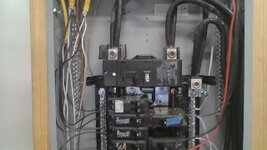
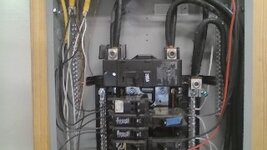
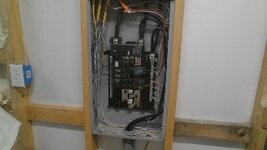
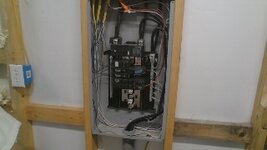
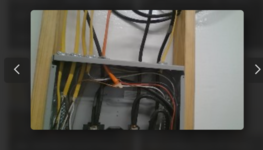
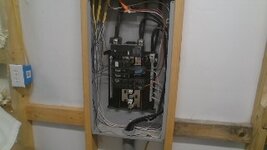
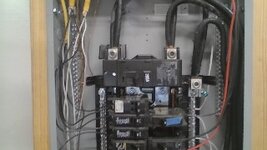
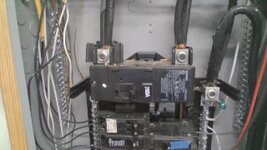
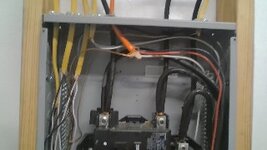
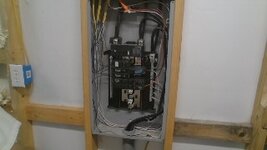
I walked out there to the meter and finally got the box open and there was a 200 amp disconnect breaker right under the meter...

This is the " Main Panel " coming in from the meter....

Notice there is no earth ground....

I took the neutral wire out of the lug that led to the sub-panel, and connected it to the grounding lug, because everyone said I didn't need a neutral wire for the sub, " If I wasn't going to have a 120 volt circuit ". so the end of the wire that once was a neutral wire, is now connected to the grounding bus bar in the sub.....

I also took the jumper off ground bar ( From the ground to the neutral Bar ) in the sub....

There is no disconnect breaker in the sub panel yet...

The hots are coming in hot and heavy right to the top of the hot lugs....in the sub....

I haven't figured out completely how to send a message through this../.. But If everyone or anyone can read this message....

One thing I just say is thank you for helping me......

This is a very cool web site and I really appreciate you guys help.....

I'm learning trying to get it right.....
 

Attachments

  • best 1.jpg
    best 1.jpg
    29.9 KB · Views: 30
  • WIN_20231030_13_15_09_Pro.jpg
    WIN_20231030_13_15_09_Pro.jpg
    25.6 KB · Views: 30
  • WIN_20231030_13_15_14_Pro.jpg
    WIN_20231030_13_15_14_Pro.jpg
    25.4 KB · Views: 30
OP
S

Smarthomes.Cal

Well-known member
Joined
Oct 27, 2023
Messages
47
Location
Seattle Wa.
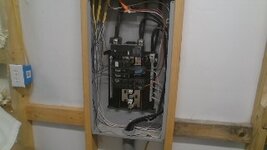
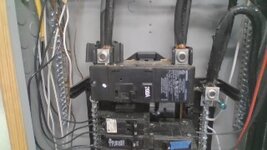
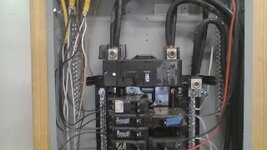
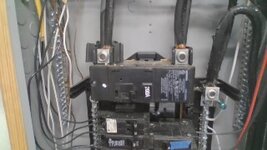
Sir, this is all I could get today....

I took the out going neutral to the sub and connected it to the grounding lug.... Because everyone told me that if I only had 240 volt circuits then I didn't need a neutral wire.... So now that wire is a ground....However, I still don't have an earth ground from thew main panel....
I also removed the jumper in the sub panel....The once neutral wire is just a ground in the sub panel.....
 

Attachments

  • best 1.jpg
    best 1.jpg
    29.9 KB · Views: 29
  • WIN_20231030_13_14_45_Pro.jpg
    WIN_20231030_13_14_45_Pro.jpg
    31 KB · Views: 25
  • WIN_20231030_13_14_50_Pro.jpg
    WIN_20231030_13_14_50_Pro.jpg
    27.3 KB · Views: 25
  • WIN_20231030_13_15_09_Pro.jpg
    WIN_20231030_13_15_09_Pro.jpg
    25.6 KB · Views: 21
OP
S

Smarthomes.Cal

Well-known member
Joined
Oct 27, 2023
Messages
47
Location
Seattle Wa.
If there is a disconnect at the meter then the panel youre calling “main panel” is actually a subpanel… should be 4-wire with isolated neutral bus
There is a disconnect at the meter, and yes sir, I was calling this the main panel....
The meter is about 30 feet away outside...
And there is no earth ground there either....
 
To avoid these ads, REGISTER NOW!
Top Bottom