Sorry, but there's still too much ambiguity here. When you say air tools, do you mean an impact wrench, a die grinder, or a DA sander? Those tools have massively different air requirements.
Also, what (specifically) is your price cap?
In general, there are very few (electric) compressors with tanks smaller than 60 gallons that will provide the output necessary to use high consumption are tools continuously. Any example you find will be pretty specialized, and will be well over $1,000.
Compressors basically fall into the following categories:
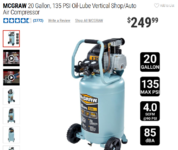
20 - 30 gallon "portable" compressors (may be either vertical or horizontal) that have wheels and are intended to be moved. These are available with 2ish HP motors in either 120 or 240 volts and can be either single or two stage, either oiled or oilless. These will range in flow from about 5 - 7 CFM. Examples include models from just about any box store including Dewalt, Husky, Kobalt, Ingersoll Rand, Campbell Hausfeld, Craftsman, and many others. This category also includes oilless models like California Air Tools and clones from the likes of Harbor Freight. These will
probably run an HVLP gun for small to medium sized projects, and will run impacts guns, air ratchets, and other low consumption air tools. They will run "medium" consumption air tools like die grinders, needle scalers, and band files for limited bursts. Usefulness for these purposes depends on your expectations. Really high consumption air tools intended to be used continuously like DA sanders will be very frustrating to use and are not recommended. Blasting is possible with the right gun but will be slow and tedious.
20 - 30 gallon "portable" compressors with larger (3-4HP) motors. These are only 240 volt, and VERY rarely available in a vertical configuration nowadays. This segment seems to have shrunk significantly in recent years, and I'm only aware of a couple new models that fit this description. These can be either oiled, or oilless, but the oilless models will be "duplex" with two separate motor/pumps mounted to the receiver. These will make around 10 CFM. Painting should be no problem, low consumption air tools no problem, and medium consumption air tools will be more useable but you may still outrun them with continuous use. High consumption air tools are still not recommended.
One example from CH.
The next category are "full size" compressors with 60 - 80 gallon tanks. These are not portable, and are available with a variety of different motor/pump combinations. Common configurations are 2ish HP (5 - 7 CFM), 3-4ish HP (10ish CFM), 5 HP (15ish CFM) and 7.5 HP (25ish CFM). They also come larger with even higher displacement but I would consider those a different category. Most in this category are 2-stage, but single stage models are available. The 2ish and 3-4ish HP models will function similarly to the portable models described above with a slight benefit of a larger tank. This will allow a larger buffer for low duration/high consumption tasks, but will still fall short for continuous high consumption uses. 5HP models are very common, are fairly affordable based on the broad availability, and are very useful for most home shop and even some professional tasks. These will allow for moderate blasting and general use of higher flow air tools. It is definitely still possible to outrun a 15CFM compressor with large grinders and sanders, but for the occasional home shop body panel work, they're serviceable. 7.5HP and larger compressors in this category are really commercial/industrial machines intended to run air distribution systems for automotive shops with multiple users or for extremely high consumption purposes. These will also allow much faster abrasive blasting and nearly continuous grinding/sanding.
All the examples above are reciprocating piston compressors. The rules go out the window for rotary screw and scroll compressors.
Unfortunately, it kind of sounds like you are looking for something in category 2 above, which (as mentioned) is a really limited category. There just aren't a lot of options for high output compressors with smaller tanks. Puma makes a
40 gallon 5 HP compressor, as do a couple Canadian companies, but they're not really portable and they basically take the same footprint as a 60 gallon.
Good luck!