I’m looking to buy a different air compressor; I have an older 25gal horizontal craftsman. I want to get a 30gal vertical. Any recommendations would be great, (and the ones to avoid). I have a limited budget so the less expensive the better. Thanks.


You are using an out of date browser. It may not display this or other websites correctly.
You should upgrade or use an alternative browser.
You should upgrade or use an alternative browser.
Need some air compressor advice
- Thread starter Ren Hoek
- Start date
In order to really give a recommendation, we need to know how much air you need, and whether or not you have 240 volt power available.
Without knowing any of that, I think the Harbor Freight Fortress 26 gallon 175 PSI is a great option. Its compact, quiet, runs on 120 volts, and makes enough air for most home shop uses short of blasting and running high consumption air tools (grinders, sanders, etc).
That said, I sold my little benchtop blast cabinet to a friend who has one and he blasts with it regularly using a TP Tools gun and a small tip/jet combo. It sits right next to his blast cabinet and he's able to blast without it driving him batty.
26 Gallon, 175 PSI Ultra Quiet Oil-Free Vertical Shop/Auto Air Compressor https://share.google/ZELDHEDOdIxOZIpwv
Alternate link. https://www.harborfreight.com/26-ga...6768637354&adsetid=186768637354&product=57336
Without knowing any of that, I think the Harbor Freight Fortress 26 gallon 175 PSI is a great option. Its compact, quiet, runs on 120 volts, and makes enough air for most home shop uses short of blasting and running high consumption air tools (grinders, sanders, etc).
That said, I sold my little benchtop blast cabinet to a friend who has one and he blasts with it regularly using a TP Tools gun and a small tip/jet combo. It sits right next to his blast cabinet and he's able to blast without it driving him batty.
26 Gallon, 175 PSI Ultra Quiet Oil-Free Vertical Shop/Auto Air Compressor https://share.google/ZELDHEDOdIxOZIpwv
Alternate link. https://www.harborfreight.com/26-ga...6768637354&adsetid=186768637354&product=57336
I can run a 240V circuit if needed, I would like to be able to use a HVLP paint gun, and air tools.In order to really give a recommendation, we need to know how much air you need, and whether or not you have 240 volt power available.
Without knowing any of that, I think the Harbor Freight Fortress 26 gallon 175 PSI is a great option. Its compact, quiet, runs on 120 volts, and makes enough air for most home shop uses short of blasting and running high consumption air tools (grinders, sanders, etc).
That said, I sold my little benchtop blast cabinet to a friend who has one and he blasts with it regularly using a TP Tools gun and a small tip/jet combo. It sits right next to his blast cabinet and he's able to blast without it driving him batty.
26 Gallon, 175 PSI Ultra Quiet Oil-Free Vertical Shop/Auto Air Compressor https://share.google/ZELDHEDOdIxOZIpwv
Alternate link. https://www.harborfreight.com/26-ga...6768637354&adsetid=186768637354&product=57336
thool
Well-known member
Mine is a Husky brand, probably 22 years old now, I think 26 gallon. I use the hell out of it, but it is loud and doesn't have a lot of capacity. When we move, I'll probably sell this one and get a larger capacity oiled one that calls for 240V. If you use it a lot, I'd lean toward the quietest one you can find that can keep up.
Sorry, but there's still too much ambiguity here. When you say air tools, do you mean an impact wrench, a die grinder, or a DA sander? Those tools have massively different air requirements.I can run a 240V circuit if needed, I would like to be able to use a HVLP paint gun, and air tools.
Also, what (specifically) is your price cap?
In general, there are very few (electric) compressors with tanks smaller than 60 gallons that will provide the output necessary to use high consumption are tools continuously. Any example you find will be pretty specialized, and will be well over $1,000.
Compressors basically fall into the following categories:
20 - 30 gallon "portable" compressors (may be either vertical or horizontal) that have wheels and are intended to be moved. These are available with 2ish HP motors in either 120 or 240 volts and can be either single or two stage, either oiled or oilless. These will range in flow from about 5 - 7 CFM. Examples include models from just about any box store including Dewalt, Husky, Kobalt, Ingersoll Rand, Campbell Hausfeld, Craftsman, and many others. This category also includes oilless models like California Air Tools and clones from the likes of Harbor Freight. These will probably run an HVLP gun for small to medium sized projects, and will run impacts guns, air ratchets, and other low consumption air tools. They will run "medium" consumption air tools like die grinders, needle scalers, and band files for limited bursts. Usefulness for these purposes depends on your expectations. Really high consumption air tools intended to be used continuously like DA sanders will be very frustrating to use and are not recommended. Blasting is possible with the right gun but will be slow and tedious.
20 - 30 gallon "portable" compressors with larger (3-4HP) motors. These are only 240 volt, and VERY rarely available in a vertical configuration nowadays. This segment seems to have shrunk significantly in recent years, and I'm only aware of a couple new models that fit this description. These can be either oiled, or oilless, but the oilless models will be "duplex" with two separate motor/pumps mounted to the receiver. These will make around 10 CFM. Painting should be no problem, low consumption air tools no problem, and medium consumption air tools will be more useable but you may still outrun them with continuous use. High consumption air tools are still not recommended. One example from CH.
The next category are "full size" compressors with 60 - 80 gallon tanks. These are not portable, and are available with a variety of different motor/pump combinations. Common configurations are 2ish HP (5 - 7 CFM), 3-4ish HP (10ish CFM), 5 HP (15ish CFM) and 7.5 HP (25ish CFM). They also come larger with even higher displacement but I would consider those a different category. Most in this category are 2-stage, but single stage models are available. The 2ish and 3-4ish HP models will function similarly to the portable models described above with a slight benefit of a larger tank. This will allow a larger buffer for low duration/high consumption tasks, but will still fall short for continuous high consumption uses. 5HP models are very common, are fairly affordable based on the broad availability, and are very useful for most home shop and even some professional tasks. These will allow for moderate blasting and general use of higher flow air tools. It is definitely still possible to outrun a 15CFM compressor with large grinders and sanders, but for the occasional home shop body panel work, they're serviceable. 7.5HP and larger compressors in this category are really commercial/industrial machines intended to run air distribution systems for automotive shops with multiple users or for extremely high consumption purposes. These will also allow much faster abrasive blasting and nearly continuous grinding/sanding.
All the examples above are reciprocating piston compressors. The rules go out the window for rotary screw and scroll compressors.
Unfortunately, it kind of sounds like you are looking for something in category 2 above, which (as mentioned) is a really limited category. There just aren't a lot of options for high output compressors with smaller tanks. Puma makes a 40 gallon 5 HP compressor, as do a couple Canadian companies, but they're not really portable and they basically take the same footprint as a 60 gallon.
Good luck!
F.R. FARM & RANCH
Member
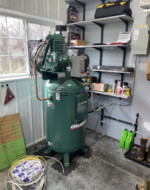
I bought the Ingersoll Rand Garage Mate compressor a year ago. Been very happy with it, and it is ultra quiet. It's a 20 gallon tank so it does most everything I ask it to do. One thing to note is that it is very top heavy (on the vertical model). I wouldn't get this if you need to roll it around much as it weighs over 200lbs.
I hooked a 1/2" Goodyear reel hose above it, and a nice quality regulator/water separator. Not a bad setup for an at home shop.
I hooked a 1/2" Goodyear reel hose above it, and a nice quality regulator/water separator. Not a bad setup for an at home shop.
pdl2mtl90
Well-known member
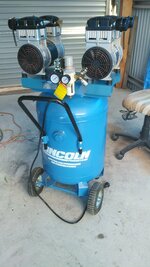
I bought this air compressor several years ago at Northern Tool and i am more than happy with it:
Running air tools is no problem with a typical 30 gallon compressor but you're glimg to have a lot stopping and waiting for it to catch up. Probably the majority of people do that. If you are using them regularely and already said you have the voltage you should really consider a 60 gallon one.
I bought the Ingersoll Rand Garage Mate compressor a year ago. Been very happy with it, and it is ultra quiet. It's a 20 gallon tank so it does most everything I ask it to do. One thing to note is that it is very top heavy (on the vertical model). I wouldn't get this if you need to roll it around much as it weighs over 200lbs.
I hooked a 1/2" Goodyear reel hose above it, and a nice quality regulator/water separator. Not a bad setup for an at home shop.
I bought this air compressor several years ago at Northern Tool and i am more than happy with it:
These are both good examples from category 1 from my post above. These are popular options because they provide more flow and more reserve than little "nail gun" compressors, but they're still portable and completely self contained (can be plugged into a typical wall socket.
The highest output model in this class is the Quincy q12124vp, or variants sold under the Atlas Copco, Bellaire, Chicago Pneumatic, or even NAPA labels. Here's a link the the Quincy from Northern Tool:
https://share.google/mgprcEZZ28a03e3m1
At 7.4 CFM at 100 psi, this is almost 50% more output than others in this class rated at 5 CFM. And this is from a 120 volt compressor. Make no mistake however, it will use every bit of a 20 Amp breaker if wired for 120 volts.
theoldwizard1
Well-known member
The most IMPORTANT specification for an air compressor is VOLUME of air the pump can supply (CFM sometimes called SCFM) at your most commonly used pressure.
High pressure and large tank are good, but if you are using a tool that takes a lot of air (sander, sand blaster, die grinder, etc.), the tank will quickly run low. Running multiple nail guns can empty a tank quickly !
I sure wish Quincy would put the motor and pump from the Q13160VQ 3.5HP 60 gallon stationary on the 24 gallon Q12124VPQ tank !
High pressure and large tank are good, but if you are using a tool that takes a lot of air (sander, sand blaster, die grinder, etc.), the tank will quickly run low. Running multiple nail guns can empty a tank quickly !
I sure wish Quincy would put the motor and pump from the Q13160VQ 3.5HP 60 gallon stationary on the 24 gallon Q12124VPQ tank !
Shoreline_
Well-known member
Something used off marketplace of cl is the best bet but not if you dont know what you're looking for. If you wanna buy brand new just go for something at HF. All the Chinese stuff is made in the same factory or the same design.
Im pretty sure a little IR T30 242 will run off 3hp.
But what do I know. A small compressor for me is 40hp.
Im pretty sure a little IR T30 242 will run off 3hp.
But what do I know. A small compressor for me is 40hp.
NFT5
Well-known member
The most IMPORTANT specification for an air compressor is VOLUME of air the pump can supply (CFM sometimes called SCFM) at your most commonly used pressure.
High pressure and large tank are good, but if you are using a tool that takes a lot of air (sander, sand blaster, die grinder, etc.), the tank will quickly run low. Running multiple nail guns can empty a tank quickly !
This!
The size of the tank is largely irrelevant, even if it was even remotely close to the capacity that most in North America are claimed to have. A bigger tank does give you some reserve and the larger volume does help to allow the air to cool a bit, but really what matters is the capacity of the pump and motor to replace the air that you're using.
I built this, by using the pumps and motors from a compressor with a smaller (40 litre) tank together with the tank from another. The tank is 100 litres, so about 27 US gallons. The pumps/motors have a capacity of 470 litres/minute or about 17cfm. Importantly I modified the outlet lines from the pumps to go through a copper tubing array (about 12.5m) which is almost 100% effective at removing all the moisture which these compressors produce. This array fits between the pumps and the tank, so the air is cooled and dry before it goes into the tank.
I'm a spray painter so clean, dry air is essential for my needs. I only have single phase 240V power and that's limited to 10A. This unit just plugs in and runs within those limitations. And it's quiet, so no complaints from the neighbours.
All of my guns are HTE(High Transfer Efficiency) or RP(Reduced Pressure), not HVLP which are air hogs, most needing 14cfm or more and their finish quality isn't on a par with RP where the higher pressure gives better, finer atomisation for a smoother finish. My guns mostly run on about 10cfm, so well within the capacity of the compressor. I do use air tools and things like palm sanders and inline sanders can use a lot of air but I still have enough.
Chumly
Well-known member
HVLP, break it down really. As said, that's high volume. Paint a fender or feathering, 30G tank will do. Paint an entire car, it just ain't going to be optimal on a small cap compressor with any sized tank. I can do motorcycle fairings just fine on a 20G but it's asking a lot of the IR GarageMate even there since it's a 5cfm unit; Rushing is asking for failure. 20+ CFM compressors get you into higher middle class compressors and the budget is up to really you since the tank, again prior stated, has you running on reserve if it's below what is actually needed.
I think I seen it up there in the replies and I even made a question a few years back here about the garage mate tripping: it uses 20A and no less. Not knowing your garage setup, choosing an IR garage mate will need a dedicated 20Amp socket or you walk softly on anything else on that circuit...or you're running "220, 221. Whatever it takes" for a Quincy 60G rig. I don't think I saw if space was a concern, just budget.
I think I seen it up there in the replies and I even made a question a few years back here about the garage mate tripping: it uses 20A and no less. Not knowing your garage setup, choosing an IR garage mate will need a dedicated 20Amp socket or you walk softly on anything else on that circuit...or you're running "220, 221. Whatever it takes" for a Quincy 60G rig. I don't think I saw if space was a concern, just budget.
gimpyrobb
Well-known member
Unless you NEED high pressure, there is no need for a dual stage pump. A single stage is fine for MOST pneumatic tools. You get more cfm with single stage to boot!
nadogail
Well-known member
The Harbor Freight "Ultra Quiet" 26 gallon vertical tank compressor exceeded my expectations.
that's misleading.Unless you NEED high pressure, there is no need for a dual stage pump. A single stage is fine for MOST pneumatic tools. You get more cfm with single stage to boot!
while you might be able to BUY a single stage compressor labelled to do more work with the "same" 5HP motor, in fact, you are not getting more CFM of air per operational dollar (energy input) with single stage over a two stage unit. e.g. all that's been done is given you a lower maximum PSI and a higher RPM compressor.

Single-Stage vs. Two-Stage Air Compressors: What's Right for Your Operation? - FS-Compression - Industrial Air Compressors
Air compressors are the backbone of many industrial operations, but not all compressors are built the same. One of the most common decisions plants face is whether to use a single-stage or a two-stage air compressor. At first glance, the two designs may look similar — but their performance...
 fs-compression.com
What Makes Two-Stage Compressors Different?
On the outside, a single-stage and a two-stage compressor may look similar. But under the hood, the differences are game-changing.
This design produces more air output per horsepower, lower energy costs, and longer machine life.
- Single-Stage: Air is compressed in one step, which puts heavy strain on bearings and can increase energy usage.
- Two-Stage: Air is compressed in two steps with interstage cooling between, reducing stress on components and boosting efficiency.
More CFM per Horsepower
The NXHE series delivers significantly more airflow at the same horsepower rating.
Example: A 250 HP single-stage compressor typically delivers 1,026 CFM @ 125 PSI. The FS Curtis NX185 (two-stage, 250 HP) delivers 1,217 CFM @ 125 PSI — an increase of 191 CFM, equal to adding a 50 HP machine without the extra cost or footprint.
Higher Energy Efficiency
Efficiency isn’t just about airflow — it’s about how much power you consume to get it. This is where the money is saved!
In simple terms: You get more air while pulling less power.
- Lower package power draw: Two-stage compressors deliver more air while consuming less kW.
- Better specific power: FS-Curtis NXHE units achieve industry-leading numbers (as low as 15.69 kW/100 CFM).
- Superior isentropic efficiency: Higher ratings mean less wasted energy and reduced operating costs.
for example, at work our 10HP VFD compressor is rated for 175PSI. at 90PSI and full speed, it's only inputting 6HP of electricity into the motor.
often you can take advantage of this yourself if you check the RPM range for a given compressor, and then run it faster/slower to meet your needs. since this is GJ, you want to buy the largest two stage compressor money can buy and spin it at the minimum allowable RPM for maximum minimum-noise. best done on a unit with an oil pump (splash lube is for noobs!)
The most IMPORTANT specification for an air compressor is VOLUME of air the pump can supply (CFM sometimes called SCFM) at your most commonly used pressure.
+1
$/cfm at 90psi is really the spec to look at. If the tank is larger, you have more reserve.
I have been using a 3hp/10cfm portable (240V) for about 25 years - no sandblasting or painting though. Was about to expand with an additional reserve tank, but picked up a 5hp vertical from a buddy that was selling cheap. Really, 3.7-5hp vertical is such a common machine, there's used ones available all the time.
If you can wire up a hot water tank, you can wire up a compressor in this class.
theoldwizard1
Well-known member
Some shop run their air tools at 125+ psi ! Yes, they wear out quicker, but they are cheap to rebuild !$/cfm at 90psi is really the spec to look at. If the tank is larger, you have more reserve.
Some shop run their air tools at 125+ psi ! Yes, they wear out quicker, but they are cheap to rebuild !
I was thinking more for comparing mfr specs, but ya.
Some places set their regulators high because they're compensating for loss on small or long hose.
theoldwizard1
Well-known member
I would love to see a picture of that !... I modified the outlet lines from the pumps to go through a copper tubing array (about 12.5m) which is almost 100% effective at removing all the moisture which these compressors produce. This array fits between the pumps and the tank, so the air is cooled and dry before it goes into the tank.
The problem with water separators is, where does the water go ? Usually there is a sealed chamber at a low point that captures the condensate. This must be drained regularly. Depending on it size, you may have to drain it a couple of ties a day !
theoldwizard1
Well-known member
If you want accurate air pressure, you need a surge tank near where the tool is being used with the regulator AFTER the surge tank.Some places set their regulators high because they're compensating for loss on small or long hose.
High volume tools DO benefit from 3/8" (10mm?) ID hoses from the surge tank to the tool.
Some shop run their air tools at 125+ psi ! Yes, they wear out quicker, but they are cheap to rebuild !
The rating of the pump is a flow rate at a given pressure. Some rate at 40 PSI, some rate at 90 PSI, some rate at their max output pressure (175 PSI etc). CFM at 90 PSI is probably the most common rating across compressors in the category we're discussing here, and it has nothing to do with the maximum pressure the pump is capable of, or the pressure the tools attached to it will be used at.
gimpyrobb
Well-known member
I don't know where your logic comes from, but if you have 2 cylinders pumping and one set is the same size VS one that is smaller, you get less cfm. You can argue all you want, volume is volume.that's misleading.
while you might be able to BUY a single stage compressor labelled to do more work with the "same" 5HP motor, in fact, you are not getting more CFM of air per operational dollar (energy input) with single stage over a two stage unit. e.g. all that's been done is given you a lower maximum PSI and a higher RPM compressor.
Single-Stage vs. Two-Stage Air Compressors: What's Right for Your Operation? - FS-Compression - Industrial Air Compressors
Air compressors are the backbone of many industrial operations, but not all compressors are built the same. One of the most common decisions plants face is whether to use a single-stage or a two-stage air compressor. At first glance, the two designs may look similar — but their performance...
for example, at work our 10HP VFD compressor is rated for 175PSI. at 90PSI and full speed, it's only inputting 6HP of electricity into the motor.
often you can take advantage of this yourself if you check the RPM range for a given compressor, and then run it faster/slower to meet your needs. since this is GJ, you want to buy the largest two stage compressor money can buy and spin it at the minimum allowable RPM for maximum minimum-noise. best done on a unit with an oil pump (splash lube is for noobs!)
Yes if you are looking at HIGH pressure, it might be easier, but AS I SAID, if you don't need high pressure, single stage is BETTER.
Shoreline_
Well-known member
Exactly. And that other user was quoting marketing material. Not exactly a lab result. A two stage screw compressor is the same efficiency up to 70 psi.I don't know where your logic comes from, but if you have 2 cylinders pumping and one set is the same size VS one that is smaller, you get less cfm. You can argue all you want, volume is volume.
Yes if you are looking at HIGH pressure, it might be easier, but AS I SAID, if you don't need high pressure, single stage is BETTER.
SouthernIllinois
Well-known member
- Joined
- Jan 14, 2024
- Messages
- 1,808
Just here for the single stage vs 2-stage debate.
I am firmly in the 2-stage camp.
I am firmly in the 2-stage camp.
SouthernIllinois
Well-known member
- Joined
- Jan 14, 2024
- Messages
- 1,808
And that's why bodyshops all had 2-stage compressors for multiple employees until screw compressors became more common?There's no debate. They're different tools for different purposes.
I had that oilless tankless harbor freight for less than a year when it seized, I had never been so thankful in my life it was noisier than watching def leopard center stage while on a run away locomotive being carried on a couple of Saturn 5 rockets
SouthernIllinois
Well-known member
- Joined
- Jan 14, 2024
- Messages
- 1,808
I can agree with that.2 stage also costs more. Unless you need it for specific use in most home shop type applications there's no problem with single stage.
Having said that, I never wish I had more air when running DA's, die grinders or when a friend helps out and we have multiple DA's running at once.
I can agree with that.
Having said that, I never wish I had more air when running DA's, die grinders or when a friend helps out and we have multiple DA's running at once.
You can never have too much air in those situations but then it comes down to how often do you use those tools. If it's pretty regularely and you're always having to let it catch up that's a good reason to go 2 stage.
I think my biggest air use is sandblasting. But I don't use it often enough to justify getting another compressor.
I run 1/2" hose and oversize fittings for the same reason. Improved the zoot on my big impact gun for sure.High volume tools DO benefit from 3/8" (10mm?) ID hoses from the surge tank to the tool.
NFT5
Well-known member
I would love to see a picture of that !
The problem with water separators is, where does the water go ? Usually there is a sealed chamber at a low point that captures the condensate. This must be drained regularly. Depending on it size, you may have to drain it a couple of ties a day !
Easy. There are two motors, two sets of pumps and, therefore, two outlets. Remove original lines from these outlets and replace joining together in a Y fitting. I used braided lines but it could be done in copper tube. A hose attached to this then attaches to the copper tube array

Cooling tube array. Each vertical is about 1.8m long and you can see the series of taps along the bottom. Water condenses as it cools at flows into the extensions where it sits, out of the airflow, until drained. Where I live is not humid so what I have is more than sufficient. In a more humid climate those legs could be longer or larger diameter tube used. I drain daily - it's easy to just flick the handle to open the valve. Much easier than draining the tank, which I never have to do, although I do check occasionally. It could also be set up to all drain into a single receptacle fitted with an auto drain.
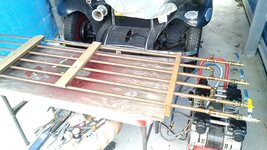
The cooling array sits behind the compressor, in this picture in a temporary position but later attached to a wall.
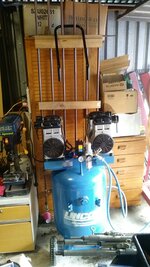
One other major advantage of drying your air before it goes into the tank (apart from the fact that no water sits in the tank to cause rust) is that there is a valve where the air comes into the tank. This is connected to the switchbox but if the air coming through is wet then these valves can play up and leak back up to the switch unit. Dry air means that this valve never causes a problem.
Last edited:
Shoreline_
Well-known member
Screws for body shops are definitely single stage and def shitboxes. They wont last as long as a good reciprocating compressor with the air filter changed regularly. Most body shops have 2 stage compressors because thats what the more expensive brands made to make 175 pounds. There are 175 pound screw machines out there but I hate running them. The oil filters usually leak around the crimp. The unload solenoid valve takes a hit. The inlet takes a hit.And that's why bodyshops all had 2-stage compressors for multiple employees until screw compressors became more common?
gimpyrobb
Well-known member
I have a similar champion I used for 20yrs. I am upgrading to an r30 pump as I purchased a blast cabinet.Just here for the single stage vs 2-stage debate.
I am firmly in the 2-stage camp.
the logic comes from the wasted swept area of the low pressure piston acting like a spring.I don't know where your logic comes from, but if you have 2 cylinders pumping and one set is the same size VS one that is smaller, you get less cfm. You can argue all you want, volume is volume.
Yes if you are looking at HIGH pressure, it might be easier, but AS I SAID, if you don't need high pressure, single stage is BETTER.
The number of pistons doesn't seem relevant, just volume of the low stage. The first stage of a 2 stage compressor never sees full tank pressure, so you lose effective displacement much faster on a single stage unit.
I don't see how 2 stage would ever be less efficient, unless you're using a piston compressor without a restriction and the friction of the additional piston(s) is additional loss. I'm sure the curves cross somewhere. might be at the zero point.
if we assume a linear relationship, the 2 stage compressor is still 8% more efficient at 50PSI than the single stage unit.Rules of thumb:
- A good single-stage compressor, per true HP input, will deliver about 4 true CFM at 100 psig. It is not uncommon to see this more like 3 CFM per HP, when using compressors from a retail store.
- A two-stage compressor is more efficient, typically by 15 percent, versus a single-stage compressor. You might see 4 to 5 CFM per HP at 100 psi, instead of 3 or 4 CFM.
- Formulas (see references below) for the theoretical power to compress one CFM are:
- HP = 0.015*P*(R0.29-1) [single-stage compressor, per CFM]
- HP = 0.030*P*(R0.145-1) [two-stage compressor, per CFM]
where:- R = the ratio of the compressed air absolute pressure to the ambient air pressure. R is about 8 for 100 psig compressed air versus 14.7 psia atmospheric pressure, and
- P = atmospheric pressure in psi (that is, 14.7 psi)
These formulas reduce to a theoretical 5.5 CFM/HP (single stage) or 6.4 CFM/HP (two-stage), but do not include various inefficiences such as mechanical losses, the effects of heat and moisture in the input air, and the build-quality and condition of the equipment. These are the theoretical limits of what can be achieved with ideal machinery. The imperfections of practical compressors and operating conditions typically lose about 1/3 of this theoretical performance. This is the basis of my rule of thumb that in practice you can count on about only 3 or 4 CFM per HP from shop air compressors. My rule agrees with the advice of quality compressor manufacturers like Quicy, who honestly report that their "well-designed compressors produce approximately 4 CFM at 100 PSIG per unit of horsepower."
the logic comes from the wasted swept area of the low pressure piston acting like a spring.
The number of pistons doesn't seem relevant, just volume of the low stage. The first stage of a 2 stage compressor never sees full tank pressure, so you lose effective displacement much faster on a single stage unit.
I don't see how 2 stage would ever be less efficient, unless you're using a piston compressor without a restriction and the friction of the additional piston(s) is additional loss. I'm sure the curves cross somewhere. might be at the zero point.
if we assume a linear relationship, the 2 stage compressor is still 8% more efficient at 50PSI than the single stage unit.
Simply put, compressing air takes work. Compressing air more, takes more work. In a less than perfectly efficient system, converting electrical to mechanical energy results in some losses (heat, sound, etc.) so any time you do more work, there are greater losses.
In short, compressing a given volume of ambient pressure air to 120 PSI takes less work than compressing that same initial volume to 175 PSI. As a result, there will be greater losses, thus reduced efficiency.
That said, because most piston compressors most of us are familiar with are used in scenarios where higher tank pressure is desirable, most compressors in this class are 2 stage compressors. As a result, companies are investing more in the design and manufacture of these offerings than the single stage offerings which make up only a small fraction of sales. So design and manufacturing are geared toward making better, more efficient 2-stage compressors, where single stage compressors don't benefit from the same investment. The result is that the small selection of single stage compressors available on the market do not demonstrate the kinds of efficiencies that physics should allow.
Theoretically, single stage compressors should be more efficient. Practically, we as consumers can't really take advantage of that fact.
The single vs two stage debate is pointless; this will essentially be determined by your CFM requirements. 10 CFM and less will typically be single. Once you exceed this by more than a few CFM, they'll typically be two stage.
How many garage suitable 240V 15+ CFM at 90+ PSI piston compressors are single stage?
I didnt need a 175 PSI two stage compressor, 120 PSI is fine, but wanting 20+ CFM for pressure blasting, everything I saw when I shopped was two stage.
How many garage suitable 240V 15+ CFM at 90+ PSI piston compressors are single stage?
I didnt need a 175 PSI two stage compressor, 120 PSI is fine, but wanting 20+ CFM for pressure blasting, everything I saw when I shopped was two stage.
disagree vehemently. the more you compress in a single event the LESS efficient it is.Simply put, compressing air takes work. Compressing air more, takes more work. In a less than perfectly efficient system, converting electrical to mechanical energy results in some losses (heat, sound, etc.) so any time you do more work, there are greater losses.
In short, compressing a given volume of ambient pressure air to 120 PSI takes less work than compressing that same initial volume to 175 PSI. As a result, there will be greater losses, thus reduced efficiency.
(snip)
Theoretically, single stage compressors should be more efficient. Practically, we as consumers can't really take advantage of that fact.
a two stage compressor isn't compressing to 175 PSI unless the tank is at 175PSI. all a two stage compressor is doing is separating the compression into two events. big piston does half the work, small piston does half the work. compressing less is more efficient than compressing more, so the system that compresses "less" wins.
disagree vehemently. the more you compress in a single event the LESS efficient it is.
a two stage compressor isn't compressing to 175 PSI unless the tank is at 175PSI. all a two stage compressor is doing is separating the compression into two events. big piston does half the work, small piston does half the work. compressing less is more efficient than compressing more, so the system that compresses "less" wins.
But the tank IS at 175 PSI. Otherwise what's the point?