To avoid these ads, REGISTER NOW!

New AC unit, air handler crazy loud

TangoFoxTrot

Well-known member
Joined
Jan 23, 2009
Messages
1,961
I had an older American Standard AC unit that developed a bad leak in the evaporator coil, it would lose like a pound a day. So decided it was time for a new unit. Terrible timing right now.

Salesperson came out and I told him even when things were working, one bedroom of the house just always had weak flow and cooling. Seemed very knowledgable. He thought upgrading the air handler from 3.5 to 4 ton would be the right move, keeping the 3.5 ton condensing unit size. Square footage is around 1600, lots of skylights and windows, Phoenix AZ area. So I ordered a new split system, Trane, xr14 heat pump with Tem6 variable air handler. I honestly wanted a "nicer" Trane, but inventory was out and called other places and had the same story. No idea when inventory levels would return and it's 110 degrees here. I usually prefer "simple" though.

Problem is, new unit is ridiculously loud with the airflow. Like you can't have a normal conversation in the house, sounds like a harrier jet in my living room. Never had this problem previously. Really, really loud. I honestly thought the "upgraded" variable flow air handler vs single speed would be a quieter experience, but that's just the first few minutes of startup. Are single stage quieter in an application like this? Old unit was way, way quieter. if I could have done it over again, would have repaired the A coil even though I felt that was good money after bad.

I got the manual and you can adjust the dip switches, and did so for the 3.5 ton setting down from 4 ton. That helped immensely, but the rooms closest to the air handler are still quite a bit louder than previous unit. Cooling works great, happy with performance. On the other side of the house, I have an old 5 ton unit, single stage, and even the ducts closest to the air handler, it's simply quieter.


The outfit I used was probably the largest Trane dealer in my state, they've been around for like 40 years, and really happy with their service and technicians.

What remedies are there available for this? What the larger air handler a mistake? Is there any harm leaving it on the 3.5 dip switch setting? Any subtle duct adjustments?
 
To avoid these ads, REGISTER NOW!

Gizzi

Well-known member
Joined
Oct 25, 2015
Messages
68
Do you have a single common return vent or returns in various rooms? Did the contractor check static pressure of the duct system? (There will likely be holes drilled in the air handler and duct work at various points in they did) If the air handler was upsized, the fan speeds at the rated static pressure would likely need to be adjusted from factory settings with the dip switches. Perhaps they used a very restrictive filter given the size of your existing ductwork.
 
OP
T

TangoFoxTrot

Well-known member
Joined
Jan 23, 2009
Messages
1,961
Return vents are in various rooms, for this zone there is a total of 4 return vents. I can't imagine it needs more. Trane rep never said it was an issue either.

Does a less restrictive air filter help with the noise department? The slot is an "Envirowise" unit, filter is 22.7 x 20.7 x 4.7" Merv 11.

The setting at 4 ton was simply unacceptable, the 3.5 is much better, but still too loud in a few rooms. In the dining room, you can't have a normal conversation when running. I'm thinking in one room possibly installing a damper? Rest of the rooms are okay and will probably just live with it.
 

Gizzi

Well-known member
Joined
Oct 25, 2015
Messages
68
Try pulling the filter and see if that helps with noise, but don't leave it that way. Sounds like the installers need to come back and test static pressure. Fan speeds may be too high. Merv 11 is pretty restrictive if the ductwork is undersized.
 

Bert_

Well-known member
Joined
Dec 24, 2016
Messages
9,732
Location
NW Iowa
So he suggested and installed a 4t air handler, connecting it to the existing, probably already undersized, ductwork? All while expecting it to fix an airflow problem? Who could have expected issues with that...

Honestly I think you now have an oversized unit with ductwork issues that need corrected. Putting in an even bigger unit made your ductwork issues even worse.

Generally the higher efficiency units need bigger ductwork than the old one. That's if you're expecting it to actually meet the the rated efficiency and be quiet.
 

danski0224

Well-known member
Joined
Jan 29, 2005
Messages
13,425
Location
Near Naperville, IL
So he suggested and installed a 4t air handler, connecting it to the existing, probably already undersized, ductwork? All while expecting it to fix an airflow problem? Who could have expected issues with that...

Honestly I think you now have an oversized unit with ductwork issues that need corrected. Putting in an even bigger unit made your ductwork issues even worse.

Generally the higher efficiency units need bigger ductwork than the old one. That's if you're expecting it to actually meet the the rated efficiency and be quiet.
This.

"Enough" ductwork doesn't necessarily mean "it has 4 returns".

The old unit had an airflow reduction due to increased static pressure, it was not capable of ever moving the air it was supposed to.

The new variable speed unit CAN deliver the airflow that it is set to, within some limits.

That's why the new one is louder.

The ductwork is still inadequate, but the new air handler can adjust accordingly, within limits.

You are likely to be using much more electricity, not getting "4 tons" of cooling, and the fan motor is more likely to burn out.

Good luck.
 
OP
T

TangoFoxTrot

Well-known member
Joined
Jan 23, 2009
Messages
1,961
Well, glad I went with an expert that supposedly knows his trade.

I'll bring it all up with him on Monday. Old unit never had these issues.

So I'm not out of line to insist a different air handler be put in (at their cost, since they screwed up)?
 

danski0224

Well-known member
Joined
Jan 29, 2005
Messages
13,425
Location
Near Naperville, IL
HVAC salespeople are not necessarily trade experts. Usually not, the job I'd to move boxes of equipment. The "#1 Dealer" sales pitches means nothing with respect to improving comfort. It's number of boxes sold.

I'd start with a nice complaint that "it's way too loud" and I wouldn't mention messing with the setup switches. I'd put them back before they "check it out".
 

Wrench97

Well-known member
Joined
Jun 23, 2018
Messages
12,103
Location
Southeastern Pa
Well, glad I went with an expert that supposedly knows his trade.

I'll bring it all up with him on Monday. Old unit never had these issues.

So I'm not out of line to insist a different air handler be put in (at their cost, since they screwed up)?
Not out of line for having them fix it at no cost, it may not need another air handler just a tech that knows how to set it up.
Installers are not usually great techs.
But be aware in my limited experience the ducts are sized to the unit if you upsize the unit you need to rework the ducts(larger return sizes and output sizes. To me if there is a setting in that unit for 3.5t the unit will probably be fine if set up correctly. There are also on some units "high velocity" fan speeds/settings and standard duct settings.
 
OP
T

TangoFoxTrot

Well-known member
Joined
Jan 23, 2009
Messages
1,961
HVAC salespeople are not necessarily trade experts. Usually not, the job I'd to move boxes of equipment. The "#1 Dealer" sales pitches means nothing with respect to improving comfort. It's number of boxes sold.

I'd start with a nice complaint that "it's way too loud" and I wouldn't mention messing with the setup switches. I'd put them back before they "check it out".

Yea, I'm going to put it back the way I found it and just let them figure out a solution. Right when it was installed and they started it up, I told them it crazy loud and they just sort of shrugged their shoulders and said thats the way it is. Certain rooms you can't have a conversation.

I just hate being the homeowner and having to figure this out myself, its why I outsource it.

I think they'll make it right, I'm just trying to figure out if it's purely a wrong air handler problem or if it's something simple with the ducts that can be adapted. I feel like a duct issue should have been identified before an install. Never had any noise issues. I don't want them to try and sell me a complete duct reengineerinng with ripping out drywall when the problem is just too big an air handler.

If ultimately the solution is the air handler is set at 3.5 tons instead of 4 tons with the dip switches, is that an "improper" solution that has an energy penalty? Or does that maybe make the most sense?
 

Bert_

Well-known member
Joined
Dec 24, 2016
Messages
9,732
Location
NW Iowa
All the dip switches do is adjust fan speed. Lowering fan speed will solve the noise issue. It's not going to hurt anything to lower it as long as it can't freeze up. It's not going to meet advertised efficiency at lower fan speeds but it a tradeoff you have to accept unless the ductwork gets redone.

No amount of fiddling with the fan will fix the airflow issue to the room that gets to hot. That is 100% a ductwork issue.
 

danski0224

Well-known member
Joined
Jan 29, 2005
Messages
13,425
Location
Near Naperville, IL
Yea, I'm going to put it back the way I found it and just let them figure out a solution. Right when it was installed and they started it up, I told them it crazy loud and they just sort of shrugged their shoulders and said thats the way it is. Certain rooms you can't have a conversation.

I just hate being the homeowner and having to figure this out myself, its why I outsource it.

I think they'll make it right, I'm just trying to figure out if it's purely a wrong air handler problem or if it's something simple with the ducts that can be adapted. I feel like a duct issue should have been identified before an install. Never had any noise issues. I don't want them to try and sell me a complete duct reengineerinng with ripping out drywall when the problem is just too big an air handler.

If ultimately the solution is the air handler is set at 3.5 tons instead of 4 tons with the dip switches, is that an "improper" solution that has an energy penalty? Or does that maybe make the most sense?

Unfortunately, many people (especially here) are of the opinion that HVAC isn't difficult and anyone with a pair of snips and a jug of Freezone can do it.

Homeowners quickly get glazed eyes when someone tries to explain something that they can't see- but obviously impacts how the system operates (air). The tools to measure air cost thousands of dollars and more to keep them calibrated- much less finding someone to use them properly.

A system can appear to function (as in make cold or hot air) when the switch is flipped, but isn't operating correctly. Can't find these issues with the "rope 'em in" $29.95 tuneup specials...

A given quantity of airflow requires a given quantity of duct opening. No getting around it. That's physics.

Your original ductwork is undoubtedly undersized. It is proven that most ductwork in homes is undersized from the start. That installation manual you looked at with the switch settings also has airflow charts that show the relationship between static pressure and airflow (CFM). More static pressure = lower airflow. The variable speed fan motors hit this wall much later than the plain old PSC motors- this is why your old system didn't make any noise. I would almost guarantee you that it NEVER delivered the required airflow for the equipment requirements.

A "hot room" complaint should have triggered some questions that ultimately should have led to additional (paid) diagnostics and testing. Almost always, ductwork somewhere needs to be changed to correct the issue. Whether or not the homeowner wants to go through the expense is a different matter.

In my experience, homeowners do not volunteer these complaints- they wait until the new stuff is installed, thinking that the problem will magically fix itself. I always ask about hot or cold rooms and poor airflow.

A "bigger unit" never works when coupled to the existing and unchanged ductwork. Never.

The proper approach would have been to do a load calculation to establish the required btu's for heating/cooling.

That number of btu's dictates equipment size, which then dictates duct size.

Then the existing ductwork needs to be looked at to see if it is correctly sized and look for ****** installation practices. Then the hot/cold room(s) questions come up.

Then you ask about air filters. You have to ask because everyone wants to use those ungodly restrictive pleated 1" air filters and not change them because the package says that it's good for up top 90 days- so it should be good for 180...

Only once these questions are answered can a system be selected and installed.

The HVAC contractor should be able to do a static pressure test on the existing system to see if it is within the rated capacity of the equipment- which is usually specified as 0.5" of water column (wc). With a variable speed motor, as static pressure goes up, so does amp draw. The motors usually hit a wall at 0.85" or 0.9" wc (they can deliver the selected airflow until that pressure range).

The PSC motors would drop off immediately over 0.5" wc (1200 CFM at 0.5" wc may mean 800 CFM at 0.8" wc). It is important to note that CFM at the equipment does not account for CFM losses in the ductwork due to leakage or ****** design.

This means that it is quite easy to "lose" a ton or more of cooling just from static pressure losses and duct leakage. The 4 ton system just became a 3 ton system (or smaller), but costs "4 tons" of electricity to run. The difference of 400 CFM at the air handler due to high static pressure (1200 CFM vs 800 CFM) IS a loss of "1 ton" of cooling (400 CFM). This is before additional losses from duct leakage and/or ****** duct design/installation.

Undersized ductwork, restrictive air filter, airflow restrictive evaporator coil or too big of a fan will show up as too much static pressure. The problem area can be shown with additional diagnostics that don't take much time.

And waiting until the stuff breaks puts one between a rock and a hard place, once it is discovered that sleeping without the AC isn't good... or that the pipes will freeze in a few hours. Yeah, **** breaks, but running the HVAC until every last penny of life is extracted from it is stupid- unless you really can manage without it. Most that say they can, can't.

Good luck.
 
Last edited:

Terry D

Well-known member
Joined
Mar 25, 2015
Messages
2,202
Location
St. Louis, MO.
I totally agree with the rest on the ductwork issue. I installed a new condenser and air handler with evaporator beginning of last season. I went from a 2 1/2 to a 3 ton. When I bought the house 35 years ago, it had and still does have hydronic heat. So no central air, all window units. On of my first projects was to install central air. A very good friend and I, who he worked for a HVAC contractor installed the duct work and unit. It was fine for all those years, still had the original air handler and evaporator, but was on 2nd condenser.

The problem with the new unit was it was installed on a ductwork system designed for 2 1/2 ton CFM. When I checked CFM with a hot wire anemometer, it was only 1000 CFM. Should be around 1200 CFM. And it should be checked with the coil wet ( AC running ) It does add restriction.

I ended up adding a few more return airs and increasing the size of the return plenum. Its running right at 1200 CFM. I also went from a MERV 8 to a 6, which really helped. I did a CFM test without a filter, it is crazy how much a higher MERV rating restricts air flow. To me, these filters need to be changed more often because the trap finer particles and get restrictive easier. I almost want to say its a gimmick on those crazy over priced filters. There are some that still swear by just using the cheap filters. By doing all of this, I also lower my delta T, which was high.

All my rooms were and still are the same temp. With you having a room that was warmer, before the unit change, pretty much indicates an air flow issue cased by a ductwork problem. Is this room at the end of the ductwork. Does it have a return. You need the same amount of return as you have supply
 
Last edited:

Walkers

Well-known member
Joined
May 17, 2021
Messages
3,912
Location
Cave Creek Az
For what it’s worth, my Trane with the variable air handler is very quiet. If I am on the opposite side of the house from the compressor I almost can’t tell if it is running.
 

yeldogt

Well-known member
Joined
Jan 2, 2012
Messages
18,184
It's rare when a house does not have equipment too large and ductwork too small -- you never want to "just" add more capacity or CFM or remove ductwork capacity.

There are situations where you would install a larger evaporator into a system -- but, not the blower or condenser. Was any math done on this system? Load done ...??

Modern fan motors will ramp up to force the CFM -- this can be very loud.
 
OP
T

TangoFoxTrot

Well-known member
Joined
Jan 23, 2009
Messages
1,961
Thanks for the suggestions.

What irritates me is, all of this should have been figured out (by the installer) BEFORE the system was installed by the dealer. It's like bringing my car into a dealership with a problem and they put the wrong transmission in. Of course I don't have equipment that can make these types of measurements and "check their work". I show him what I have, ask some questions, and he makes the recommendation. I never "overruled" him on anything or insisted it be done "my way". Not a word about duct capacity being a potential issue. In fact, he thought the system was undersized for my duct size. The installers made the airflow measurements and didn't seem to take issue with fact it sounds like a helicopter taking off in some of the rooms.

Looking around the web, this seems to be a big problem "undersized ducts" when someone gets a new variable flow unit and it being very sensitive to that. Maybe the industry just has unreasonable expectations about what kind of duct work is in the average home? Clearly a lot of homes were designed for a different type of equipment because this is a frequent problem.

If I could have done it all over again, I would have have gotten a single speed air handler , like the old one. I had low electric bills and it worked fine. I had no reason to upgrade except the old unit failed. But I'm not willing to extensively redo the ductwork to adapt , the home doesn't have a crawlspace that allows easy access, it would be a big job. So maybe a single speed air handler swap out makes the most sense (it worked before).

On the other end of the house, have an 25 year old, 5 ton American Standard/Trane, it's ice cold and quiet. I guess I shouldn't dare try and change it out for "better" technology. I may have to make extensive modifications.
 

yeldogt

Well-known member
Joined
Jan 2, 2012
Messages
18,184
Thanks for the suggestions.

What irritates me is, all of this should have been figured out (by the installer) BEFORE the system was installed by the dealer. It's like bringing my car into a dealership with a problem and they put the wrong transmission in. Of course I don't have equipment that can make these types of measurements and "check their work". I show him what I have, ask some questions, and he makes the recommendation. I never "overruled" him on anything or insisted it be done "my way". Not a word about duct capacity being a potential issue. In fact, he thought the system was undersized for my duct size. The installers made the airflow measurements and didn't seem to take issue with fact it sounds like a helicopter taking off in some of the rooms.

Looking around the web, this seems to be a big problem "undersized ducts" when someone gets a new variable flow unit and it being very sensitive to that. Maybe the industry just has unreasonable expectations about what kind of duct work is in the average home? Clearly a lot of homes were designed for a different type of equipment because this is a frequent problem.

If I could have done it all over again, I would have have gotten a single speed air handler , like the old one. I had low electric bills and it worked fine. I had no reason to upgrade except the old unit failed. But I'm not willing to extensively redo the ductwork to adapt , the home doesn't have a crawlspace that allows easy access, it would be a big job. So maybe a single speed air handler swap out makes the most sense (it worked before).

On the other end of the house, have an 25 year old, 5 ton American Standard/Trane, it's ice cold and quiet. I guess I shouldn't dare try and change it out for "better" technology. I may have to make extensive modifications.
Your problem is not the VS .... trust me the single would be even louder. In the old days the motor did it's thing -- put more force against the output (static pressure of the ductwork) you got less flow. Simple -- just like a bath fan .... long runs or put you hand over the vent and less flow. Same with a dryer.

Not now with the new ECM/ feedback motors -- they ramp up to maintain. This is why they can burn out. Your problem is the unit is too high of CFM. The answer to getting better temp control was better duct work -- or longer run times. You have unequal cooling --- the unit shuts off before the area is the correct temp

Actually -- a fully modulating system may have been able to be installed in a way to increase the flow to the other areas .... this is where simple zoning can work. The other areas get a zone and when the bedroom fails to keep the temp you want the system closes off other parts of the house -- these new system "know" the ductwork as they do a test when you first start them. This way they say -- this zone can take this amount of CFM I will set my flow to match ..... they also have a way to part close a damper.

My systems are very cool -- if you watch the system control they are moving the dampers all the time and changing the CFM based on the flow needed.

All you did was get a big blower to push air through a duct .... like a stove ventilator.

I read HVAC people talking about not having one system for two story houses --- or how these Modulating system don't work with far flung areas. It's confusing that the pro think this way --- They work better when set up correctly.
 
Last edited:

danski0224

Well-known member
Joined
Jan 29, 2005
Messages
13,425
Location
Near Naperville, IL
Thanks for the suggestions.

What irritates me is, all of this should have been figured out (by the installer) BEFORE the system was installed by the dealer. It's like bringing my car into a dealership with a problem and they put the wrong transmission in. Of course I don't have equipment that can make these types of measurements and "check their work". I show him what I have, ask some questions, and he makes the recommendation. I never "overruled" him on anything or insisted it be done "my way". Not a word about duct capacity being a potential issue. In fact, he thought the system was undersized for my duct size. The installers made the airflow measurements and didn't seem to take issue with fact it sounds like a helicopter taking off in some of the rooms.

Looking around the web, this seems to be a big problem "undersized ducts" when someone gets a new variable flow unit and it being very sensitive to that. Maybe the industry just has unreasonable expectations about what kind of duct work is in the average home? Clearly a lot of homes were designed for a different type of equipment because this is a frequent problem.

If I could have done it all over again, I would have have gotten a single speed air handler , like the old one. I had low electric bills and it worked fine. I had no reason to upgrade except the old unit failed. But I'm not willing to extensively redo the ductwork to adapt , the home doesn't have a crawlspace that allows easy access, it would be a big job. So maybe a single speed air handler swap out makes the most sense (it worked before).

On the other end of the house, have an 25 year old, 5 ton American Standard/Trane, it's ice cold and quiet. I guess I shouldn't dare try and change it out for "better" technology. I may have to make extensive modifications.

So, if there isn't "easy access", how did they determine correct duct size?

How did they make airflow measurements?

It isn't that the new variable speed units are "sensitive" to undersized ductwork.

Unlike a standard non-ECM or variable speed motor, the PSC motors simply ran out of steam above 0.5" wc (typical design for residential equipment) and airflow was reduced.

The variable speed motor will attempt to deliver whatever CFM it is set up for and can easily overcome minor high static pressure duct problems up to 0.80" wc. Even at 1.0" wc, a variable speed (VS) motor will deliver far more CFM than a PSC motor. That's when the ductwork and registers start making noise, and the amp draw goes up on the VS motor.

I'd wager that most "installers" in residential HVAC outfits are just there to install. Put in what the sales ticket calls for and move on. The problems should have been identified by the "salesperson" or "comfort specialist" before install time.
 
To avoid these ads, REGISTER NOW!

Git

Well-known member
Joined
May 18, 2008
Messages
6,894
Location
S Cal
I replaced one of our HVAC units last year (we have 2) and I was glad to see that California now has mandatory HERS testing which helps protect the consumer. (HERS - Home Energy Rating System)

Basically, the contractor had to hire an independent, 3rd party, HERS tester to come out and verify the system was working correctly and efficiently. The technician sealed up all the vents and then uses a computerized fan with a pressure sensor to check for leaks, check air flow and verify the system was charged properly, checks the efficiency of the fan, etc. Can't call for a final inspection unless it passed the HERS test and if it didn't pass the test, the contractor had to make it right.

The company tried to sell me on extra duct work, and I saw the need to replace some of the branch boxes with a better design/construction so I paid a little extra for them to do that. I was pleased with the HERS test results. Required minimum target was 1200 CFM and we came in at 1948 CFM. It has now been about a 18 months and the system is working great
 
OP
T

TangoFoxTrot

Well-known member
Joined
Jan 23, 2009
Messages
1,961
Your problem is not the VS .... trust me the single would be even louder. In the old days the motor did it's thing -- put more force against the output (static pressure of the ductwork) you got less flow.
But if the old, single speed unit didn't make the same amount of noise, what's different? Why isn't there a solution that simply replaces what I had that works with the current duct configuration?

I understand its not "peak efficiency", but it worked for 20+ years, electric bills were low, noise levels weren't excessively loud, etc.
 

danski0224

Well-known member
Joined
Jan 29, 2005
Messages
13,425
Location
Near Naperville, IL
But if the old, single speed unit didn't make the same amount of noise, what's different? Why isn't there a solution that simply replaces what I had that works with the current duct configuration?

I understand its not "peak efficiency", but it worked for 20+ years, electric bills were low, noise levels weren't excessively loud, etc.
Because the motor ran out of CFM (airflow) as static pressure went up.

On the other hand, the variable speed motor will attempt to deliver the set CFM, and it can, up to around 0.9" wc, well past the point where your old motor was losing CFM.
 

Gizzi

Well-known member
Joined
Oct 25, 2015
Messages
68
I agree with the others who mentioned that nothing outside of the contractor doing a load calc warranted upsizing the unit. A bigger unit wont fix undersized ductwork. In my area, a lot of homes either had no apparent rhyme or reason to why the ductwork was sized the way it is, or was sized for heating systems which need less CFM than AC. Your installers and sales person who spec'd the job should have done some basic figuring before slapping a larger unit in. The furnace install manual itself shows various static pressures vs CFM requirements.

Following old rules of thumb, for every ton of cooling you need 350-400cfm. If your old 3.5 ton unit was supplying around 1400cfm on higher blower speeds, your new 4 ton unit on higher speeds is trying to push 1600 or more CFM through the same ductwork, hence why you have noise issues - too much flow through ducts that can't handle it. I don't think your contractor will have to rip the new unit out, but they will need to test static pressure and use the chart in the install manual to get proper air flow.
 
OP
T

TangoFoxTrot

Well-known member
Joined
Jan 23, 2009
Messages
1,961
It isn't that the new variable speed units are "sensitive" to undersized ductwork.
When I was looking through some other topics like this here to get some background, you wrote this on a different thread:

"I have yet to see an existing residential ductwork installation that does NOT require major re-work or a complete tear out to match the high SEER equipment airflow requirements."

I guess that's my point. Maybe if someone is not interested in a major rework of their duct work, single speed is the way to go?
 

danski0224

Well-known member
Joined
Jan 29, 2005
Messages
13,425
Location
Near Naperville, IL
When I was looking through some other topics like this here to get some background, you wrote this on a different thread:

"I have yet to see an existing residential ductwork installation that does NOT require major re-work or a complete tear out to match the high SEER equipment airflow requirements."

I guess that's my point. Maybe if someone is not interested in a major rework of their duct work, single speed is the way to go?
Re-work to tear out is a fairly large window.

A load calculation may show that the equipment can be reduced in size, and possibly aligning with the available existing ductwork size.

Fittings can be changed at the air handling equipment, resulting in a substantial increase in airflow.

Parts of the existing duct system can be changed for improvement, not necessarily all of it.

The trick is picking the right area to improve.

Ductwork can still be undersized for traditional blower motor system. Crappy design/installation can be somewhat more forgiving at smaller CFM/tonnage, but when it gets to 4 and 5 ton systems, it's gotta be right.
 

yeldogt

Well-known member
Joined
Jan 2, 2012
Messages
18,184
But if the old, single speed unit didn't make the same amount of noise, what's different? Why isn't there a solution that simply replaces what I had that works with the current duct configuration?

I understand its not "peak efficiency", but it worked for 20+ years, electric bills were low, noise levels weren't excessively loud, etc.
They did not replace the same -- you have a larger fan. that's why I think you are going to have to use the switches to bring it down
 

yeldogt

Well-known member
Joined
Jan 2, 2012
Messages
18,184
When I was looking through some other topics like this here to get some background, you wrote this on a different thread:

"I have yet to see an existing residential ductwork installation that does NOT require major re-work or a complete tear out to match the high SEER equipment airflow requirements."

I guess that's my point. Maybe if someone is not interested in a major rework of their duct work, single speed is the way to go?
There is more than one thing going on. You have to think about the old system ---- was it working to it's potential?

You were happy with the old ... without an exact copy of your house next door with another system that's cutting edge -- what do you have to compare? This is why things get copied ...

To get the most out of a system you have to have the correct ductwork .... a new system could work better and still not be running at optimum

There is a science to HVAC ... the sad thing is it's rarely used when placing systems. Installers use "rules of thumb" when factoring size and duct work. This is how we do it ... rules. The sad thing is that with a little math and thought system can be better from the start ... but once it's in ... that's it. It's also easier and cheaper for a builder to install very basic systems --- installing two is easier than doing one.

The reason states are now including energy audits in the rebate programs, with blower door testing and required followup, is to force the industry to change. When I did my house in NJ a few years back the program has you contact a HVAC contractor in the program -- you can contact more then one. They do a free energy audit w/ a blower door test ... review the house insulation and condition. Only then do you get the equipment quote .... the contractor has to quantify the savings. The NJ program is really good -- it allows up to 5k of direct rebates and up to 10k of 0% loans for 10 years. I was doing a lot of stuff and knew I wanted to spray foam .... so I ended up getting the full 15k (5k +10K) My house was large and the electric saving doing my new two systems is greater than the $88 month the load costs. Now the work was just over 33k .... but, I would have had the cost anyway
 
OP
T

TangoFoxTrot

Well-known member
Joined
Jan 23, 2009
Messages
1,961
They did not replace the same -- you have a larger fan. that's why I think you are going to have to use the switches to bring it down

But you were saying earlier a single speed would be even louder?
Your problem is not the VS .... trust me the single would be even louder.
I'm saying worse case scenario, put the air handler with the same specs back in (single speed, 3.5 ton). Shouldn't the noise levels be back to where they were?
 

yeldogt

Well-known member
Joined
Jan 2, 2012
Messages
18,184
But you were saying earlier a single speed would be even louder?

I'm saying worse case scenario, put the air handler with the same specs back in (single speed, 3.5 ton). Shouldn't the noise levels be back to where they were?
Putting a larger fan into a system that's already a problem w/o checking into the ductwork is asking for problems .... the cheaper units today have fewer adjustments. They just have speed settings . The VS blowers typically have some ...

Without looking at the system it's impossible to tell ..... this stuff is not hard. The units are rates for CFM and the ductwork has rated capacity based on the size. In many cases the trunk is not large enough and the returns too small ..... the plenum on top restrictive
 
OP
T

TangoFoxTrot

Well-known member
Joined
Jan 23, 2009
Messages
1,961
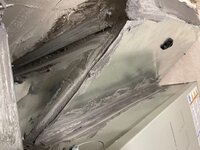
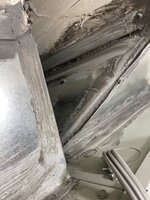
I'm thinking that the transition off the air handler with the new ductwork is at least part of the issue. I noticed it didn't look right (and sloppy). There seems to be a lot of turbulence from this area and more noise from the air handler closet. It's a severe angle, old air handler did not have this, was a straight shot to connect with rest of the ducts.

Is this an issueIMG_6017.jpg

See what you guys think:

IMG_6015.jpgIMG_6019.jpg
 
Last edited:

Gizzi

Well-known member
Joined
Oct 25, 2015
Messages
68
I'm thinking that the transition off the air handler with the new ductwork is at least part of the issue. I noticed it didn't look right (and sloppy). There seems to be a lot of turbulence from this area and more noise from the air handler closet. It's a severe angle, old air handler did not have this, was a straight shot to connect with rest of the ducts.

Is this an issueIMG_6017.jpg

See what you guys think:

IMG_6015.jpgIMG_6019.jpg

Not the best install I've seen. The duct mastic looks really thin and didn't cover joints all that great. Is that appliance cord powering the air handler? Hard to tell by the pics if the duct transition angle from the air handler is too steep. It could be contributing to higher static pressure in the ductwork if the back is as steep as the front. Looks like a tight space to fit an air handler.
 

danski0224

Well-known member
Joined
Jan 29, 2005
Messages
13,425
Location
Near Naperville, IL
That certainly looks like a first class installation... :ROFLMAO:

It pains me to see work like that, especially when someone paid for that level of workmanship. :(
 
Last edited:

Wrench97

Well-known member
Joined
Jun 23, 2018
Messages
12,103
Location
Southeastern Pa
But you were saying earlier a single speed would be even louder?

I'm saying worse case scenario, put the air handler with the same specs back in (single speed, 3.5 ton). Shouldn't the noise levels be back to where they were?
More likely then not you will not find a unit with the same specs, especially if moving from R22 to R410a and up in Seer rating.
Seems with A/C equipment nothing is ever a "drop in" replacement........................................
 

PoorUB

Well-known member
Joined
Mar 29, 2021
Messages
11,640
Location
Fargo, ND
A duct transition coming off from an air handler such as that needs to transition slowly. The longer the better, within reason. If it transitions to fast it just causes a bunch of turbulence in the supply and you actually lose some air flow, and crates noise. I would like to see 3-4 feet, but sometimes you do what you gotta do.

A better picture of the supply would help, but that transition looks like a CFM killer.
 

Terry D

Well-known member
Joined
Mar 25, 2015
Messages
2,202
Location
St. Louis, MO.
I don't want to offend you but that sheet metal work is terrible. Is the return coming up from the bottom. Is it sitting on a return air box. Can you post some pictures standing back some to get the whole unit including the return. And all sides. Thanks
 
OP
T

TangoFoxTrot

Well-known member
Joined
Jan 23, 2009
Messages
1,961
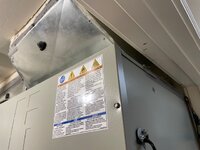
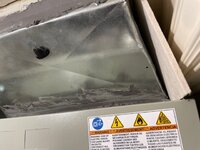
The more I look at it, the worse it looks. I can literally stick my finger inside where the sheet metal has such a large separation.
They're sending a "seasoned tech" out to take a look. Would have liked the "seasoned tech" to have done the install.

I don't know if this is all of my problems, but it definitely needs to be redone.

IMG_6028.jpg

IMG_6025.jpgIMG_6024.jpg
 

Gizzi

Well-known member
Joined
Oct 25, 2015
Messages
68
That sheet metal looks like it was folded on the edge of a ladder or something... Apparently these guys never heard of a portable brake. Is that a twinned air handler? I can't see where the return is based on the picture angles.
 

Terry D

Well-known member
Joined
Mar 25, 2015
Messages
2,202
Location
St. Louis, MO.
That sheet metal looks like it was folded on the edge of a ladder or something... Apparently these guys never heard of a portable brake. Is that a twinned air handler? I can't see where the return is based on the picture angles.
Thats the same reason i was wanting pictures of the whole unit
 
To avoid these ads, REGISTER NOW!
Top Bottom