To avoid these ads, REGISTER NOW!

New drill bit set

gizardlizard

Well-known member
Joined
Aug 29, 2019
Messages
726
Location
Madison, WI
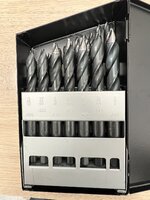
Just picked up this new 29 piece set from Astro. Anybody else try it yet? First impressions: they work awesome for hand drilling and self center really well. They don’t leave the cleanest of holes but if your simply looking for a thru hole, they’re fine. Not sure if I can get them sharpened just anywhere. They have flats on the shank to prevent spinning in the chuck. Will report back after more use at work with them. IMG_1531.jpeg
 
To avoid these ads, REGISTER NOW!

GeoBruin

Well-known member
Joined
May 5, 2018
Messages
3,737
Just picked up this new 29 piece set from Astro. Anybody else try it yet? First impressions: they work awesome for hand drilling and self center really well. They don’t leave the cleanest of holes but if your simply looking for a thru hole, they’re fine. Not sure if I can get them sharpened just anywhere. They have flats on the shank to prevent spinning in the chuck. Will report back after more use at work with them. from back when they IMG_1531.jpeg
I have the 29 piece set from back when they did a BOGO with the smaller set (shortly after they first released them). I've posted elsewhere about my positive experiences with them but in short, I really like them. I especially like that they seem to make rounder holes when hand drilling vs the trilobed holes I often get with regular 135 degree split points.

I am concerned about sharpening them but I figure that's a cross that bridge when I come to it type issue. I think astro said here that they'll sell individual replacements so I suppose I could just replace my most used sizes all at once.
 

AJHD

Well-known member
Joined
Jan 4, 2020
Messages
3,014
Location
AZ
I have some individual bits I got from Astro and some others from Matco.
I need to buy a full set one of these days. They are outstanding bits.

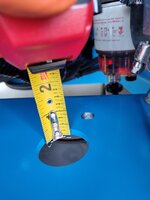
I used them working at CAT. We used a handful of specific sizes for installing disconnect switches. Everything we drilled through was minimum 1/4" thick hard as **** steel. Attached picture is an example.
 

Attachments

  • IMG_20221123_082157.jpg
    IMG_20221123_082157.jpg
    375.3 KB · Views: 103

RoninB4

Well-known member
Joined
Jul 22, 2020
Messages
3,511
Location
Under My House
The self centering is a function of how they're ground, the same as any other drill. The included angle is much more shallow than standard geometry but that's something anybody could grind the if they chose to. The serrated cutting edges are similar to a "hogging" end mill, also sometimes called a "corn cob" end mill and is used for roughing large amounts of metal in a milling machine as it uses less cutting force. A standard end mill is required afterward to clean up the rough surface left behind by the "hogging" mill. This type of grind probably doesn't produce long stringy chip curls, instead (perhaps) producing smaller bits of metal than a continuous curl of metal. Pausing your drilling every few seconds negates long curls with a standard twist drill too. Sharpening/duplicating these serrated edges will be nearly impossible for the average homeowner and a giant PITA for even an experienced tool sharpener. A special form grinding wheel is needed to achieve clearance in the gullets or they'll just skate instead of cut. I could duplicate this but would chose not to, instead giving them a standard twist drill geometry grind. There may be a marginal advantage to the serrated cutting edge but it's not worth the time/trouble/cost to duplicate IMO.

If you already have a set and like them that's fine, I'm just saying the grind is a marginal gimmick that will not be duplicated when re-sharpening time comes around. No idea what they're made from, should be HSS. The flats on the end are a nice feature for some.
 
Last edited:

mhejl

Well-known member
Joined
Aug 7, 2015
Messages
328
Location
DFW Texas
I suspect these are OEM'd from Norseman. HJE has Molly coated singles under Norseman "Vortex" bits.

I like mine, the Vortex-branded set, too.
 

msbytes

Well-known member
Joined
Apr 4, 2008
Messages
52
I picked up the Matco set last week, haven't had a chance to use them yet. A little more money, but lifetime warranty on sizes larger than 1/4in.
 

GeoBruin

Well-known member
Joined
May 5, 2018
Messages
3,737
I suspect these are OEM'd from Norseman. HJE has Molly coated singles under Norseman "Vortex" bits.

I like mine, the Vortex-branded set, too.
It has been discussed elsewhere that these are not made by Norseman. In fact, I think it goes something like they were Astro's design, but they licensed the design to Matco (or whoever makes them for Matco, maybe Norseman) and because of some issue, Astro was not able to manufacture them under their own name. It was recently resolved, and Astro was able to begin manufacturing them, but I don't believe they are made in the US.

Sorry if I botched the details. Someone who knows the story should chime in.
 

AA/FC

Well-known member
Joined
Dec 9, 2010
Messages
2,080
I'm sure they're very nice but damn, they're proud of them that's for sure. I just looked at their current pricing and as of right now, that 29 piece set from Astro is $217.06 on Amazon. That's a lot of money for Chinese drill bits. The "made in USA" Norseman version of that same 29 piece set is currently $172.95 on Amazon.

Astro 29 piece set:

Norseman 29 piece set:

If I was buying new drill bits today, I'd have a hard time paying more for Chinese bits, when I can get pretty much the exact same set manufactured in the USA for $45 bucks less. (roughly)

Don't get me wrong, I have nothing against Astro Tools..... but something just doesn't add up, at least to me anyway.
 

GeoBruin

Well-known member
Joined
May 5, 2018
Messages
3,737
I'm sure they're very nice but damn, they're proud of them that's for sure. I just looked at their current pricing and as of right now, that 29 piece set from Astro is $217.06 on Amazon. That's a lot of money for Chinese drill bits. The "made in USA" Norseman version of that same 29 piece set is currently $172.95 on Amazon.

Astro 29 piece set:

Norseman 29 piece set:

If I was buying new drill bits today, I'd have a hard time paying more for Chinese bits, when I can get pretty much the exact same set manufactured in the USA for $45 bucks less. (roughly)

Don't get me wrong, I have nothing against Astro Tools..... but something just doesn't add up, at least to me anyway.
According to CCC, the Astro set jumped up like $50 recently. I wonder why.
 

Attachments

  • amazon.png
    amazon.png
    33.2 KB · Views: 93

shanker

Well-known member
Joined
Jun 27, 2005
Messages
1,259
Location
Portland, TX
I purchased the Norseman version of these and used them for the first time recently and like them so far. The only reason why I purchased Norseman over Astro was that they were advertised as made in the USofA
 

Astro_Pneumatic_Tools

Well-known member
Joined
Oct 30, 2013
Messages
2,108
Location
South El Monte
We don't set sale prices, not sure why the recent jump or if it's a temporary bump. Our cost to retailers has not changed. It usually means they are just running low on stock, but we have more.
As for the price in general of these, they are indeed expensive to manufacture compared to a normal twist drill and just personally in my opinion especially so when you're the original source with multiple patents and others are just riding the train with copies until litigation puts an end to the party.
 

msbytes

Well-known member
Joined
Apr 4, 2008
Messages
52
We don't set sale prices, not sure why the recent jump or if it's a temporary bump. Our cost to retailers has not changed. It usually means they are just running low on stock, but we have more.
As for the price in general of these, they are indeed expensive to manufacture compared to a normal twist drill and just personally in my opinion especially so when you're the original source with multiple patents and others are just riding the train with copies until litigation puts an end to the party.
Is there any warranty or can you purchase them separate.
 

Astro_Pneumatic_Tools

Well-known member
Joined
Oct 30, 2013
Messages
2,108
Location
South El Monte
Is there any warranty or can you purchase them separate.
The only ones that carry a warranty to my knowledge are under Matco brand.
We carry replacement singles of the larger 2 rows, and I believe 3 or 5pcs packs of the 1st small row (just due to shipping not scaling well on a 3/32" drill bit). We also cover defect with free replacements which is like something happening on first use such as chipping or breaking.
Generally speaking, if you show me a picture of a smoked one in a DM here and contend you weren't doing anything stupid I send out replacements though - not that this is a written out policy per-say, but I do what i can.
 

shanker

Well-known member
Joined
Jun 27, 2005
Messages
1,259
Location
Portland, TX
We don't set sale prices, not sure why the recent jump or if it's a temporary bump. Our cost to retailers has not changed. It usually means they are just running low on stock, but we have more.
As for the price in general of these, they are indeed expensive to manufacture compared to a normal twist drill and just personally in my opinion especially so when you're the original source with multiple patents and others are just riding the train with copies until litigation puts an end to the party.

I'm all for manufacturers protecting their investment via the patent process. I'm also a very happy Astro customer, but I just want to make sure it's noticed, that the ONLY reason I purchased the Norseman bits vs. Astro bits was due to the advertised country of origin. If litigation brings and end to patent infringements until it expires; I'm great with that, but bring the manufacturing home for the the real victory please.
 

Zewnten

Well-known member
Joined
Jun 11, 2017
Messages
1,803
Tried them didn't find them to cut any better than a quality HSS bit. Seemed to dull as fast as a HSS bit but couldn't be sharpened.
 
To avoid these ads, REGISTER NOW!

99LeCouch

Well-known member
Joined
Apr 18, 2011
Messages
1,053
Location
Rochester, NY
I got a set of the Norseman Vortex bits. They drilled straight and true through a nylon wheel hub to enlarge it. Can't wait to try the larger ones on a slatwall installation in a month.
 

AJHD

Well-known member
Joined
Jan 4, 2020
Messages
3,014
Location
AZ
Tried them didn't find them to cut any better than a quality HSS bit. Seemed to dull as fast as a HSS bit but couldn't be sharpened.

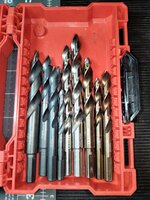
Interesting. I had the exact opposite experience. I also broke several "normal" bits, but yet to break any of these. I'm also still on the 1st bit in each size, I have not needed to replace them with a new bit due to dullness.

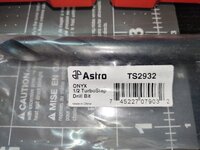
As for COO, none of my Astro branded or Matco branded bits are marked USA (or China). But my unopened Astro bits are marked "made in China" on the package.

So I have to speculate that someone is possibly infringing on a patent, because I fail to see why Astro would manufacturer bits in China under Astro and Matco, and also manufacturer the same bits under a different brand in the USA.
 

Attachments

  • IMG_20230823_000927.jpg
    IMG_20230823_000927.jpg
    1 MB · Views: 38
  • IMG_20230823_001147.jpg
    IMG_20230823_001147.jpg
    640 KB · Views: 37

F-22

Well-known member
Joined
Jan 23, 2022
Messages
1,830
I question what is actually patented. A German brand sell them too. I recently found out about these made in Germany by Ruko.
Ultimately, I doubt what you can actually patent about a drill bit since it is such an old product.

The Ruko are much more affordable at 91€ for the HSS-Co5 (not just normal HSS), but I don't know about the warranty.
 

F-22

Well-known member
Joined
Jan 23, 2022
Messages
1,830
Just checked Matco. 614$ for a cobalt drill bit set ??? I understand it has a few more bits but that's just disgusting.

I don't know how many sizes you need for automotive work in USA. Here in Europe you typically need a 5, 6, 8 and 10mm for the equivelant screw holes. A 4, 7 and 8.5 if you want to also be able to make threaded holes. That's about it, unless you need something very specific in which case regular drill bits would suffice just as well!
 

AJHD

Well-known member
Joined
Jan 4, 2020
Messages
3,014
Location
AZ
I question what is actually patented. A German brand sell them too. I recently found out about these made in Germany by Ruko.
Ultimately, I doubt what you can actually patent about a drill bit since it is such an old product.

The Ruko are much more affordable at 91€ for the HSS-Co5 (not just normal HSS), but I don't know about the warranty.

A patent attorney would have to answer that question and more... Where is the line drawn to say your product is unique enough to have its own patent and not infringe on an existing patent? Also how does US patent law apply to countries outside the US?


Just checked Matco. 614$ for a cobalt drill bit set ??? I understand it has a few more bits but that's just disgusting.

I don't know how many sizes you need for automotive work in USA. Here in Europe you typically need a 5, 6, 8 and 10mm for the equivelant screw holes. A 4, 7 and 8.5 if you want to also be able to make threaded holes. That's about it, unless you need something very specific in which case regular drill bits would suffice just as well!

Yeah, that's an insane amount. However a few things to keep in mind...

Matco is a tool truck. That set is also Cobalt, not just HSS. So they're going to be more expensive. Their HSS offerings are also more than buying the Astro set from Amazon for example.

Warranty also needs to be considered. Astro may warranty their bits, but it's going to be online or phone call and replacements will be mailed out. If you have a Matco dealer at your shop, you can warranty bits on the truck. After all, that's one selling point for all tool trucks.

As for number of bits you need, that all depends on the person and what they do. As I said in an earlier post, I only needed a handful of sizes and picked up individual bits, not a whole set. Your mileage may vary.
 

Jure

Well-known member
Joined
Jun 1, 2011
Messages
1,766
Location
Croatia
They are great,as long as you can match the speed if using them on a hand held drill. Wurth also sells them and i'm think OEM for Wurth is Rukko,a bit pricey (like $10 for 7.5 mm single drill bit) but worth every penny. I am not sure if Wurth's are HSS or HSSCo,but sicne they are kinds goldish in color i doubt they are plain HSS.
 

RoninB4

Well-known member
Joined
Jul 22, 2020
Messages
3,511
Location
Under My House
I also broke several "normal" bits, but yet to break any of these.
-Without intending to be insulting I must tell you that if you "broke" a drill bit made from HSS then your drilling technique is probably wrong. Drills break most often when the cutting lip snags on something, like when breaking out the other side. You can't just shove a drill through something. Better to back-up what's being drilled with a piece of wood to prevent the cutting edges grabbing the last bit of material being drilled through. Either that or, if using a DP or milling machine, use the quill stop to gradually cut the last few 1/64's through. Pushing a drill through material is almost guaranteed to snag/break the drill. There's also a tendency for the drill to "grab" when drilling brass but that's not the topic here. PM me if you'd like a solution to that.
I have not needed to replace them with a new bit due to dullness.
-A HSS drill run at the proper RPM should last for 100's of holes unless you were running it too fast. I'd just about bet you were running the drill too fast for the material. Different materials require different RPM. I've posted about this several times with simple solutions for this.
 

AJHD

Well-known member
Joined
Jan 4, 2020
Messages
3,014
Location
AZ
-Without intending to be insulting I must tell you that if you "broke" a drill bit made from HSS then your drilling technique is probably wrong. Drills break most often when the cutting lip snags on something, like when breaking out the other side. You can't just shove a drill through something. Better to back-up what's being drilled with a piece of wood to prevent the cutting edges grabbing the last bit of material being drilled through. Either that or, if using a DP or milling machine, use the quill stop to gradually cut the last few 1/64's through. Pushing a drill through material is almost guaranteed to snag/break the drill. There's also a tendency for the drill to "grab" when drilling brass but that's not the topic here. PM me if you'd like a solution to that.

-A HSS drill run at the proper RPM should last for 100's of holes unless you were running it too fast. I'd just about bet you were running the drill too fast for the material. Different materials require different RPM. I've posted about this several times with simple solutions for this.

Correct. The bits I broke got snagged and snapped either the tip or back towards the drill chuck.

As for dulling, I tried different speeds to find the balance between speed and "ease of drilling." I also used drilling lubricant.

I'm an amateur at best when it comes to drilling, especially hard steel.
 

RoninB4

Well-known member
Joined
Jul 22, 2020
Messages
3,511
Location
Under My House
Correct. The bits I broke got snagged and snapped either the tip or back towards the drill chuck.
-That's the nature of breaking through when drilling, happens even to the "professionals" too. Also happens on weldments. Did I explain the part about using the quill stop with a drill press or milling machine well enough? Hope so but tell me if I'm not. For use with a hand drill there's not much you can do to control the "feed" so using a scrap 2x4 as a backing should help. There is a technique for setting a stop with your hands but would take to long to explain here. I could explain why the "snag" occurs but that's not important. Drill breakage has almost nothing to do with the drill material itself and almost everything to do with the drilling technique. When about to break-through, reduce pressure a lot and use the peck method (interrupted) method. For drilling brass there's a type of blunting of the edges with a small stone to avoid "snagging". I can explain further whenever you want to hear it.
As for dulling, I tried different speeds to find the balance between speed and "ease of drilling." I also used drilling lubricant.
-With HSS drills a quick method of estimating speed is to watch the flutes. When the flutes just start to disappear you're close to the correct speed. The second method (better) for steel, is to watch the chips/curls coming out of the hole. If they're yellow you're running a bit too fast. If the chips/curls are purple/royal blue/light blue you're running waaaaay to fast and may have already burned/dulled the drill. I also recommend cutting oil over dry machining. Yes it makes more of a mess but in addition to helping the cutting process it offers another telltale sign of speed. If you're smoking up the cutting fluid there's a lot of heat involved, perhaps too much. Optimum cutting speed will smoke the fluid but when I don't have exact speed control (hand drilling) I prefer to keep the smoke to a minimum. That will be slower than optimum speed but it ensures that I don't burn up the drill/cutter and don't need a re-sharpening. Material also makes a difference. Aluminum and white metals can be at speeds almost flat out. Mild steel use the suggestions I made above. Yellow metals can be run almost as fast as the white metal (alumina-bronze being the exception). Red metals (copper/bronze alloys) need to be drilled carefully and by the charts as the different alloys can cause unique problems (hole shrinking and grabbing the entire drill). Non-magnetic stainless steel (300 series) can be a PITA and needs to be run slow or it work-hardens and makes the job a lot more difficult. Run it about half the speed of mild steel and absolutely use a cutting fluid or it galls or it can seize the drill, breaking it half off in the hole. Magnetic stainless steel (400 series) machines about like any alloy steel in the soft state. Use chip/curl color as your guide. Thickness of what's being drilled is almost an entire discussion topic by itself. Ask me if you wish to....you'll be sorry you did.
I'm an amateur at best when it comes to drilling, especially hard steel.
-Nothing wrong with being an amateur, I was when I started in the shop too. If the steel is truly heat treated for hardness (48-52 Rc or above) this calls for special techniques AND likely special drills/equipment. Not to be approached casually by the amateur and often difficult for even the professional. After 30+ years in machine shops there's probably a few things I could still learn about drilling. You're willing to "empty your cup" and admit this, which makes you more open to learning than those that think they know enough already. If my post has helped then it was worth me sharing my experience with you/others. If you have questions about drilling/machining either start a thread or PM me in private. Hope this helps somebody.
 
Last edited:

neophyte

Well-known member
Joined
Apr 23, 2012
Messages
9,585
Location
Pennsylvannia
I question what is actually patented. A German brand sell them too. I recently found out about these made in Germany by Ruko.
Ultimately, I doubt what you can actually patent about a drill bit since it is such an old product.

The Ruko are much more affordable at 91€ for the HSS-Co5 (not just normal HSS), but I don't know about the warranty.
The Ruko bits appear to be a different design.
The Ruko design is similar, but the steps appear to be curved and scalloped rather than straight walled.
I would suspect Ruko is very specifically trying to avoid potential Patent violation, while producing a similar bit, whereas whoever in the US is producing the design, may just think the patent was wrongly issued and is taking their chances with possible litigation.
 

Zewnten

Well-known member
Joined
Jun 11, 2017
Messages
1,803
@RoninB4
Maybe you can answer my question. The best drill bits I've used, they are a brownish maybe a bit of red color. Stay sharper than anything others and drills even hardened steel fine. But they're just labeled HSS not cobalt or anything special that I can find.
 

RoninB4

Well-known member
Joined
Jul 22, 2020
Messages
3,511
Location
Under My House
@RoninB4
Maybe you can answer my question. The best drill bits I've used, they are a brownish maybe a bit of red color. Stay sharper than anything others and drills even hardened steel fine. But they're just labeled HSS not cobalt or anything special that I can find.
-There are materials that would drill through hardened steel (Ferro-tic comes to mind) but since yours are marked HSS that leaves Ferro-tic out. Besides, Ferro-tic is difficult to machine and expensive, can't see anybody making a set for anybody but NASA. There are some tool steels that it could be made from. HSS is somewhat of a generic classification as there two main groups of HSS. The following is just a clumsy overview a metallurgist would find lacking.

Tungsten High Speed Steel- first type developed around the turn of the last century, there are at least 7 different flavors now

Molybdenum High Speed Steel- Molybdenum was substituted to preserve the elements in the above group and lower the cost. I have 18 different compositions listed in Machinery's Handbook (20th edition) from 1979, there may be more that's been developed since then.

The Tungsten group was the preferred material for decades, it was regarded as the material for a superior cutting tool due to it's hot hardness and abrasion resistance index. T-1 was, and may still be, relatively unchanged in composition since the turn of the last century. The development of T-5 had substantial more cobalt in it, making it even better suited for tools taking a fine cut. The last development that I've worked with is T-15, considered the transition steel between ordinary HSS and cemented carbides. It makes a terrific cutting tool but it's a real b*tch to grind, very low grindability index. The cost is also prohibitive, suitable for custom made cutters in special machines.

The Molybdenum group was developed (as I understand it) due to the rapidly rising cost of the elements used in the Tungsten Group. The substitution worked fairly well for most applications and cobalt was also added just like the Tungsten Group for the same reasons. I'd be willing to bet that most general purpose cutting tools (like twist drills) are made with the Molybdenum based recipes.

Makers are always playing with the recipes for steel, trying to hold down the cost of a good cutting tool while struggling with machinability, safety/depth of hardening, decarb and stability of shape in heat treatment. It's a balancing act and not an easy one either. If the cutting tools is made in the 3rd world then there's no telling how often the recipe has been "tweaked". To add further confusion the addition of coatings (TiN, and a dozen more that I'm aware of) has come in vogue the last 30 years. The coatings do have a demonstrated advantage but once the coating is ground off it's just whatever the base metal is now. IMO I feel that many of the cheap drills from the 3rd world use an inferior steel and compensate for this with a flash coating. So those TiN coated drills are cheap for a good reason, inferior steel or sub-standard heat treating. I've used several types of coatings in stamping dies and they work well until the coating begins to shear/wear off. After that it should be considered a disposable tool due to several problems that won't interest anybody but another die maker.

To the OP- If you feel they're a better make of drill I'd use them selectively, there's a chance (especially if they're vintage drills) that they're made from the Tungsten Group. It may simply be that there's more cobalt in them (like T-5) and that may account for the color. They may also have received a better heat treatment, which is almost more important than the cutting material itself. Inconsistent or sub-par heat treatment (hardening and multiple tempering cycles) produces an inferior cutter no matter what it's made from. If I were you I'd get a cheaper set of drills for daily duty and save the better drills for those special jobs that need a better drill.

As a side note, if the steel you're drilling is truly hardened/tempered higher than Rc 56-58 you aren't going to get far drilling with HSS. If a file won't cut it you need carbide, CBN, ceramic, or some other exotic material. I do have more to say on this subject but I feel it would bore most of the members. I hope this helped.
 
Last edited:

CR888

Well-known member
Joined
Feb 19, 2017
Messages
1,198
-There are materials that would drill through hardened steel (Ferro-tic comes to mind) but since yours are marked HSS that leaves Ferro-tic out. Besides, Ferro-tic is difficult to machine and expensive, can't see anybody making a set for anybody but NASA. There are some tool steels that it could be made from. HSS is somewhat of a generic classification as there two main groups of HSS. The following is just a clumsy overview a metallurgist would find lacking.

Tungsten High Speed Steel- first type developed around the turn of the last century, there are at least 7 different flavors now

Molybdenum High Speed Steel- Molybdenum was substituted to preserve the elements in the above group and lower the cost. I have 18 different compositions listed in Machinery's Handbook (20th edition) from 1979, there may be more that's been developed since then.

The Tungsten group was the preferred material for decades, it was regarded as the material for a superior cutting tool due to it's hot hardness and abrasion resistance index. T-1 was, and may still be, relatively unchanged in composition since the turn of the last century. The development of T-5 had substantial more cobalt in it, making it even better suited for tools taking a fine cut. The last development that I've worked with is T-15, considered the transition steel between ordinary HSS and cemented carbides. It makes a terrific cutting tool but it's a real b*tch to grind, very low grindability index. The cost is also prohibitive, suitable for custom made cutters in special machines.

The Molybdenum group was developed (as I understand it) due to the rapidly rising cost of the elements used in the Tungsten Group. The substitution worked fairly well for most applications and cobalt was also added just like the Tungsten Group for the same reasons. I'd be willing to bet that most general purpose cutting tools (like twist drills) are made with the Molybdenum based recipes.

Makers are always playing with the recipes for steel, trying to hold down the cost of a good cutting tool while struggling with machinability, safety/depth of hardening, decarb and stability of shape in heat treatment. It's a balancing act and not an easy one either. If the cutting tools is made in the 3rd world then there's no telling how often the recipe has been "tweaked". To add further confusion the addition of coatings (TiN, and a dozen more that I'm aware of) has come in vogue the last 30 years. The coatings do have a demonstrated advantage but once the coating is ground off it's just whatever the base metal is now. IMO I feel that many of the cheap drills from the 3rd world use an inferior steel and compensate for this with a flash coating. So those TiN coated drills are cheap for a good reason, inferior steel or sub-standard heat treating. I've used several types of coatings in stamping dies and they work well until the coating begins to shear/wear off. After that it should be considered a disposable tool due to several problems that won't interest anybody but another die maker.

To the OP- If you feel they're a better make of drill I'd use them selectively, there's a chance (especially if they're vintage drills) that they're made from the Tungsten Group. It may simply be that there's more cobalt in them (like T-5) and that may account for the color. They may also have received a better heat treatment, which is almost more important than the cutting material itself. Inconsistent or sub-par heat treatment (hardening and multiple tempering cycles) produces an inferior cutter no matter what it's made from. If I were you I'd get a cheaper set of drills for daily duty and save the better drills for those special jobs that need a better drill.

As a side note, if the steel you're drilling is truly hardened/tempered higher than Rc 56-58 you aren't going to get far drilling with HSS. If a file won't cut it you need carbide, CBN, ceramic, or some other exotic material. I do have more to say on this subject but I feel it would bore most of the members. I hope this helped.

I enjoy reading your info on drill bits, composition of metals and technique. My drilling experience is very low but Ive noticed my HSS Australian made Sutton Viper drill set is completely different to say my Chinese made HSS Bosch drills. Big differenc in price and performance. I think there is quite a huge margin of quality/performance between 'HSS' drill sets. Certainly with the more price range Chinese made ones.
 

F-22

Well-known member
Joined
Jan 23, 2022
Messages
1,830
How do you sharpen them when they get dull?
That's the main issue - you don't. I think you should be able to get a cobalt HSS drill set for less than even the Astro bits, and you can resharpen them. If you resharpen the Astros you'll just get a generic face. To resharpen to that shape would be way too expensive.

With the ~90€ Ruko cobalt ones, for the fancy grind at least you only pay ~20€ more than their standard cobalt drill bits set costs, and then you can continue to grind them like standard drill bits.
 

AA/FC

Well-known member
Joined
Dec 9, 2010
Messages
2,080
<snip>
As for the price in general of these, they are indeed expensive to manufacture compared to a normal twist drill and just personally in my opinion especially so when you're the original source with multiple patents and others are just riding the train with copies until litigation puts an end to the party.
I'd like to hear more about this. Astro invented them, yet others started making and selling them long before Astro had their own version available? Weird.

I can't believe Norseman (Viking Drill and Tool) located in St. Paul Minnesota is knowingly making and selling a product that is under current patent litigation. Stranger things have happened, I guess...

There has to be more to the story? And of course there is always TWO two sides to every story...
 

F-22

Well-known member
Joined
Jan 23, 2022
Messages
1,830
I really doubt they can just patent a certain kind of a drill bit grind. There's nothing terribly unique about the drill bits, weirdly sharpened drill bits were literally used for a century for specifical industrial needs. And the big step dril bit designed for sheet metal is also basically using the same "tip", except that it's very large and has no further flute for deep holes. Or a shoulder drill bit for making allen heads hide into the material.

Patents are often just simply used as a form of advertisement, trying to say the company is using something unique that you can't get anywhere else on the market.

You can patent stuff that are "novel, not obvious and useful". Modern twist drill bits exist for over a century, they are a very mature product so patents are typically about very minor differences that are probably extremely hard and costly to enforce.
 

RoninB4

Well-known member
Joined
Jul 22, 2020
Messages
3,511
Location
Under My House
I'd like to hear more about this. Astro invented them,

-Well that's a stretch to say they "invented" this. They're using a variation of what spade drills have been using for decades. Mix in the profile of the "corn cob" roughing end mills and you can see there's not really anything new, it's just been combined. The idea of creating non-continuous chips has been around for a long time.

No offense to Astro Tool intended.
 

RoninB4

Well-known member
Joined
Jul 22, 2020
Messages
3,511
Location
Under My House
Ive noticed my HSS Australian made Sutton Viper drill set is completely different to say my Chinese made HSS Bosch drills. Big differenc in price and performance. I think there is quite a huge margin of quality/performance between 'HSS' drill sets. Certainly with the more price range Chinese made ones.
-Astute observation. I would also agree that there's a wide margin of performance difference with many of the drill sets offered on the market. The material a drill is made from gets the somewhat generic "HSS" designation but is it a "T Group" an "M Group" or something else? For that matter what particular flavor of those groups is it? Each one has particular characteristics and an appropriate price, that's why they were developed in the first place. I certainly can't tell what it's made from by looking at it regardless of what the marking says. If it's made from one of the "T Group" steels the manufacturer would want that known to justify the higher price tag. The cheap TiN coated drills from the 3rd world should be regarded, for the most part, as just marketing BS. Avoid purchasing these imposters of the real thing.

Next we move to heat treating. This can make/break the tool performance. I've heat treated a lot of tool steels and it's not a casual process. The more exotic the tool steel the more stringent the guidelines for time/temperature for hardening. The tempering that follows is a bit more relaxed but equally important to follow the guidelines, often requiring multiple tempering cycles to achieve the desired potential.

The average consumer doesn't know or doesn't care about all this. What they see/read is what makes the sale. Marketing tosses in a few buzzwords, makes an attractive package, and price points to what they think the demographic audience will pay. "All things are equal except the price" is the mantra of the misinformed. For drilling wood, aluminum, or the occasional mild steel project I guess it really doesn't matter how good the drill is. It's only when drilling for production quantities or more problematic materials that a better quality drill is really needed.

I still recommend getting a cheap set for drilling the easier materials and saving your good set for the tougher jobs. Disposable, throw-away drills don't make much sense to me for what I do. I can see where it might make sense on some jobs where time is money but I don't put myself in a position where I need to work that way. Do what works for you.
 
To avoid these ads, REGISTER NOW!
Top Bottom