@RoninB4
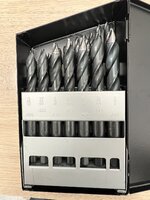
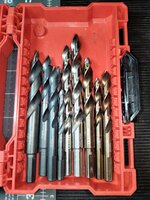
Maybe you can answer my question. The best drill bits I've used, they are a brownish maybe a bit of red color. Stay sharper than anything others and drills even hardened steel fine. But they're just labeled HSS not cobalt or anything special that I can find.
-There are materials that would drill through hardened steel (Ferro-tic comes to mind) but since yours are marked HSS that leaves Ferro-tic out. Besides, Ferro-tic is difficult to machine and expensive, can't see anybody making a set for anybody but NASA. There are some tool steels that it could be made from. HSS is somewhat of a generic classification as there two main groups of HSS. The following is just a clumsy overview a metallurgist would find lacking.
Tungsten High Speed Steel- first type developed around the turn of the last century, there are at least 7 different flavors now
Molybdenum High Speed Steel- Molybdenum was substituted to preserve the elements in the above group and lower the cost. I have 18 different compositions listed in Machinery's Handbook (20th edition) from 1979, there may be more that's been developed since then.
The Tungsten group was the preferred material for decades, it was regarded as the material for a superior cutting tool due to it's hot hardness and abrasion resistance index. T-1 was, and may still be, relatively unchanged in composition since the turn of the last century. The development of T-5 had substantial more cobalt in it, making it even better suited for tools taking a fine cut. The last development that I've worked with is T-15, considered the transition steel between ordinary HSS and cemented carbides. It makes a terrific cutting tool but it's a real b*tch to grind, very low grindability index. The cost is also prohibitive, suitable for custom made cutters in special machines.
The Molybdenum group was developed (as I understand it) due to the rapidly rising cost of the elements used in the Tungsten Group. The substitution worked fairly well for most applications and cobalt was also added just like the Tungsten Group for the same reasons. I'd be willing to bet that most general purpose cutting tools (like twist drills) are made with the Molybdenum based recipes.
Makers are always playing with the recipes for steel, trying to hold down the cost of a good cutting tool while struggling with machinability, safety/depth of hardening, decarb and stability of shape in heat treatment. It's a balancing act and not an easy one either. If the cutting tools is made in the 3rd world then there's no telling how often the recipe has been "tweaked". To add further confusion the addition of coatings (TiN, and a dozen more that I'm aware of) has come in vogue the last 30 years. The coatings do have a demonstrated advantage but once the coating is ground off it's just whatever the base metal is now. IMO I feel that many of the cheap drills from the 3rd world use an inferior steel and compensate for this with a flash coating. So those TiN coated drills are cheap for a good reason, inferior steel or sub-standard heat treating. I've used several types of coatings in stamping dies and they work well until the coating begins to shear/wear off. After that it should be considered a disposable tool due to several problems that won't interest anybody but another die maker.
To the OP- If you feel they're a better make of drill I'd use them selectively, there's a chance (especially if they're vintage drills) that they're made from the Tungsten Group. It may simply be that there's more cobalt in them (like T-5) and that may account for the color. They may also have received a better heat treatment, which is almost more important than the cutting material itself. Inconsistent or sub-par heat treatment (hardening and multiple tempering cycles) produces an inferior cutter no matter what it's made from. If I were you I'd get a cheaper set of drills for daily duty and save the better drills for those special jobs that need a better drill.
As a side note, if the steel you're drilling is truly hardened/tempered higher than Rc 56-58 you aren't going to get far drilling with HSS. If a file won't cut it you need carbide, CBN, ceramic, or some other exotic material. I do have more to say on this subject but I feel it would bore most of the members. I hope this helped.