To avoid these ads, REGISTER NOW!

New house wanting 400A service for future shop - load breakdown help

mikewire

Active member
Joined
Aug 4, 2014
Messages
39
Location
SATX
Hi all, just getting started on a new house, we are about 6 months in. It's time to get the electrical built out so I'm working with the local provider (local electrical co-op) and engineering technician to get the build out started. A little background and context: I'm on 2 acres, house is about 80ft from the road, 3000 sq. ft. house with attached garage and we'll also have propane. Power currently available at the road, and we'll need a transformer installed. The elec. meter is required to be on the house, out of sight - I have chosen a location for the meter and the transformer.

Here's the thing - in the next 5 years I want to build a 1500-2000 sq. ft. shop behind the house, I'm guessing it will be about 50-100ft away from the house/meter. Because I want to build a shop later, and I want to have one meter, I'm requesting 400A service. The co-op has no problem doing this but they are asking me for a load breakdown analysis and provided me a form to fill out and return to the engineer so the build out can be designed and installed.

Currently I have broken down each room, # of outlets for 120V and 240V, and have a rough calculation amps x volts = watts (and kW /1k) for the entire build of the house and attached garage. so I have some good info.

But where I need some help is figuring out how to fill out each section calculating load on this form (in kW), and I'm a bit lost at this point.

Has anyone done this exercise and maybe have an example they could share? Or point me to something for reference?

Appreciate any help!!
 
Last edited:
To avoid these ads, REGISTER NOW!

Norcal

Well-known member
Joined
Mar 16, 2008
Messages
13,753
Hi all, just getting started on a new house, we are about 6 months in. It's time to get the electrical built out so I'm working with the local provider (local electrical co-op) and engineering technician to get the build out started. A little background and context: I'm on 2 acres, house is about 80ft from the road, 3000 sq. ft. house with attached garage and we'll also have propane. Power currently available at the road, and we'll need a transformer installed. The elec. meter is required to be on the house, out of sight - I have chosen a location for the meter and the transformer.

Here's the thing - in the next 5 years I want to build a 1500-2000 sq. ft. shop behind the house, I'm guessing it will be about 50-100ft away from the house/meter. Because I want to build a shop later, and I want to have one meter, I'm requesting 400A service. The co-op has no problem doing this but they are asking me for a load breakdown analysis and provided me a form to fill out and return to the engineer so the build out can be designed and installed.

Currently I have broken down each room, # of outlets for 110 and 220, and have a rough calculation amps x volts = watts (and kW /1k) for the entire build of the house and attached garage. so I have some good info.

But where I need some help is figuring out how to fill out each section calculating load on this form (in kW), and I'm a bit lost at this point.

Has anyone done this exercise and maybe have an example they could share? Or point me to something for reference?

Appreciate any help!!
Note it is not appropriate to use 110 & 220 in the calculations use 120 & 240, back in the '70's 115/230 was required. You should have a copy of the NEC in effect where you live if your going to wire it according to this: https://www.mikeholt.com/technical-nec-menu.php if Texas is correct your on the 2023 NEC, & follow the calculations there, the information should be able to transfer over to the PoCo form.
 
OP
M

mikewire

Active member
Joined
Aug 4, 2014
Messages
39
Location
SATX
Thanks, noted and I'll use those values for my calculations. I'm in IT and a technical person so trying to learn the language and understanding of the basic concepts here. I've done wiring in the multiple houses we've owned over the years so I know the basics but this is kinda hard for me to wrap my arms around. Getting there though.

What am I supposed to be looking for in that link? I don't see any resources there other than info on the NEC licensing board...what am I missing.
 
OP
M

mikewire

Active member
Joined
Aug 4, 2014
Messages
39
Location
SATX
Ok appreciate any additional replies - here's how I calculated the load breakdown:

3000sq/ft house x 4.8W = 14400W
Small appliances = 14400W
Large appliances (dryer, oven, hot tub, welder) = 40800W
HVAC = 14400W

That totals to 84000
Divide by 240V
Watts/Volts = Amps | 84000W / 240V = 350A

Does that all make sense? Seems like it may be overkill on the estimation?

Should justify the install for 400A service - any thoughts are appreciated.
 

dave*99

Well-known member
Joined
May 5, 2009
Messages
4,259
Location
Coastal NJ
Ok appreciate any additional replies - here's how I calculated the load breakdown:

3000sq/ft house x 4.8W = 14400W
Small appliances = 14400W
Large appliances (dryer, oven, hot tub, welder) = 40800W
HVAC = 14400W

That totals to 84000
Divide by 240V
Watts/Volts = Amps | 84000W / 240V = 350A

Does that all make sense? Seems like it may be overkill on the estimation?

Should justify the install for 400A service - any thoughts are appreciated.
Looks like your calculations assume every one of those items will all be turned on simultaneously.
Google "residential load calculation worksheet" and you will see many loads are factored at 25%, 35% etc.

Here is an example - I can't vouch for the quality of this example but it illustrated the concepts in play.


dcg9381

Well-known member
Joined
Jun 20, 2018
Messages
11,705
Location
Austin, TX
I have a very similarly sized property. When I built, I opted for 320A service - which is basically 2 x 200A mains that split.
I think the load calculations that can be done are very "ambitious" in terms of power use, probably by design. Then again, many power companies require them.

I've checked the reality of our property draw by using a device installed on the main (Vue). Our power peaks are 15-17KW, so we could easily get by with 200A service. I'm in a hot climate, so we see a lot of HVAC draw. Largest draws are actually during very infrequent (once every 2-5 years) cold snaps where aux heat kicks in (if I let it). I've seen few homes that need 400A, but if your options are 200 or 400A, I'd probably go the way you're leaning too.
 

Innovate1

Well-known member
Joined
Jul 28, 2014
Messages
4,287
Location
Illinois near St. Louis, Missouri
When I built the POCO just suggested a 320A service and meter base when I told them I was planning to add a large detached garage. No calcs needed. In you case can you include the loads in the future garage? Seems like the only way you are going to justify the larger service when doing the derating of other loads not being 100%
 
OP
M

mikewire

Active member
Joined
Aug 4, 2014
Messages
39
Location
SATX
Looks like your calculations assume every one of those items will all be turned on simultaneously.
Google "residential load calculation worksheet" and you will see many loads are factored at 25%, 35% etc.

Here is an example - I can't vouch for the quality of this example but it illustrated the concepts in play.


Oh yeah, I won't have that much running concurrently for sure. Although if I have 400A service with 240V, that would be 96000W of total max capacity so 25% capacity would be 24000W. Good call out!

That's a great link, I'll use it to help guestimate - thanks!!


I have a very similarly sized property. When I built, I opted for 320A service - which is basically 2 x 200A mains that split.
I think the load calculations that can be done are very "ambitious" in terms of power use, probably by design. Then again, many power companies require them.

I've checked the reality of our property draw by using a device installed on the main (Vue). Our power peaks are 15-17KW, so we could easily get by with 200A service. I'm in a hot climate, so we see a lot of HVAC draw. Largest draws are actually during very infrequent (once every 2-5 years) cold snaps where aux heat kicks in (if I let it). I've seen few homes that need 400A, but if your options are 200 or 400A, I'd probably go the way you're leaning too.

Agreed, and without the future shop plans I would just go with 200A service. But since another building that's 1/2 the size of the house will be built I want to future-proof as much as possible. Also to add, we will have propane as well as electric, so we are hoping to get as much as possible on propane since it's much cheaper to operate.

When I built the POCO just suggested a 320A service and meter base when I told them I was planning to add a large detached garage. No calcs needed. In you case can you include the loads in the future garage? Seems like the only way you are going to justify the larger service when doing the derating of other loads not being 100%

It's the POCO that's requiring the load breakdown, since it's over the standard 200A service. Yep, there's a section on the POCO's form that asks for future load, so I'm adding that into the equation as well which helps explain the 400A service request. Also talking with the POCO Engineer, who has been super helpful, this is what he did with his property and house, so he's cool and will know exactly what I'm looking to do - just getting past the formalities of submitting the required forms.
 

dave*99

Well-known member
Joined
May 5, 2009
Messages
4,259
Location
Coastal NJ
Oh yeah, I won't have that much running concurrently for sure. Although if I have 400A service with 240V, that would be 96000W of total max capacity so 25% capacity would be 24000W. Good call out!
Just to be clear.....
The factoring kind of goes the other way. Just for argument sake, consider this...

Is you came up with 96kW of load devices in your house presuming they would all be on simultaneously. Then considered the fact that with WON'T be on simultaneously so a 25% rating was appropriate, you would need 24kW of service capacity.

Alternately, turn that math around and assume you have 96kW service and your stuff only runs 25% of the time, you could accommodate 384kW of load devices (running sporadically) in your house/shop. Of course it's a little more complicated than that. And that's why the load calc. sheet has different derating factors for different devices.

Do keep in mind your intended use of your shop. Is it a one man shop? You can't weld, use the plasma cutter, milling machine and air compressor simultaneously. Well, the plasma cutter and compressor do run together.... But this is a key part of the considerations. You have propane for heat today. That lowers electric demand. There is a push toward using heat pumps for everything.

All this begs careful thought to today and future usage. So it's great you are going through the exercise.
 

rwreuter

Well-known member
Joined
Feb 21, 2011
Messages
243
Location
Mulvane, Kansas
You know why they are doing this right?

I had a similar issue when building my house, I told them what my future plans are and that I wanted an upsized (25kva) transformer so there would be no issue in the future. The complied.

Now as far as the 400amp service, unless you are planning on some insane equipment and operating all that equipment at the same time, 3 phase and such you don't need a 400amp service.

What you really are looking for is breaker space. Just get a 60 space 200amp panel and you will have what you want, if you need more space put a sub panel in. As far as the future detached garage is concerned, put a large 100amp or 200amp sub panel in the garage if you want off the main panel. You can also request a meter that has multiple lugs on it so you can run wire underground from the meter to the new detached garage.
 

ratflinger

Well-known member
Joined
Jul 7, 2016
Messages
322
Location
South Central Texas
What kind of equipment do you have in the shop? I have a 2500sqft house and a 1200sqft shop. I have a 240v compressor & a 240v plug for my welder. Also have a 4-post 120v lift and a Delta table saw. Various other things. All this runs off of one 200a service. Constant load at your house is probably 50a, I think you are over thinking this.
 

American Locomotive

Well-known member
Joined
Jan 8, 2017
Messages
10,947
Location
Rhode Island
84KW is an immense amount of power. I think your estimations are very high.

Large Appliances:
Dryer: 5kW (Large dryer, Max heat)
Range: 15kW (Premium dual-oven electric range with literally every burner and both ovens on)
Hot Tub: 6kW (Pump and heaters running at once)
Welder: 7.5kW (Miller Multimatic 220 @ Full Power)

That's 33.5kW, vs your estimated 40.8. And what are the odds you would be having all 4 of those machines going, at full power, simultaneously? It's a scenario that will basically never happen.

Small Appliances:
14.4 kW is a monumental amount of power for "small appliances". That's 8 high-powered hair dryers running at once, or 12 microwaves, or 18 coffee makers, or 40 refrigerators. I honestly don't think it's really possible for a residential home to hit 14.4kW in "small appliance" power consumption unless there were 6 kitchens and 30 people living there.

A more "realistic" "peak" small appliance load would be more like 5kW, IMO. Hair dryer, toaster, microwave, coffee maker, fridge/freezer, blender - somehow running all at once.

"House":
"3000sq/ft house x 4.8W = 14400W", where is this even coming from, and what does that even mean? Is that things like lights and random stuff people might have plugged in? 14.4kW is a ludicrous number for the random widgets and doodads someone might plug in. 14.4 kW is enough power for 72 PlayStation 5s, or about 140 70" televisions or 1,400 "75W Equivalent" LED light bulbs.

In a modern house with LEDs, I think you would be hard-pressed to exceed 500w total lighting load - even with an attached shop. Add a few TVs, computers, game console, maybe someone using a vacuum cleaner - and I think your peak "House" load would really be around 2kW

HVAC:

14400W for HVAC sounds very high since you said you have propane for heat. At most, I would expect a modern 5 ton AC system (typical 3,000 square foot home system) to consume about 5kW.

--------------------------
So I'm calculating about 45.5kW or about 190A. If you get a gas range/oven, you're down to 127A. Add a gas dryer on top of that and now you're at 106A.
 

wyliesdiesels

Well-known member
Joined
Aug 14, 2012
Messages
19,998
Location
Modesto, CA
You know why they are doing this right?

I had a similar issue when building my house, I told them what my future plans are and that I wanted an upsized (25kva) transformer so there would be no issue in the future. The complied.

Now as far as the 400amp service, unless you are planning on some insane equipment and operating all that equipment at the same time, 3 phase and such you don't need a 400amp service.

What you really are looking for is breaker space. Just get a 60 space 200amp panel and you will have what you want, if you need more space put a sub panel in. As far as the future detached garage is concerned, put a large 100amp or 200amp sub panel in the garage if you want off the main panel. You can also request a meter that has multiple lugs on it so you can run wire underground from the meter to the new detached garage.
that would be the meter pan. but its not a good idea to have that much unfused wire on a property...
 
OP
M

mikewire

Active member
Joined
Aug 4, 2014
Messages
39
Location
SATX
Update, I submitted the load breakdown to the POCO last night, just want to get this submitted and schedule the buildout. If they don't like any of it, they will come back and ask for more information.

I ended up estimating the breakdown to about a full total of 65kW, which is still quite high but I feel could be somewhat realistic if we have parties or visitors and guests and things are full-tilt at the house. Odds of that happening are very low.

All replies are appreciated! Even the snarky ones :) See my replies in line, and my note at the bottom for more info...


Just to be clear.....
The factoring kind of goes the other way. Just for argument sake, consider this...

Is you came up with 96kW of load devices in your house presuming they would all be on simultaneously. Then considered the fact that with WON'T be on simultaneously so a 25% rating was appropriate, you would need 24kW of service capacity.

Alternately, turn that math around and assume you have 96kW service and your stuff only runs 25% of the time, you could accommodate 384kW of load devices (running sporadically) in your house/shop. Of course it's a little more complicated than that. And that's why the load calc. sheet has different derating factors for different devices.

Do keep in mind your intended use of your shop. Is it a one man shop? You can't weld, use the plasma cutter, milling machine and air compressor simultaneously. Well, the plasma cutter and compressor do run together.... But this is a key part of the considerations. You have propane for heat today. That lowers electric demand. There is a push toward using heat pumps for everything.

All this begs careful thought to today and future usage. So it's great you are going through the exercise.

Great info, yes it's great exercise and so far I've learned a lot about the design and electrical requirements. I've also had to fill in a lot with unknowns and guestimates, since I have no info on the appliances we are getting installed other than the basics, plus adding in future growth (hot tub, shop, etc.) - it's all one large guestimate.


include "future" EV charging station(s) for load calc as justification for 320a

Good call. I'm not planning on going EV any time soon, but if they end up dominating the market and we buy one or two, then as some point we'll need some charging endpoints. I have 2x 240V in the garage planned for that.

You know why they are doing this right?

I had a similar issue when building my house, I told them what my future plans are and that I wanted an upsized (25kva) transformer so there would be no issue in the future. The complied.

Now as far as the 400amp service, unless you are planning on some insane equipment and operating all that equipment at the same time, 3 phase and such you don't need a 400amp service.

What you really are looking for is breaker space. Just get a 60 space 200amp panel and you will have what you want, if you need more space put a sub panel in. As far as the future detached garage is concerned, put a large 100amp or 200amp sub panel in the garage if you want off the main panel. You can also request a meter that has multiple lugs on it so you can run wire underground from the meter to the new detached garage.

Yes, I know exactly why they are doing this - mainly because it's required by them for any request over 200A...but I've talked with the engineer and am directly involved in the buildout since my builder is not handling it for me. Mainly going this way for a single meter on the house for simplified billing etc. for when we build the shop. And yes, we are planning on an upsized transformer so I'm with you there, as well accommodating for additional sub-panel(s) and breaker space for future growth. They way I see it, it's 200A for the house, 200A for the (future) shop.

What kind of equipment do you have in the shop? I have a 2500sqft house and a 1200sqft shop. I have a 240v compressor & a 240v plug for my welder. Also have a 4-post 120v lift and a Delta table saw. Various other things. All this runs off of one 200a service. Constant load at your house is probably 50a, I think you are over thinking this.

Welder (220V) and a QuickJack (120V), compressor (120V for now) and various points for charging tool batteries. Yes...I am overthinking it, that's one of my superpowers :)

If I can get ahead of the future growth items now and accommodate it during the new build, I'm hoping to have reduced cost and stress when it comes time to build the shop and add anything else to the 2 acre property.


84KW is an immense amount of power. I think your estimations are very high.

Large Appliances:
Dryer: 5kW (Large dryer, Max heat)
Range: 15kW (Premium dual-oven electric range with literally every burner and both ovens on)
Hot Tub: 6kW (Pump and heaters running at once)
Welder: 7.5kW (Miller Multimatic 220 @ Full Power)

That's 33.5kW, vs your estimated 40.8. And what are the odds you would be having all 4 of those machines going, at full power, simultaneously? It's a scenario that will basically never happen.

Small Appliances:
14.4 kW is a monumental amount of power for "small appliances". That's 8 high-powered hair dryers running at once, or 12 microwaves, or 18 coffee makers, or 40 refrigerators. I honestly don't think it's really possible for a residential home to hit 14.4kW in "small appliance" power consumption unless there were 6 kitchens and 30 people living there.

A more "realistic" "peak" small appliance load would be more like 5kW, IMO. Hair dryer, toaster, microwave, coffee maker, fridge/freezer, blender - somehow running all at once.

"House":
"3000sq/ft house x 4.8W = 14400W", where is this even coming from, and what does that even mean? Is that things like lights and random stuff people might have plugged in? 14.4kW is a ludicrous number for the random widgets and doodads someone might plug in. 14.4 kW is enough power for 72 PlayStation 5s, or about 140 70" televisions or 1,400 "75W Equivalent" LED light bulbs.

In a modern house with LEDs, I think you would be hard-pressed to exceed 500w total lighting load - even with an attached shop. Add a few TVs, computers, game console, maybe someone using a vacuum cleaner - and I think your peak "House" load would really be around 2kW

HVAC:

14400W for HVAC sounds very high since you said you have propane for heat. At most, I would expect a modern 5 ton AC system (typical 3,000 square foot home system) to consume about 5kW.

--------------------------
So I'm calculating about 45.5kW or about 190A. If you get a gas range/oven, you're down to 127A. Add a gas dryer on top of that and now you're at 106A.

This is great info! Yes my estimations were very high, when I started this I pretty much had no clue but as I researched and read more I learned quickly that was way too high and to dialed it down. Even with what I submitted it's still high from a total consumption level but it's reasonable and it's now in the POCO hands to schedule and build out.

That looks a lot like the size of the breakers for those circuits. Not their factored power consumption.

You would be correct. I then dialed it back based on calculations after researching wattages per device/appliance.

It's all good for now, don't beat on me too bad - a couple of days ago I was lost, that's why I came here asking for some help, and now I have a little more knowledge and understanding than I used to, so thanks all that replied. I didn't expect the forum to be this active, but I'm glad it is!

If anyone wants to follow along with the house/garage build the thread is here: https://www.garagejournal.com/forum...n-hill-country-700sq-ft.520505/#post-10274494
 

ratflinger

Well-known member
Joined
Jul 7, 2016
Messages
322
Location
South Central Texas
If you really want 400a service then I'd bet you can get CPS to give it to you. When I lived N of SA had 200a on the hosue, but all underground and no easy way to get that power to the new shop. I explained this and they allowed a second meter on the shop. That might be a way to go - 2 meters.
 
OP
M

mikewire

Active member
Joined
Aug 4, 2014
Messages
39
Location
SATX
If you really want 400a service then I'd bet you can get CPS to give it to you. When I lived N of SA had 200a on the hosue, but all underground and no easy way to get that power to the new shop. I explained this and they allowed a second meter on the shop. That might be a way to go - 2 meters.

It's not CPS I'm dealing with but an electrical co-op. The co-op has no problem delivering the 400A service, I simply have to send in a load breakdown with my application. I'm outside SA city limits...so no city taxes etc., but close enough to enjoy the city life when I want to. Without giving away my location, if you know SATX well enough you could probably guess where I am building.

Ratflinger - you know this, but others may not, so let me explain to those reading that don't have the experience of living in Texas Hill Country - the area landscape is mostly made up of limestone. Our property lies directly on top of this limestone, with not a lot of topsoil and the foundation sits on top of the limestone. What that means is that it's quite an expense to trench and/or dig into the ground because the limestone has to be broken up in chunks and moved about with heavy equipment.

I could have chosen to go with 2 meters (one now and one on the shop later), but after talking with the Engineer, we decided to go with one meter for a couple of reasons: one, a single meter will reduce the costs later - the shop will be (most likely) be closer to the house than the transformer will be, so it will cost less if we come off the house and trench to the new shop rather than coming from the transformer later. Two, having one meter also simplifies billing since they only have to read one meter, not two, plus I receive one bill. Three, when they build the new service out it will cost just a bit more per ft. for the 400A cabling/wiring but the buildout labor costs are the same, so it would cost less now than it will in the future if I were to go from 200A to 400A (also, costs will never decrease), so let's go 400A from the get-go and save in the long run.

I figure I get one shot to get as much correctly built out for future plans, so I'd rather pay a bit more to get it done they way I want it for future growth.
 
To avoid these ads, REGISTER NOW!

dcg9381

Well-known member
Joined
Jun 20, 2018
Messages
11,705
Location
Austin, TX
Mike, does your co-op do 320A service? Apparently the parts/cost availability of this can be better. You get the same 2 panels as 400A.

Yea, it's a real Beeeotch to dig out here. 250' took me two days with a rock saw just creeping along... Just to get to 24".
 
OP
M

mikewire

Active member
Joined
Aug 4, 2014
Messages
39
Location
SATX
Mike, does your co-op do 320A service? Apparently the parts/cost availability of this can be better. You get the same 2 panels as 400A.

Yea, it's a real Beeeotch to dig out here. 250' took me two days with a rock saw just creeping along... Just to get to 24".

Good question, I'm betting they can, but all I talked about with the engineer is 400A. Mainly because I was asking about 200A for the house and 200A for the shop, later when it's time.

So I'm curious, can you tell me more about the parts availability and cost? Like, what components would be specialized for 400A?
 

dcg9381

Well-known member
Joined
Jun 20, 2018
Messages
11,705
Location
Austin, TX
So I'm curious, can you tell me more about the parts availability and cost? Like, what components would be specialized for 400A?
I'll let one of the sparkies chime in, but my understanding is that there was a problem with 400A component availability and a big jump in price. I don't know if that has changed, but I've seen people fairly recently complain about it.

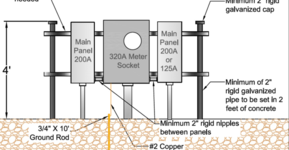
This is the design of a "standard" 320A setup from my co-op.

1692388624403.png

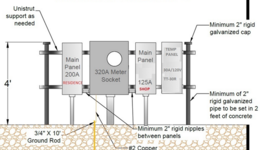
I deviated from that when I built a little bit, what I built is below. The shop is actually on a 90A breaker. Shop is 48K of AC, a hot tub, refrigerator, and multiple RV hookups, welder, and has an EV drop, 2400 feet of cooled space.. I do have 6kw of solar helping out, but I've never needed 90A of power. I do not cool the shop full time.

The temp panel is 60A - that's what we used for construction, it's still out there.

1692388893398.png
 
OP
M

mikewire

Active member
Joined
Aug 4, 2014
Messages
39
Location
SATX
This is awesome info. As of yet I don't have a price for install - first up is a staking appointment, which is scheduled TBD so I should know soon.

Also, I'm pretty sure I will be fine with 125A to the shop.
 

u3b3rg33k

Well-known member
Joined
Dec 18, 2017
Messages
4,048
Provided you don't have to pay a higher monthly fee for a bigger service, might as well "go big." that said, it's important to understand your load calcs, or you'll lose an argument with the power company.
 

mm08822

Well-known member
Joined
Jan 13, 2012
Messages
5,895
Location
NJ
The calcs you have are showing full circuit loading and all circuits running at the same time. You have 4.8w/sqft when 3w/sgft was used for incandescents. 2w/sgft is plenty with leds. If propane use is eminant, than why bother with electric appliances?
I'm sure 320A metermain would be fine allowing you two panels in the house (more for cb space) and could run the 125A to the shop. I'd put 40 space panels in all 3 locations.

You really need to consider simultaneous loads vs. total of all loads. This what diversity factors are for. Just b/c a panel has a certain rating, does not mean the combined loading of 3 panels will exceed 320A. My 200A service sees about 8amps routinely w/o ac running, maybe 30 with ac running. (NG appliances and heat.)

Even doubling the size of house or shop does not mean doubling its load......just becomes a bigger place to store ****.
 
OP
M

mikewire

Active member
Joined
Aug 4, 2014
Messages
39
Location
SATX
Provided you don't have to pay a higher monthly fee for a bigger service, might as well "go big." that said, it's important to understand your load calcs, or you'll lose an argument with the power company.

Residential didn't pay any additional, but you reminded me they charge $15 per meter, per month, so there was another reason to go with one meter.

Help me understand what you mean, what kind of argument would I lose with the power company? Not sure what you mean there.
 

mike93lx

ALLIANCE MEMBER
Joined
Dec 9, 2013
Messages
37,479
Location
Richmond, VA
Residential didn't pay any additional, but you reminded me they charge $15 per meter, per month, so there was another reason to go with one meter.

Help me understand what you mean, what kind of argument would I lose with the power company? Not sure what you mean there.
They won't just install whatever you want. You have to support it with the right load calc.
 

rwreuter

Well-known member
Joined
Feb 21, 2011
Messages
243
Location
Mulvane, Kansas
that would be the meter pan. but its not a good idea to have that much unfused wire on a property...
It was just an option that I provided. The NEC allows it though. I think he is making a mountain out of a mole hill, but hey, it is his house and his money and if I was the Electrical Contractor, sure I will put a 400 amp service in for ya, but do you know how much it is going to cost over a 200 amp? ALOT!
 

rwreuter

Well-known member
Joined
Feb 21, 2011
Messages
243
Location
Mulvane, Kansas
They won't just install whatever you want. You have to support it with the right load calc.
I guess that makes sense because they don't want to have an unnecessarily large transformer going to waste. Guess I was fortunate when I put mine in, they didn't balk hardly at all.
 

u3b3rg33k

Well-known member
Joined
Dec 18, 2017
Messages
4,048
They won't just install whatever you want. You have to support it with the right load calc.
I put 200A service in my garage. I told them I was gonna use the plasma cutter + air compressor (about 40A), charge two EVs at the same time (40A cont *2), while running a 5kW space heater (21A). total 140A draw, 200A gives you 160A continuous. pretty sure 200A is standard for new around here, but they asked, so I told them.
 

mike93lx

ALLIANCE MEMBER
Joined
Dec 9, 2013
Messages
37,479
Location
Richmond, VA
I put 200A service in my garage. I told them I was gonna use the plasma cutter + air compressor (about 40A), charge two EVs at the same time (40A cont *2), while running a 5kW space heater (21A). total 140A draw, 200A gives you 160A continuous. pretty sure 200A is standard for new around here, but they asked, so I told them.
They get the shenanigans, but if a box exists, it must be checked.
 
OP
M

mikewire

Active member
Joined
Aug 4, 2014
Messages
39
Location
SATX
I put 200A service in my garage. I told them I was gonna use the plasma cutter + air compressor (about 40A), charge two EVs at the same time (40A cont *2), while running a 5kW space heater (21A). total 140A draw, 200A gives you 160A continuous. pretty sure 200A is standard for new around here, but they asked, so I told them.

Exactly this, they just want the justification and to verify load for the service - I get it. 10 years down the road it's possible I could be charging two vehicles at the same time in there. We'll for sure have a hot tub installed at the back of the house and I'll hopefully have the shop all built out. Compressor, welder etc. plus my Wife being all domestic I want to have all the availability and capacity.

Thanks all for the help here, it's been insightful at the least!
 

dcg9381

Well-known member
Joined
Jun 20, 2018
Messages
11,705
Location
Austin, TX
I guess that makes sense because they don't want to have an unnecessarily large transformer going to waste. Guess I was fortunate when I put mine in, they didn't balk hardly at all.
Here they install 15K transformers, these can feed several homes - no cost difference.. I think on the consumer side, you'll be hit for the 400A panels and associated wire, that's what's going to impact you.
 

mike93lx

ALLIANCE MEMBER
Joined
Dec 9, 2013
Messages
37,479
Location
Richmond, VA
You figure 3W per square ft. for general receptacle and lighting loads = 9000W
I get it's the standard, but damn, I couldn't even come up with 9kw of stuff to turn on if I take out major appliances. That's a lot of lights, tv's, computers and cell phone chargers.
 

alfredeneuman

Well-known member
Joined
Mar 3, 2011
Messages
4,580
Location
Fullerton, CA
I get it's the standard, but damn, I couldn't even come up with 9kw of stuff to turn on if I take out major appliances. That's a lot of lights, tv's, computers and cell phone chargers.
I forgot to add that the first 3000W are figured @ 100%
The remaining 6000 should be figured @ 35% =2100W
So 3000+2100=5100W, not 9000 as I mentioned above.
Sorry about that.
 
To avoid these ads, REGISTER NOW!
Top Bottom