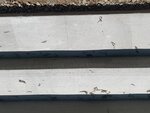
AgreedThe contractor joke about concrete is that "it's grey and it cracks."
Looks fine, just a small shrinkage crack. Unless it's some fancy museum-quality architecturally exposed structural concrete, this is normal.
Agreed--looks great with the lines of the house, and I like the multi-levels.No comment on the concrete, but I really like that patio!
Thanks for the input. The mix didn't look overly wet, actually drier than I expected to see, but I think you hit the nail on the head re shrinkage as the steps were poured after the upper part and were constrained by it.shrinkage cracks. nothing you can do about it now. its from excess water in the mix not required for cement hydration that evaporates off. The resulting reduction in volume (as the water evaporates) causes internal tension in the concrete as it shrinks. cracks form perpendicular to direction of tension stresses from shrinkage. you'll get them at points of the shrinkage restraint such as the corner of your step, probably corners of the slab, or around openings, etc.
Only thing you could have done was keep the concrete wet for no less than 3 days but preferably more like 7 days. that would have allowed the concrete strength (f'c) to have risen substantially before the shrinkage occured (as the excess water evaporated) and may have resulted in less noticable cracking. As an example, I put a lawn sprinkler on my concrete pool ~ 1 hour after they were done finishing the shell and let it run for a week. Even after shutting off the sprnkler and the pool shell drying out (before plaster finish) I never saw a single crack. They are probably there just way finer and not readily visible. I pity the fool that tries to remove that pool (famous last words; it will probably be me)
Most don't reailze this, but to get the rated strength of a mix design (f'c), you have to "cure" the concrete which generally means keeping it wet or spraying compounds on it that stop the evaporation of excess water. Your patio will be fine becuase its not a structural element supporting loads. But proper concrete work includes the curing step which is rarely done outside of commercial construction.
Huh, I thought that was a joke.Agreed--looks great with the lines of the house, and I like the multi-levels.
If you did get fired up, that's a perfect surface to go over with slate or porcelain (as someone mentioned).
Thanks for the compliments, I actually came up with the idea.No comment on the concrete, but I really like that patio!
...Thanks for the compliments, I actually came up with the idea...
The mix doesn't have to be "overly wet" to end up with shrinkage. Pretty much all mixes that exactly follow the mix design will have extra water for just hydration because the exact amount of water needed for full hydration of the cement would make the mix so stiff as to be completely unworkable. So as a rule, mixes include more water than is necessary for complete hydration. Theoretically you could have just enough water for hydration and add a bunch of plasticizers for workability and not have any shrinkage (because there is no water to evaporate) but that would be very expensive concrete because chemicals cost lots more than water. There might also be practical limitations to this too such as making sure what little water is there comes in contact with all cement particles. So you have mixes that are a compromise on results, workability, cost, etc. and usually have more water than is needed for just hydration. And that extra water is going to evaporate causing changes in volumne and the resulting shrinkage.Thanks for the input. The mix didn't look overly wet, actually drier than I expected to see, but I think you hit the nail on the head re shrinkage as the steps were poured after the upper part and were constrained by it.
It was supposed to be cut the next day but we had scheduling issues and that would have probably prevented this. I didn't want expansion joints as they look like **** on a patio IMO and on the steps there would just be a big ugly gap in a few years.