To avoid these ads, REGISTER NOW!

New slab cracking concerns

kd3pc

Well-known member
Joined
Aug 10, 2013
Messages
3,630
Location
Northern Neck
Trying to learn something here.

I'll ask again.


Why would you want a polished floor in a shop?

it looks good, it holds up well to things that would otherwise stain, it looks good, it is very easy to clean, it is easy to clean up spills on, it is easy to find dropped parts (as long as they are not the same color as the floor), in a commercial shop, the customer expects it,

I am sure there are more
 
To avoid these ads, REGISTER NOW!

rburke65

Well-known member
Joined
Nov 10, 2007
Messages
12,349
Location
Canfield, Ohio
Ok...ill ask.... Why would you NOT want a polished floor in your shop? Great looking, shinny, reflects light, easy to sweep, clean looking...id like one
 
OP
B

BadMannerz

Well-known member
Joined
Mar 11, 2016
Messages
66
Ebfabman,

I did months of research on the floor finishing options and spent a lot of time on the phone with different people. Including quite a few sponsors of this forum. I went with the polishing for many reasons. Honestly, the wow factory was a large reason. As I said previously, when a customer shows up at your shop from hours away and wants to drop off his $100,000 pulling truck with you, I would like to have a professional looking outfit. When you can walk in a shop and see yourself in the floor....... It gives just about anybody a good feeling. They are easy to clean, mop, squeegy. No dust. No coating to chip or pop off. No coating to have weld spatter or slag melt into. No worries about tire lift or anything like that. Nothing to reapply (ever). They are not any more slippery when wet than an epoxy coating. I have worked in shops with unfinished concrete, epoxied, and polished. Polished is hands down my choice. Though not cheap.
 

lakeroadster

Well-known member
Joined
Jan 19, 2015
Messages
5,166
Location
Central Colorado
Ok...ill ask.... Why would you NOT want a polished floor in your shop? Great looking, shinny, reflects light, easy to sweep, clean looking...id like one

I wouldn't want that smooth of a surface in my working shop. Slicker than snot if there are fluids on the floor. Our concrete in the attached garage is smooth... every winter I nearly bust my ***..

But, to each their own. Looks nice!
 
Last edited:

brownbagg

Well-known member
Joined
Mar 20, 2006
Messages
5,208
Ok...ill ask.... Why would you NOT want a polished floor in your shop? Great looking, shinny, reflects light, easy to sweep, clean looking...id like one

because mine is a shop, that welds, grinds beat, drop, spill oil, antifreeze, slide heavy objects, full of dirt, dust, slag, because it would last less than a day. Im lucky to keep the spiders, lizards, and mice at bay
 
OP
B

BadMannerz

Well-known member
Joined
Mar 11, 2016
Messages
66
I'm not sure if everybody has read the entire post. This new space is attached to my old garage. The old shop space is where 95% of the welding, cutting, grinding, etc..... will take place. I doubt any of these guys would look at a polished concrete floor and say "I'm sure glad I don't have that"... LOL Everybody has their own opinions. Do you buy a house and then trash it just because its a space to live in?
 

lakeroadster

Well-known member
Joined
Jan 19, 2015
Messages
5,166
Location
Central Colorado
How much rebar is needed to prevent cracks?

That depends on how good... or bad... the sub-grade preparations and compaction is... as well as drainage, strength of concrete, where the building is located......

Bottom line is the entire foundation, sub-grade, reinforcing and concrete work as a system.

There are no shortcuts.
 

groovyjay

Well-known member
Joined
Oct 17, 2005
Messages
102
Location
Far Far Away
How much rebar is needed to prevent cracks?

You can use all the rebar in the world and still have cracks in your concrete. Imo there's no such thing as crack-free concrete floor. It's just matter of when and how bad the cracking will be. Nobody can guarantee a concrete slab that doesn't crack. eventually at some point every slab gets cracks, some smaller so larger. I think the OP's floor look amazing, too bad the crack is right there in the prime spot.
 

matt_i

Well-known member
Joined
Mar 14, 2008
Messages
10,722
Location
SE Michigan
How much rebar is needed to prevent cracks?

Imo you need both the rebar and 10-12' squares saw cut (or zip strip...those would seem economical to buy but painful to fit at intersections). I placed my rebar grid 16" oc. I want to say its roughly 1lb of steel per 1sqft of floor (1200# iirc and 1100sf). I am intending heavy useage with forklifts and machine tools.
 

walrus

Well-known member
Joined
Nov 12, 2008
Messages
11,674
Location
Maine
That depends on how good... or bad... the sub-grade preparations and compaction is... as well as drainage, strength of concrete, where the building is located......

Bottom line is the entire foundation, sub-grade, reinforcing and concrete work as a system.

There are no shortcuts.
This is the whole key, Just like many projects, the prep work makes the job come out well.
 

walrus

Well-known member
Joined
Nov 12, 2008
Messages
11,674
Location
Maine
How much rebar is needed to prevent cracks?

Its the whole system that limits cracks not just rebar. Rebar keeps the cracks from displacing. The compacted base, the placement, the slump, the finishing, the curing process etc.
 

wssix99

Well-known member
Joined
Mar 2, 2011
Messages
5,155
Location
Chicago, IL
How much rebar is needed to prevent cracks?

0.5%+ of the cross sectional area is what PCA recommends. (Reference - Design of Slabs-on-Ground ACI360R-06)

^ This doesn't "prevent" cracks. That's effectively impossible - what it does is that all that rebar helps manage the tension in the slab and causes any cracking to be very small (thus more frequent) and spread out across the slab. The effect of this is such that you can't see the cracking.

There are some practical limitations with this:
- The rebar needs to be in the middle or in the upper part of the slab.
- The rebar should be evenly spaced in a square grid.
- 1.5" to 2" of cover should still be present over the rebar.
- Problematic features like reentrant corners will still cause major cracking.

^ So, to pull this off with #4 rebar, one would effectively need a 3.5+ inch slab with the rebar precisely in the middle of the slab.
 

wssix99

Well-known member
Joined
Mar 2, 2011
Messages
5,155
Location
Chicago, IL
When you can walk in a shop and see yourself in the floor....... It gives just about anybody a good feeling. They are easy to clean, mop, squeegy. No dust. No coating to chip or pop off. No coating to have weld spatter or slag melt into. No worries about tire lift or anything like that. Nothing to reapply (ever). They are not any more slippery when wet than an epoxy coating. I have worked in shops with unfinished concrete, epoxied, and polished. Polished is hands down my choice. Though not cheap.

This is good to know. You could also fill the cracks with a non-shrinking repair mortar. (Ardex makes products like this, for one http://www.ardexamericas.com/en-us/Products/engconrep/Pages/EngineeredConcreteRepairSystems.aspx) Then, you could go back and re-polish. This would give you "veins" at the cracks, but I wouldn't think they would be all that visible, particularly if you get a company who really knows what they are doing and can add dyes to the mix to match the color of your existing floor.

^ The key would be to get one of these non-shrinking polymer repair mortars as regular cement products would just shrink in the cracks and spall out. Our contractor used this stuff to fill our saw-cut joints and expansion joints before epoxy coating three years ago and it's performing flawlessly.
 

James E

Well-known member
Joined
Jun 21, 2010
Messages
16,507
Location
Raleigh, NC
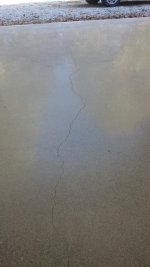
Based on your pic of the apron, showing that the crack goes all the way through the slab, this doesn't appear to me to be due to shrinkage during curing. Looks to me to be settling in the dirt underneath the slab. Plus, you say that one side has settled lower than the other, which reinforces my suspicion.

Was there any major grading, or especially filling, done to the site before the slab was poured?

The fact that you've got an apparent settling issue so soon after the pour makes me worry that this will continue to get worse.
 

ct03911

Well-known member
Joined
Jan 17, 2008
Messages
229
Location
Connecticut
I removed a 26x28 floor last fall that had a lot of cracks when I finally came to grips with the crappy job and sucked it up as part of finishing my garage.
My second concrete guy assured me I would never have cracks in my 26x28 4000psi fiber new floor. He said control cuts were unnecessary.
It was not a simple deal like cut it two ways or whatever. I could not be positive of my lift column position and it seemed every plan to cut could be close to my lift.
I finally agreed to no cuts.
It cracked.
So, now on my second floor - albeit with one crack vs lots of cracks and simply a bad pour - I have to just relax and deal with it.
My plan is to let it sit, it's been a year now but another winter is coming in CT, let it sit to the spring and see what I get.
Have a pro fill the cracks, expoxy it and move on.
My point is, we stress over this stuff. It just happens. The perfect pour and control cut is elusive really.
A proper crack repair can be done professionally once it's done moving and finish the surface and move on.
I feel your pain.
 

DougWil

Well-known member
Joined
Dec 29, 2015
Messages
545
Location
NW Montana
My second concrete guy assured me I would never have cracks in my 26x28 4000psi fiber new floor. He said control cuts were unnecessary.
It was not a simple deal like cut it two ways or whatever. I could not be positive of my lift column position and it seemed every plan to cut could be close to my lift.
I finally agreed to no cuts.
It cracked.

Hope your 2nd slab has rebar or heavy mesh and not just fiber.
Otherwise there is nothing to keep the cracks from growing and shifting in elevation.
 

Falcon67

Well-known member
Joined
Jun 11, 2009
Messages
18,371
Location
Merkel, TX
Trying to learn something here.

I'll ask again.


Why would you want a polished floor in a shop?

If it's flat within spec or better, after coating it becomes a giant surface plate. Great for chassis work, etc. The slab at the old shop was polished and slick like ice when wet. After etching and epoxy, it became a nice work surface.
 
To avoid these ads, REGISTER NOW!
OP
B

BadMannerz

Well-known member
Joined
Mar 11, 2016
Messages
66
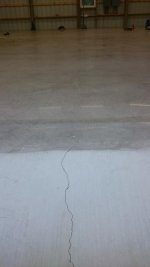
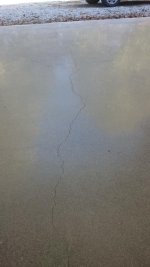
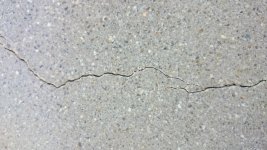
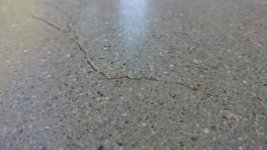
Here is an update with some pics. After notifying the builder that there was an issue with the slab he stopped answering his phone and will not return any of my calls or text messages. I have been documenting this and the main crack (the one that splits the entire slab) is getting wider and a step is forming. Other cracks are forming as with steps in them as well. There are now loose pieces of concrete where the clack is splitting off and coming back that you can wiggle and can be removed. One of the pics shows the elevation change at one location. Keep in mind that this slab is only 3 months old. Looks like this is going to become a court battle. I will send a certified letter with pictures this week to the builder. If he doesn't respond, I'm calling a lawyer.
 

Attachments

  • DSC_0301.jpg
    DSC_0301.jpg
    56.6 KB · Views: 109
  • DSC_0299.jpg
    DSC_0299.jpg
    40.3 KB · Views: 109
  • DSC_0300.jpg
    DSC_0300.jpg
    99.6 KB · Views: 109
  • DSC_0301(1).jpg
    DSC_0301(1).jpg
    56.6 KB · Views: 101
  • DSC_0302.jpg
    DSC_0302.jpg
    95 KB · Views: 101
  • DSC_0303.jpg
    DSC_0303.jpg
    98 KB · Views: 96
  • DSC_0305.jpg
    DSC_0305.jpg
    61.7 KB · Views: 93
Last edited:

ozyborn

Well-known member
Joined
Apr 26, 2011
Messages
684
Document everything, I mean everything. Contact a good lawyer for this.

As an earlier soul posted. I know enough to be dangerous but I am not a concrete expert. My garage slab is 26x35. I dug down 24" and used C6 with fine and compacted over and over for a few weeks. I had a lot of rebar so I used the 1" rebar in a raised grid. Then the 6" of 5000psi fiberglass reinforced. My contractor still used the control joints to help vs unwanted cracking.
 

DougWil

Well-known member
Joined
Dec 29, 2015
Messages
545
Location
NW Montana
Here is an update with some pics. After notifying the builder that there was an issue with the slab he stopped answering his phone and will not return any of my calls or text messages. I have been documenting this and the main crack (the one that splits the entire slab) is getting wider and a step is forming. Other cracks are forming as with steps in them as well. There are now loose pieces of concrete where the clack is splitting off and coming back that you can wiggle and can be removed. One of the pics shows the elevation change at one location. Keep in mind that this slab is only 3 months old.

Sounds like little to no compaction and little to no reinforcement.

Let me guess, only fibermesh. :mad:
 

brownbagg

Well-known member
Joined
Mar 20, 2006
Messages
5,208
any thing bigger than 10x 10 will crack without control joints. and yes that picture is a control joint crack
 

walrus

Well-known member
Joined
Nov 12, 2008
Messages
11,674
Location
Maine
any thing bigger than 10x 10 will crack without control joints. and yes that picture is a control joint crack
My slab is 30 by 34 with no control joints and no cracks.Proper compaction, #4 rebar, proper placement and proper curing
 

jkeyser14

Well-known member
Joined
Dec 19, 2008
Messages
1,816
Location
(rural) Maryland
any thing bigger than 10x 10 will crack without control joints. and yes that picture is a control joint crack

Asserting it will crack is wrong. I have had slabs 2-3x the size free of cracks in my house or friend's houses. Larger than 10x10 you are more likely to get cracks, but it is not a guarantee.
 

DougWil

Well-known member
Joined
Dec 29, 2015
Messages
545
Location
NW Montana
My slab is 30 by 34 with no control joints and no cracks.Proper compaction, #4 rebar, proper placement and proper curing

You have cracks, you just don't see them because they are small and the rebar keeps them from growing.
Wet the slab down and the cracks become visible because they retain water longer as the slab drys off.

Wet concrete, even a low slump mix shrinks as the water evaporates or is consumed by the hydration process.
If the slab is restrained in any way, by friction of the slab to base, rebar etc,,, it cracks.
It is physics.
 
Last edited:

lakeroadster

Well-known member
Joined
Jan 19, 2015
Messages
5,166
Location
Central Colorado
Sounds like little to no compaction and little to no reinforcement.

Let me guess, only fibermesh. :mad:

The fibermesh nazi strikes again.... :lol:

Are you working for the American Re-bar Association? JK

All kidding aside, it was good to see you mention compaction.

Without proper compaction... which is easily assured by testing that costs under $200, the concrete doesn't stand a chance.
 

DougWil

Well-known member
Joined
Dec 29, 2015
Messages
545
Location
NW Montana
The fibermesh nazi strikes again.... :lol:

Are you working for the American Re-bar Association? JK

No, but I can read Fibermesh's Data Report and understand that it is to be used as secondary reinforcement, so something else must be the primary reinforcement.

Gee, might that be REBAR! MESH! ??

Read it for yourself.
http://www.fibermesh.com/downloads/Fibermesh 300.pdf

Specifically engineered and manufactured in an ISO 9001:2000 certified facility to an optimum gradation for use as concrete secondary reinforcement at a minimum of 0.1% by volume (1.5 lbs/yd3, 0.9 kg/m3).


It does help reduce plastic shrinkage cracks, BUT it is no substitute for primary reinforcement and doesn't claim to be.
But that doesn't stop contractors everywhere from claiming otherwise.
 

brownbagg

Well-known member
Joined
Mar 20, 2006
Messages
5,208
Asserting it will crack is wrong. I have had slabs 2-3x the size free of cracks in my house or friend's houses. Larger than 10x10 you are more likely to get cracks, but it is not a guarantee.

I have work for a concrete testing lab for the last 32 years, anything over 10x10 without control joint will crack, It has nothing to do with your special one of a kind concrete mix than only you have, It has to do with the curling of the concrete as it hydrated. If you have not notice the cracks then you are one of the fortune choosen ones like hillary, but there are cracks there. Now not all cracks are settlement cracks and except being ugly are not a threat.

the 10x10 comes from ACI 318
 

rwilner

Well-known member
Joined
Apr 26, 2013
Messages
104
Location
Boston, MA
Fwiw:
I just poured a 48 x 22 slab in August.
The garage is 36x22, the last 12x22 is for my mudroom, which attaches the garage to the house.

I have what I consider the best concrete guy in the Boston area. Cracking here is almost unavoidable because of the huge humidity and temperature swings.

He told me to get a crack free slab, I needed 4" chairs, 6" thick, 5000 psi (!!!), And control joints cut across the slab every 12', plus a joint cut along the whole slab where the apron meets the main part.

In August is was 90 degrees, 100% humidity.

It's now 30 degrees, 10% humidity.

Only time will tell but no cracks yet.

Based on what you've written - you were set up for cracks by someone who either didn't know how to do it right or didn't take pride in their work.

Legal route is slow, painful and expensive. I hope you get it resolved quickly and correctly.

If you want to talk to my concrete guy pm me. He is the best anywhere.

Beautiful space you have there.
 

walrus

Well-known member
Joined
Nov 12, 2008
Messages
11,674
Location
Maine
You have cracks, you just don't see them because they are small and the rebar keeps them from growing.
Wet the slab down and the cracks become visible because they retain water longer as the slab drys off.

Wet concrete, even a low slump mix shrinks as the water evaporates or is consumed by the hydration process.
If the slab is restrained in any way, by friction of the slab to base, rebar etc,,, it cracks.
It is physics.
If I have to wet it down to see them, they don't exist. :) the slab is wet every winter when I melt ice and snow off vehicles, I still haven't seen a crack. I'm sure there may be small spider like cracks but I've never seen any crack that goes the length or width of slab. And no saw cuts, radiant on top of rebar
 

DougWil

Well-known member
Joined
Dec 29, 2015
Messages
545
Location
NW Montana
If I have to wet it down to see them, they don't exist. :) the slab is wet every winter when I melt ice and snow off vehicles, I still haven't seen a crack. I'm sure there may be small spider like cracks but I've never seen any crack that goes the length or width of slab. And no saw cuts, radiant on top of rebar


<iframe width="854" height="480" src="https://www.youtube.com/embed/QVGXUrKJVCU" frameborder="0" allowfullscreen></iframe>
Do the Laws of Physics not apply to your slab? LOL


Unless it is shrinkage compensating concrete, it shrinks as it cures.
Unless it is placed on a surface with little friction and no rebar or mesh to restrain the shrinkage and cause tension in the concrete it will crack because concrete, especially fresh concrete has very little tensile capacity.

Those small spider cracks that you do not see and do not exist :) are non uniform shrinkage or plastic cracks. If you had crack control joints you would have less random cracking.

The OP cracks probably are mostly from poor compaction, settling.
Compounded by a high water to cement ratio, the more water the more it shrinks.
And I bet any mesh he has is dinky and stepped on which pushed it to the bottom of the slab and is pretty much useless.

ACI paper on concrete shrinkage and the many factors that affect it.
http://www.civil.northwestern.edu/people/bazant/PDFs/Papers/R21.pdf :thumbup:
 
Last edited:

Kaizen

Well-known member
Joined
Jan 9, 2015
Messages
6,938
Location
New England
curious what the fix is for this? besides a total rip out would epoxy or some thing be injected in hopes it stopped it?
 

walrus

Well-known member
Joined
Nov 12, 2008
Messages
11,674
Location
Maine
curious what the fix is for this? besides a total rip out would epoxy or some thing be injected in hopes it stopped it?

Nothing is gong to stop it and with a polished floor I doubt he would accept it anyway. He has settlement issues by the looks of things and slab has already moved
 
OP
B

BadMannerz

Well-known member
Joined
Mar 11, 2016
Messages
66
Nothing is gong to stop it and with a polished floor I doubt he would accept it anyway. He has settlement issues by the looks of things and slab has already moved

That is my next question. The builder has refused to communicate with me for the last 4 weeks. No response to any forms of communication. I only see a demo, address the site prep issue that is causing this, and a new pour with rebar (not wire) and appropriately place saw cuts, then polish. I don't see any other way. With a step of 1/16" in some locations only 3 months after the pour..... What might it look like in 3 years????? Lawyer, or call the BBB and ask for suggestions? The builder obviously thinks he has washed his hands of this.

I'm frustrated beyond belief at this point.
 

walrus

Well-known member
Joined
Nov 12, 2008
Messages
11,674
Location
Maine
I'd say your next step is to get another concrete guy in there to look at it.
 

DougWil

Well-known member
Joined
Dec 29, 2015
Messages
545
Location
NW Montana
Unless he has a contract specifying compaction, comp strength of the mix, w/c ratio, slump, crack control, flatness, etc.... he really doesn't have much of a claim.

That is the risk of being your own contractor, not really knowing the basics and not overseeing the subs.
 
To avoid these ads, REGISTER NOW!
Top Bottom