To avoid these ads, REGISTER NOW!

New Three Phase Panel Mess, Suggestions?

Joined
Feb 10, 2010
Messages
19
Hello;
I recently had an electrical contractor upgrade the panels in my shop building, a former printing plant with three phase service. This powered a few 110V DC cartridge fuse boxes and a separate 110V A/C fuse panel.
I had them replace it with a new Siemens 200A three phase panel. Unfortunately, there was a big disconnect between me, the contractor, and his crew.
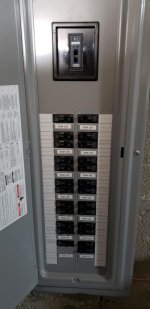
I now have a panel with a third of the slots blocked and useless for the hi leg (208V). The existing lightly loaded 110V circuits took the rest of the panel and I have only about six slots left.
I'd like at least two 220/240V circuits, a 40Amp and a 20Amp (welder, compressor) and a few more 110V circuits for more lights. etc. I'd eventually like a 220 lift but who knows how I'd power it.
Are the 208V slots completely useless?
I am looking for recommended fixes, not to do myself but to be armed when I negotiate a fix for this mess.
Any suggestions welcome.
Mark
 
To avoid these ads, REGISTER NOW!

Bert_

Well-known member
Joined
Dec 24, 2016
Messages
9,699
Location
NW Iowa
Anything that runs on 240v can use the high leg, even if it's single phase 240v.

Welders, air compressors and probably the lift do not use a neutral so the high leg is fine.
 

Terry D

Well-known member
Joined
Mar 25, 2015
Messages
2,202
Location
St. Louis, MO.
We do not have 3 phase delta here with a high leg. Our 3 phase delta here is just straight 240 0r 480. But yes as Bert said, if you have a load that needs 2 hots or all 3 hots, you are fine using those spaces. Just don't use those spaces for a 120 volt load, because you will get 208 instead
 

sparky 1971

Well-known member
Joined
Oct 9, 2018
Messages
7,967
Location
Central Iowa
I am assuming by useless high leg you mean that there is a single pole breaker above and below the slot for the high leg.


I would add a single phase sub panel and move some of the 120 volt stuff to it. Run the 240 volt equipment out of the main panel and take advantage of the high leg.
 

Terry D

Well-known member
Joined
Mar 25, 2015
Messages
2,202
Location
St. Louis, MO.
I am assuming by useless high leg you mean that there is a single pole breaker above and below the slot for the high leg.


I would add a single phase sub panel and move some of the 120 volt stuff to it. Run the 240 volt equipment out of the main panel and take advantage of the high leg.

I agree, feed it with a 2-pole breaker ( not the high leg ) and a neutral. And use it for the 120 volt loads
 

Bert_

Well-known member
Joined
Dec 24, 2016
Messages
9,699
Location
NW Iowa
Honestly the best way to do these if you have lots of 120v circuits is to add a single phase sub panel.

Another option if you're ordering a panelboard you can usually specify to only have A and C phase in part of the panel.
 

TRWham

Well-known member
Joined
Aug 11, 2017
Messages
1,957
Location
East Cobb County, Georgia
The 208 volts will only happen if you go from neutral to the high leg. If you put a 2 or 3-pole breaker in, it will be always 240 volts.

I think we all understand that, but I was responding specifically to what Bert said without quoting. There is legitimate 208/1/60 equipment that could run on the high leg, but assuming all 240 V equipment would run on 208 is questionable.
 

Bert_

Well-known member
Joined
Dec 24, 2016
Messages
9,699
Location
NW Iowa
I think we all understand that, but I was responding specifically to what Bert said without quoting. There is legitimate 208/1/60 equipment that could run on the high leg, but assuming all 240 V equipment would run on 208 is questionable.

I've seen multivolt ballasts powered by the high leg - neutral before. I wouldn't do it though.

For a line - line load though the high leg is no different than the others
 

Norcal

Well-known member
Joined
Mar 16, 2008
Messages
13,752
If you use the high leg & another phase for a 240V load, you must use a 2 pole breaker rated for 240V, a standard slash rated 120/240V breaker is not permitted as the 208V high leg exceeds the lower rating of the slash rated breaker, 240 2-pole breakers are a catalog item but expensive.

There are no single pole breakers rated for 208V, other then 277V breakers, & they are not going to fit in a normal panel.
 

TRWham

Well-known member
Joined
Aug 11, 2017
Messages
1,957
Location
East Cobb County, Georgia
I've seen multivolt ballasts powered by the high leg - neutral before. I wouldn't do it though.

For a line - line load though the high leg is no different than the others

I see what you are saying now. Not high leg to neutral, but high to any other. It’s only high when referenced to neutral. Carry on.
 

walta

Well-known member
Joined
Jan 13, 2017
Messages
2,309
Location
Dutzow Missouri
Most 240 volt equipment will except 208 supply if that is true for your equipment consider having the utility change your service from 240 to 208 then any leg to neutral will give you 120 volts or buy a transformer and new panel so you step it down yourself.

Note most utility have a surcharge for unbalanced loads like you have now all your loads are on one phase and nothing on the other two. The utility has to generate power equal on all 3 phases so it is only right so they tipple your bill.

Walta
 

wyliesdiesels

Well-known member
Joined
Aug 14, 2012
Messages
19,991
Location
Modesto, CA
We do not have 3 phase delta here with a high leg. Our 3 phase delta here is just straight 240 or 480. But yes as Bert said, if you have a load that needs 2 hots or all 3 hots, you are fine using those spaces. Just don't use those spaces for a 120 volt load, because you will get 208 instead

corner grounded delta or floating?

I think we all understand that, but I was responding specifically to what Bert said without quoting. There is legitimate 208/1/60 equipment that could run on the high leg, but assuming all 240 V equipment would run on 208 is questionable.

the voltage of the hi-leg to neutral is not consistent. it can vary widely depending on the loading on the transformer bank. not a good idea

If you use the high leg & another phase for a 240V load, you must use a 2 pole breaker rated for 240V, a standard slash rated 120/240V breaker is not permitted as the 208V high leg exceeds the lower rating of the slash rated breaker, 240 2-pole breakers are a catalog item but expensive.

There are no single pole breakers rated for 208V, other then 277V breakers, & they are not going to fit in a normal panel.

Its amazing how so many dont pay attention to this and use slash rated breakers on delta service
 

Terry D

Well-known member
Joined
Mar 25, 2015
Messages
2,202
Location
St. Louis, MO.
corner grounded delta or floating?


It is grounded B phase delta. No center tapping. Just straight 240 or 480 volts. They are trying to do away with delta here. They will only allow a new install on rare occasions. They want all 3 phase now to be a wye. We still have a lot old manufacturing businesses that have a delta service for their three phase and a single phase 120/240 volt service also
 

wyliesdiesels

Well-known member
Joined
Aug 14, 2012
Messages
19,991
Location
Modesto, CA
It is grounded B phase delta. No center tapping. Just straight 240 or 480 volts. They are trying to do away with delta here. They will only allow a new install on rare occasions. They want all 3 phase now to be a wye. We still have a lot old manufacturing businesses that have a delta service for their three phase and a single phase 120/240 volt service also

yes that is called corner grounded delta.
 

TRWham

Well-known member
Joined
Aug 11, 2017
Messages
1,957
Location
East Cobb County, Georgia
...

the voltage of the hi-leg to neutral is not consistent. it can vary widely depending on the loading on the transformer bank. not a good idea

...

I get that, but initially thought that's what Bert was suggesting. My point was that even if the voltage were a constant 208, a lot of 240 V equipment would not play well with it.
 
To avoid these ads, REGISTER NOW!

Stuff

Well-known member
Joined
Aug 31, 2013
Messages
572
How much true 240v equipment is out there?

OP might be best served by asking the POCO what it would take to change service to a traditional 208/120Y.

Also wonder if it is an open delta where the high leg is not supposed to have anything but a 3 phase load on it.
 

Norcal

Well-known member
Joined
Mar 16, 2008
Messages
13,752
If it is 220V, or 208/230V it will do fine on 208V but if 230V, or 240V, it will not.
 

Terry D

Well-known member
Joined
Mar 25, 2015
Messages
2,202
Location
St. Louis, MO.
I get that, but initially thought that's what Bert was suggesting. My point was that even if the voltage were a constant 208, a lot of 240 V equipment would not play well with it.

I believe you might be confusing a Wye system with a Delta. The only way a high leg is created in a Delta system is when you center tap one of the transformers to create a neutral. As long as you go from neutral to either phase of that same transformer, which is wired in delta with the other two, you will get 120 volts, which is fine. Its when you go from neutral to the phase of the opposite end, that you will get the 208 volts. Because you are actually going across a winding and a half of transformers instead of just a half of winding.

There is no 240 volt equipment that requires a neutral and one phase, other than possibly a multi voltage ballast that the range would be 120v to 277v, which Bert has said would not be a good idea. 240 volt equipment requires at least two phases, which the high leg doesn't matter
 

TRWham

Well-known member
Joined
Aug 11, 2017
Messages
1,957
Location
East Cobb County, Georgia
I believe you might be confusing a Wye system with a Delta. ..

For the last time: the only thing I was ever confusing here is what Bert was saying. It initially sounded to me that he was saying you could always run 240V/1/60 equipment on 208 V using the high leg and the neutral on a delta system. I WAS WRONG- THAT IS NOT WHAT HE WAS SAYING.
 

wyliesdiesels

Well-known member
Joined
Aug 14, 2012
Messages
19,991
Location
Modesto, CA
How much true 240v equipment is out there?

OP might be best served by asking the POCO what it would take to change service to a traditional 208/120Y.

Also wonder if it is an open delta where the high leg is not supposed to have anything but a 3 phase load on it.

youre confusing things here. an open delta transformer means it only has 2 transformers instead of 3 which means it has reduced output vs a closed delta bank w/ 3 transformers. The whole point in an open delta bank is so that PoCos can save money on transformers where the 3Ø demand on the bank is low and mostly single phase.

It has nothing to do w/ what loads should or can be on the high leg. The high leg can have 240v single phase and 240v 3Ø loads on it. being an open delta will not change that.
 

Stuff

Well-known member
Joined
Aug 31, 2013
Messages
572
youre confusing things here. an open delta transformer means it only has 2 transformers instead of 3 which means it has reduced output vs a closed delta bank w/ 3 transformers. The whole point in an open delta bank is so that PoCos can save money on transformers where the 3Ø demand on the bank is low and mostly single phase.

It has nothing to do w/ what loads should or can be on the high leg. The high leg can have 240v single phase and 240v 3Ø loads on it. being an open delta will not change that.

You don't trust Wikipedia?
Commonly there is a high-leg to neutral load limit when only two transformers are used. One transformer manufacturer's page suggests that High-leg to neutral loading to not exceed 5% of transformer capacity.
 

wyliesdiesels

Well-known member
Joined
Aug 14, 2012
Messages
19,991
Location
Modesto, CA
You don't trust Wikipedia?

Commonly there is a high-leg to neutral load limit when only two transformers are used. One transformer manufacturer's page suggests that High-leg to neutral loading to not exceed 5% of transformer capacity.

that isnt what you said though. you said only 3Ø loads should go on the high-leg as opposed to single phase 240v loads.

also that is talking about hi-leg to neutral loading which makes no sense because you dont use the neutral w/ the hi-leg, unless you want to let the smoke out of 120v equipment. that wouldnt be talking about 208v hi-leg to neutral loads either, as there are no single pole breakers rated for >120v line to ground listed for use in a 240v Delta panel.
 
Last edited:

Stuff

Well-known member
Joined
Aug 31, 2013
Messages
572
that isnt what you said though. you said only 3Ø loads should go on the high-leg as opposed to single phase 240v loads.

also that is talking about hi-leg to neutral loading which makes no sense because you dont use the neutral w/ the hi-leg, unless you want to let the smoke out of 120v equipment. that wouldnt be talking about 208v hi-leg to neutral loads either, as there are no single pole breakers rated for >120v line to ground listed for use in a 240v Delta panel.

Need to fix Wikipedia. Reference there points to doc about transformers with a 120v lighting tap used in delta services.
The 120V loads must not exceed 5% of the nameplate KVA, and the total of the nameplate KVA must be derated by 30%

What I was trying to say earlier is that the high leg transformer is often undersized/sized specifically for the 3ø loads so recommendation is not to put anything else on it.

The point is that with delta services is you don't know what you are getting so find out what the design is before you make changes.
 

Bert_

Well-known member
Joined
Dec 24, 2016
Messages
9,699
Location
NW Iowa
Need to fix Wikipedia. Reference there points to doc about transformers with a 120v lighting tap used in delta services.


What I was trying to say earlier is that the high leg transformer is often undersized/sized specifically for the 3ø loads so recommendation is not to put anything else on it.

The point is that with delta services is you don't know what you are getting so find out what the design is before you make changes.

On pretty much any service they will size the transformer to the load. Pretty common to see 200A service on a 15kva transformer.

Sounds like he doesn't even have any three-phase loads. It won't hurt a thing to throw some single phase on the b phase.

I always make it a point to check transformer size when adding major loads. Looked at one the other day. Has a 400 amp service with a 25 KVA transformer. Has (2) 15 hp fans plus a farmyard. Will be adding another 15 hp fan. I will be talking to the Electric co-op, 37.5 KVA would be about the minimum. I'm guessing they will go to a 50.
 
Last edited:

wyliesdiesels

Well-known member
Joined
Aug 14, 2012
Messages
19,991
Location
Modesto, CA
Need to fix Wikipedia. Reference there points to doc about transformers with a 120v lighting tap used in delta services.


What I was trying to say earlier is that the high leg transformer is often undersized/sized specifically for the 3ø loads so recommendation is not to put anything else on it.

The point is that with delta services is you don't know what you are getting so find out what the design is before you make changes.

might be an issue in some areas but not out here. ive seen many delta services with 240v single phase loads across the hi-leg
 

alfredeneuman

Well-known member
Joined
Mar 3, 2011
Messages
4,580
Location
Fullerton, CA
ive seen many delta services with 240v single phase loads across the hi-leg

We remodeled a big restaurant (7-42 circuit full panels) that had an existing delta service once.
We wired almost all of our 1Ø 240 equipment sharing a phase with the high leg. We needed the breaker space for the 120V loads. :)
 

13mo

Well-known member
Joined
Mar 10, 2020
Messages
78
Location
Missouri
How much true 240v equipment is out there?

There is a lot of single-phase stuff that only runs on 240 volts vs. being able to run on 208 or 240. Single-phase motors in particular are not often able to run on 208 volts, and thus many pieces of single-phase equipment with motors in them are not able to run on 208 volts. Generally purely resistive loads without motors such as water heaters, ranges, baseboard heaters, welders, quite a few electronics, most commercial/industrial lighting, and some commercial equipment will be rated to run on 208 volts. Things such as most single-phase motor-driven tools, most A/C units, most clothes dryers, and the like often cannot run on 208 volts.

OP might be best served by asking the POCO what it would take to change service to a traditional 208/120Y.

Maybe, but then he loses the ability to run 240 volt loads without using a transformer. Quite a bit of 240 volt single-phase equipment cannot run on 208 volts but pretty much everything that can run on 208 volt single-phase can run on 240. If he has no 3 phase loads and his demand is small, he'd likely be better off going with a regular 120/240 volt single-phase service. It may very well be quite a bit less expensive to boot.
 

Norcal

Well-known member
Joined
Mar 16, 2008
Messages
13,752
There is a lot of single-phase stuff that only runs on 240 volts vs. being able to run on 208 or 240. Single-phase motors in particular are not often able to run on 208 volts, and thus many pieces of single-phase equipment with motors in them are not able to run on 208 volts. Generally purely resistive loads without motors such as water heaters, ranges, baseboard heaters, welders, quite a few electronics, most commercial/industrial lighting, and some commercial equipment will be rated to run on 208 volts. Things such as most single-phase motor-driven tools, most A/C units, most clothes dryers, and the like often cannot run on 208 volts.


Maybe, but then he loses the ability to run 240 volt loads without using a transformer. Quite a bit of 240 volt single-phase equipment cannot run on 208 volts but pretty much everything that can run on 208 volt single-phase can run on 240. If he has no 3 phase loads and his demand is small, he'd likely be better off going with a regular 120/240 volt single-phase service. It may very well be quite a bit less expensive to boot.

Most A/C condensing or packaged units are rated as 208/230V, gone are the days when you had to order them for use at 208V, same for ranges, they are dual rated for either 120/240V or 120/208V just at a lower KW rating at 208V.
 
OP
M
Joined
Feb 10, 2010
Messages
19
To answer a question, see the photo here for the "blocked" spaces in the panel, they are the hi leg ones.
So, Do I understand correctly that a standard 2 pole breaker will provide 240 Volts? My compressor data plate says 240, so I suspect I need to give it that.
Thanks all,
Mark
 

Attachments

  • 20210423_123525.jpg
    20210423_123525.jpg
    53.4 KB · Views: 35

Norcal

Well-known member
Joined
Mar 16, 2008
Messages
13,752
To answer a question, see the photo here for the "blocked" spaces in the panel, they are the hi leg ones.
So, Do I understand correctly that a standard 2 pole breaker will provide 240 Volts? My compressor data plate says 240, so I suspect I need to give it that.
Thanks all,
Mark

A 2 pole is used for 240V, but if the high leg and another phase is used a standard 2-pole may not be used as it is rated for 120/240V and a costly one rated for straight 240V must be used as long as the high leg is not involved a 120/240V slash rated one is fine.
 

wyliesdiesels

Well-known member
Joined
Aug 14, 2012
Messages
19,991
Location
Modesto, CA
To answer a question, see the photo here for the "blocked" spaces in the panel, they are the hi leg ones.
So, Do I understand correctly that a standard 2 pole breaker will provide 240 Volts? My compressor data plate says 240, so I suspect I need to give it that.
Thanks all,
Mark

Norcal beat me to it.

you CANNOT use a slash rated (what youre calling standard 2 pole breaker) breaker across the hi leg and another leg. this is because the line to ground voltage is 208v not 120.
 

Bert_

Well-known member
Joined
Dec 24, 2016
Messages
9,699
Location
NW Iowa
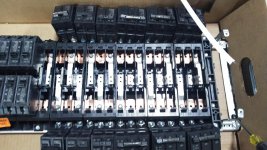
This would have been a good option.

If you look close you can see only the top half of the panel has B phase (high leg) spaces. Bottom is all A and C (no high leg)
KIMG1106.jpg
 

Attachments

  • KIMG1106.jpg
    KIMG1106.jpg
    153.2 KB · Views: 24
To avoid these ads, REGISTER NOW!
Top Bottom