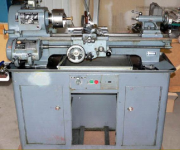
Ive started looking last week and came apon a standard modern 11" 2000. Guy doesn't have tooling other than what's on it. Down the road i qould like to make hopefully all kinds of stuff but right now I need to make bushings and pins to help fix tools and things I have in my shop.
-I have a few thoughts and hope they help. I'm a retired machinist/toolmaker/die&mold maker. I've run more lathes than I can remember but there's still a few I'd love to take for a spin. The lathe in your photo is a decently made one, all the Standard Modern lathes I've run have been much larger and they were stout beasts. Your desired entry into machining is something I'd like to encourage....and offer a few cautionary comments on. Machining is a LARGE subject so do bear with me. You'll want to do a lot of reading about the machinery, how it operates, and what to avoid.
-Machining has a lot of rules despite the perceived simplicity of it. The first, and most important priority is SAFETY. I've seen several horrible industrial accidents that left the operator disfigured for life. Machinery doesn't care what's in the way and the accident will happen so fast you won't even have time to react. This is not just the usual "Be careful" disclaimer, the lathe is one of the more dangerous machines in the shop. Yes even a tiny hobby lathe can break bones, gash blood vessels, throw chips into your eyes, or even drag you into the whirling chuck face first if it's got enough HP. Many lathes you'll consider have enough power to kill you and anybody that thinks it's not possible doesn't know what they're talking about. Everybody new to machining has an accident. It's not a matter of IF...it's a matter of WHEN and how severe the damage will be. There's at least 5-6 rules off the top of my head to stay safe but I want you to look them up. If you don't know how to stay safe you really shouldn't even turn the lathe on. It really is that important.
-Manual lathes are grouped by function and size, we'll leave CNC lathes aside for now. Lathes are sized by swing (largest diameter that will rotate unobstructed) and bed length. To reply directly to your question about tooling interchangeability, the critical tooling will NOT be interchangeable. What I consider critical tooling is the chuck, tailstock, and steady/follow rests. You cannot mount just any chuck to the headstock, they all have different mounting methods. The tailstock/steady rest/and follow rest are for one specific machine. They can even be slightly different than others from the same maker. Beware of lathes that have mixed components. Can the different components be made to fit? Possibly yes but you don't want to do that unless you have more skills and machinery. If a lathe doesn't have the correctly matching tailstock I wouldn't consider it. The steady rest and follow rest are nice to have if working with long shafts but not a deal breaker. When I called them critical I meant that they absolutely have to match the bed-ways or they'll be useless. Lathe bed-ways are different widths and configurations for each machine maker.
-Your buddy told you to get one with a lot of tooling. What he meant to say was to get the cutting tools, tool holders, QC tool-post, and live centers. He's right, it's expensive, but the tooling is less important than the condition of the lathe itself. When considering any machine the condition it's in is everything. Machinery that has bad bearings, excessive play (wear), worn out bed-ways, or broken gear teeth (back gear) is a repair project, won't hold size, or produce bad machined surface finishes.
-Can you just replace parts for an adequate repair? Yes and no. Factory parts for a specific lathe are almost a given. Ford parts don't fit a Chevy and this is no different. Bearings can be be replaced but it's often expensive and a huge PITA for a beginner. Since we're on Ford/Chevy parts the machinery made outside of the U.S. will be almost entirely in metric and won't fit to an American made machine. Is a Chinese made lathe ok for a beginner? I don't like lower end Chinese made things but a new model might work as a hobby grade machine. Your budget and location will dictate your choices available.
-What type of lathe should the OP get? Here's a couple of groupings:
1) Secondary operations (sometimes called a speed lathe)- Spins and makes short cuts on smaller parts, usually no tailstock. Works ok for fast operations but most people will quickly outgrow the limitations. They work fine if the extra capabilities aren't needed.
2) Turret lathe- Predecessor to CNC, works well for production. Would not advise for a hobby lathe unless dirt cheap and not worn out.
3) Engine lathe- Most common type encountered, several subsets. Will often be the best suited for hobby type work.
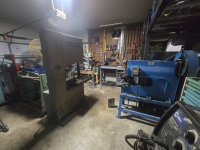
I RENT my house and have a fab shop in the garage, this is easier to move,
-This is a BIG factor in choosing a lathe. You don't want to move a lathe more than a few times and renting may mean unexpected changes. I rented too so when the landlord sold the house I had to sell all the smaller machinery I couldn't easily move/store myself. Lathe size should also be matched to the size/length of what you expect to work on. If you're not working a driveshafts or long spindles there's no need to pay for a bed length you won't use, especially if you have to consider moving it in the future.
$2k (want ro get lower), and looks decent,
-It appears to be ok although that chuck looks vastly oversized/overweight for that lathe. An overweight lathe chuck leads to headstock bearings/bushings getting worn-out. Condition of the machine is everything so if you don't know how to evaluate machinery take someone that does.
but i dont know what really is or isnt interchangeable
-The components that came with the lathe are usually NOT interchangeable. Tool-posts are if they can match the spindle center height.
-All the other "tooling" (twist drills, cutters, etc.) are interchangeable, chucks/collets will be dependent on the lathe itself.
Won't be doing much other than very simple things for a while.
-The lathe in the photo will work just fine but the condition of the lathe is the most important. If you want opinions about a different candidate you can post here. Electrical requirements are quite important. Most industrial grade machinery runs on 3 phase power, residential areas usually only have single phase. Three phase machinery can be made to run on single phase with a VFD (not really expensive) or RPC system that can be more expensive. There's fairly inexpensive ways for 3 phase power but that's something to read about. Most hobbyists will insist on single phase machinery for the plug-and-play aspect but that often commands a higher price due to the greater number of people seeking it. Three phase machinery is less sought after, a better grade of machinery, and usually at a lower cost than single phase machinery. It's not a show stopper but you should know the power requirements for any machine you consider purchasing. Hope this helps.