Couple o' things in no particular order.
To Bobhdus: Yes FCAW is (usually) a different polarity than solid-wire GMAW. Usual 'small-machine' FCAW runs DCEN, GMAW (aka MIG) runs DCEP. BUt I've
never seen or heard of 0.023 FCAW wire. Smallest I know of is 0.030 FCAW wire.
To the OP,
Not horrible for some first welds. At least you brushed the slag off before posting the pics and asking for a critique.

They do look a bit too 'cold'. You would need to turn up the WFS (wire feed speed) a bit to get more heat/amps into the weld. Also, slow down your travel speed a bit.
Watch the puddle of molten metal, not the bright arc.
Watch the puddle, watch the puddle, watch the puddle.
(notice a pattern there?

)
Watch the puddle of molten metal, while watching the arc melt 'into' the parent material and the wire/puddle fill in the molten 'crater'. As the arc melted 'into' the parent material and then the puddle fills it in, then you move forward with your travel movement.
To me, running a bead on a flat plate/sheet is not the 'best' way to see and practice a weld.
Go get some 1/8" thick (or the metric equiv, since you are up in Canada, ~3mm thick). Put two plates on top of one another so you can do a "lap joint" (look it up if you are not sure exactly what that is). Now you have an edge to follow and also you can watch the arc melt the edge from the top plate and the wire fill in the molten zone. The lap joint is also a bit more forgiving for a beginner with regards to 'instant melt-through' because you have two thicknesses of metal. You would set the weld parameters (voltage and WFS) for just
one thickness of metal though (because that is the thickness you are welding).
Practice, practice, practice.
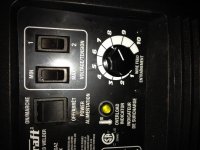
btw, that "tension" setting is just French for "voltage", in case you somehow didn't realize that.
Wire welding (FCAW and GMAW) parameters are the arc voltage and the WFS (machine settings). Also, the operator controls the "stick-out" and the travel speed. Set the voltage per the recommended settings on the machine (door chart or in the manual, usually) and then set the WFS as recommended. Adjust the WFS (if needed) to get a relatively smooth 'sizzling bacon' sound. Too low of a WFS (for that particular voltage setting) and the wire will burn back to the tip, too high a WFS (for that particular voltage setting) and the wire will 'stub' into the workpiece and push the gun back away from the work. Too high a voltage (for a particular WFS) and you get an unstable arc and excess spatter, too low a voltage (for a particular WFS) and the wire stubs into the workpiece and pushes the gun back.
The 'heat' of a wire-feed weld is mostly controlled by the WFS (controls the amperage of the weld).
Go check and read up some of the tons of information available on the Lincoln (
http://www.lincolnelectric.com) and ESAB (
http://www.esabna.com) websites.
Especially good info is there on the ESAB 'Welding University' site at
http://www.esabna.com/us/en/education/index.cfm
http://www.esabna.com/us/en/education/esab-university.cfm
http://edgewh.esabna.com/EUWeb/MIG_handbook/592mig1_1.htm
Practice, practice, practice.