To avoid these ads, REGISTER NOW!

Not enough AC return air vents?

TheVodkaMan

Active member
Joined
Feb 21, 2020
Messages
28
Location
Tennessee, USA
Howdy, everyone!

It's been a few years since my last visit here, and I hope all is well with you all.

I know this is a garage-related forum, but I've seen folks post questions unrelated to garages (especially in the AC section), so I'm hoping someone can point me in the right direction.

I've been living in a small house, just under 1,500 sq ft, here in the mid-south for a little over 5 years now. Since day one, my AC unit has struggled to keep the temperature below 77°F during the day or 73°F at night. It's a small, starter home where the builder used the cheapest materials possible throughout.

I've done all the normal due diligence as any average homeowner would: sealing the air vents from the attic, making sure my eave vents aren't blocked, and ensuring I have a typical amount of insulation in the attic. The shingles are black, so there's a lot of radiant heat. I've added an attic fan controlled by a thermostat, but I don't believe it does much to help.

Long story short, my AC guy says there's nothing wrong with my system. It's a 2.5-ton Goodman unit, and in the attached pic, I've shown the location of all air vents for supply and return. He says the location of my return vents is wrong and the pressure isn't balanced. One room doesn't even have a return at all. The problem is my unit runs all day throughout the summer just trying to keep the temp at 77°F, and I feel like I'm wasting money on a system that hardly keeps the house comfortable. The master bedroom is by far the most affected room; it only has 1 supply and 1 return vent, just like the smaller room (bottom left in the pic), but it's significantly larger and always off by 5 or so degrees.

My AC guy keeps saying I need to find someone who specializes in some kind of analysis to figure out proper connections. I wasn't even aware of such a service; I always thought this was something AC guys handled.

I'm not in a position to replace my roof or add a ridge vent (which is normally done when the shingles need replacing anyway). I'm looking for things I can do myself. Here are a few things I'm considering:

1. Adding a return air vent to the smaller room (top left in the pic).
2. Adding one additional supply air vent to the master bedroom by T-ing it off the supply that's right next to it in the living room.

Any suggestions are welcome. Thanks!
 

Attachments

  • Screenshot 2024-07-29 at 14-09-30 e5f87072a4df906d1472eb4c9105e981-uncropped_scaled_within_153...jpg
    Screenshot 2024-07-29 at 14-09-30 e5f87072a4df906d1472eb4c9105e981-uncropped_scaled_within_153...jpg
    92.3 KB · Views: 90
To avoid these ads, REGISTER NOW!

mikedodge

Well-known member
Joined
Jun 27, 2017
Messages
2,801
Are you getting proper cold air coming out?We're inna bigger house and have 3, maybe 4. At least one of them is buried behind furniture. Another house we had that was your size had 2. We only ever had cooling problems when there was something physically wrong or in extreme heat. Are you leaving your thermostat on? Some people wait until it's roasting before turning it on then wonder why it doesn't seem to work properly.

If it was a budget built house how well was it insulated? That can also make a big difference.
 

The Cobbler

Super Moderator
Staff member
Joined
Oct 24, 2013
Messages
25,920
Location
Niagara Region, Ontario, Canada
often supply runs are undersized too .
I think a tinwacker ( someone that installs ductwork would be able to help you diagnose .
a buddy had a townhouse where the upstairs was very warm. we ran a 6" ( if I remember correctly) duct up to his bedroom and without altering any of the returns, it cooled the upstairs amazingly well. in the winter he turned off the damper for heat mode .
 

Wrench97

Well-known member
Joined
Jun 23, 2018
Messages
12,125
Location
Southeastern Pa
Sounds like you need a HVAC design specialist to look at your system and tell you where it's lacking.
You may have a local architect that does it or he may be able refer you to someone that does.
Most A/C firms around here claim they can design a system but it's usually based on incorrect assumptions about heat loss do to insulation, and other heat loss/gains in the building. This is a example of the service> https://ductworks.net/ductwork-design-services/

Where is your air handler under the house or in the attic?
Do you air leaks so that when you ran the attic fan you are sucking the cool air out of the house?
Have you checked the ducts for loose, collapsed, missing or disconnected hoses?
 

OccupantRJ

Well-known member
Joined
May 15, 2009
Messages
11,117
Location
Eastern North Carolina
How clean are the evaporator and condenser coils?
What type and thickness of return air filter(s) are you using?
Is the unit properly charged with refrigerant?
If charge is low or air flow is low, the evaporator coil can freeze up and reduce cooling.
No air flow, no air conditioning. (Most important thing I ever learned about air conditioning).
I bought an anemometer to balance outlet air flows and a manometer to test my duct pressures differential.
Is it a split unit or package unit?
I have a Goodman 2.5 ton package unit on my shop and have ten outlets fed by 6” duct off the 3 size diameters of trunk line. If I remember correctly, the unit has 1100 cfm air flow, so ideally, 110 cfm per outlet In my case If properly balanced.
 

ericm

Well-known member
Joined
Apr 17, 2016
Messages
1,963
Location
Southern Oregon
We had an energy analysis done on our house about six years ago. Cost about $600 then but it was so worth it. They found places where the insulation was just wrong, like not on the boundary between the heated and unheated parts of the house. Also that the HVAC return system was insufficient, and the ducts leaked.

There were more, like air leaks(they did a blower door test), but those are harder to find. The company ranked the problems in order of bang for the buck, so we fixed the first three I listed. The hardest part was finding someone to do the sheet metal work to add an additional return duct in a cramped space. It was totally worth the $600. The house cools much better even with a smaller A/C unit (we replaced the furnace and A/C at the same time).
 

PWC Repair

Well-known member
Joined
Dec 27, 2012
Messages
3,182
Location
Arkansas
First of all.......find another AC guy. If yours can't figure out airflow, cfm, and duct issues, he's not that great . In our climate (I'm in northern Arkansas) most homes around 1500 sq ft require a 3 ton unit. A well insulated house with quality windows can probably make out OK with a 2.5 ton. My house was built in '58, 1200ft, has basic windows, and a barely insulated attic. I have a 3 ton unit (one central return) that will hold 70* even in the hottest weather! The first thing you need to do is see what type of ducting you have, and what size. If it's a builders "spec" home it probably has some spider flex system that will NEVER work right.
 

u3b3rg33k

Well-known member
Joined
Dec 18, 2017
Messages
4,048
We had an energy analysis done on our house about six years ago. Cost about $600 then but it was so worth it. They found places where the insulation was just wrong, like not on the boundary between the heated and unheated parts of the house. Also that the HVAC return system was insufficient, and the ducts leaked.

There were more, like air leaks(they did a blower door test), but those are harder to find. The company ranked the problems in order of bang for the buck, so we fixed the first three I listed. The hardest part was finding someone to do the sheet metal work to add an additional return duct in a cramped space. It was totally worth the $600. The house cools much better even with a smaller A/C unit (we replaced the furnace and A/C at the same time).
+1 for getting actual data. energy audits/blower door tests tell you things that you can't "sounds like" diagnose.


my place is about 1600sqft and has a 2 ton system, and I can HOLD temp in 85-90F weather but not lower it until the sun goes down. God help you if you run the gas stove/oven when its 95F outside!

Is @TheVodkaMan using setbacks? I recommend not doing that in hot weather. start out at the temperature you want to be at. if your house is warming up from 73 to 77F throughout the day while the system is running, then I'd suspect a major issue.

FWIW I recently had a ton of ductwork re-done correctly, and things are MUCH more comfortable and even. same AC coil and condenser.
 

chinboys

Well-known member
Joined
Jun 20, 2011
Messages
434
In the commercial arena, we want 400 ft3 of air flow per cooling ton to pass through the evaporator coils. The coil should be at 45-55 degrees F. And the air temp above the coil ought to be 55 - 65 F.
You want to make sure your blower is set for cooling mode or the fastest run speed.
The duct design having the right sized cross sections and lengths need to be spec'ed for the air volume being cooled (denser air) and blown.

But first have your hvac system checked for clean evaporator and condenser coils, and proper levels of refrigerant.
Then have the air volume per minute measured at each vent. The sum of these measurement should be equal to the volume of air leaving the evaporator area duct.
Likewise, measure the air volume per return and sum it up. It ought to add up to the volume of air leaving the evaporator duct.
When the supply and return air volumes don't add up... You have ducting problems with too small cross section of duct, too long section, and too many elbows.

To fix the above would now be expensive. Perhaps, a quick and dirty, and would be to swap out the old blower with one that has more cold air output (more hp).

Good luck
 
Last edited:

PopcornSutton

Well-known member
Joined
Jun 10, 2024
Messages
789
Location
Northern Tip of VA
The air handler needs as much return air as supply, at a minimum. The supply fan should not be starving for air, so return air is typically capable of higher cfms.

Are the 3 returns ducted to a common plenum?
 
Last edited:

karoc

Well-known member
Joined
Dec 19, 2017
Messages
2,009
Location
Hemphill Tx
All these suggestions are fantastic but going come at expense, then are you willing to make changes? I’ve gone on lot of service calls in my younger days with these same problems. The ac is older, days are hotter, it’s just max out. As suggested 2.5 ton is on border of being too small.
If you live in subdivision, visit your neighbors see how their ac is doing. Biggest thing is to check your return from inside, making sure not sucking air from attic. Sounds like your ac guy has done all he could without replacing system.
FYI- AC company’s hire “Service Technician” not mechanical engineers. Big pay difference, as home owner do you want pay engineer to come out check your charge? I don’t think so, the house mechanicals was size before it was built. As service techs past/present will figure about 600 sq ft per ton.
Disclaimer- Owner of company or who has license may be able to do load calculation. I know that power company use to do that for free years ago.
Side Note: Pull your filter out see if you notice big difference, leave it out for few hrs. Or open your front door about couple inches to see if there’s big draw of air being pulled in.
 
Last edited:

Wrench97

Well-known member
Joined
Jun 23, 2018
Messages
12,125
Location
Southeastern Pa
I've always been told you can't just up the tonnage of the unit and expect better results if the ducts are under sized or already flowing at capacity.
The last I was involved with something like this was at work where the system was installed one year and the next year we had issues with it freezing up and sucking the filters in. The contractor up the tonnage from 3 to 5 ton and used the original ducts, the basement was like a walk in refrigerator and the Terminal Managers office was always warm, there was one 4" duct to his office and no return, the return in the main office was behind the filing cabinets with them pushed tight up against it, the sales office had a return and no feed duct and the door was usually closed. The ladies room was the best it had a 6" feed and a 6" return was all of 4'x5' room.........
We put a vent in the sales office door, pulled the filing cabinets 6" away from the wall return vent added a 6" return and 6" feed to the TM's office, blocked off some of the basement vents and some of the return and added another 12" return to the main office.
It made a big difference but the unit was still over sized by everyone's calculations.
 

xjfish

Well-known member
Joined
Feb 22, 2014
Messages
1,294
My current home is similar to yours, with a more meandering layout. (central A/C in MN) We only have 2 return vents total at living room area. Its not ideal. Master bedroom is furthest away in an addition and is warmer than rest of house (summer), but not significantly. Place relies on ceiling fans for air distribution. Hiring an HVAC tech to replace aging furnace soon. I may inquire about lack of returns but i suspect there is not a very viable fix without significant work/cost.

Bedroom windows are sliders. I think adding a portable or window A/C unit in master would probably make me content during hot summer months, without significant ductwork reworking...
 

ericm

Well-known member
Joined
Apr 17, 2016
Messages
1,963
Location
Southern Oregon
My impression is that ducts are often too small for the unit that was installed. And if they're more than a decade or two old, they leak. My 2500 sq ft house originally had a 5 ton A/C and a single return duct. We replaced it with a 3 ton A/C and added another large return duct. Both return ducts are in the great room/kitchen which is not ideal but is the best we can do with the house layout without spending a ton of money.
 
OP
T

TheVodkaMan

Active member
Joined
Feb 21, 2020
Messages
28
Location
Tennessee, USA
Are you getting proper cold air coming out?We're inna bigger house and have 3, maybe 4. At least one of them is buried behind furniture. Another house we had that was your size had 2. We only ever had cooling problems when there was something physically wrong or in extreme heat. Are you leaving your thermostat on? Some people wait until it's roasting before turning it on then wonder why it doesn't seem to work properly.

If it was a budget built house how well was it insulated? That can also make a big difference.
The returns in my house are all ceiling-mounted, like 13" or 14"x14" squares or something. I'm just concerned that one of the smaller rooms has a return but not the other. Once I realized that my system can't keep up with the heat, the best I "got it to work" is to set it to 77 during the day and 73 starting 10 PM. It takes a couple of hours, usually close to 12 AM for it to come down to 73 from 77. It has about 18" of blown in insulation on the top of the ceiling. I don't see any batt insulation anywhere but the sides/walls.
often supply runs are undersized too .
I think a tinwacker ( someone that installs ductwork would be able to help you diagnose .
a buddy had a townhouse where the upstairs was very warm. we ran a 6" ( if I remember correctly) duct up to his bedroom and without altering any of the returns, it cooled the upstairs amazingly well. in the winter he turned off the damper for heat mode .
Pretty sure I have 6s.. It starts out big and then branches out to thinner ducts. It would probably be easier if I took some photos.
Sounds like you need a HVAC design specialist to look at your system and tell you where it's lacking.
You may have a local architect that does it or he may be able refer you to someone that does.
Most A/C firms around here claim they can design a system but it's usually based on incorrect assumptions about heat loss do to insulation, and other heat loss/gains in the building. This is a example of the service> https://ductworks.net/ductwork-design-services/

Where is your air handler under the house or in the attic?
Do you air leaks so that when you ran the attic fan you are sucking the cool air out of the house?
Have you checked the ducts for loose, collapsed, missing or disconnected hoses?
The furnace is in the attic sitting over the small bathroom; it's installed horizontally due to steep roof angle, running parallel to the left side of the house. It's basically just sits on the floor on some foam blocks. I've checked all the ducts and pathways, everything is fine, no leaks. I am not sure if the forementioned fan is sucking anything from the inside, well, unless I open the attic latter then yeah, I can see that but no, I don't think it's the case with my home.
How clean are the evaporator and condenser coils?
What type and thickness of return air filter(s) are you using?
Is the unit properly charged with refrigerant?
If charge is low or air flow is low, the evaporator coil can freeze up and reduce cooling.
No air flow, no air conditioning. (Most important thing I ever learned about air conditioning).
I bought an anemometer to balance outlet air flows and a manometer to test my duct pressures differential.
Is it a split unit or package unit?
I have a Goodman 2.5 ton package unit on my shop and have ten outlets fed by 6” duct off the 3 size diameters of trunk line. If I remember correctly, the unit has 1100 cfm air flow, so ideally, 110 cfm per outlet In my case If properly balanced.
Clean the condenser unit annually, I take it apart and clean with condenser foam, hose it down, straighten out all bent fins whenever possible. Last time I've even cleaned all all rusted out terminals in the wire section behind the unit. My filter size is 14x25x1 and it's in the return box, so I only have 1 filter. I'll look into buying a anemometer, though I'm not sure what I can even do once I find that some outlets aren't blowing out enough. I know for sure that my only supply line in the master bedroom ain't blowing enough for sure compared to all other ones that are closer to the furnace.
We had an energy analysis done on our house about six years ago. Cost about $600 then but it was so worth it. They found places where the insulation was just wrong, like not on the boundary between the heated and unheated parts of the house. Also that the HVAC return system was insufficient, and the ducts leaked.

There were more, like air leaks(they did a blower door test), but those are harder to find. The company ranked the problems in order of bang for the buck, so we fixed the first three I listed. The hardest part was finding someone to do the sheet metal work to add an additional return duct in a cramped space. It was totally worth the $600. The house cools much better even with a smaller A/C unit (we replaced the furnace and A/C at the same time).
Thanks, I'll look into this. To be frank, my house is 13 years old, I think if can get another year out of this system, I'd be ready to replace it with something better though I'd like to have proper calculations in terms of what I really need and what to replace it with with efficiency in mind.
First of all.......find another AC guy. If yours can't figure out airflow, cfm, and duct issues, he's not that great . In our climate (I'm in northern Arkansas) most homes around 1500 sq ft require a 3 ton unit. A well insulated house with quality windows can probably make out OK with a 2.5 ton. My house was built in '58, 1200ft, has basic windows, and a barely insulated attic. I have a 3 ton unit (one central return) that will hold 70* even in the hottest weather! The first thing you need to do is see what type of ducting you have, and what size. If it's a builders "spec" home it probably has some spider flex system that will NEVER work right.
Yeah, he's not doing duct work due to his age, etc. I am in Memphis and I am doing my best to survive this heat wave.... And yes, it's a builder grade home, which comes with most basic and cheap stuff. I think the ducts are R3 if I am not mistaken. I have basic double pane, Andreson I think windows, which I re-caulked everywhere not too long ago. I've also sealed all supply and return outlets early spring but that hardly helped...
+1 for getting actual data. energy audits/blower door tests tell you things that you can't "sounds like" diagnose.


my place is about 1600sqft and has a 2 ton system, and I can HOLD temp in 85-90F weather but not lower it until the sun goes down. God help you if you run the gas stove/oven when its 95F outside!

Is @TheVodkaMan using setbacks? I recommend not doing that in hot weather. start out at the temperature you want to be at. if your house is warming up from 73 to 77F throughout the day while the system is running, then I'd suspect a major issue.

FWIW I recently had a ton of ductwork re-done correctly, and things are MUCH more comfortable and even. same AC coil and condenser.
Yes, that's the case with my house. The temp start rising after sunrise... I can keep the thermostat at 50 degrees, it doesn't matter, it just goes up and the best my system can do is to keep it at 77-78 though not too long ago when we had a 100 degrees outside, the inside was at 80 until sunset. My ducts are R3 rated I think. My house is 13 years old, I think if I can get another year out of this system, I'd be ready to replace everything with something better though I'd like to have proper calculations in terms of what I really need and what to replace it with exactly with efficiency in mind.
In the commercial arena, we want 400 ft3 of air flow per cooling ton to pass through the evaporator coils. The coil should be at 45-55 degrees F. And the air temp above the coil ought to be 55 - 65 F.
You want to make sure your blower is set for cooling mode or the fastest run speed.
The duct design having the right sized cross sections and lengths need to be spec'ed for the air volume being cooled (denser air) and blown.

But first have your hvac system checked for clean evaporator and condenser coils, and proper levels of refrigerant.
Then have the air volume per minute measured at each vent. The sum of these measurement should be equal to the volume of air leaving the evaporator area duct.
Likewise, measure the air volume per return and sum it up. It ought to add up to the volume of air leaving the evaporator duct.
When the supply and return air volumes don't add up... You have ducting problems with too small cross section of duct, too long section, and too many elbows.

To fix the above would now be expensive. Perhaps, a quick and dirty, and would be to swap out the old blower with one that has more cold air output (more hp).

Good luck
Thanks.
The air handler needs as much return air as supply, at a minimum. The supply fan should not be starving for air, so return air is typically capable of higher cfms.

Are the 3 returns ducted to a common plenum?
Yes
All these suggestions are fantastic but going come at expense, then are you willing to make changes? I’ve gone on lot of service calls in my younger days with these same problems. The ac is older, days are hotter, it’s just max out. As suggested 2.5 ton is on border of being too small.
If you live in subdivision, visit your neighbors see how their ac is doing. Biggest thing is to check your return from inside, making sure not sucking air from attic. Sounds like your ac guy has done all he could without replacing system.
FYI- AC company’s hire “Service Technician” not mechanical engineers. Big pay difference, as home owner do you want pay engineer to come out check your charge? I don’t think so, the house mechanicals was size before it was built. As service techs past/present will figure about 600 sq ft per ton.
Disclaimer- Owner of company or who has license may be able to do load calculation. I know that power company use to do that for free years ago.
Side Note: Pull your filter out see if you notice big difference, leave it out for few hrs. Or open your front door about couple inches to see if there’s big draw of air being pulled in.
Once I determine how much longer I will be living in this house (all depends on my job) then I can make the decision. If I will be moving in the next year or two, not so much; it would make more sense financially to just get a portable unit from Costco and call it a day. I already use a portable space heater during winter in my bedroom, so it would just be another thing on the wheels to move in and out LOL.

Thanks, I will try your suggestions and report back with my findings.
I've always been told you can't just up the tonnage of the unit and expect better results if the ducts are under sized or already flowing at capacity.
The last I was involved with something like this was at work where the system was installed one year and the next year we had issues with it freezing up and sucking the filters in. The contractor up the tonnage from 3 to 5 ton and used the original ducts, the basement was like a walk in refrigerator and the Terminal Managers office was always warm, there was one 4" duct to his office and no return, the return in the main office was behind the filing cabinets with them pushed tight up against it, the sales office had a return and no feed duct and the door was usually closed. The ladies room was the best it had a 6" feed and a 6" return was all of 4'x5' room.........
We put a vent in the sales office door, pulled the filing cabinets 6" away from the wall return vent added a 6" return and 6" feed to the TM's office, blocked off some of the basement vents and some of the return and added another 12" return to the main office.
It made a big difference but the unit was still over sized by everyone's calculations.
Reading all these comments, it seems like I am facing a serious financial decision. It sounds like I have to replace EVERYTHING, including my R3 rated ducts. They are so thin that if I poke a finger through, I might make a hole.
My current home is similar to yours, with a more meandering layout. (central A/C in MN) We only have 2 return vents total at living room area. Its not ideal. Master bedroom is furthest away in an addition and is warmer than rest of house (summer), but not significantly. Place relies on ceiling fans for air distribution. Hiring an HVAC tech to replace aging furnace soon. I may inquire about lack of returns but i suspect there is not a very viable fix without significant work/cost.

Bedroom windows are sliders. I think adding a portable or window A/C unit in master would probably make me content during hot summer months, without significant ductwork reworking...
I am thinking likewise, it's just my SO isn't supporting the idea of having a window cracked open for the ac vent to go out. We also use ceiling fans in every room and it helps. It just kills me to have a system that eats my electricity while not cooling enough. It just *****.
This.

A system with an existing 3 ton unit on 2 ton ductwork will not work better with a nice shiny new 4 ton unit.
;)
 
OP
T

TheVodkaMan

Active member
Joined
Feb 21, 2020
Messages
28
Location
Tennessee, USA
My impression is that ducts are often too small for the unit that was installed. And if they're more than a decade or two old, they leak. My 2500 sq ft house originally had a 5 ton A/C and a single return duct. We replaced it with a 3 ton A/C and added another large return duct. Both return ducts are in the great room/kitchen which is not ideal but is the best we can do with the house layout without spending a ton of money.
I'll take a picture and show what I have.
 

danski0224

Well-known member
Joined
Jan 29, 2005
Messages
13,437
Location
Near Naperville, IL
And if they're more than a decade or two old, they leak.

Residential duct sealing wasn't even a thing in my neck of the woods until the 2012 International Residential Code.

Only high end builders and or HVAC companies did it.

I can guarantee you that any unsealed duct system will have an air leakage rate of 20% or more, and that's if the installation LOOKS good. Numbers will be much worse for the typical residential hack job.

This EXCLUDES performance loss due to ****** duct design.

And in order to pass current duct leakage testing standards where there is ductwork in an unconditioned space, EVERYTHING has to be sealed. This includes assembly seams on all purchased fittings like register boots, elbows and wall stack heads and snap pipe... and the duct connections.

I have seen 30% leakage results.
 

u3b3rg33k

Well-known member
Joined
Dec 18, 2017
Messages
4,048
I've always been told you can't just up the tonnage of the unit and expect better results if the ducts are under sized or already flowing at capacity.
The last I was involved with something like this was at work where the system was installed one year and the next year we had issues with it freezing up and sucking the filters in. The contractor up the tonnage from 3 to 5 ton and used the original ducts, the basement was like a walk in refrigerator and the Terminal Managers office was always warm, there was one 4" duct to his office and no return, the return in the main office was behind the filing cabinets with them pushed tight up against it, the sales office had a return and no feed duct and the door was usually closed. The ladies room was the best it had a 6" feed and a 6" return was all of 4'x5' room.........
We put a vent in the sales office door, pulled the filing cabinets 6" away from the wall return vent added a 6" return and 6" feed to the TM's office, blocked off some of the basement vents and some of the return and added another 12" return to the main office.
It made a big difference but the unit was still over sized by everyone's calculations.

correct, you need to flow AIR to cool things. an oversized unit will just be a problem (maybe freeze the coil, cost a lot more and not cool better, be loud, etc). you can get away with SOME things with an inverter unit that runs on sensors, but that's not a magic bullet for design flaws.

This.

A system with an existing 3 ton unit on 2 ton ductwork will not work better with a nice shiny new 4 ton unit.
haha NOPE!

The returns in my house are all ceiling-mounted, like 13" or 14"x14" squares or something. I'm just concerned that one of the smaller rooms has a return but not the other. Once I realized that my system can't keep up with the heat, the best I "got it to work" is to set it to 77 during the day and 73 starting 10 PM. It takes a couple of hours, usually close to 12 AM for it to come down to 73 from 77. It has about 18" of blown in insulation on the top of the ceiling. I don't see any batt insulation anywhere but the sides/walls.

Pretty sure I have 6s.. It starts out big and then branches out to thinner ducts. It would probably be easier if I took some photos.

The furnace is in the attic sitting over the small bathroom; it's installed horizontally due to steep roof angle, running parallel to the left side of the house. It's basically just sits on the floor on some foam blocks. I've checked all the ducts and pathways, everything is fine, no leaks. I am not sure if the forementioned fan is sucking anything from the inside, well, unless I open the attic latter then yeah, I can see that but no, I don't think it's the case with my home.

Clean the condenser unit annually, I take it apart and clean with condenser foam, hose it down, straighten out all bent fins whenever possible. Last time I've even cleaned all all rusted out terminals in the wire section behind the unit. My filter size is 14x25x1 and it's in the return box, so I only have 1 filter. I'll look into buying a anemometer, though I'm not sure what I can even do once I find that some outlets aren't blowing out enough. I know for sure that my only supply line in the master bedroom ain't blowing enough for sure compared to all other ones that are closer to the furnace.

Thanks, I'll look into this. To be frank, my house is 13 years old, I think if can get another year out of this system, I'd be ready to replace it with something better though I'd like to have proper calculations in terms of what I really need and what to replace it with with efficiency in mind.

Yeah, he's not doing duct work due to his age, etc. I am in Memphis and I am doing my best to survive this heat wave.... And yes, it's a builder grade home, which comes with most basic and cheap stuff. I think the ducts are R3 if I am not mistaken. I have basic double pane, Andreson I think windows, which I re-caulked everywhere not too long ago. I've also sealed all supply and return outlets early spring but that hardly helped...

Yes, that's the case with my house. The temp start rising after sunrise... I can keep the thermostat at 50 degrees, it doesn't matter, it just goes up and the best my system can do is to keep it at 77-78 though not too long ago when we had a 100 degrees outside, the inside was at 80 until sunset. My ducts are R3 rated I think. My house is 13 years old, I think if I can get another year out of this system, I'd be ready to replace everything with something better though I'd like to have proper calculations in terms of what I really need and what to replace it with exactly with efficiency in mind.

Thanks.

Yes

Once I determine how much longer I will be living in this house (all depends on my job) then I can make the decision. If I will be moving in the next year or two, not so much; it would make more sense financially to just get a portable unit from Costco and call it a day. I already use a portable space heater during winter in my bedroom, so it would just be another thing on the wheels to move in and out LOL.

Thanks, I will try your suggestions and report back with my findings.

Reading all these comments, it seems like I am facing a serious financial decision. It sounds like I have to replace EVERYTHING, including my R3 rated ducts. They are so thin that if I poke a finger through, I might make a hole.

I am thinking likewise, it's just my SO isn't supporting the idea of having a window cracked open for the ac vent to go out. We also use ceiling fans in every room and it helps. It just kills me to have a system that eats my electricity while not cooling enough. It just *****.

;)
if your ducts are really R3, well, YIKES. and 18" of blown-in is underwhelming.


it won't matter how many tons your system is if you've got uninsulated ductwork sitting in a 100F attic.

what kind of discharge air temps are you seeing at registers?
 

danski0224

Well-known member
Joined
Jan 29, 2005
Messages
13,437
Location
Near Naperville, IL
if your ducts are really R3,

Twenty years ago, code was R 4 for duct insulation. I believe it's R 8 now.

That R value is attained only when it's properly installed, so actual installed value is much less.

It might be a better option to spray foam the attic and make it conditioned space.
 
To avoid these ads, REGISTER NOW!
OP
T

TheVodkaMan

Active member
Joined
Feb 21, 2020
Messages
28
Location
Tennessee, USA
if your ducts are really R3, well, YIKES. and 18" of blown-in is underwhelming.


it won't matter how many tons your system is if you've got uninsulated ductwork sitting in a 100F attic.

what kind of discharge air temps are you seeing at registers?
This is just a lessons learned for me. I will never buy another starter home because to make it right would require rebuilding/replacing half of the things in it. I'd say my attic is probably around 130 degrees. That radiant heat from black shingles isn't a joke, I even replace the filter during nights because going there during the day, well, I might not return back actually. I don't have a probe to measure the actual air but pointing the laser at the grille - I will see high 60s on a good day.
It might be a better option to spray foam the attic and make it conditioned space.
Great option but not at this home.
 
OP
T

TheVodkaMan

Active member
Joined
Feb 21, 2020
Messages
28
Location
Tennessee, USA
Thanks everyone. Reading all these comments just proves me that I might have a combination of things that contribute to the issue - 1) black shingles 2) not enough attic ventilation 3) not enough insulation throughout 4) weak duct work 5) weak unit. That's just too much to do and invest in a house that I might not live in next year or two years from now tops.

I was just wondering or hoping even for a slight improvement if I added another return or something but realistically, I now understand that there are plenty of other problems in this house, so adding another return probably won't change anything.
 
OP
T

TheVodkaMan

Active member
Joined
Feb 21, 2020
Messages
28
Location
Tennessee, USA
Unless the roof is white, there isn't much of a difference between black and other colors.

Certainly not enough to justify a new roof.

I have a friend that chose greyish shingles and it made a difference according to him but then again he also opted for a ridge vent while he was at it. Grey shingles cost more than the identical black shingles too.

Either way, my roof/shingles is 13 years old. I think "builder grade" shingles' life expectancy is roughly about 15 years anyway.

For all I know I won't be in that house by the time all these things need a replacement.
 
OP
T

TheVodkaMan

Active member
Joined
Feb 21, 2020
Messages
28
Location
Tennessee, USA
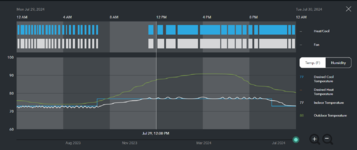
Here's a typical day in my house from this week:

1722611223978.png

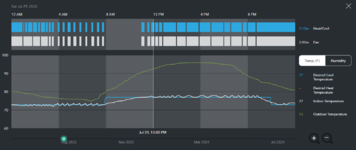
and here's last year:

1722611330042.png

The system is running longer this year vs last year (don't have July report at the moment):

1722612254275.png
1722612279468.png
1722612662160.png
 

Attachments

  • 1722612078695.png
    1722612078695.png
    54.2 KB · Views: 29

u3b3rg33k

Well-known member
Joined
Dec 18, 2017
Messages
4,048
Here's a typical day in my house from this week:

1722611223978.png

and here's last year:

1722611330042.png

The system is running longer this year vs last year (don't have July report at the moment):
well according to these graphs your system is working pretty well and not at 100% capacity.

why're you setting back to 77F at 8am? you've got nearly 4 hours of uninterrupted off time that could be leveraged for comfort.

if you want to convince me with data your system is inadequate, show me the graph when the setpoint stays at 72F the whole day.


that aside, if you're looking to make an investment in it, I'd suggest blowing in more insulation. that's relatively inexpensive, and if the ducts are under some insulation, their effective R value will increase.

I see low 60s from my vents with discharge air in the plenum in the low 50s (ductwork is in the conditioned envelope). it takes some runtime for numbers to stabilize as well.
 
Last edited:
OP
T

TheVodkaMan

Active member
Joined
Feb 21, 2020
Messages
28
Location
Tennessee, USA
well according to these graphs your system is working pretty well and not at 100% capacity.

yeah it works "well" using the scenario I programmed into my thermostat

why're you setting back to 77F at 8am? you've got nearly 4 hours of uninterrupted off time that could be leveraged for comfort.

because the system is physically incapable of keeping up with 73 after 8 AM... Look at the green line on my graphs (outdoor temp) anything after 8 AM is when the system starts fighting heat resulting in running non-stop all day wasting electricity; the heat will eventually 'win' and the indoor temp will rise to 77 regardless of what I set the thermostat to.. The only reason it kinda sorta works for us is because no one is home after 8 AM. So, since the system can't keep my indoor temps at 73 all day, there's no reason setting thermostat to anything lower than 77... At least it cycles through and doesn't run uninterruptedly.
 
OP
T

TheVodkaMan

Active member
Joined
Feb 21, 2020
Messages
28
Location
Tennessee, USA
if you want to convince me with data your system is inadequate, show me the graph when the setpoint stays at 72F the whole day.

Not possible. The 6 years I live in this house, I NEVER experienced what it would be like to have 72 during the day in the summer heat.

Edit: I misunderstood. You asked to see my graph whilst having my thermostat set at 72 at all times. I will do that just for you tomorrow and Sunday just so you can see, though, I already know it will NEVER get to 72 throughout the sunlight during the day. It will keep fighting heat and stay at 77 at best during the day. It will get down to 72 at night and will start going up in the morning.

I will be back with new graphs.
 
Last edited:

u3b3rg33k

Well-known member
Joined
Dec 18, 2017
Messages
4,048
yeah it works "well" using the scenario I programmed into my thermostat


because the system is physically incapable of keeping up with 73 after 8 AM... Look at the green line on my graphs (outdoor temp) anything after 8 AM is when the system starts fighting heat resulting in running non-stop all day wasting electricity; the heat will eventually 'win' and the indoor temp will rise to 77 regardless of what I set the thermostat to.. The only reason it kinda sorta works for us is because no one is home after 8 AM. So, since the system can't keep my indoor temps at 73 all day, there's no reason setting thermostat to anything lower than 77... At least it cycles through and doesn't run uninterruptedly.
so on a "design day" aka 95F or whatever it is for your region, your system is 'supposed' to run non-stop to maintain setpoint.

here's a chart for the numbers:
for Tennessee that's about 95F for cooling and 15F for heating.

here's what design day means to the occupant:
the heating equipment must have the capability of heating to at least 68 degrees Fahrenheit.

according to a post on the acca blog, design temps are supposed to be 70F heating, 75F cooling
  • Indoor design temperatures. The standard indoor temperatures are 70° F for heating and 75° F for cooling (with 50% relative humidity).

so if your system can do 75F on a day in the 90s, it's working as designed. if that design is favorable to you, that's another matter.

another thing to consider is that humidity removal has an "invisible" cost (latent heat). it takes energy to remove but doing that takes away from your systems ability to lower the temperature. so if you have good insulation, but air leaks let in humid air, you now have to dry the new air AND cool it.
Not possible. The 6 years I live in this house, I NEVER experienced what it would be like to have 72 during the day in the summer heat.

Edit: I misunderstood. You asked to see my graph whilst having my thermostat set at 72 at all times. I will do that just for you tomorrow and Sunday just so you can see, though, I already know it will NEVER get to 72 throughout the sunlight during the day. It will keep fighting heat and stay at 77 at best during the day. It will get down to 72 at night and will start going up in the morning.

I will be back with new graphs.
Operating under the assumption that you're right, I'd suggest some of the following:

1: increase your attic insulation. don't bother changing ductwork out, add some blown-in insulation (being careful not to crush or kink any ductwork that's hidden under it.

insulation is a double whammy on benefits. it will lower the heat load on your AC, AND covering the ducts will lower the supply temperature, delivering more cooling to the space. and you only have to pay for it once! not every time you use it, like the AC.

2: get a thermal imager (FLIR or the competition), that'll let you audit your own house, and you can target your efforts at hot spots.
a thermal imager can show you relative differences in heat. so you can see things like missing/settled insulation, or thermal bridging

plus, this is GJ, who doesn't like a new tool!

here's an example of thermal bridging:
1722625430381.png

you can see the studs transferring heat from the inside, past the insulation, to the outside of the house. hopefully this was taken mid-build, before they put on continuous exterior insulation and siding.
 
Last edited:

AGuinn

Well-known member
Joined
Jan 5, 2015
Messages
48
Location
West TN.
I'm your neighbor (slightly) to the north - I'm up in Tipton Co.

I don't recall if you said which way your house faced or orientation/number of windows, but we've gone through the same struggle. 1450sq/ft built in 2006, back of the house faces West and gets baked in the afternoons and lots of west facing windows. Our HVAC is a 3-ton unit and "correctly" sized for our square footage, but not the volume. We have 10ft ceilings everywhere.

Our return vents have a 20x20 and a 20x16 opening, but are restricted to 2x20" inside the studded walls. Our first few summers the system would run all day and the interior temp would steadily climb into the mid-80's, and wouldn't get the temp down to ~75 until 11:30pm. So I started looking for ways to reduce the heat load on the system.

3 things we did made noticeable improvements, 2 or which are relatively cheap/easy:

I started installing solar film on all the windows, and replaced all our blinds with cellular shades. Even with the old blinds closed, you could feel the heat radiating from the window glass when you walked by. It feels like the amount of heat from UV was reduced by 75%. Before, you would roast sitting at the kitchen table, and now it's much, much cooler. The cellular shades are cut *very* snug to the window frames and the closed-cell construction seems to add an extra layer of insulation. The shades make a bigger improvement in the winter, but we've never had issues keeping the house warm.

The 3rd thing we did was have ridge vents added when the roof was replaced a few years ago. The two passive roof vents were too low on the roof and weren't cycling enough air from the attic. It was easily 150* in July up there - hot enough that it had baked our shingles from underneath. After adding the ridge vents, the temps were drastically lower. I could stand up there for several minutes and it was almost comfortable. Not cheap or easy though.
 
OP
T

TheVodkaMan

Active member
Joined
Feb 21, 2020
Messages
28
Location
Tennessee, USA
so on a "design day" aka 95F or whatever it is for your region, your system is 'supposed' to run non-stop to maintain setpoint.
Understood. It does run non-stop, except the indoor temps rise from 73 to 77 anyway making the system run all day pointlessly hoping to actually reach 73 yet it only does so at around 11:30 pm... I'd be happy to keep it at 73 all day/night if the system could actually do that... the 73F luxury I can only have at nights....
insulation is a double whammy on benefits. it will lower the heat load on your AC, AND covering the ducts will lower the supply temperature, delivering more cooling to the space. and you only have to pay for it once! not every time you use it, like the AC.
I thought about doing it, you know, renting the machine and spraying it myself but it's just too late and I am not doing it until like November LOL if I actually decide to spend a couple of grand on insulation. I still don't know if I need to get rid of the old one as I don't really know if its effectiveness deteriorated over the years since the house was built. It'd be a lot easier to just buy batt insulation and roll it out on top of the lose insulation. Cost-wise - it's about the same last time I checked.
get a thermal imager (FLIR or the competition), that'll let you audit your own house
I guess that could be a good start. I already have a thermal leak detector from B&D:

1722634004554.png

I already audited most areas with this thing and of course most corners 3-5 degrees hotter as well as the walls that are coming close to the ceiling. I can only imagine that the walls are simply affected from the ceiling heat, otherwise, insulating walls would most definitely be out of my scope.
 
OP
T

TheVodkaMan

Active member
Joined
Feb 21, 2020
Messages
28
Location
Tennessee, USA
I'm your neighbor (slightly) to the north - I'm up in Tipton Co.

I don't recall if you said which way your house faced or orientation/number of windows, but we've gone through the same struggle. 1450sq/ft built in 2006, back of the house faces West and gets baked in the afternoons and lots of west facing windows. Our HVAC is a 3-ton unit and "correctly" sized for our square footage, but not the volume. We have 10ft ceilings everywhere.

Our return vents have a 20x20 and a 20x16 opening, but are restricted to 2x20" inside the studded walls. Our first few summers the system would run all day and the interior temp would steadily climb into the mid-80's, and wouldn't get the temp down to ~75 until 11:30pm. So I started looking for ways to reduce the heat load on the system.

3 things we did made noticeable improvements, 2 or which are relatively cheap/easy:

I started installing solar film on all the windows, and replaced all our blinds with cellular shades. Even with the old blinds closed, you could feel the heat radiating from the window glass when you walked by. It feels like the amount of heat from UV was reduced by 75%. Before, you would roast sitting at the kitchen table, and now it's much, much cooler. The cellular shades are cut *very* snug to the window frames and the closed-cell construction seems to add an extra layer of insulation. The shades make a bigger improvement in the winter, but we've never had issues keeping the house warm.

The 3rd thing we did was have ridge vents added when the roof was replaced a few years ago. The two passive roof vents were too low on the roof and weren't cycling enough air from the attic. It was easily 150* in July up there - hot enough that it had baked our shingles from underneath. After adding the ridge vents, the temps were drastically lower. I could stand up there for several minutes and it was almost comfortable. Not cheap or easy though.
Hey neighbor! What a small world! :)

It's just amazing the amount of money they want for these "starter" homes and then you have to spend more money fixing their mistakes that could be avoided from the get-go. The front of our house is facing north - if you look at the diagram in my first post, the garage is on the north side. I can't say we're getting a lot of sunshine through the windows but then again, we have zero shade and of course no trees at all.

Thanks for the window film suggestion, that's actually a great idea and most def fits the bill.

If we were to live here for ~5 more years or so, I'd opt for a new roof with ridge vent for sure. I'd imagine that this alone could solve 50% of my heating/cooling issues and then go down the list addressing other items but the film I can definitely try ;)
 

ratflinger

Well-known member
Joined
Jul 7, 2016
Messages
322
Location
South Central Texas
Okay, I have a 2500sqft house south of San Antonio, it's tight. Built with Insulated Concrete Forms. HVAC Engineer did the Manual J. I have a 2.5T Goodman and it will keep my house at 77* in 100* weather. I can almost guarantee that a Manual J was never performed on that house. It would be well worth the fee to see what you actually need plus any ways to mitigate going to a larger unit.
 

ericm

Well-known member
Joined
Apr 17, 2016
Messages
1,963
Location
Southern Oregon
so on a "design day" aka 95F or whatever it is for your region, your system is 'supposed' to run non-stop to maintain setpoint.

Thanks for a very useful and informative post.

I looked up the design day high for both where we live now in CA and where we're having a house built in OR. The numbers seem low to me for both places, and some other CA areas I'm familiar with as well. In all those places, the daily high gets higher than that much more than 1% of days. That would be about 3.5 days per year if I understand the concept correctly. Its been hotter than that for many days this summer and we're not even to the hottest part yet.

I wonder, how often do they update the tables? Climate change is making it hotter, and in an uneven way that is not all that predictable for a given location.

I don't think this is the OP's problem, or if it is it isn't a big part of it. I'm a little concerned that my new house may be designed to an updated temperature and will be unable to keep up during heat waves in the near future.
 

danski0224

Well-known member
Joined
Jan 29, 2005
Messages
13,437
Location
Near Naperville, IL
I already audited most areas with this thing and of course most corners 3-5 degrees hotter as well as the walls that are coming close to the ceiling. I can only imagine that the walls are simply affected from the ceiling heat, otherwise, insulating walls would most definitely be out of my scope.

Exterior wall corners are difficult/impossible to insulate due to contemporary construction methods. Yes, there are different ways that will allow some insulation to be used. Headers are the same- there's nowhere to add insulation in a 2x4 wall.

Insulation can be added to exterior wall with low expansion foam done from outside. I got a quote for my house, and it is fairly reasonable at $5,000.00. Tearing off the drywall and redoing the interior would be way more, and the spray foam will also air seal, unlike fiberglass.

Most insulation I have seen over the years has not been properly installed. This significantly reduces installed R value. The wall insulation batts aren't supposed to be pushed in and stapled along the sides of the studs, but that's how I have seen it done 98% of the time.

In the grand scheme of things, wall insulation is not the biggest problem.

Improperly sealed/insulated window and door openings is something that might be addressable, but it is way more difficult with shallow depth vinyl windows.

The ceiling/attic boundary is the place of greatest temperature and pressure difference. Spending money here will reap the highest rewards.

Crappy HVAC ductwork at the furnace/air handler will also kill performance.

Unsealed register boot openings in the ceiling will pull in attic air. So will unsealed ductwork in the attic.

A blower door test and thermal imaging can point out problem areas. Unfortunately, fixing it post construction can be difficult/expensive.
 
Last edited:

danski0224

Well-known member
Joined
Jan 29, 2005
Messages
13,437
Location
Near Naperville, IL
Residential HVAC is at odds with itself.

The builder does not want to pay for anything extra, and the homeowner is stuck relying on the code minimum job.

Then later, post construction, the homeowner doesn't want to spend anything because "I'm moving soon" or "I don't wanna tear out walls" or whatever excuse there is at the time.

None of this even begins to address the quality of the installation, which includes properly sized equipment and ductwork. Locations with building codes that require Manual J,D and S help, but if the system is full of cap and taps and/or flex, it isn't gonna work.

I just looked at a now probably $million dollar + house that was likely $700k when it was built near The Lakelands in Plainfield, IL, and the system is attempting to pull 1600 cfm through a 16 x 25 x 4 Honeywell filter on one side of the furnace, and the homeowner is wondering why the $900 variable speed blower motor (that is part cost, not markup and installation and service call) took a ****. And, there's like 600 equivalent feet of ductwork at the furnace with all of the cap and taps, and the homeowner is wondering why the airflow *****.
 
Last edited:

Yankeefarmer

Well-known member
Joined
Jul 25, 2011
Messages
1,185
Location
Connecticut
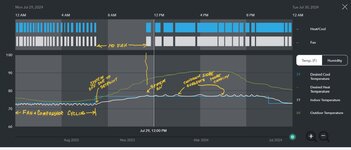
After reviewing your plots, it may be worthwhile to verify that the compressor is actually operating whenever the fan is. You might look for an explanation of why the inside temperature cycles during the day while the fan is running. It’ll be interesting to see the results of your weekend test with the lowered set point.
 

Attachments

  • IMG_0460.jpeg
    IMG_0460.jpeg
    141.8 KB · Views: 23
To avoid these ads, REGISTER NOW!
Top Bottom