To avoid these ads, REGISTER NOW!

Nut Jam question.

Stobal

Well-known member
Joined
Feb 15, 2014
Messages
180
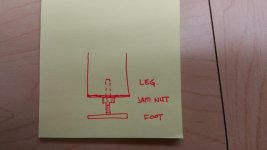
I am restoring an old pinball machine with steel legs. The legs are a length of 90 angle with a threaded plate at the bottom for a leveling foot. One I insert the foot and rotate it to the proper height I should be able to to tighten a nut from the top side of the plate to create a nut jam and lock the leveling foot in that position, correct? I was thinking I may need two nuts but my understanding is that the threaded plate will act as the second nut. The only reason I am unsure is because it is fixed in place.

If you really want to impress me and satisfy my curiosity and have the time of course, would you either explain or diagram the physics behind your answer. I think I understand the principle behind why/how a nut jam works but would love someone to lay it out in a simple way.

Thanks in advance,
 
To avoid these ads, REGISTER NOW!

jd_1138

Well-known member
Joined
May 8, 2013
Messages
17,049
Location
NE Ohio
The effects of gravity on the mass of the pinball machine will negate the possibility of the leveling foot turning. Thus no need for a 2nd nut. If your pinball machine were located on the ISS, you might need the second nut.

snes-nba-jam-box-front.jpg


For a second, I thought the title of the thread was NBA Jam. lol, used to play that game a lot. But you're into old school pinball which is cool. What table is it?
 
Last edited:

Fcvapor05

Well-known member
Joined
May 4, 2014
Messages
1,079
Yes, your bottom plate will function as a second nut and you do not need two on top of it.

The nut should go ABOVE the plate, not below.

If you want to dive deep into the science, this website has a lot of great information about fastener locking and what techniques do and don't work:

http://www.boltscience.com/pages/twonuts.htm
 
OP
S

Stobal

Well-known member
Joined
Feb 15, 2014
Messages
180
Ok. Thanks for the info. Any body want to chime in on the particular reason this is so, as far the forces involved?
 

jd_1138

Well-known member
Joined
May 8, 2013
Messages
17,049
Location
NE Ohio
Ok. Thanks for the info. Any body want to chime in on the particular reason this is so, as far the forces involved?

I think it's mostly a function of gravity and mechanical resistance/impedance.
 
OP
S

Stobal

Well-known member
Joined
Feb 15, 2014
Messages
180
Haha. While I was writing my second post I got another 4 responses and a great link. I am off to lose myself in boltscience.com. What a great site. It just got bookmarked. Thanks to all who replied.
 
OP
S

Stobal

Well-known member
Joined
Feb 15, 2014
Messages
180
Fcvapor, you shared my understanding of this. I am going to try and learn the why now on the site you linked.
 
OP
S

Stobal

Well-known member
Joined
Feb 15, 2014
Messages
180
Forgot to answer what type of machine, it's a Gotleib "Big Injun" two player edition. Pretty cool stuff. It's my first machine.
 

LXCam

ALLIANCE MEMBER
Joined
Apr 23, 2013
Messages
19,135
Location
AZ
First off it's a JAMB NUT, a nut jamb is a hole nother ballgame.

So now that we got that straight. The purpose of the jamb nut is to stop the rotation at a predetermined location. Which obviously is impossible if you only had a single nut and the flange was not threaded. But because it is only a single nut is needed to cinch the assembly in place. And it would not matter if it were on top or on the bottom. Inversely if you were to nut jamb from the bottom position it might be more painful since you don't have control of counter acting the force of gravity.
 

Fcvapor05

Well-known member
Joined
May 4, 2014
Messages
1,079
First off it's a JAMB NUT, a nut jamb is a hole nother ballgame.

So now that we got that straight. The purpose of the jamb nut is to stop the rotation at a predetermined location. Which obviously is impossible if you only had a single nut and the flange was not threaded. But because it is only a single nut is needed to cinch the assembly in place. And it would not matter if it were on top or on the bottom. Inversely if you were to nut jamb from the bottom position it might be more painful since you don't have control of counter acting the force of gravity.

Jam nut. Because it jams the threads. That's how it works. Jambs are for doors.

Also, it does matter which side the jam nut is on.

When the machine is set on the feet, the threads of the stud rest on the lower threads of the threaded plate. When the jam nut is tightened on the top, the correct threads are already in contact. After the jam nut is run down so it is touching the plate, it will only need a little bit of torque applied to stretch the stud and lock everything in place. If the nut is on the bottom, tightening the jam nut lifts the weight of the machine off of the threads in the threaded plate.

The jam nut should always go on top if possible.
 
To avoid these ads, REGISTER NOW!

WWheeler

Well-known member
Joined
Jun 23, 2015
Messages
4,105
Location
Middleofnowhere USA
Jam nut. Because it jams the threads. That's how it works. Jambs are for doors.

Also, it does matter which side the jam nut is on.

When the machine is set on the feet, the threads of the stud rest on the lower threads of the threaded plate. When the jam nut is tightened on the top, the correct threads are already in contact. After the jam nut is run down so it is touching the plate, it will only need a little bit of torque applied to stretch the stud and lock everything in place. If the nut is on the bottom, tightening the jam nut lifts the weight of the machine off of the threads in the threaded plate.

The jam nut should always go on top if possible.

Interesting. Before reading this I would have thought to do it like this instead.


Fcvapor05's reply makes sense, but I did notice my washer / dryer both came with a jam nut on the bottom of the threaded insert plate like ptgarcia's pic. There would be no access to the nut if it were on top.
 

L5wolvesf

Well-known member
Joined
Dec 4, 2011
Messages
1,831
Location
Northern AZ
Jam nut. Because it jams the threads. That's how it works. Jambs are for doors.

The jam nut should always go on top if possible.

This plus . . .

First off it's a JAM NUT, a nut jamb is a hole nother ball game.

So now that we got that straight. The purpose of the jamb nut is to stop the rotation at a predetermined location. Which obviously is impossible if you only had a single nut and the flange was not threaded. But because it is only a single nut is needed to cinch the assembly in place. And it would not matter if it were on top or on the bottom. Inversely if you were to nut jamb from the bottom position it might be more painful since you don't have control of counter acting the force of gravity.

The rotation you are looking to prevent would be from the forces exerted on the machine by the player(s).
 

The Tool Tyrant

ALLIANCE MEMBER
Joined
Dec 19, 2011
Messages
2,182
Location
Bonita, Ca. (San Diego)
First off it's a JAMB NUT, a nut jamb is a hole nother ballgame.

Ahh, yes...I recall as a young boy sliding frontward off my bicycle seat and experiencing said "nut jamb". A painful "Ballgame" as I recall.:eek:


I guess we could also go into great detail as to the tension incurred between the female and male threads when the jam (Not Jamb) nut is torqued.
Anyone??
 

L5wolvesf

Well-known member
Joined
Dec 4, 2011
Messages
1,831
Location
Northern AZ
Fcvapor05's reply makes sense, but I did notice my washer / dryer both came with a jam nut on the bottom of the threaded insert plate like ptgarcia's pic. There would be no access to the nut if it were on top.

But on a washer or dryer the threaded portion of the feet are mostly enclosed within the cabinet. On pinball machines that usually is/was not the case.
 

jd_1138

Well-known member
Joined
May 8, 2013
Messages
17,049
Location
NE Ohio
Forgot to answer what type of machine, it's a Gotleib "Big Injun" two player edition. Pretty cool stuff. It's my first machine.

I am 1/8th Native American, and I find that extremely insulting. Just kidding. Ben Heck (a hacker/engineer) created a Bill Paxton pinball. He built it from scratch a few years ago.
19.jpg
 
Last edited:

larry_g

Well-known member
Joined
Apr 28, 2007
Messages
16,880
Location
oregon
In this specific case the jam nut goes on top.

True jam nuts are thinner than a regular or heavy nut.

There is a certain amount of play in screw threads allowing vertical motion of the foot stud within the threads in the leg of the machine.

If you have the jam nut on the bottom then it has to lift the machine to remove this play in the threads before it provides its locking action.

Therefore the thin jam nut on the bottom is carrying the weight of the machine as well as the additional force due to jamming against the fixed thread.

lg
no neat sig line
 
OP
S

Stobal

Well-known member
Joined
Feb 15, 2014
Messages
180
My understanding was that a jam nut was an often smaller nut used to create a "nut jam" locking system. I had a chuckle at what else nut jam could refer to depending on whether you have teenager mentality or shop at the fresh market.
 

Fcvapor05

Well-known member
Joined
May 4, 2014
Messages
1,079
You'll see machines all the time which have a jam nut on the bottom of a threaded foot- but as in the washing machine example, you usually see this when there is no or limited access to the top side.

A jam nut on the bottom is better than none at all, but jam nut on top is the first choice if you have access to get it on and tighten it.
 

MikeF2316

Well-known member
Joined
Dec 29, 2012
Messages
9,605
Location
Thornhill, ON
Yes, your bottom plate will function as a second nut and you do not need two on top of it.

The nut should go ABOVE the plate, not below.

If you want to dive deep into the science, this website has a lot of great information about fastener locking and what techniques do and don't work:

http://www.boltscience.com/pages/twonuts.htm

That's awesome, I learned something today! I especially liked this:
"The proper application of the two-nut method is time intensive and requires a degree of skill and is hence unlikely to make a major comeback on new machinery any time soon. "

So from what I understand from that site, since the load on the thread of the foot (bolt) is up, the nut if it's full size should be on the bottom. If it's thin, and there's a full size nut as part of the frame, then that nut should be on the top. In the sense of ease of adjustment, you'd want the loose nut on the bottom. Since that would bear the load, it would be easier to replace if it got damaged too.
 
To avoid these ads, REGISTER NOW!
Top Bottom