WTF!!!!!!!!!! I've typed my response twice and it didn't post.
Basically, I agree with your assertion, with a couple caveats for discussion:
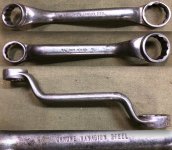
I've never seen an MTF wrench not marked MTF (or other MTF markings, in addition to True - Fit);
I've never seen an MTF wrench with a model number;
If you check my Lectrolite page, you'll see Lectrolite registered the latter True-Fit version in 1950, noting first use in "1921 by predecessor."
I gave this a lot of thought, twertsy, and a little more poking around on the web, including that late 1940s LC catalog you have. My conclusion is that we could collectively write a pretty healthy essay on this, and the best we might do is eliminate some possibilities of what this wrench is not.
Something we can both say for sure is, just because we've never seen one personally doesn't mean it doesn't exist. I am at a particular disadvantage here because finding anything pre-1950s in Florida is very challenging. Before residential AC became ubiquitous, there simply were not that many people here. The heat/humidity/flooding/hurricanes tended to destroy a good portion of what little there was.
I don't know where your LC page is referring to the 1950 registration of "True-Fit". To my knowledge, LC never used this form of the name, so unsure of its relevance to the wrench in question.
We are operating without essential reference catalogs. One is the 1931 MTF catalog mentioned by AA, which encompasses the Tru-Fit tool line. The catalog is cross-referenced in the US Congress 1931 Catalog of Copyright Entries, so I imagine one could obtain a copy from the Library of Congress. AA maintains that it was this year when MTF changed from True Fit to Tru-Fit. This format is also confirmed in the USC 1931 catalog. Both sources agree that this was presented as a "Tru-Fit" catalog as opposed to an "MTF" catalog that also contained Tru-Fit tools. This, along with the name change, could suggest that MTF had decided to position the Tru-Fit brand as a distinct line of tools under the MTF umbrella, which might be a plausible reason for not having the MTF name on them. This change of market strategy may also have included finally adding model numbers to the tools. Speculative, for sure, but it's
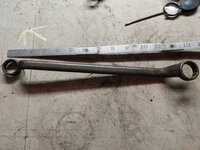
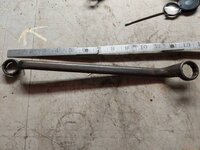
reasonable speculation. The model number B 2628 corresponds to no LC number I'm familiar with. What I would hope to find in this 1931 catalog is artwork showing whether or not this is an MTF model number and/or if the MTF mark was dropped from the wrenches.
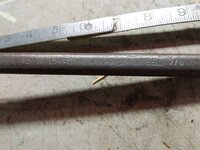
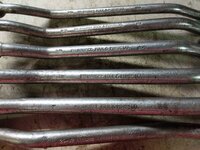
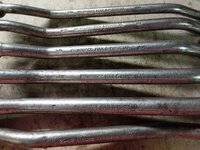
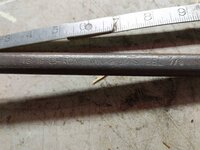
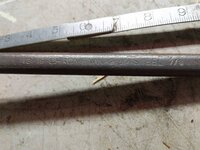
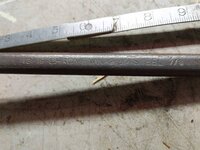
There are two other issues. First, if you take a very close look at the Tru-Fit mark on the wrench, you can see that the letters all have serifs. All known examples of LC-made wrenches show straight sans serif letters. In fact, the use of serif characters in the names on LC wrenches is completely unknown. However, figure 6 on AA's MTF page shows an adapter with serif lettering. If you have any other wrenches that bear both MTF and the latter-style Tru-Fit names, check for serifs.
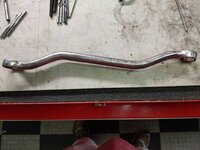
Second is the shank. All LC Tru-Fit deep offset box ends have a distinct edge at the angle where the box transitions to the shank. The heavier LC pre-war long DBE deep offset wrenches have a similar shank to this wrench, but has more distinct edges where the surfaces transitions to each successive side or facet. This wrench has soft, radius transitions.
On the other hand, we have very little info on what the earliest LC tools actually looked like. The earliest LC catalog I've seen is that late-1940s one on your site. We've been discussing LC wrench characteristics of known LC-marked tools, from those artifacts, it seems clear that every LC wrench through the end of the war, Tru-Fit or not, bore the LECTROLITE name. Could the very earliest LC wrenches have been made with existing MTF dies? Sure. But if this wrench were one of them, it would prove that MTF indeed made such wrenches! And given the propensity of LC to put LECTROLITE on every tool they made, it would have been perhaps as easy to add that name as it would have been to eliminate the MTF mark on those existing dies.
So, where does this leave us? If we travel the ambiguous road of "anything's possible," then it's nowhere. However, the constraints of reality rarely allow for "anything" to be possible--you're not going to put your Thanksgiving turkey in the oven and open it 3 hours later to find a Wankel rotary engine. if we follow the more reasonable reckoning of "less probable vs more probable," I feel it's reasonable that, given what we do already know, and if there is no new information forthcoming, it's more probable your wrench was made by MTF rather than under the Lectrolite management.
And with that, I think this is my dedicated GJ time sink for the entire month!

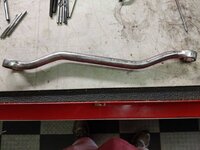


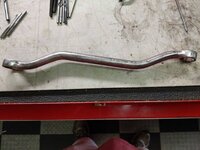


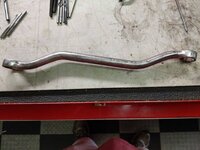









 Extremely cool find for a Lectrolite collector!