To avoid these ads, REGISTER NOW!

Oddball Unknown Wrench

twertsy

Well-known member
Joined
Jan 5, 2014
Messages
6,726
Location
Reedville, VA
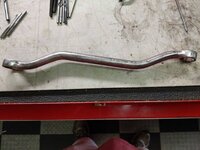
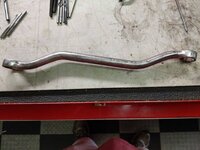
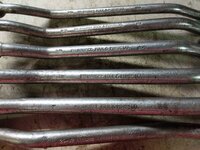
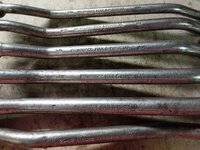
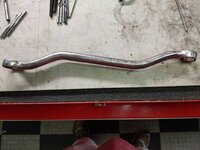
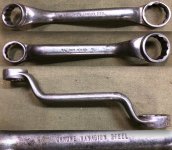
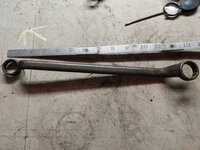
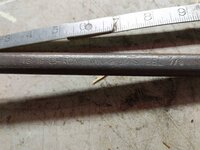
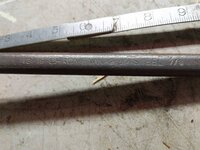
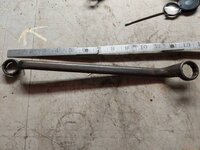
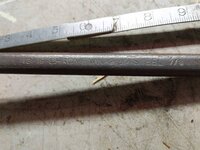
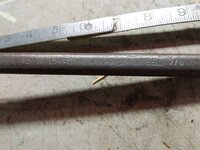
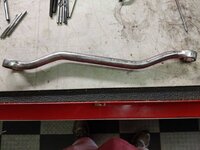
This was I the pile I brought home yesterday. It was sitting in water and covered in rust, but the shape was familiar. 1st pic is the wrench shape, second is the only marking. 3 & 4 are why I picked it up, with the newbie on the bottom.

Ideas on a maker? Early Lectrolite? MTF is the only maker I've seen produce this shape offset. I do have a very early oval (not round) shank "Tru-Fit" marked Chrome Vanadium Steel with the sizes marked with a dash, but it's the normal offset DBE style.

89406a8d7a598bfadc852f489cc50102.jpg9267bdbe3ca81e9d05dea05b211a1645.jpg64b392e10bcc98ab395f9ea7d5d5acf0.jpg7eaf0749f52fe280e2a26656b0ae1d2f.jpg

Sent from my Pixel 2 XL using Tapatalk
 

Attachments

  • 89406a8d7a598bfadc852f489cc50102.jpg
    89406a8d7a598bfadc852f489cc50102.jpg
    89.6 KB · Views: 1
  • 9267bdbe3ca81e9d05dea05b211a1645.jpg
    9267bdbe3ca81e9d05dea05b211a1645.jpg
    67.8 KB · Views: 1
  • 64b392e10bcc98ab395f9ea7d5d5acf0.jpg
    64b392e10bcc98ab395f9ea7d5d5acf0.jpg
    100.5 KB · Views: 1
  • 7eaf0749f52fe280e2a26656b0ae1d2f.jpg
    7eaf0749f52fe280e2a26656b0ae1d2f.jpg
    109.8 KB · Views: 1
Last edited:
To avoid these ads, REGISTER NOW!

r_olson_06

Well-known member
Joined
Feb 12, 2012
Messages
4,076
Location
SD
This was I the pile I brought home yesterday. It was sitting in water and covered in rust, but the shape was familiar. 1st pic is the wrench shape, second is the only marking. 3 & 4 are why I picked it up, with the newbie on the bottom.

Ideas on a maker? Early Lectrolite? MTF is the only maker I've seen produce this shape offset. I do have a very early oval (not round) shank "Tru-Fit" marked Chrome Vanadium Steel with the sizes marked with a dash, but it's the normal offset DBE style.

89406a8d7a598bfadc852f489cc50102.jpg9267bdbe3ca81e9d05dea05b211a1645.jpg64b392e10bcc98ab395f9ea7d5d5acf0.jpg7eaf0749f52fe280e2a26656b0ae1d2f.jpg

Sent from my Pixel 2 XL using Tapatalk
Nice find. Never seen that style of MTF let alone a full set.

Sent from my XT1080 using The Garage Journal mobile app
 

Attachments

  • 7eaf0749f52fe280e2a26656b0ae1d2f.jpg
    7eaf0749f52fe280e2a26656b0ae1d2f.jpg
    104.9 KB · Views: 1
  • 64b392e10bcc98ab395f9ea7d5d5acf0.jpg
    64b392e10bcc98ab395f9ea7d5d5acf0.jpg
    97 KB · Views: 1
  • 9267bdbe3ca81e9d05dea05b211a1645.jpg
    9267bdbe3ca81e9d05dea05b211a1645.jpg
    65.9 KB · Views: 1
  • 89406a8d7a598bfadc852f489cc50102.jpg
    89406a8d7a598bfadc852f489cc50102.jpg
    86.9 KB · Views: 0

Username already in use

Well-known member
Joined
Sep 4, 2015
Messages
2,177
Location
Ohio
Interesting. I think the easy answer is contract production made by MTF. But I've seen that hyphen style size marking on early P&C as well as some Hinsdale wrenches (I think). And of course, Indestro liked to use 'Chrome Vanadium Steel' as a branding.
 
OP
T

twertsy

Well-known member
Joined
Jan 5, 2014
Messages
6,726
Location
Reedville, VA
Nice find. Never seen that style of MTF let alone a full set.

Sent from my XT1080 using The Garage Journal mobile app

Not quite a full set, I think I'm missing 1 wrench. 3/4" isn't covered.

Interesting. I think the easy answer is contract production made by MTF. But I've seen that hyphen style size marking on early P&C as well as some Hinsdale wrenches (I think). And of course, Indestro liked to use 'Chrome Vanadium Steel' as a branding.

True, but Indestro didn't make that style as far as I know. Did you guys notice the "3" to the right of the stamps? Appears it could be a date stamp? I don't know but I'm certainly leaning toward early '30s MTF contract production or Lectrolite.
 

DadsTools

Well-known member
Joined
Jul 27, 2017
Messages
1,852
You guys know I'm seriously into Lectrolite Corp. Like many companies, LC's contract stuff always is identical to their branded production except for the markings. Even so, all Lectrolite DBE I've ever encountered, contract or otherwise, that had no recess or raised panel holding the characters were always forged in, not stamped (these are very early LC). There's also something about the bends in the shank that just doesn't seem right. And of course, LC doesn't seem to have ever made any such wrench shape.

If pressed for a call I'd say that from what I can see in the photo, there's nothing about this wrench that's LC-ish to me. I can't imagine LC tooling up special just for this design to make what was apparently (due to its scarcity) a very short run. Nor can I picture a contract buyer that might having been seeking out that particular geometry not going to a mfr that was already making it. I think your MTF is a far stronger candidate.
 

Username already in use

Well-known member
Joined
Sep 4, 2015
Messages
2,177
Location
Ohio
And Indestro actually used "Chromium Vanadium" as a branding for their own production as well as production for Ward's and Western Auto.

On the sockets, yes. But at least on the DOEs they did use Chrome Vanadium Steel as evidenced by this wartime ISN 723 wrench. However, I agree that the OPs wrench is likely not Duro/Indestro made.

attachment.php


Edit to add this Duro/Indestro DBE also marked Chrome Vanadium Steel, not Chromium.

attachment.php
 

Attachments

  • CV Steel.jpg
    CV Steel.jpg
    19.3 KB · Views: 260
  • CV DBE.jpg
    CV DBE.jpg
    147 KB · Views: 260
Last edited:
OP
T

twertsy

Well-known member
Joined
Jan 5, 2014
Messages
6,726
Location
Reedville, VA
You guys know I'm seriously into Lectrolite Corp. Like many companies, LC's contract stuff always is identical to their branded production except for the markings. Even so, all Lectrolite DBE I've ever encountered, contract or otherwise, that had no recess or raised panel holding the characters were always forged in, not stamped (these are very early LC). There's also something about the bends in the shank that just doesn't seem right. And of course, LC doesn't seem to have ever made any such wrench shape.

If pressed for a call I'd say that from what I can see in the photo, there's nothing about this wrench that's LC-ish to me. I can't imagine LC tooling up special just for this design to make what was apparently (due to its scarcity) a very short run. Nor can I picture a contract buyer that might having been seeking out that particular geometry not going to a mfr that was already making it. I think your MTF is a far stronger candidate.
Dad's, here's the other oddball I have, which also could be MTF or LC. However, I've never seen an MTF wrench with a model number (I have 30+), and if Lectrolite it should be 3005.

No other markings.e7255cc7d1e47eedb5858b89dbc73296.jpgfc83dd8f42656200bd7c987f36919b64.jpg9e6a9c4fcc3fae5773b5905e30eaa348.jpg

Sent from my Pixel 2 XL using Tapatalk
 

Attachments

  • fc83dd8f42656200bd7c987f36919b64.jpg
    fc83dd8f42656200bd7c987f36919b64.jpg
    74.4 KB · Views: 0
  • 9e6a9c4fcc3fae5773b5905e30eaa348.jpg
    9e6a9c4fcc3fae5773b5905e30eaa348.jpg
    69.6 KB · Views: 0
  • e7255cc7d1e47eedb5858b89dbc73296.jpg
    e7255cc7d1e47eedb5858b89dbc73296.jpg
    97.6 KB · Views: 0

Private Lugnutz

Well-known member
Joined
Mar 30, 2012
Messages
30,477
Location
The Authentic Jersey Shore
On the sockets, yes.
Not just the sockets. They marked their DOE and DBE wrenches "Chromium Vanadium" as well. (Parenthetically, so as not to side-track Todd's thread, it actually never registered with me that they ever used the shortened "Chrome" Vanadium before, so thanks. Oddly, when the whole point of using the full "Chromium" was to distinguish their products from every tom, ****, and harry that WAS using the much more common "Chrome Vanadium". I wonder for how long - and exactly when - they did that. But I see your point that it's a bit different with the 'Steel' on the end of it.)
 
To avoid these ads, REGISTER NOW!
OP
T

twertsy

Well-known member
Joined
Jan 5, 2014
Messages
6,726
Location
Reedville, VA
I could be all wet here but that mark that you think is a 3 looks like that stylized W that Stevens Walden used.
Bill,
I believe the use of that W was way later. Plus, they never used Tru-Fit and under mag, it's definitely a 3.

Sent from my Pixel 2 XL using Tapatalk
 

DadsTools

Well-known member
Joined
Jul 27, 2017
Messages
1,852
Dad's, here's the other oddball I have, which also could be MTF or LC. However, I've never seen an MTF wrench with a model number (I have 30+), and if Lectrolite it should be 3005.

No other markings.e7255cc7d1e47eedb5858b89dbc73296.jpgfc83dd8f42656200bd7c987f36919b64.jpg9e6a9c4fcc3fae5773b5905e30eaa348.jpg

Sent from my Pixel 2 XL using Tapatalk

:scared: Extremely cool find for a Lectrolite collector!

This wrench had me scratching my head for a moment. That TruFit name seemed to be telling. But while the cross-section profile of the shank seems to be similar to the later 4000 series LECTROLITE line, other characteristics did not.

The early days of LC through to sometime in the late 1940s were kind of a lottery when it came to the wrenches they produced. There were numerous variations, including the model numbers for the budget TruFit 3000 series being interchanged with the 4000 series LECTROLITE first line wrenches and vice versa (these same model numbers were used on LC's contract production as well). But from all the examples I've seen of these early years, all the LC wrenches have the Lectrolite name on them whether its a TruFit or not. And while the early LC version of the TruFit name is hyphenated like this wrench, I've never seen the name stamped on an early LC unless it's on a raised panel, whereas I've seen only forged in names used on shanks having no panel. And as you also observed, I too have never seen this kind of model number on an LC.

After some digging, I believe the answer can be found on the AA site. Sometimes good info comes from those having access to certain vintage catalogs. Apparently, AA had access to the 1931 MFT catalog just prior to its merger with the other entities that collectively formed LC. This catalog shows that MFT had changed the spelling of its brand from the earlier True Fit to the Tru-Fit with the overlines coming off the T and F that is shown on this wrench and that LC continued to used for a time following the merger. The model number may have been added to MFT's Tru-Fit line at that time as well.

Based on all this, I strongly suspect your oddball Tru-Fit is very late MFT production just prior to the formation of Lectrolite.
 

Attachments

  • e7255cc7d1e47eedb5858b89dbc73296.jpg
    e7255cc7d1e47eedb5858b89dbc73296.jpg
    94.9 KB · Views: 0
  • 9e6a9c4fcc3fae5773b5905e30eaa348.jpg
    9e6a9c4fcc3fae5773b5905e30eaa348.jpg
    68 KB · Views: 0
  • fc83dd8f42656200bd7c987f36919b64.jpg
    fc83dd8f42656200bd7c987f36919b64.jpg
    74.4 KB · Views: 0
Last edited:
OP
T

twertsy

Well-known member
Joined
Jan 5, 2014
Messages
6,726
Location
Reedville, VA
WTF!!!!!!!!!! I've typed my response twice and it didn't post.

Basically, I agree with your assertion, with a couple caveats for discussion:

I've never seen an MTF wrench not marked MTF (or other MTF markings, in addition to True - Fit);

I've never seen an MTF wrench with a model number;

If you check my Lectrolite page, you'll see Lectrolite registered the latter True-Fit version in 1950, noting first use in "1921 by predecessor."
 

DadsTools

Well-known member
Joined
Jul 27, 2017
Messages
1,852
WTF!!!!!!!!!! I've typed my response twice and it didn't post.

Basically, I agree with your assertion, with a couple caveats for discussion:

I've never seen an MTF wrench not marked MTF (or other MTF markings, in addition to True - Fit);

I've never seen an MTF wrench with a model number;

If you check my Lectrolite page, you'll see Lectrolite registered the latter True-Fit version in 1950, noting first use in "1921 by predecessor."

I gave this a lot of thought, twertsy, and a little more poking around on the web, including that late 1940s LC catalog you have. My conclusion is that we could collectively write a pretty healthy essay on this, and the best we might do is eliminate some possibilities of what this wrench is not.

Something we can both say for sure is, just because we've never seen one personally doesn't mean it doesn't exist. I am at a particular disadvantage here because finding anything pre-1950s in Florida is very challenging. Before residential AC became ubiquitous, there simply were not that many people here. The heat/humidity/flooding/hurricanes tended to destroy a good portion of what little there was.

I don't know where your LC page is referring to the 1950 registration of "True-Fit". To my knowledge, LC never used this form of the name, so unsure of its relevance to the wrench in question.

We are operating without essential reference catalogs. One is the 1931 MTF catalog mentioned by AA, which encompasses the Tru-Fit tool line. The catalog is cross-referenced in the US Congress 1931 Catalog of Copyright Entries, so I imagine one could obtain a copy from the Library of Congress. AA maintains that it was this year when MTF changed from True Fit to Tru-Fit. This format is also confirmed in the USC 1931 catalog. Both sources agree that this was presented as a "Tru-Fit" catalog as opposed to an "MTF" catalog that also contained Tru-Fit tools. This, along with the name change, could suggest that MTF had decided to position the Tru-Fit brand as a distinct line of tools under the MTF umbrella, which might be a plausible reason for not having the MTF name on them. This change of market strategy may also have included finally adding model numbers to the tools. Speculative, for sure, but it's reasonable speculation. The model number B 2628 corresponds to no LC number I'm familiar with. What I would hope to find in this 1931 catalog is artwork showing whether or not this is an MTF model number and/or if the MTF mark was dropped from the wrenches.

There are two other issues. First, if you take a very close look at the Tru-Fit mark on the wrench, you can see that the letters all have serifs. All known examples of LC-made wrenches show straight sans serif letters. In fact, the use of serif characters in the names on LC wrenches is completely unknown. However, figure 6 on AA's MTF page shows an adapter with serif lettering. If you have any other wrenches that bear both MTF and the latter-style Tru-Fit names, check for serifs.

Second is the shank. All LC Tru-Fit deep offset box ends have a distinct edge at the angle where the box transitions to the shank. The heavier LC pre-war long DBE deep offset wrenches have a similar shank to this wrench, but has more distinct edges where the surfaces transitions to each successive side or facet. This wrench has soft, radius transitions.

On the other hand, we have very little info on what the earliest LC tools actually looked like. The earliest LC catalog I've seen is that late-1940s one on your site. We've been discussing LC wrench characteristics of known LC-marked tools, from those artifacts, it seems clear that every LC wrench through the end of the war, Tru-Fit or not, bore the LECTROLITE name. Could the very earliest LC wrenches have been made with existing MTF dies? Sure. But if this wrench were one of them, it would prove that MTF indeed made such wrenches! And given the propensity of LC to put LECTROLITE on every tool they made, it would have been perhaps as easy to add that name as it would have been to eliminate the MTF mark on those existing dies.

So, where does this leave us? If we travel the ambiguous road of "anything's possible," then it's nowhere. However, the constraints of reality rarely allow for "anything" to be possible--you're not going to put your Thanksgiving turkey in the oven and open it 3 hours later to find a Wankel rotary engine. if we follow the more reasonable reckoning of "less probable vs more probable," I feel it's reasonable that, given what we do already know, and if there is no new information forthcoming, it's more probable your wrench was made by MTF rather than under the Lectrolite management.

And with that, I think this is my dedicated GJ time sink for the entire month!
 
Last edited:
OP
T

twertsy

Well-known member
Joined
Jan 5, 2014
Messages
6,726
Location
Reedville, VA
I gave this a lot of thought, twertsy, and a little more poking around on the web, including that late 1940s LC catalog you have. My conclusion is that we could collectively write a pretty healthy essay on this, and the best we might do is eliminate some possibilities of what this wrench is not.

Something we can both say for sure is, just because we've never seen one personally doesn't mean it doesn't exist. I am at a particular disadvantage here because finding anything pre-1950s in Florida is very challenging. Before residential AC became ubiquitous, there simply were not that many people here. The heat/humidity/flooding/hurricanes tended to destroy a good portion of what little there was.

I don't know where your LC page is referring to the 1950 registration of "True-Fit". To my knowledge, LC never used this form of the name, so unsure of its relevance to the wrench in question.

We are operating without essential reference catalogs. One is the 1931 MTF catalog mentioned by AA, which encompasses the Tru-Fit tool line. The catalog is cross-referenced in the US Congress 1931 Catalog of Copyright Entries, so I imagine one could obtain a copy from the Library of Congress. AA maintains that it was this year when MTF changed from True Fit to Tru-Fit. This format is also confirmed in the USC 1931 catalog. Both sources agree that this was presented as a "Tru-Fit" catalog as opposed to an "MTF" catalog that also contained Tru-Fit tools. This, along with the name change, could suggest that MTF had decided to position the Tru-Fit brand as a distinct line of tools under the MTF umbrella, which might be a plausible reason for not having the MTF name on them. This change of market strategy may also have included finally adding model numbers to the tools. Speculative, for sure, but it's reasonable speculation. The model number B 2628 corresponds to no LC number I'm familiar with. What I would hope to find in this 1931 catalog is artwork showing whether or not this is an MTF model number and/or if the MTF mark was dropped from the wrenches.

There are two other issues. First, if you take a very close look at the Tru-Fit mark on the wrench, you can see that the letters all have serifs. All known examples of LC-made wrenches show straight sans serif letters. In fact, the use of serif characters in the names on LC wrenches is completely unknown. However, figure 6 on AA's MTF page shows an adapter with serif lettering. If you have any other wrenches that bear both MTF and the latter-style Tru-Fit names, check for serifs.

Second is the shank. All LC Tru-Fit deep offset box ends have a distinct edge at the angle where the box transitions to the shank. The heavier LC pre-war long DBE deep offset wrenches have a similar shank to this wrench, but has more distinct edges where the surfaces transitions to each successive side or facet. This wrench has soft, radius transitions.

On the other hand, we have very little info on what the earliest LC tools actually looked like. The earliest LC catalog I've seen is that late-1940s one on your site. We've been discussing LC wrench characteristics of known LC-marked tools, from those artifacts, it seems clear that every LC wrench through the end of the war, Tru-Fit or not, bore the LECTROLITE name. Could the very earliest LC wrenches have been made with existing MTF dies? Sure. But if this wrench were one of them, it would prove that MTF indeed made such wrenches! And given the propensity of LC to put LECTROLITE on every tool they made, it would have been perhaps as easy to add that name as it would have been to eliminate the MTF mark on those existing dies.

So, where does this leave us? If we travel the ambiguous road of "anything's possible," then it's nowhere. However, the constraints of reality rarely allow for "anything" to be possible--you're not going to put your Thanksgiving turkey in the oven and open it 3 hours later to find a Wankel rotary engine. if we follow the more reasonable reckoning of "less probable vs more probable," I feel it's reasonable that, given what we do already know, and if there is no new information forthcoming, it's more probable your wrench was made by MTF rather than under the Lectrolite management.

And with that, I think this is my dedicated GJ time sink for the entire month!
As I said in my last post, I'm inclined to agree, but am on the hunt for more cats!!!

Here's the Lectro page link: http://toolarchives.com/node/292
 

DadsTools

Well-known member
Joined
Jul 27, 2017
Messages
1,852
As I said in my last post, I'm inclined to agree, but am on the hunt for more cats!!!

Here's the Lectro page link: http://toolarchives.com/node/292
Thanks for the link, twertsy. Lots of great info there. I simply couldn't find that page on my own for some reason.

Yes, the catalogs! That 1931 MFT catalog would be very useful to have. Again, because it was filed in the copyright catalog, a copy of it may be obtainable from the Library of Congress. I understand that the public can have access to what they have, and just about everything's been scanned into digitized form over the years.

Lectrolite is a bit of a mystery company at times, and documentation is scarce. The info from your TA LC page and also from AA tells of LC's origin from the merger of Milwaukee Tool & Forge Co., Saturn Electric Water Heater Corp., Defiance Stamping Co., and Pressed Products Co. Two of these, Pressed Products and Saturn, were fundamentally involved with the mfr of electric water heaters and appliances. I believe it was these products that were at the time the main focus of the merger, and so the reasoning behind the new name Lectrolite, which is an obviously bizarre name for a tool company.

I also believe the decision to continue making tools came from the existing capability and distribution channel of MTF. The 'Lectrolite' name indicates to me that tool production may have been seen as a sustainable sideline for the new company. I think it ironic that this secondary product ultimately became its flagship.

Another suspicion of mine is that the seemingly complete lack of catalogs from those early LC years is due to the fact that they were primarily a commercial supplier at first. This is based in part on the failure to find any reference whatsoever to period electric heater or other home appliance attributed to Lectrolite. Such consumer items would still have references about them in the collectors market if nothing else. Apparently, there are no period Lectrolite branded home heaters or other appliances. Nor are there Saturn-branded period heaters or appliances. Nor are there Lectrolite-branded auto parts. And so I believe their early products were distributed through jobbers, directly to commercial customers, or involved primarily with contract work. Certainly, the companies that merged to form LC had commercial/contract channels of distribution established for their existing product lines. But, other than the MFT tool line, I can find no references to any other products from these companies.

Which brings us to the catalog dilemma. If my line of thinking is correct, LC tools would have been distributed to retail stores through jobbers. There may have been no standalone LC tool catalog in those early years. And we all know how hard it is to obtain general line jobbers catalogs aimed at retailers. The catalogs are huge and so took up a lot of space. A retailer might have dozens of these. So as soon as the next issue came out, the previous one was tossed to make room. The salesman took care of the selling, demos, showing samples, etc. The physical product may have only been shown by the salesman whereas the catalog may have a one or two line text-only listing in the catalog amid thousands of products from hundreds of mfrs. I suspect this may be the story behind the 'missing' early LC catalogs.
 
Last edited:
To avoid these ads, REGISTER NOW!
Top Bottom