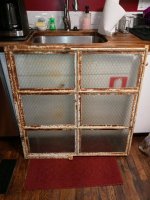
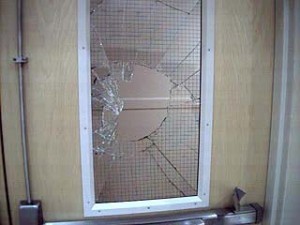
Wired Glass, Is It Safe? Read more

safti.com
From this link:
Each year hundreds of children and young adults are seriously or permanently injured in wired glass accidents. According to Dr. Philip Graitcer, Center for Injury Control at Rollins School of Public Health in Atlanta, this figure could be much higher.
“Since 1977 only wired glass and tempered or laminated glass (safety glass) have been permitted in hazardous locations such as school doors or door side panels. If there is any annealed or plate glass in these installations, they are part of an original door installation dated before 1977, or they are part of an illegal replacement. Tempered and laminated glasses are unlikely to produce the kinds of lacerations and cuts that are reported. I would conservatively estimate that 90% of the 2,500 glass door injuries seen each year in the CPSC (Consumer Products Safety Commission) system involve wired glass,” states Graciter.
In response to pressure from advocacy groups, glass industry members, and various state representatives, building codes are changing. The 2003 IBC and NFPA 5000 codes have eliminated the use of wired glass in the construction of all educational and athletic facilities. The state of Oregon may soon become the first in the nation to protect its citizens from the debilitating injuries caused by human impact with wired glass in all occupancies, not just educational and athletic facilities.
[end]
It's been awhile (long time since retirement) but when I was a plans examiner and lifesafety code inspector, the use of chicken glass was to maintain integrity of door windows during fires. Advances in materials has made them obsolete in many occupancies. Changes in occupancies compels the structure to be updated to comply with the regulations currently in-place for that classification of occupancy.
From NFPA 257:
This edition of NFPA 257, Standard on Fire Test for Window and Glass Block Assemblies, was prepared by the Technical Committee on Fire Tests. It was issued by the Standards Council on July 28, 2006, with an effective date of August 17, 2006, and supersedes all previous editions. This edition of NFPA 257 was approved as an American National Standard on August 17, 2006. Origin and Development of NFPA 257 This standard was tentatively adopted by NFPA in 1969 and officially adopted in 1970. Subsequent revisions were released in 1975, 1980, 1985, and 1990. The 1996 edition of NFPA 257 was a complete rewrite that included editorial and technical revisions. Many of the editorial and technical revisions were made to parallel those of NFPA 252, Standard Methods of Fire Tests of Door Assemblies. The technical revisions included modifications to the furnace pressure. The neutral pressure was eliminated so that the test assembly could be tested to the pressure required by other code requirements (i.e., NFPA 101 ® , Life Safety Code ® , and the model building codes). In addition, the duration of the test method was extended beyond the 45 minutes required in previous editions to allow for the testing of new glazing materials. The 2000 edition was completely revised for the purposes of consistency and editorial reformatting. This document was modified so that the test protocols and equipment used would be more consistent with the provisions found in NFPA 251, Standard Method of Tests of Fire Endurance of Building Construction and Materials, and NFPA 252, Standard Method of Fire Tests of Door Assemblies. This revision recognized the positive pressure testing required by some of the model building codes. It also provided greater clarification on how to conduct the hose stream test to achieve greater repeatability and reproducibility. The 2007 edition is a complete revision for compliance with the Manual of Style for NFPA Technical Committee Documents. It also contains revisions to its scope and purpose Copyright NFPA