To avoid these ads, REGISTER NOW!

Old Garage Lean

OldGarageChris

Well-known member
Joined
Feb 18, 2012
Messages
48
Location
Beamsville, Ontario, Canada
Hey guys,

I've got an old detached garage lean that I'll be repairing in the spring. I wanted somewhere to track the progress and a forum to ask questions. I'm handy, but carpentry projects are rare for me.

Pics uploaded here:http://s1240.photobucket.com/user/OldGarageChris/library/Garage

All viewpoint references are standing in front of the garage looking back at it. Building dimensions: 18.25ft length x 22.4ft width.

I don't know how old the garage is...it just looks old. The good news is that the walls were built on top of a concrete pad. There is a crack in the concrete that has lifted one side slightly (too much stuff in the way for a pic right now). However, I plan on leaving the concrete untouched.

The building is only leaning to the left. As you can see in the pictures, there is a tree on the right side that is likely the cause of the lean. I cannot move this tree as it is my neighbours. The very bottom of the wall is about 4 inches away and I think I have enough room to lean this back. I will have to split my eaves trough on the right side as the tree will be very close to the building.

I don't see any anchor bolts on the sill plates...so I will start by adding those to secure the bottom of the walls. The sill plates look ok but I haven't decided if I will replace them anyways.

After securing the sill plates, I plan on using a cable winch to correct the lean as described here: http://www.hammerzone.com/archives/framecarp/liftmove/straighten/garage1/winch.htm

I want to make this building rock solid, while keeping the cost minimal. The plan is to install new siding and finish the inside of the garage.

Questions:
- Should I be removing the wooden siding before twisting this building back into shape? I can't decide if it is a help or hindrance in the leaning process.
- Is metal T bracing enough to hold this building straight? I only have 1 wall to stop this lean as the front wall is a garage door.
- Should I install new siding over top of the old wood siding or remove the boards completely, install OSB and then new siding?
- Is it worth cutting out the corners to install concreted 4x4 posts?
- What are the chances drywall will still crack with T bracing and possibly using OSB on the outside?

That's basically it. I've got a couple months to plan this out before spring. I have yet to look into materials and pricing. Hopefully there are people interested in watching my progress and helping me out. It's not a crazy lean, but it sure is a big project.

Chris
 
Last edited:
To avoid these ads, REGISTER NOW!

fflintstone

Well-known member
Joined
Jul 18, 2010
Messages
2,722
Location
MOFnowhere Mi.
There is a guy here who did this last year. Use the search function.
IMO winch it back, then remove the rear siding. the siding fasteners will come out easier if the stress of the lean is removed. Forget metal T braces and just sheet with OSB. Then reinstall the old siding.
Just my opinion.
 
OP
O

OldGarageChris

Well-known member
Joined
Feb 18, 2012
Messages
48
Location
Beamsville, Ontario, Canada
Thanks Flin. Yes, I have seen the other thread and it has been a great help. However, I
have questions not related to the retired thread and I wanted to describe my situation. Some people like to see pictures of projects like this even if it has been done before.

Will drywall last with only leaning the build back + OSB sheeting on the back/front walls? I figured I would need to beef this up more...
 

fflintstone

Well-known member
Joined
Jul 18, 2010
Messages
2,722
Location
MOFnowhere Mi.
Thanks Flin. Yes, I have seen the other thread and it has been a great help. However, I
have questions not related to the retired thread and I wanted to describe my situation. Some people like to see pictures of projects like this even if it has been done before.

Will drywall last with only leaning the build back + OSB sheeting on the back/front walls? I figured I would need to beef this up more...

pm your phone to me and I will call you.
 

Zeke

Well-known member
Joined
Aug 13, 2009
Messages
17,176
Location
Long Beach CA, the sewer by the sea.
You say you can't do anything about the tree because it's your neighbor's. Au contraire but you won't make any friends doing it. Just like if their tree roots get in your sewer line, they pay for cleanout.
 

theoldwizard1

Well-known member
Joined
Feb 22, 2011
Messages
43,142
Location
SE MI
I agree with Zeke. That tree has damaged your property and will continue to do so until it is removed.

Have you had a friendly chat with the neighbor and asked about removing the tree ?

If the neighbor says no way, it is time to contact your town's zoning/ordnance enforcement department and ask them about the situation. Be certain to tell them the tree is causing damage to your structure. You may have to get a survey to establish the exact property line. My gut tells me the tree is more than 50% on your property because it is highly unlikely that any town would allow a garage be built that close to a property line.


If you don't remove that tree and then break up the floor and the foundation you are going to put in a lot of work and not get a permanent solution.
 

bczygan

Well-known member
Joined
Nov 4, 2009
Messages
22,002
Location
DETROIT! Arsenal of Scrappers
Hey guys,

I've got an old detached garage lean that I'll be repairing in the spring. I wanted somewhere to track the progress and a forum to ask questions. I'm handy, but carpentry projects are rare for me.

Starting pics uploaded here: http://photobucket.com/OldGarageChris All viewpoint references are standing in front of the garage looking back at it. Building dimensions: 18ft length x 23ft width.

I don't know how old the garage is...it just looks old. The good news is that the walls were built on top of a concrete pad. There is a crack in the concrete that has lifted one side slightly (too much stuff in the way for a pic right now). However, I plan on leaving the concrete untouched.

The building is only leaning to the left. As you can see in the pictures, there is a tree on the right side that is likely the cause of the lean. I cannot move this tree as it is my neighbours. The very bottom of the wall is about 4 inches away and I think I have enough room to lean this back. I will have to split my eaves trough on the right side as the tree will be very close to the building.

I don't see any anchor bolts on the sill plates...so I will start by adding those to secure the bottom of the walls. The sill plates look ok but I haven't decided if I will replace them anyways.

After securing the sill plates, I plan on using a cable winch to correct the lean as described here: http://www.hammerzone.com/archives/framecarp/liftmove/straighten/garage1/winch.htm

I want to make this building rock solid, while keeping the cost minimal. The plan is to install new siding and finish the inside of the garage.

Questions:
- Should I be removing the wooden siding before twisting this building back into shape? I can't decide if it is a help or hindrance in the leaning process.
- Is metal T bracing enough to hold this building straight? I only have 1 wall to stop this lean as the front wall is a garage door.
- Should I install new siding over top of the old wood siding or remove the boards completely, install OSB and then new siding?
- Is it worth cutting out the corners to install concreted 4x4 posts?
- What are the chances drywall will still crack with T bracing and possibly using OSB on the outside?

That's basically it. I've got a couple months to plan this out before spring. I have yet to look into materials and pricing. Hopefully there are people interested in watching my progress and helping me out. It's not a crazy lean, but it sure is a big project.

Chris


The biggest enemy of any structure is water.
When you say you want the structure to be rock solid and keep the cost minimal. Neither of these are defined.
I see a lot of evidence of water damage from top to bottom. If you want to expend enough money to finish the inside with maybe insulation and heat, then you need to repair the damage already existing and then made alterations that will prevent future damage. The definition of "rock solid" that I would adopt is one where the structure was adequate for the loads and uses it is put to and that the structure was protected from future water damage by making necessary modifications.
Once you decide on the goals, you can start by examining the existing structure and figuring out what damage needs repairing and also what has caused the damage and what needs doing to prevent future damage. Once all these things are defined and quantified you will have a list of materials that will allow you to determine the cost. The cost will be what it is.

I'll go through the list of what I see as existing conditions in the next post.
 

bczygan

Well-known member
Joined
Nov 4, 2009
Messages
22,002
Location
DETROIT! Arsenal of Scrappers
It is very difficult to examine a building from photos, but I see a lot of garages like the one shown. They date from the first half of the 20th century and are cheaply constructed by today's standards but an improvement over the dirt floor carriage houses of the pre automobile era. Some of the problems typically found include foundations inadequate or missing, slabs on badly prepared bases, no positive drainage away from slab/foundation, board siding that leaks, Gutters backed up, downspouts missing or not kicked out, fascia boards rotted, roofs left far past replacement time, inadequate roof framing and too low slope roofs.

OK, Lets go through these things.
Missing or inadequate foundations and slabs on improper bases allow for differential settlement and structural cracking of slabs. Add to this the fact that the slabs are seldom set far enough above surrounding grade to provide for positive drainage away from the structure and in freeze thaw cycles you have constant movement of the slab, foundation and structure. Missing downspouts or no kick outs compound the problem by dumping water at the slab edge. A shallow roof slope, lack of roofing maintenance and improperly installed gutters rot out fascias and roof sheathing, especially at the edge, and allow water entry to the wall structure. Lack of a barrier between the sill and concrete slab or foundation rot out the sill plate. Wood siding and structure within 8" of grade allows water to splash and rot out siding, sill and studs. Board siding, once left to the elements won't keep the structure square like it did when new.
Most of these typical problems exist in your garage.
I see evidence of water in many places in the roof and wall structure. The roof needs replacing. The siding is not keeping water out. The doors are not adequate for an enclosed work space.

I have a neighbor with virtually the same garage in similar shape. Like you, his budget won't allow demolition and rebuild. But his labor is free. With a LOT of labor and a pretty fair sum of money for materials, his structure (And yours) can be made structurally sound and weather tight to create a good work space.

First, you and I need to make a more complete evaluation of the existing structure from top to bottom.
First step is to tell me how you want to use the space.
Then I'll tell you what info I need to evaluate the structure.

Bill
 

bczygan

Well-known member
Joined
Nov 4, 2009
Messages
22,002
Location
DETROIT! Arsenal of Scrappers
OK,
I've got a minute so I'll go on.

The first thing you need is a stable structure and the base for that is your foundation. You need to find out what you have. Is it simply as slab on grade or is there a stem wall under the exterior walls. Do the wood framed walls rest on the foundation with the slab floating inside the foundation (Unlikely) or do they sit on the slab which either rests on a foundation wall (Likely) or does the slab just have a thickened or turned down edge.
Find out by digging down along the outside wall to see how deep the foundation wall is. What area of the country are you in? When was the house built? Is the garage similar vintage? Do you have photos of the house? We need photos of the cracks in the slab you mentioned. Do the different parts of the slab move during different seasons? How much is the lip at the crack? How close is the sill plate to grade at different points around the garage?
We need a stable base for the wood structure and need to determine if you have that
or if what you have can be stabilized.
 

bczygan

Well-known member
Joined
Nov 4, 2009
Messages
22,002
Location
DETROIT! Arsenal of Scrappers
Next step is to investigate the wood framing of the structure. Take an awl and a screwdriver and try sticking it in the tops and bottoms of studs and top and bottom plates and rafter ends and the ends of ceiling joists. Make a list of the places that have dry rot. Check the siding and roof sheathing boards where they appear to have been wet and especially near roof edges and openings or on walls near the ground. Check building corners and around windows and doors.
When we have a good handle on the damage we will know what to do to repair it and more importantly how to prevent future damage.
 

bczygan

Well-known member
Joined
Nov 4, 2009
Messages
22,002
Location
DETROIT! Arsenal of Scrappers
The roof is a cap which sheds water and snow and keeps water from damaging your structure. Once this membrane and the one on your walls is breached, your structure is at risk. How many layers of shingles are there on your roof? I never have more than one on a garage, especially for these vintage ones, because the roof structures are always minimal. I ALWAYS strip to look for damage to the deck boards, rafter ends, fascias etc.
All these old garages have low roof slopes. Personally I like a 12 and 12 pitch for positive drainage, but they never have that!
With low slopes you need a membrane under your shingles. I would cover the entire roof with one and also use 30# felt.
You have one positive feature. Your overhang helps keep water away from the structure. This can become problematic when you insulate and heat it though.
 

bczygan

Well-known member
Joined
Nov 4, 2009
Messages
22,002
Location
DETROIT! Arsenal of Scrappers
The simplest roof, and the least prone to leaking is a plain gable. It has only one ridge and no valleys. When you place the cap shingles on your ridge start on one end and work toward the direction the prevailing winds come from in your locale. I prefer a continuous ridge vent as cans are harder to properly seal. I like the one formed from 4' rigid sections that you nail your cap shingles on. Remember to also have continuous eave vents in your soffits. Use plastic baffles in each rafter space to keep the insulation from blocking the flow of air from the soffit vents to the ridge vent.

Another thing to remember is to keep your edge metal spaced out so the drip portion is 1/4" out from the edge of the roof sheathing or boards at eave and rake so it really acts as a drip and does not rot out the wood.
 

bczygan

Well-known member
Joined
Nov 4, 2009
Messages
22,002
Location
DETROIT! Arsenal of Scrappers
The easiest way to solve your siding problem, after you deal with the structural framing problems in the wall system, is to cover the existing wood board siding with house wrap and then vinyl siding. First replace any rotted boards so you have a good nailing surface. This assumes you already (At this point in the work) have a plumb and square structure sitting on a stable foundation or slab.

Just a note: Before doing any straightening of the structure it is easier to strip your roofing off in preparation for re-roofing as it lightens the load on the structure and makes the structure more movable.

Properly trim out your openings with J mold and seal around windows and doors with ice and water shield and caulk and leave your nails NOT hammered home to allow the siding to expand and contract. Choose your desired viewpoint and place your siding laps so the piece closest to you laps on top of the one further away so laps don't show.
 

bczygan

Well-known member
Joined
Nov 4, 2009
Messages
22,002
Location
DETROIT! Arsenal of Scrappers
After you have a sound base for the wall framing to sit on your leaning problems are easy to solve. Your board siding is not keeping your structure plumb and square. It is acting like a parallelogram. You have no let in bracing (Either wood or metal) or Plywood or OSB sheathing to triangulate the walls and keep them square and plumb. In addition, this problem is critical on either side of your door because the wall panels there are too small to create the triangulation necessary and the wall has completely detached on one side. You need braces or panels at all the building corners and specially constructed panels on either side of the door opening. This will solve your problems with leaning. Easiest would be to use metal braces let in at all corners diagonally on the inside of the studs and plywood panels on each side of the door opening. The metal braces allow the existing siding to be left as is for a nailing surface and allow for any interior wall treatment you desire. The plywood panels need special gluing, screwing and other fastening and will require removal of the board siding on either side of the garage door. When you straighten your walls you will need to temporarily brace them until the metal braces and plywood panels are installed.
 
Last edited:

Falcon67

Well-known member
Joined
Jun 11, 2009
Messages
18,371
Location
Merkel, TX
That tree's gotta go. Pay the neighbor $250 for it and get it out of there.

> There is a crack in the concrete that has lifted one side slightly
Find out why before you spend anything on improvements. Crack and lift could be frost heave or roots.

Other than that, you don't have much of a lean - proper bracing and some work with a could of come-a-longs should get that squared up. Been there fixed this

garageA.jpg
 

bczygan

Well-known member
Joined
Nov 4, 2009
Messages
22,002
Location
DETROIT! Arsenal of Scrappers
A note to others:
The reason I am going into such detail in this thread is because this garage is very typical and can act as an object lesson for other people with similar garages and similar problems.
 

Vvmvbb

Well-known member
Joined
Aug 5, 2011
Messages
744
Location
CT
I pulled the front of mine square- looked a lot like yours. Two big screw eyelets in the left top plate connected by a short piece of chain and a come-along from the chain diagonally to a little T beam with holes that I lag bolted to the foundation. Worked great. Since that wall is compromised by the door I pulled the siding off the front before the pull and once in position I boxed the frame of the sides to the left and right of the door with 3/4 plywood and many long drywall screws to make it extremely stiff. Then put new siding over that. Trim the insides so it's square and will match the door. My garage ended up just a little trapezoidal - outer edges weren't exactly vertical. So I hung the outer trim strait (over hangs a little at the tops) so it appears perfect from the front. ~15 years and no issues.
 
OP
O

OldGarageChris

Well-known member
Joined
Feb 18, 2012
Messages
48
Location
Beamsville, Ontario, Canada
bczygan> Thank you. I really appreciate the time you put into your comments. I created this thread not just for me, but for future 'googlers' with the same situation/questions.

I will put a lot more work into answering your questions tomorrow when the sun is out.

In regards to the tree, I know this IS the problem. I pulled out an old survey and discovered this could actually be my tree. I will take measurements tomorrow to determine if it is. The building beside me is about 10ft away from the tree as seen in the tree picture. The building is actually a city building! This might make things easier if it's a city tree causing damage to my property. However, the tree is 50 feet tall and spans likely 500sq ft...so I don't really see how this could be taken down.

I will take pics of the cracked foundation tomorrow. My thoughts are that a new foundation means tearing the building down...so I had planned to leave the foundation as is. I want to think the shifting has already settled everything in place...but better judgement tells me it will never stop moving. Quick measurements of the biggest crack (10 feet long in the front right corner) show the corner slab raised by 0.5" and separated by 0.5". There are other cracks as well, but minor compared to this.

The walls are on concrete. The concrete under the walls is at or slightly below ground level. The inside portion of the concrete is an inch or so higher than the concrete under the walls. Does this mean two separate pours? Or did people create outer edges to fit the walls in place?

To elaborate on my goals. This garage was a huge turn off (but the house was nicely priced) when buying the house 3 years ago and I see it severely hurting my resale value. Realistically, I plan on selling in 2-3 years. My main goal is fix this up as much as possible, while not spending more than what I think a remodelled garage would gain me in property value. To give an actual number before getting into costs of materials, I am aiming under 10k. I have been quoted a new garage would cost 15-20k but we all know how quotes work. I guess the ultimate goal is to have opening/shutting doors and be able to drive a vehicle inside. The garage is big enough to create a killer work space.

I guess what I'm looking for is a building with no lean that looks good inside and out. I want to install new siding, door and windows. I also want a functional front door as I do not dare open them now. I really want to keep the current doors and refinish them. I have 2 or 3 layers of shingles (I will confirm tomorrow) and the roof repair will be done at a later time. Inside, I may or may not insulate and may or may not close up the walls. Like the roof, this will be done later.

More info to come tomorrow. Thanks again everyone for your help. I live near Toronto, Canada so shifting temperatures throughout the year is a problem.
 
To avoid these ads, REGISTER NOW!

bczygan

Well-known member
Joined
Nov 4, 2009
Messages
22,002
Location
DETROIT! Arsenal of Scrappers
I pulled the front of mine square- looked a lot like yours. Two big screw eyelets in the left top plate connected by a short piece of chain and a come-along from the chain diagonally to a little T beam with holes that I lag bolted to the foundation. Worked great. Since that wall is compromised by the door I pulled the siding off the front before the pull and once in position I boxed the frame of the sides to the left and right of the door with 3/4 plywood and many long drywall screws to make it extremely stiff. Then put new siding over that. Trim the insides so it's square and will match the door. My garage ended up just a little trapezoidal - outer edges weren't exactly vertical. So I hung the outer trim strait (over hangs a little at the tops) so it appears perfect from the front. ~15 years and no issues.

This exactly!
You created a sheer wall. And that is exactly what is needed on both sides of this garage door as well. Modern codes require a 4' wide panel on each side, or if less, engineering of a panel to resist the forces as needed. The more earthquake prone the area, the more the requirements are. Buildings with a row of garage doors on the first floor have collapsed in quakes without this, destroying the upper floor living spaces.
 

Bull

Super Moderator
Joined
Dec 12, 2005
Messages
16,189
Location
MA
I love these old, leaning garage projects. Keep the updates coming. Great info in here already.
 

ishiboo

Well-known member
Joined
Oct 27, 2010
Messages
9,481
Location
Oshkosh, WI
I pulled the front of mine square- looked a lot like yours. Two big screw eyelets in the left top plate connected by a short piece of chain and a come-along from the chain diagonally to a little T beam with holes that I lag bolted to the foundation. Worked great. Since that wall is compromised by the door I pulled the siding off the front before the pull and once in position I boxed the frame of the sides to the left and right of the door with 3/4 plywood and many long drywall screws to make it extremely stiff. Then put new siding over that. Trim the insides so it's square and will match the door. My garage ended up just a little trapezoidal - outer edges weren't exactly vertical. So I hung the outer trim strait (over hangs a little at the tops) so it appears perfect from the front. ~15 years and no issues.

Perfect, but do NOT use drywall screws.

First choice would be polyurethane glue (PL) and nails, next would be construction screws and PL, next would be construction screws or nails alone.

Drywall screws rust very easily and have almost no structural application... they have little shear strength (side to side) and very little tensile strength (holding the plywood against the studs tightly enough to make it act as a single unit)
 

bczygan

Well-known member
Joined
Nov 4, 2009
Messages
22,002
Location
DETROIT! Arsenal of Scrappers
The best way to describe the structure of a garage, or the structure of any wood framed building of conventional shape, is a box, or series of boxes. Boxes are pretty strong as long as their connecting edges are securely fastened. But when these connections are compromised, usually by water entry and damage, the box becomes a bunch of panels that, like a parallelogram, fold and collapse very easily. If you've ever taken and disassembled a drawer out of a dresser you know that once you have busted one joint, the whole box folds up easily. Likewise, it usually takes very little force to straighten and plumb them back up. In my neighborhood there are numerous leaning garages, and I can't seem to convince the owners how easy it would be to save them. In most cases a temporary tarp to prevent further water damage, a come along and some temporary braces would get things square and plumb. But to most people, they seem to be a radical and unsolvable problem. Even if you need to jack the structure up or move it over for new foundation or slab, the work can be done by as little as one person if you take the work slowly and methodically.
 
Last edited:

bczygan

Well-known member
Joined
Nov 4, 2009
Messages
22,002
Location
DETROIT! Arsenal of Scrappers
One way to think about an old garage is to compare it to a new one. To think only about repairing the damage to an old garage leaves it vulnerable to that same damage. We should try to improve it in areas where it was deficient to begin with, so the same types of damage don't recur. If the roof slope was too low we should consider ways of increasing it. If no membrane was used we should use one. If no overhangs were installed we should consider installing them. The same goes for house wrap, insulation, venting, gutters, downspouts, grading and drainage. Electrical power and lighting, communications and security should be looked at with an eye to upgrading. In addition, I always look at the possibility of an addition or renovation. An existing structure is not a blank slate. There is something already there. But that doesn't mean you are required to use it as is. You can poke holes for windows and doors as long as you provide proper headers. You can add skylights for natural light. You can add bays or bump outs. You can raise roofs or add stories. You can partly or completely demolish. You can take out whole walls and open up structure as long as you support the structure above. You can add lean to roofs to create covered outdoor storage spaces. What I'm trying to say, is you can do whatever the zoning and building rules, your available space, budget and desire allow. So start thinking outside that existing box. There are plenty of great examples right here on Garage Journal!
 
Last edited:

bczygan

Well-known member
Joined
Nov 4, 2009
Messages
22,002
Location
DETROIT! Arsenal of Scrappers
Concerning the tree..........

You have to make a judgment.

A large healthy tree like that one adds value to a property. Many thousands of dollars. In fact, you couldn't replace it with a like sized one for any amount of money. As an appraiser I would value it at $5K at least.
But at the same time it is badly placed and detracts from the value of the garage and threatens it's value.
You need to decide which is more valuable in the minds of potential buyers.
If the tree needs to go you might talk it over with the city forester. Tell him it has no anchoring on the side where it is growing under the garage and has the potential, in a high wind, of being uprooted and falling on the city property and damaging things. Tell him you would allow city crews to remove it.
 
Last edited:

bczygan

Well-known member
Joined
Nov 4, 2009
Messages
22,002
Location
DETROIT! Arsenal of Scrappers
Here is how I think about water on a garage. I want to get it off the garage as quickly as possible and take it as far away as possible and keep it away from the wooden structure as well as away from the slab and foundation. Like a raincoat, shed it off and away. Water will of course, rot any wood it comes in contact with, but concrete is also porous. And in the north it is important to keep it away from the slab and foundation so it won't saturate the soils under the garage and cause frost heave and damage to the slab and foundation.
The best way to move water to where you want it is by mechanical barriers. By that, I mean physical impediments to it flow. Caulk and sealants should only be used as a backup method. Shingles shed water. The steeper the pitch the better. The membrane under them blocks it's entry. A metal drip edge on the eave and rake of a roof edge keep water from wicking under the edge of the roof. An overhang will protect the wall from some driven rain and cause dripping from the roof to fall further from the foundation. A properly installed gutter and downspout system gathers water from the roof and sends it far from the foundation with kick outs on the downspouts and even french drains if needed. Vinyl siding sheds water and house wrap blocks liquid water. A properly installed and compacted fill pad under the slab keeps the slab above surrounding grade, causing positive drainage away from the foundation. In certain situations perimeter drainage can also be employed.
These are things I think about when designing a new garage structure to deal with water. They are also things to think about when renovating an existing garage. Most of these improvements can be installed when re-roofing or re-siding. A too low slab at an existing garage is another matter. If there is a problem with water surrounding the foundation and getting under the slab that the kick outs on the downspouts don't solve, then I look for the source of the water. If it comes from the surrounding grade then I try to regrade to take it around and away from the building. Sometimes underground perforated drain pipe with a filter sock in a bed of gravel sloping to daylight or into a french drain is the solution.
Another place that water is a problem is at the garage door. A door that is not properly weatherstripped will allow driven rain to enter. A exterior slab that slopes toward to door allows water to seep in. A solution for this is a trench drain in the slab along the front of the door.
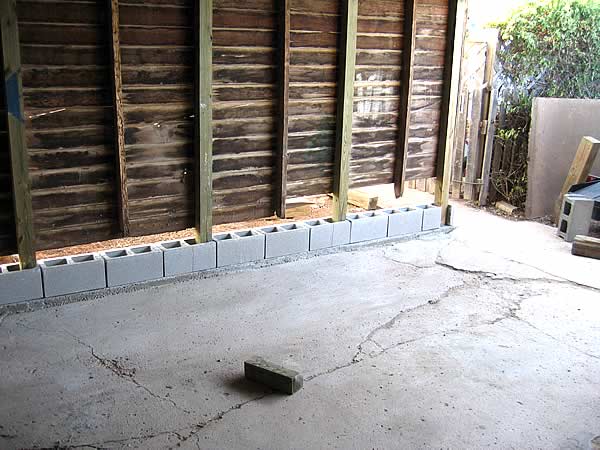
One other problem I encounter, especially with wood sided garages, is water splashed on the siding close to the ground. There are some solutions to this problem. One is to cover the wood siding with vinyl. Another is to place a bed of pea gravel around the perimeter of the building to reduce splashing. Another is to install a row of masonry units to keep the wood frame structure at least 8" above grade. This last one is something I would design into a new building. But it is also a solution when you have rotted out sill plated and the bottoms of wall studs that need to be replaced. In this case a contributing factor is often to low a grade with water getting at the sill. It is relatively easy to jack up the entire structure (Especially if you have removed the roofing to re-roof), and install a course or two of masonry units with anchor bolts, sill seal and a new sill. You can then waterproof the outside of the masonry, allowing you to build up adjacent grade creating positive drainage away from the foundation.
 
Last edited:

bczygan

Well-known member
Joined
Nov 4, 2009
Messages
22,002
Location
DETROIT! Arsenal of Scrappers
Time to talk about insulation. I like to think about insulation as a winter coat full of down. People lose heat most through their extremities. The head loses the most. Heat rises, so your building loses, by far, the most of it's heat through the ceiling. You also lose heat at a lesser rate through walls and even floors. If you heat your space above the ambient (Outside) temperature and then turn off the heat source, after a time the space will lose all it's heat above the ambient level and reach equilibrium with that surrounding temperature. All insulation does is to slow down that heat transfer. Some things to think about. Heated air rises. If you can mechanically force it down lower in a space where you are, you can make better use of it. On the other hand, moving air (Even warm moving air) feels cooler as it evaporates moisture on our skin, acting as an air conditioner. Radiant heat heats objects. The shape of your building matters. The surface ares relates to heat loss. The shape with the least surface are for volume is a sphere. A cube comes closest in a usable shape for structures. A certain distance below ground the temperature is an average 55 degrees F. Sealing and caulking are very important for heat loss and even more important for comfort. Leaking air creates drafts of moving air which make the air feel colder. Heat goes to cold. Heat will go to the coldest, least insulated part of your envelope. Besides sealing and weatherstripping all joints consider high R value windows and doors and even insulated shutters and attic access hatches.
Foamed in place insulation gives the highest R value, eliminates drafts and leaks and creates a vapor barrier. You must have enough insulation in your ceiling so that the underside of your roof deck remains cold in the winter to avoid thawing and refreezing of snow, thus creating ice dams and roof leaks. In new construction I highly recommend under slab and perimeter foundation insulation. Also use truss or rafter and joist details that allow a full depth of attic insulation all the way to the exterior face of exterior walls. The idea is to create a continuous envelope of insulation that surrounds your space. For this reason, SIP's (Structural Insulated Panels) do a good job because they don't have as many wood framing members transferring heat through the building envelope.
 
Last edited:
OP
O

OldGarageChris

Well-known member
Joined
Feb 18, 2012
Messages
48
Location
Beamsville, Ontario, Canada
I've gathered from the feedback, that I need to give more weight to the importance of a good foundation. I was hoping to leave it alone, but maybe I shouldn't. Maybe there is something I can do without tearing the entire thing up?

I discovered that my sill plates are in fact rotted and require replacing. I know how to do this. I also discovered that the "lower lip" used to hold the sill plates, is only used on the left wall and back wall. The right wall is on concrete at the same level as the floor. The front short walls, around the garage door, seem to be off the concrete on bricks...

I dug under the foundation on the left and right sides. The right side foundation is 12 inches deep. The left side wall has 9 inches as seen in the following pic:
Foundation-Leftsidewall.jpg

I noticed a couple of things. First, it looks like they didn't frame the pad. Stone or some type of base below the concrete pour was also not used. I also found a brick and random large rocks...which I likely would have thrown in as filler...but I'm not sure if comprises things?

Here are pics of the cracks:
Floor-Frontrightcorner.jpg

This is a crack at the front right corner that chops off the corner by around 30 sq ft.
Floor-Frontrightcornercloseup2.jpg

Raised and separated by 0.5"
Floor-Frontrightcornercloseup.jpg


Floor-Cenrecrackstretchingfromfronttoback.jpg

Middle crack stretching from front to back down the centre of the floor.

Floor-Frontleftcornerwalloffconcrete.jpg

Front left corner completely off the concrete pad.

I really dont want to replace the foundation. My original thoughts were to straighten the walls, OSB inside and out on front/rear walls, replace sill plates, new siding, possibly finish interior walls, possibly new roof wood+shingles (currently 2 shingle layers and rotted).

Is it worth all this work with a cracked foundation? With the foundation surely to continue to move over time, how much of an affect will this have on the walls if I really beef them up with OSB and metal bracing?

Should I be cutting out walls one at a time, cut the concrete back and pour new footings and rebuild the wall? To be honest...in terms of a complete rebuild, I'm scared of the permit and inspection process as this is new ground for me...
 
Last edited:

bczygan

Well-known member
Joined
Nov 4, 2009
Messages
22,002
Location
DETROIT! Arsenal of Scrappers
Chris,
I need to respond to your photos of floor and foundation.

For me, if I have a slab with small cracks, even if they go all the way through, as long as the floor doesn't have a lip where one slab is higher than the other, I consider it usable. This assumes all parts are stable and don't move up and down. Only if I wanted an epoxy finish would I consider replacing a slab like that.
But this slab shows evidence of structural cracking and heaving and settling. The base under it is a question mark. Drainage and water problems are a question mark.
If you can answer those questions with responses that assure you that you can keep water out from under the slab and halt the freeze thaw heaving and settling and stabilize the slab, then you could go ahead with the rest of the renovations. It would still be a very bad floor, but usable. This assumes you can drill and mudjack so the slabs are even, eliminating the tripping hazard. You could have a usable space for your short term. When selling it would still be a big negative and hard to hide (And you really wouldn't want to). Sometime, someone needs to jack up the structure and put a proper footing and slab under it. That is a LOT easier to do after the roofing is stripped but before the new roofing, siding, insulation, interior finish or other work is done.
You need to realistically judge how long you intend to be there, what use you want to make of the structure and ultimately if the improvements you make will return to you their cost at sale. With a short time like 2-3 years I doubt a full renovation will pay you back. But that is up to you to determine.

I'm a builder, so I always want to renovate to highest and best use. But in your situation I would be tempted to do as little as possible, use the space as I could and sell it as a fixer upper with potential.

So my route would be to straighten and brace the structure with wood diagonal braces on the inside. Stuff cracks to cut down leaks. Use some roll roofing or tarps to prevent roof leaks. I would leave the sills and slab and tree. The floor could rock and roll so I would just be careful of tripping. I would not use it much in the winter, except for storage, because of lack of insulation. I would save my money for my next project and garage and only buy things I could take with me. Sometimes not doing a project is the right choice.
Throw a coat of paint on the outside before selling.
 
Last edited:
OP
O

OldGarageChris

Well-known member
Joined
Feb 18, 2012
Messages
48
Location
Beamsville, Ontario, Canada
My apologies for not responding to your last post bczygan. I got overwhelmed and put this repair on the back burner. However, now I've bought a new house to be built end of next year and I need to sell mine this coming spring/early summer. There's no procrastinating now, I need to fix this garage.

I've got the straightening/bracing part planned out. Should be OK there. Lots of great threads about this here. It's a matter of pulling the garage door walls back onto the pad and then plumb up the back wall. Whether or not I install new siding/roof is a decision to be made later. Curb appeal will likely make it worthwhile...but its a big chunk of change for siding/roof. Not only did I buy a new house, but I'm also getting married in July. Crazy year for juggling expenses.

So this brings me to the foundation. All of the cracks are fine except for the front corner crack that was shown in the last photo's posted. FYI, the multiple pictures of the raised crack is ONE crack. All of the other cracks have not separated/raised so they are fine. I've got appointments set for estimates on raising/stabilizing that concrete corner slab. Once done, I can move forward.

I was searching through Falcon67's thread (http://www.garagejournal.com/forum/showthread.php?t=41042) and came across this idea:
garageP.jpg


I like the idea of concrete blocks raising the wall off the ground. I know that I ultimately need to fix grading/water problems, but this prevents the sill plates from contacting the ground. 4x4's were used into the ground which I think is a great idea. However, Falcons in Texas and I'm in Southern Ontario which means my posts need to go 4' deep. I can very easily cut back parts of the slab and rent an auger to dig these holes. Does anyone think its worth digging and cementing posts and using concrete blocks? If this gets around my slightly unstable foundation issue, then I'd see the benefit of new siding. It also tells any potential buyers that it wasn't a quick fix. I just don't want to do all this work/spend the money to have potential wall movement in the future or for it to look half assed.
 
Last edited:

theoldwizard1

Well-known member
Joined
Feb 22, 2011
Messages
43,142
Location
SE MI
I like the idea of concrete blocks raising the wall off the ground. I know that I ultimately need to fix grading/water problems, but this prevents the sill plates from contacting the ground.
Fix the grading problem FIRST !

There is nothing wrong with pressure treated lumber on solid concrete floor/foundation.

4x4's were used into the ground which I think is a great idea. However, Falcons in Texas and I'm in Southern Ontario which means my posts need to go 4' deep.
You are basically trying to convert a stick built structure into a pole built structure. I don't know if the rest of the structure is up to that.

I can very easily cut back parts of the slab and rent an auger to dig these holes.
I think you are over simplifying the amount of work to do that !

Does anyone think its worth digging and cementing posts and using concrete blocks? If this gets around my slightly unstable foundation issue, then I'd see the benefit of new siding. It also tells any potential buyers that it wasn't a quick fix. I just don't want to do all this work/spend the money to have potential wall movement in the future or for it to look half assed.

To me it would look like a low cost repair. Sorry. Do it right or don't do.
 
OP
O

OldGarageChris

Well-known member
Joined
Feb 18, 2012
Messages
48
Location
Beamsville, Ontario, Canada
You are basically trying to convert a stick built structure into a pole built structure. I don't know if the rest of the structure is up to that.

To me it would look like a low cost repair. Sorry. Do it right or don't do.

Thanks for the reply oldwizard! My thinking is that my structure issues are due to no bracing between walls/studs which allowed the walls to move. Sill's are rotted because of age but also because they moved off the pad onto soil/water/etc. Also no proper water barrier as the wood siding is nailed directly to the studs...no boarding behind. With exception to the raised/separated corner crack, the pad looks good. I could easily plump up the walls and replace the sill plates to have it last another 50 years. I may just do that. This things been standing for 100 years, the pad won't move enough to knock the building down after I straighten it out. However, I wondered if the building would be better off completely off the pad and the weight on these 4x4 cemented footings. My worry is in changing from a foundation where it all moves together (or most of it) to a pole type foundation where the posts are able to move individually.

Why does it look like a low cost repair? Because I'm not replacing the entire cement pad? That's not an option for me. I'm looking for the best way to secure the building as best as possible without replacing the pad. Replacing the sill plate and anchoring is a must but I want to do more and I just don't know what.
 

Bib Overalls

Well-known member
Joined
Dec 4, 2006
Messages
3,318
Location
Jonesboro, Arkansas
If you are going to sell the house then you need to talk with your Realtor about the garage before you spend any money.

The garage may be a liability on the land. Something that needs to be removed to maximize value.

The garage and it's current condition may have no impact on the sale price.

Or, it may be cost effective to do some repairs.
 
OP
O

OldGarageChris

Well-known member
Joined
Feb 18, 2012
Messages
48
Location
Beamsville, Ontario, Canada
If you are going to sell the house then you need to talk with your Realtor about the garage before you spend any money.

The garage may be a liability on the land. Something that needs to be removed to maximize value.

The garage and it's current condition may have no impact on the sale price.

Or, it may be cost effective to do some repairs.

Good idea and I have talked to my realtor who thinks I should tear it down and leave the concrete pad. To me, that's a foolish decision. Most people look at it and say its ready to fall over and it should come down. Those are the people that don't know how to fix it. I'm not an experienced carpenter, but I have the tools and can figure it out with a little research and this forum :)

As the foundation is ultimately compromised, I ended up deciding not to invest a lot of money into it. I've got a guy coming to quote jacking up the 25sqft corner slab that's raised/sunk in but I doubt I'll do it unless its under a couple hundred bucks. It's worth fixing the eyesore at that price.

Here's the plan: (from memory because I don't have my written plans with me)

- inspect rafters/joists for damage and double up where needed (wont need much as they're in great shape)
- remove eaves-troughs that will be in the way of the tree at the side of the garage. Should be enough room there to straighten out without hitting the tree.
- throw a chain around the tree and attach to the joists as a safety. Will likely use 2x4's on the exterior to help prop up the walls if needed.
- plumb up the back wall with come-alongs pretty much copying hammerzone site
- temporarily diagonal brace with 2x4's and likely OSB sheets.
- secure front corner studs to joists with brackets
- raise front corners to pull them back onto the cement pad.
- finish plumbing up walls and securing with OSB and/or metal diagonal bracing
- finish bracketing all studs to joists
- raise individual walls to replace sill plates and secure to cement pad.

That covers things structurally. Everything else is cosmetic. I will likely rebuild the front walls surrounding the garage door regardless. What I haven't decided is if I widen these walls and install a smaller new garage door. I think its worth the curb appeal. If I can find a lumberyard that carries similar wood siding, I'll replace the rotted pieces. At most, it should only require the bottom 6 layers. Then I'm going to cap the corners with new wood, strip the paint and then repaint. Depending on their condition, the old eaves-troughs will go back up or replace with new/used. Roof is staying.

I also plan to OSB sheet the entire back wall, build a long work bench and put up a peg board/shelves/etc. Nothing major, but enough to make the space functional. I will also refinish the old cabinets/shelving that were in the garage when I bought it. Should look nice with a new coat of paint.

Pricing it out (don't have my #s sheet with me) it shouldn't cost too much. Only labour which is free. I'm leaving for Alaska tomorrow for work so this is on hold for a week. Then I plan to hit it full force. I'll take pics as I go along to post.

All input is appreciated.
 
Last edited:

jruth

New member
Joined
Apr 26, 2020
Messages
1
Location
NJ
Good to see your project. Nice work, excellent results. I have a similar garage down here in NJ. Leans about 6". Planning to pull back the parallelogram, like you. Can you share what comealong model you used? Also, what strap? Strap because it's better than chain? Thanks a lot.
 

rusty1

Well-known member
Joined
Feb 6, 2009
Messages
518
Location
No. Illinois
...not quite the same situation as yours but we straigtened the neighbor's shed by pushing it straight with a loader tractor and installing wood braces diagonally inside.
 

Attachments

  • Fullers shed 003.jpg
    Fullers shed 003.jpg
    126.8 KB · Views: 7
  • Fullers shed 006.jpg
    Fullers shed 006.jpg
    124.9 KB · Views: 7
Last edited:
To avoid these ads, REGISTER NOW!
Top Bottom