
You are using an out of date browser. It may not display this or other websites correctly.
You should upgrade or use an alternative browser.
You should upgrade or use an alternative browser.
One Car Garage Project for a Car Guy
- Thread starter N0tt0N
- Start date
taumac
Well-known member
Well thank you, its taken time but sometimes wish I didn't have so much stuff.
Spent a bit of time pulling everything out of the two sliding door cabinets that got shoved in there during the build. Cleaned/dusted the insides. Pulled all the tool cases that were stored under the guest bed during the build and cleaned/dusted them as well. So, now I'm ready to start finalizing where everything goes.
I've got two books on building out your perfect garage:
How to Design, Build, & Eguip Your Automotive Workshop on a Budget (SA207 Performance How-To, Jeffrey Zurschmeide)
Ultimate Garage Handbook (141 Motorbooks Workshop, Richard Newton)
Now both are pretty good and I've found they have good advice regarding some of the big picture aspects. The first book goes into a bit more depth about reasonable tools for an automotive workshop, as you would expect. What I've been wrestling with is the concepts that you should organize your tools and supplies around the tasks you will be doing rather than some other scheme (size of boxes, alphabetical, etc.).
What I'm surprised to not be able to find is a organization scheme or typology for actually doing that. I can't seem to find one on the internet in general, or on GJ specifically, because the search engines are a bit too helpful turning 'tool' into something outside the garage, etc. Having admired many of the garage's here I wonder if I'm missing some pearl of wisdom where someone lays out a scheme that not only organizes but also categorizes tools for consideration. Anyway, having spent a bit of time scouring around here's what I've come up with so far. I know this can get blown out down to the specific tool and I may spend more time scouring tool websites but they tend to organize by how they think of their tools and how you would think to buy them not on how you would use them. I'll start a separate thread and I'm sure someone will clue me in that this has all been done somewhere already! I hope so!
I've got two books on building out your perfect garage:
How to Design, Build, & Eguip Your Automotive Workshop on a Budget (SA207 Performance How-To, Jeffrey Zurschmeide)
Ultimate Garage Handbook (141 Motorbooks Workshop, Richard Newton)
Now both are pretty good and I've found they have good advice regarding some of the big picture aspects. The first book goes into a bit more depth about reasonable tools for an automotive workshop, as you would expect. What I've been wrestling with is the concepts that you should organize your tools and supplies around the tasks you will be doing rather than some other scheme (size of boxes, alphabetical, etc.).
What I'm surprised to not be able to find is a organization scheme or typology for actually doing that. I can't seem to find one on the internet in general, or on GJ specifically, because the search engines are a bit too helpful turning 'tool' into something outside the garage, etc. Having admired many of the garage's here I wonder if I'm missing some pearl of wisdom where someone lays out a scheme that not only organizes but also categorizes tools for consideration. Anyway, having spent a bit of time scouring around here's what I've come up with so far. I know this can get blown out down to the specific tool and I may spend more time scouring tool websites but they tend to organize by how they think of their tools and how you would think to buy them not on how you would use them. I'll start a separate thread and I'm sure someone will clue me in that this has all been done somewhere already! I hope so!
polexican23
Banned
I wont be help with tool organization, but I like how you were able to get a few inches out of your foyer. BTW I also am the lucky owner of an electrical panel put on the outside of the studs and making a headache of a work around.
I wont be help with tool organization, but I like how you were able to get a few inches out of your foyer. BTW I also am the lucky owner of an electrical panel put on the outside of the studs and making a headache of a work around.
I would have been heart broken if the foyer wall move hadn't worked for whatever reason. It really opened up the feel of the place. I spent part of yesterday cleaning and loading the tools in cases that I have into the sliding cabinets and trying to group them by job. Worked out pretty well and should help remember what's behind door #1, etc. I'll post some pics later. I've taken measurements of all to boxes in case its useful for other folks.
Whenever I come out and see the electric panel I wonder what the heck they were thinking. Really? Right in the middle of the wall? Ah well, turned out ok

taumac
Well-known member
What are your questions?
Have a good one, Gerard
The 5 Stitches Garage part 1 http://www.garagejournal.com/forum/showthread.php?t=142100
The 5 Stitches Garage part2 http://www.garagejournal.com/forum/showthread.php?t=211899
Have a good one, Gerard
The 5 Stitches Garage part 1 http://www.garagejournal.com/forum/showthread.php?t=142100
The 5 Stitches Garage part2 http://www.garagejournal.com/forum/showthread.php?t=211899
What are your questions?
My question was does a nice organization list like the one I posted already existed and where so I didn't have to re-invent the wheel. With all the OCD types here on GJ I was sure someone already developed a list of labels and groups of things that belong together. I'll keep plugging away on mine as I go. Some of these guys garages are decked out and I'd have thought at least for insurance purposes they'd be keeping inventories. The post didn't seem to get much love though.
I promised I'd post some pics from last weekend. Since a lot of my stuff got dirty during construction and sitting in the tent I've been making sure it all got cleaned and maintained before putting it away again. My dad always made me put tools away clean and I guess it stuck.
Here's some of the garden tools and tall things I brought in from the utility room. This area is on the back wall to the right and therefore will be behind my tool chest that fits in front of them. The Storewall attachment devices seem really nice and the cam lock really makes them solid to the wall.

Most of the tools that I have in cases or don't belong in the tool chest are going into the sliding door units in the wall to get an initial eyeball on tool groupings. But for now at least I can begin to see volumes as I stack them in. Some will eventually move to the overhead cabinets for the things I use more often. In order for my small garage to be useful for my projects everything has to be out of the way except what I need. No piles can survive!

Here's some of the garden tools and tall things I brought in from the utility room. This area is on the back wall to the right and therefore will be behind my tool chest that fits in front of them. The Storewall attachment devices seem really nice and the cam lock really makes them solid to the wall.
Most of the tools that I have in cases or don't belong in the tool chest are going into the sliding door units in the wall to get an initial eyeball on tool groupings. But for now at least I can begin to see volumes as I stack them in. Some will eventually move to the overhead cabinets for the things I use more often. In order for my small garage to be useful for my projects everything has to be out of the way except what I need. No piles can survive!
taumac
Well-known member
My question was does a nice organization list like the one I posted already existed and where so I didn't have to re-invent the wheel. With all the OCD types here on GJ I was sure someone already developed a list of labels and groups of things that belong together. I'll keep plugging away on mine as I go. Some of these guys garages are decked out and I'd have thought at least for insurance purposes they'd be keeping inventories. The post didn't seem to get much love though.
I never did worry about insurance but maybe I should. As for organization of tools it depends on tools but grouping tools is always good. Its best to take items to store and look at what's works and doesn't what needs to go where. Its really not reinventing the wheel but my needs tools and hobbies aren't the same as yours or next persons. How you plan to use space. I prefer highly mobile garage and highly flexible and things have multiple uses. I choose not to have table saw, chop saws, grinders in one place or set up. Your just gonna have to try and work it, try it does it work or doesn't. Then change it try another idea. My garage took 8 years to get to where it is today. 4 years in first garage. Its cause things always change. It read part one and two of my garage you can see large changes just over the almost 3 years on here. In general the idea hasn't change or overall plan but If you read them you maybe understand my concepts for garage organization. Its really hard to put into words where as I could take 30 to hour tour of garage in person and you'll get it sort of say.
Have a good one, Gerard
The 5 Stitches Garage part 1 http://www.garagejournal.com/forum/showthread.php?t=142100
The 5 Stitches Garage part2 http://www.garagejournal.com/forum/showthread.php?t=211899
dubber
Well-known member
Do you have any updated overall shots? Would love to see when you have a chance. You've done a great job in there.
taumac
Well-known member
My question was does a nice organization list like the one I posted already existed and where so I didn't have to re-invent the wheel. With all the OCD types here on GJ I was sure someone already developed a list of labels and groups of things that belong together. I'll keep plugging away on mine as I go. Some of these guys garages are decked out and I'd have thought at least for insurance purposes they'd be keeping inventories. The post didn't seem to get much love though.
To simplify my answer to your question.... I don't think there is a list but you making your own or a plan of what your going to do is great. I find that even the best laid plans on paper usually don't always go as planned. You can start setting up things as fine tune them as needed. Its a lot of trail and error especially in one car place like yours. Btw I didn't see cabinet with sliding doors until today. Great idea to maximise space. Your garage is turning out great. I surly wish mine looked as clean as yours. Keep up good work.
Have a good one, Gerard
The 5 Stitches Garage part 1 http://www.garagejournal.com/forum/showthread.php?t=142100
The 5 Stitches Garage part2 http://www.garagejournal.com/forum/showthread.php?t=211899
goodgollyjosh
Member
Re: Day 19: The End of Phase I
Wow, very nice!
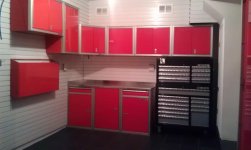
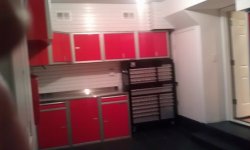
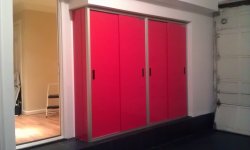
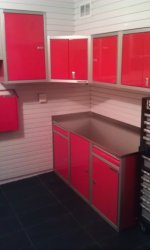
After what can only be described as a sh*t day for my first full day back at the office in two weeks I came home to a pristine garage. Final touchups and the finish coat on the paint as well as the clean/buff of the floor awaited me. They also put up the vent covers (although I need to work out a shutoff mechanism as the traditional 2"x10"s were too deep to fit and these are 4"x10" grills only) and completed the brickwork in the back to close in around the new dryer vent. I almost wanted to cry it looked so good. The guys did me proud today while I was out and I am so grateful for the help and support. Here's some pics before I take a few days to plan next steps. Enjoy!
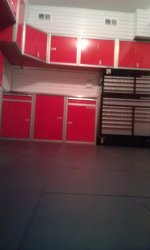
And a quick reminder where I started - and this was after the first cleanup and removal of the 12" selves on the right wall (encroaching on the garage) where the sliding doors are now.

Wow, very nice!
goodgollyjosh: Thanks, man!
dubber: I had planned on getting someone out here with a real camera. My phone simply can't get an entire wall in no matter where I stand. Unfortunately, I'm still waiting on the carriage doors and the weather has really sucked here in DC for the past few weeks - it's like Canada! These little garages make it tough to get good pics - like trying to get a picture of the inside of a shower! Your pictures have been great!
dubber: I had planned on getting someone out here with a real camera. My phone simply can't get an entire wall in no matter where I stand. Unfortunately, I'm still waiting on the carriage doors and the weather has really sucked here in DC for the past few weeks - it's like Canada!
These little garages make it tough to get good pics - like trying to get a picture of the inside of a shower! Your pictures have been great!taumac: Yeah, I figure I'll be moving stuff around constantly as things shake out. My wife has a laminator that I'm going to use to make some magnetic labels so I can trivially reorganize and keep things fluid like you said.
taumac
Well-known member
That's a good idea. Before I label my totes I moved stuff around, changing things, and would go to look for something and was pulling all the totes down until I found right one. LOL My wifey can find things too I know where everything is now that's its not changed for couple of weeks lmao
Have a good one, Gerard
The 5 Stitches Garage part 1 http://www.garagejournal.com/forum/showthread.php?t=142100
The 5 Stitches Garage part2 http://www.garagejournal.com/forum/showthread.php?t=211899
Have a good one, Gerard
The 5 Stitches Garage part 1 http://www.garagejournal.com/forum/showthread.php?t=142100
The 5 Stitches Garage part2 http://www.garagejournal.com/forum/showthread.php?t=211899
dubber
Well-known member
dubber: I had planned on getting someone out here with a real camera. My phone simply can't get an entire wall in no matter where I stand. Unfortunately, I'm still waiting on the carriage doors and the weather has really sucked here in DC for the past few weeks - it's like Canada!
Very True, and love the shower comment. Half the time your taking the pic at an awkward angle where you can't even see what your shooting lol....
Spent some time the last two days loading up to garage some more. Relearned the lesson that you are just kidding yourself if you think things aren't going to get dirty during a build or sitting in a tent. Going through bags of Lysol disinfectant wipes and Kimwipes+WD40 making sure everything comes back in clean.
Tore down my top tool chest, pulled everything out including the liners, cleaned the tools, maintained them, measured them (and added to my inventory), and temporarily put them in the sliding door cabinets. I then cleaned the chest up itself and moved it off to the side. Started on the bottom chest by cleaning the outside. Everything was covered in sanding dust or runoff. Didn't get inside yet - got distracted. In the old garage the only protected place for my stuff was in the two tool chests so I'm finding I have things in there that will be moving out into a cabinet now.
Cleaned up some sports stuff (mountain bike, boogie boards, helmet, locks) and mounted them high on the wall be the garage door. Since that freed up some floor space I got distracted and decided to begin hauling in stuff from the tent to get it out of the weather which has been for sh*t recently.
Today was beautiful so I jumped into it. When I shortened the tent from 20' to 10' after the cabinets went in there weren't grommets where they needed to be and this led to lots more weather getting in through the gaps in the top and sides. I had already ordered and received a grommet kit and so I added two grommets and reset the tent correctly. Boy everything was dirty. Cleaned up and put away to spare poles that have shown some rust Threw away a bunch of boxes that had basically fallen apart in there and hauled their contents inside - note to self: do not build a house out of cardboard unless it is inside another house not made of cardboard. Lots more cleaning before each thing can go back in the garage. Made good progress. Tent is mostly empty now except for some things that need the d*mn garage doors to open! Can't wait to get rid of the tent!
Doing the inventory led to an order for a few organizing accessories, like some more 1/2" and 3/8" GearWrench socket strips. Deciding which blown plastic holders are space efficient and which need to go. Some could easily be enhanced by airbrushing some contrasting color into the bottoms for the same effect as the dual-color foam inserts. Been eyeballing the LED strip tool chest installs here on GJ. Working out what I could do there. I also need to do some tool highlighting to make the sizes pop more (old eyes!).
Garage is in the ugly stage with lots of stuff out during the re-org. Having a blast tinkering.
Some of the things I'm bringing in are parts for my Porsche. Thinking of hanging the exhaust system and some of the suspension pieces on the wall like art. Its all so pretty and actually clean! LOL! Good times...
Tore down my top tool chest, pulled everything out including the liners, cleaned the tools, maintained them, measured them (and added to my inventory), and temporarily put them in the sliding door cabinets. I then cleaned the chest up itself and moved it off to the side. Started on the bottom chest by cleaning the outside. Everything was covered in sanding dust or runoff. Didn't get inside yet - got distracted. In the old garage the only protected place for my stuff was in the two tool chests so I'm finding I have things in there that will be moving out into a cabinet now.
Cleaned up some sports stuff (mountain bike, boogie boards, helmet, locks) and mounted them high on the wall be the garage door. Since that freed up some floor space I got distracted and decided to begin hauling in stuff from the tent to get it out of the weather which has been for sh*t recently.
Today was beautiful so I jumped into it. When I shortened the tent from 20' to 10' after the cabinets went in there weren't grommets where they needed to be and this led to lots more weather getting in through the gaps in the top and sides. I had already ordered and received a grommet kit and so I added two grommets and reset the tent correctly. Boy everything was dirty. Cleaned up and put away to spare poles that have shown some rust
Threw away a bunch of boxes that had basically fallen apart in there and hauled their contents inside - note to self: do not build a house out of cardboard unless it is inside another house not made of cardboard. Lots more cleaning before each thing can go back in the garage. Made good progress. Tent is mostly empty now except for some things that need the d*mn garage doors to open! Can't wait to get rid of the tent!Doing the inventory led to an order for a few organizing accessories, like some more 1/2" and 3/8" GearWrench socket strips. Deciding which blown plastic holders are space efficient and which need to go. Some could easily be enhanced by airbrushing some contrasting color into the bottoms for the same effect as the dual-color foam inserts. Been eyeballing the LED strip tool chest installs here on GJ. Working out what I could do there. I also need to do some tool highlighting to make the sizes pop more (old eyes!).
Garage is in the ugly stage with lots of stuff out during the re-org. Having a blast tinkering.
Some of the things I'm bringing in are parts for my Porsche. Thinking of hanging the exhaust system and some of the suspension pieces on the wall like art. Its all so pretty and actually clean! LOL! Good times...
Another Two Days Cleaning and Servicing
Alternating evenings in the garage. More cleaning, maintaining and measuring. Nice Zen time in the garage admiring the tools and recollecting how I got them and what projects they were used on.
Put a dent in the bottom tool chest. I love the Irwin Vice Grip plier sets and adjustable wrench sets. Their ergonomic grips are comfortable and grippy. Unfortunately this means they pick up dirt and oil like crazy. Fortunately they are really tough and scrubbing gets them clean again without any noticeably wear and tear on the handles. Go Blue and Yellow!
Here's a picture of one of the drawer liners after I pulled the tools out. The GearWrench tool chest doesn't seem to seal the drawers too well from dust and dirt. I make attach some weather strip solution to the bottom of the leading edge of the drawer and maybe on the chest on the left and right of the drawers.

While I've been doing the measuring I've also been taking a look at the efficiency of some of the blown cases the tools come in. Some are a complete waste of space like the GearWrench 81909 10 Piece Metric Crowfoot Wrench Set (that I moved to a 3/8" socket strip) and this Gearwrench KDT9570 Stubby Flex Gear SAE Wrench Set!

Others are fairly decent although they didn't really need to extra margins around the edges, like this GearWrench 81906 Flare Nut Metric Wrench Set.

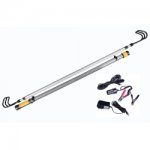
One of my adventures was cleaning up and maintaining a CPS Products Pro-Set CPSWL132R Rechargeable 132 LED Underhood Work Light. I love this thing. It is in two parts - a light-saber tube with heavy duty rubberized ends and the expandable bracket that the tube clips into. Easy to move around and clips under the hood or trunk or under the car and rotates within the clips to point the light were you want it. Here's a pic:
There was a loose machine bolt and some light surface rust on the small machine nuts on one of the end pieces (which are indexed all the way around so the end hooks can grab in any direction) so I decided to, um, take it apart. We all know taking things apart is the easy part, right? There are four bolts on each end cap and three screws. I now know that the four bolts keep the end caps attached not only to the hollow tubes that expand out of the main housing... wait for it... but also the plastic dowels inserted in the hollow tubes that are attached to bungee cords that run all the way to the other end and are what keeps the end hooks holding on to stuff. Pull out one bolt - cool. Pull out the same bolt on the second tube - cool. Pull out the next bolt on the first tube - PWANG! Huh. Pull out the final bolt - PWANG! Pull the end cap off no problem and no evidence that anything is up. Savvy readers know this is because the bungees and the dowels are waaaaay down in there in the dark. Lift up the main housing of the bracket to clean it up and the hook on the other end starts sliding out. WTF? I grab it real quick but hear the sound of a tiny metal object hitting the floor - like tinker bell whispering in my ear that I'm screwed. I find two tiny metal dowels that look somewhat like infuriating watch band keepers. Turns out the hollow tubes fit within slightly larger tubes that have a slot cut into them along the entire length. Fitting the inner tubes into the outer tubes shows that the inner tubes have two tiny holes in them and these little buggers rest in these holes and are only held in place once the inner tubes are slid far enough in that they are parallel.
Wanted: 12 handed monkey to help assemble this device as follows:
1. Pull out the far end assembly so you can get to the bungees and their plastic dowels with two holes in each for the bolts.
2. Tie strings to each dowel, rout it through the main housing and out the other side while sliding the far end assembly into place. Pull the strings through the near end.
3. slide the two inner tubes from the near end over the strings and start them in the outer tubes within the main housing. After they are in about 1", rotate them around until the first set of holes are aligned with the slots of the outer tubes facing each other. With one hand hold the two inner tubes steady. With the other hand pick up the tiny watch band thingie (WBT) and position in between he two holes. With the gripping hand move the two inner tubes in while making them slightly more parallel so the WBT goes into both holes. With the fourth hand pick up the second WBT and repeat this process with the second holes while avoiding having the first WBT fall out. Insert the inner tubes the rest of the way without having the strings fall back down the tubes. Sigh.
4. Now it gets complicated. The near end assembly does not have any mechanism to hold the plastic dowels in the end of the assembly except the four bolts that also hold the inner tubes to the assembly. Said dowels are under tremendous tension trying to shoot back down the inner tube. Also, since the dowels fit tightly within the inner tubes the string will eventually be cut if too much pulling and pushing is done near the sharp end of the tube. This may or may not necessitate starting everything all over again to re-tie new strings. After trying for some time to conceive of a way to pull on something hidden within a tube while the end of the tube is covered with the end assembly I decided that the end assembly needed further disassembly! Of course! It all made perfect sense! I could then use one hand to pull the two inner tubes out of the main assembly, my other hand to hold them down on the bottom half of the end assembly, my gripping hand to pull the strings and therefore the dowels on bungees to the end of the inner tubes while using my fourth hand to align the holes in the dowels with the holes in the inner tube and the holes in the end assembly (you still with me?) while my fifth, sixth, seventh, and eighth hands push the small machine bolts up through the end assembly thus easily holding everything together while my ninth hand lowers the top half of the end assembly with some help of my tenth hand aligning the four machine bolts. Voila! Just a walk in the park!
5. But first, it is necessary to chase the two steel ball bearings and tiny springs that will shoot out of the split end assembly as soon as the three screws are removed that hold it together. They are the indexing keys for the swiveling end hook. It all makes perfect sense except for the fact that these springs and ball bearings do not have keepers either. So, repeat step four while counteracting the pull of the bungees and use your eleventh and twelfth hands to hold down the sprung ball bearings as you clap on the top half of the assembly!
6. Until, you realize that you have to get the four tiny nuts started on the tiny bolts and the end assembly has tiny hexagonal indents to act as the nut stops. So back out each bolt from the high tension assembly but not so far as they let the dowel pull the bolt sideways down the tube. Drop in the tiny nut. Using a tiny male hex nut driver from underneath, without letting the other bolts drop onto the floor thus releasing the bungees (PWANG!) push the bolt up and engage the nut on the upper side. Repeat three more times.
7. Have anyone that helped murdered so that the secret of assembly, including the much valued 'how to not to assemble' knowledge, does not leave the room.
In any case, I was able to easily accomplish this on the first go in under five minutes. And no one is able to testify otherwise. Lesson learned - grow more hands.
Alternating evenings in the garage. More cleaning, maintaining and measuring. Nice Zen time in the garage admiring the tools and recollecting how I got them and what projects they were used on.
Put a dent in the bottom tool chest. I love the Irwin Vice Grip plier sets and adjustable wrench sets. Their ergonomic grips are comfortable and grippy. Unfortunately this means they pick up dirt and oil like crazy. Fortunately they are really tough and scrubbing gets them clean again without any noticeably wear and tear on the handles. Go Blue and Yellow!
Here's a picture of one of the drawer liners after I pulled the tools out. The GearWrench tool chest doesn't seem to seal the drawers too well from dust and dirt. I make attach some weather strip solution to the bottom of the leading edge of the drawer and maybe on the chest on the left and right of the drawers.
While I've been doing the measuring I've also been taking a look at the efficiency of some of the blown cases the tools come in. Some are a complete waste of space like the GearWrench 81909 10 Piece Metric Crowfoot Wrench Set (that I moved to a 3/8" socket strip) and this Gearwrench KDT9570 Stubby Flex Gear SAE Wrench Set!
Others are fairly decent although they didn't really need to extra margins around the edges, like this GearWrench 81906 Flare Nut Metric Wrench Set.
One of my adventures was cleaning up and maintaining a CPS Products Pro-Set CPSWL132R Rechargeable 132 LED Underhood Work Light. I love this thing. It is in two parts - a light-saber tube with heavy duty rubberized ends and the expandable bracket that the tube clips into. Easy to move around and clips under the hood or trunk or under the car and rotates within the clips to point the light were you want it. Here's a pic:
There was a loose machine bolt and some light surface rust on the small machine nuts on one of the end pieces (which are indexed all the way around so the end hooks can grab in any direction) so I decided to, um, take it apart. We all know taking things apart is the easy part, right? There are four bolts on each end cap and three screws. I now know that the four bolts keep the end caps attached not only to the hollow tubes that expand out of the main housing... wait for it... but also the plastic dowels inserted in the hollow tubes that are attached to bungee cords that run all the way to the other end and are what keeps the end hooks holding on to stuff. Pull out one bolt - cool. Pull out the same bolt on the second tube - cool. Pull out the next bolt on the first tube - PWANG! Huh. Pull out the final bolt - PWANG! Pull the end cap off no problem and no evidence that anything is up. Savvy readers know this is because the bungees and the dowels are waaaaay down in there in the dark. Lift up the main housing of the bracket to clean it up and the hook on the other end starts sliding out. WTF? I grab it real quick but hear the sound of a tiny metal object hitting the floor - like tinker bell whispering in my ear that I'm screwed. I find two tiny metal dowels that look somewhat like infuriating watch band keepers. Turns out the hollow tubes fit within slightly larger tubes that have a slot cut into them along the entire length. Fitting the inner tubes into the outer tubes shows that the inner tubes have two tiny holes in them and these little buggers rest in these holes and are only held in place once the inner tubes are slid far enough in that they are parallel.
Wanted: 12 handed monkey to help assemble this device as follows:
1. Pull out the far end assembly so you can get to the bungees and their plastic dowels with two holes in each for the bolts.
2. Tie strings to each dowel, rout it through the main housing and out the other side while sliding the far end assembly into place. Pull the strings through the near end.
3. slide the two inner tubes from the near end over the strings and start them in the outer tubes within the main housing. After they are in about 1", rotate them around until the first set of holes are aligned with the slots of the outer tubes facing each other. With one hand hold the two inner tubes steady. With the other hand pick up the tiny watch band thingie (WBT) and position in between he two holes. With the gripping hand move the two inner tubes in while making them slightly more parallel so the WBT goes into both holes. With the fourth hand pick up the second WBT and repeat this process with the second holes while avoiding having the first WBT fall out. Insert the inner tubes the rest of the way without having the strings fall back down the tubes. Sigh.
4. Now it gets complicated. The near end assembly does not have any mechanism to hold the plastic dowels in the end of the assembly except the four bolts that also hold the inner tubes to the assembly. Said dowels are under tremendous tension trying to shoot back down the inner tube. Also, since the dowels fit tightly within the inner tubes the string will eventually be cut if too much pulling and pushing is done near the sharp end of the tube. This may or may not necessitate starting everything all over again to re-tie new strings. After trying for some time to conceive of a way to pull on something hidden within a tube while the end of the tube is covered with the end assembly I decided that the end assembly needed further disassembly! Of course! It all made perfect sense!
I could then use one hand to pull the two inner tubes out of the main assembly, my other hand to hold them down on the bottom half of the end assembly, my gripping hand to pull the strings and therefore the dowels on bungees to the end of the inner tubes while using my fourth hand to align the holes in the dowels with the holes in the inner tube and the holes in the end assembly (you still with me?) while my fifth, sixth, seventh, and eighth hands push the small machine bolts up through the end assembly thus easily holding everything together while my ninth hand lowers the top half of the end assembly with some help of my tenth hand aligning the four machine bolts. Voila! Just a walk in the park!5. But first, it is necessary to chase the two steel ball bearings and tiny springs that will shoot out of the split end assembly as soon as the three screws are removed that hold it together. They are the indexing keys for the swiveling end hook. It all makes perfect sense except for the fact that these springs and ball bearings do not have keepers either. So, repeat step four while counteracting the pull of the bungees and use your eleventh and twelfth hands to hold down the sprung ball bearings as you clap on the top half of the assembly!
6. Until, you realize that you have to get the four tiny nuts started on the tiny bolts and the end assembly has tiny hexagonal indents to act as the nut stops. So back out each bolt from the high tension assembly but not so far as they let the dowel pull the bolt sideways down the tube. Drop in the tiny nut. Using a tiny male hex nut driver from underneath, without letting the other bolts drop onto the floor thus releasing the bungees (PWANG!) push the bolt up and engage the nut on the upper side. Repeat three more times.
7. Have anyone that helped murdered so that the secret of assembly, including the much valued 'how to not to assemble' knowledge, does not leave the room.
In any case, I was able to easily accomplish this on the first go in under five minutes. And no one is able to testify otherwise. Lesson learned - grow more hands.
BHR4CE1
Well-known member
WOW... looks great!
More cleaning and some label testing!
BHR4CE1: Thanks!
Got to spend some more time emptying out the big drawers and two of the small drawers in the lower tool chest. Like I said since this tool chest used to be the only thing to protect all my tools I had some things I can now move out. For instance, one drawer was full of my wire crimpers, strippers, testers, etc. I cleaned all that up and put it in my new Klein 39 pocket backpack along with my Fluke stuff. Everything in a nice, small, portable package. Very pleased.
Even more pleased when my most excellent girlfriend came down to share her secret project. Magnetic labels for tools! How cool is that?! These are the prototype tests for color, font, etc. and were done on a ink jet printer and then a laminator. Final versions will have more saturated color on a color laser.
These are the ones we thought tested best. She's been working on some standard icons for the tool groups. She selected Phillips and Screwdriver to test lots of vertical letters and a long word. I think they came out awesome! I think I like the thicker font of the one in the upper left but maybe with the gray circle and the yellow tool icon inside.

These came out well, too. I especially like the hammer.

Some runners up.
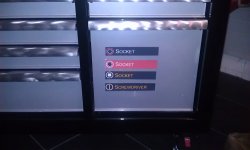
And finally the rejects.
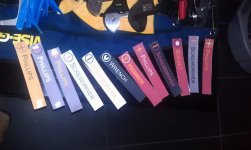
She got the idea to mount them on magnets when I told her the feedback I got on organizing - basically you wind up moving stuff around over time. What do you guys think? Have a favorite? I found a Porsche font but it actually is a terrible font for reading from across the room. Can't wait to see the next round of prototypes!
BHR4CE1: Thanks!
Got to spend some more time emptying out the big drawers and two of the small drawers in the lower tool chest. Like I said since this tool chest used to be the only thing to protect all my tools I had some things I can now move out. For instance, one drawer was full of my wire crimpers, strippers, testers, etc. I cleaned all that up and put it in my new Klein 39 pocket backpack along with my Fluke stuff. Everything in a nice, small, portable package. Very pleased.
Even more pleased when my most excellent girlfriend came down to share her secret project. Magnetic labels for tools! How cool is that?! These are the prototype tests for color, font, etc. and were done on a ink jet printer and then a laminator. Final versions will have more saturated color on a color laser.
These are the ones we thought tested best. She's been working on some standard icons for the tool groups. She selected Phillips and Screwdriver to test lots of vertical letters and a long word. I think they came out awesome! I think I like the thicker font of the one in the upper left but maybe with the gray circle and the yellow tool icon inside.
These came out well, too. I especially like the hammer.
Some runners up.
And finally the rejects.
She got the idea to mount them on magnets when I told her the feedback I got on organizing - basically you wind up moving stuff around over time. What do you guys think? Have a favorite?
I found a Porsche font but it actually is a terrible font for reading from across the room. Can't wait to see the next round of prototypes!taumac
Well-known member
Good progress. Those labels came out great. Imo I think white label with red lettering on cabinets and black label with black lettering on tool boxes.
Have a good one, Gerard
The 5 Stitches Garage part 1 http://www.garagejournal.com/forum/showthread.php?t=142100
The 5 Stitches Garage part2 http://www.garagejournal.com/forum/showthread.php?t=211899
Have a good one, Gerard
The 5 Stitches Garage part 1 http://www.garagejournal.com/forum/showthread.php?t=142100
The 5 Stitches Garage part2 http://www.garagejournal.com/forum/showthread.php?t=211899
Finally Putting Stuff Away Again!
taumac: Thanks for the feedback. Black on Black?
Finished the cleanout of the Tool Chest and was able to start putting everything back in! Woot! Here's some pics:
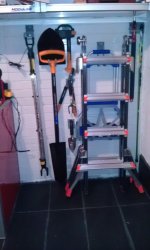
Here's where the tool chest will go. I've finished putting up the accessories to hold tall awkward things like lawn tools, ladder, foot truck, fish sticks/drills, LED shop light. I can still reach the shop light with the Tool Chest rolled in front of this as it has to be far enough out to clear the upper cabinets when I lift the top.
Top Chest Left Drawer 1 (Top): General, Screwdrivers

Top Chest Left Drawer 2: General, Sockets, 3/8" Drive
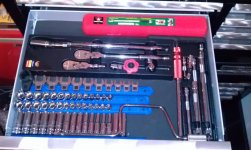
Top Chest Left Drawer 3: General, Sockets, 1/2" Drive
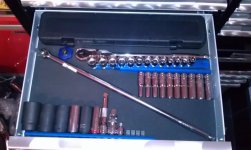
Top Chest Left Drawer 4: General, Wrenches

Top Chest Right Drawer 1 (Top): Reserved
Top Chest Right Drawer 2: General, Sockets, 1/4"; Drivers

Top Chest Right Drawer 3: General, Sockets, 3/8": Hex, Torx, XZN
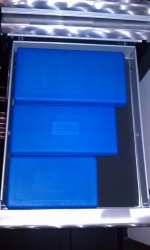
taumac: Thanks for the feedback. Black on Black?
Finished the cleanout of the Tool Chest and was able to start putting everything back in! Woot! Here's some pics:
Here's where the tool chest will go. I've finished putting up the accessories to hold tall awkward things like lawn tools, ladder, foot truck, fish sticks/drills, LED shop light. I can still reach the shop light with the Tool Chest rolled in front of this as it has to be far enough out to clear the upper cabinets when I lift the top.
Top Chest Left Drawer 1 (Top): General, Screwdrivers
Top Chest Left Drawer 2: General, Sockets, 3/8" Drive
Top Chest Left Drawer 3: General, Sockets, 1/2" Drive
Top Chest Left Drawer 4: General, Wrenches
Top Chest Right Drawer 1 (Top): Reserved
Top Chest Right Drawer 2: General, Sockets, 1/4"; Drivers
Top Chest Right Drawer 3: General, Sockets, 3/8": Hex, Torx, XZN
1/2 Cup
Member Emeritus
Awesome, well done.
Finally Putting Stuff Away Again! (Cont.)
Top Chest Right Drawer 4: General, Pliers, Specialty
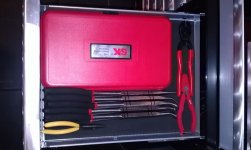
Bottom Chest Top Drawer: General, Pliers

Had to stop there as Verizon showed up to do a FIOS install and I had to take down a bunch of StoreWall to help rout RG6 around the house. Glad I made some decisions about boxing in the top of the room. Pop off the StoreWall, run the cable through open boxes, put the StoreWall back on. Really nice. Some of the other work in the older part of the house was less nice! Especially the attic! Anyway, six hours later 30-40MB internet and Comcast can kiss my *ss! Yay!
Almost have by OCD inventory done with sizes and tagging for everything. I'll post the spreadsheet in case anyone cares, LOL.
Top Chest Right Drawer 4: General, Pliers, Specialty
Bottom Chest Top Drawer: General, Pliers
Had to stop there as Verizon showed up to do a FIOS install and I had to take down a bunch of StoreWall to help rout RG6 around the house. Glad I made some decisions about boxing in the top of the room. Pop off the StoreWall, run the cable through open boxes, put the StoreWall back on. Really nice. Some of the other work in the older part of the house was less nice! Especially the attic!
Anyway, six hours later 30-40MB internet and Comcast can kiss my *ss! Yay!Almost have by OCD inventory done with sizes and tagging for everything. I'll post the spreadsheet in case anyone cares, LOL.
Awesome, well done.
LOL! I just read your post about your dog to my wife five minutes ago. Priceless pictures. Sure does have 'character'. Love your thread and read it everyday. Thanks!
1/2 Cup
Member Emeritus
LOL! I just read your post about your dog to my wife five minutes ago. Priceless pictures. Sure does have 'character'. Love your thread and read it everyday. Thanks!
Many thanks, Shelby is a unit that's for sure. I keep an eye on your thread as well, Cheers
taumac
Well-known member
Looking good ..... Oops think it ment black label silver lettering
Have a good one, Gerard
The 5 Stitches Garage part 1 http://www.garagejournal.com/forum/showthread.php?t=142100
The 5 Stitches Garage part2 http://www.garagejournal.com/forum/showthread.php?t=211899
Have a good one, Gerard
The 5 Stitches Garage part 1 http://www.garagejournal.com/forum/showthread.php?t=142100
The 5 Stitches Garage part2 http://www.garagejournal.com/forum/showthread.php?t=211899
Carriage Doors Finally Shipped!
taumac: Yeah, that might contrast nicely with the cabinet. Thanks!
Doors have shipped! I can't believe it! I may have to extend the tent back out to 20' in case the installers can't make the delivery date work. 1,500lbs total. I hope most of that is the crating! Yikes.
taumac: Yeah, that might contrast nicely with the cabinet. Thanks!
Doors have shipped! I can't believe it! I may have to extend the tent back out to 20' in case the installers can't make the delivery date work. 1,500lbs total. I hope most of that is the crating! Yikes.
Last edited:
Another Productive Day Cleaning
Got a decent day in unpacking, cleaning, and loading. All of the cabinets, being aluminum, have required a complete wipe down to remove the black oxidation from the original materials. Easy to clean but dirty. Lots of stuff in boxes got dirty sitting in the tent. Some things I had never unboxed got pulled out, put together and stowed (Dremel Workstation; Hako Soldering Station). Loaded a bunch of car parts into the sliding door cabinets.
Went through another iteration of label development with some cool new logos my wife came up with. Hard to decide as several versions look great.
Bottom Chest Left Drawer 5: General, Hammers; Chisels; Impact; Drifts
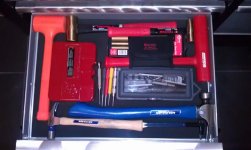
Bottom Chest Right Drawer 2: Automotive, Engine

Starting to look lived in finally. Took advantage of the StoreWall above the upper cabinets to mount the EZCarLift cross members, SmartString Alignment and Camber guage, injector cleaner, and brake bleeder. Also some sway bars and a parts cleaner. Really nice to get that stuff up out of the way.

And now or a Little Sumpin' Sumpin'...

Got a decent day in unpacking, cleaning, and loading. All of the cabinets, being aluminum, have required a complete wipe down to remove the black oxidation from the original materials. Easy to clean but dirty. Lots of stuff in boxes got dirty sitting in the tent. Some things I had never unboxed got pulled out, put together and stowed (Dremel Workstation; Hako Soldering Station). Loaded a bunch of car parts into the sliding door cabinets.
Went through another iteration of label development with some cool new logos my wife came up with. Hard to decide as several versions look great.
Bottom Chest Left Drawer 5: General, Hammers; Chisels; Impact; Drifts
Bottom Chest Right Drawer 2: Automotive, Engine
Starting to look lived in finally. Took advantage of the StoreWall above the upper cabinets to mount the EZCarLift cross members, SmartString Alignment and Camber guage, injector cleaner, and brake bleeder. Also some sway bars and a parts cleaner. Really nice to get that stuff up out of the way.
And now or a Little Sumpin' Sumpin'...
Another Day in the Garage!
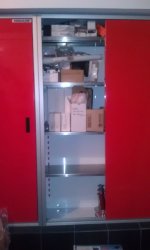
More cleaning and unloading today. Got all my Porsche parts unpacked and shelved in one side of the right sliding door cabinet.
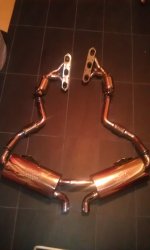
Laid out my new FabSpeed header/exhaust to see if I can easily bolt it together and hang it on the wall for art until the install. Might look neat
Cleaned the last of the lower cabinets - they each can hold one of my storage bins with room for additional stuff so that's great. I have the rearrange the slide out shelves on the center unit as I can't get the base plate out to clean as the lower shelf is too low.
Spent some time disassembling a Dewalt DW919 18v cordless light I've had forever. It has a goose neck that had lost its ability to stay up right. Since ****** doesn't work on Dewalts it went under the knife. The goose neck is actually a series of hollow bead/cup pieces that all snap together like a kid's cootie bug and the power wires pass through holes in each piece. One had split its cup so after failing to super glue it (a long shot given the stress) I cut out the broken piece and the pressed the two adjoining pieces back together. Voila! Reassemble. The light is part of an Dewalt 18v kit I bought 18 years ago! All are still running like champs!
More cleaning and unloading today. Got all my Porsche parts unpacked and shelved in one side of the right sliding door cabinet.
Laid out my new FabSpeed header/exhaust to see if I can easily bolt it together and hang it on the wall for art until the install. Might look neat
Cleaned the last of the lower cabinets - they each can hold one of my storage bins with room for additional stuff so that's great. I have the rearrange the slide out shelves on the center unit as I can't get the base plate out to clean as the lower shelf is too low.
Spent some time disassembling a Dewalt DW919 18v cordless light I've had forever. It has a goose neck that had lost its ability to stay up right. Since ****** doesn't work on Dewalts it went under the knife. The goose neck is actually a series of hollow bead/cup pieces that all snap together like a kid's cootie bug and the power wires pass through holes in each piece. One had split its cup so after failing to super glue it (a long shot given the stress) I cut out the broken piece and the pressed the two adjoining pieces back together. Voila! Reassemble. The light is part of an Dewalt 18v kit I bought 18 years ago! All are still running like champs!
taumac
Well-known member
I like that, starting to look lived in. I know that feeling way to much. It looks great all clean and such than start putting stuff up and away and look back and say. Man I got too much stuff lol. Still looks awesome
Have a good one, Gerard
The 5 Stitches Garage part 1 http://www.garagejournal.com/forum/showthread.php?t=142100
The 5 Stitches Garage part2 http://www.garagejournal.com/forum/showthread.php?t=211899
Have a good one, Gerard
The 5 Stitches Garage part 1 http://www.garagejournal.com/forum/showthread.php?t=142100
The 5 Stitches Garage part2 http://www.garagejournal.com/forum/showthread.php?t=211899
Another good day wraps up the loading
Had a very productive day today and finished up the unpacking, cleaning, measuring, and loading. Very pleased to have an empty garage again! LOL I still have a couple cases of oil and my heavy machinery (engine stand + engine; hoist; jack; and the two main pieces of the lift) still to move in but that must wait until the doors are installed. They were originally scheduled to arrive tomorrow but I haven't heard from the shipping company so I assume the weather delayed things.
As I wrapped up the loading I also began some of the detail trim work. I had ordered the glare shields for the upper cabinets as I plan on adding LED strip lighting behind them. I installed all the fronts. The end pieces will wait until I have time to trim them as the cabinets are mounted directly to the block while the StoreWall was trimmed tight (despite my request) to the cabinets. As a result the end pieces are too long. I may still retrim the Storewall but that is a lot of work. TBD.
Here is the far left upper cabinets. These cabinets are nicely made of aluminum and enameled white inside, including the door inners (they have inner and outer skins), making for a bright cabinet. The hardware rails, and the shelves are all polished aluminum.
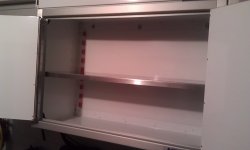
Here you can see under the cabinet where the front is flush with the bottom of the cabinet.
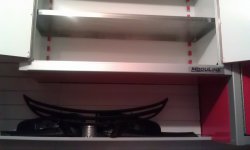
To mount the glare shield there are two nut/bolt attachments that I pre-attached with a screwdriver and a driver. The glare shield has slots that allow you to slide it back onto the bolts and hang there while you position and tighten.

Here's the first glare shield mounted.
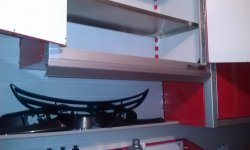
And here with the doors closed to see how well they integrate with the cabinets. As you can see the glare shields have a backwards 'C' cross section with a flat top (against the bottom of the cabinet) and a two step profile. The LED strips will be able to be positioned either on the top of the lower lip and angled down or on the underside of the upper part angled back and using the glare shield hardware. I'll have to test which provides the better lighting.

Here is the side piece showing how the StoreWall pushes the end too far out. One or the other needs to be trimmed.

Had a very productive day today and finished up the unpacking, cleaning, measuring, and loading. Very pleased to have an empty garage again! LOL I still have a couple cases of oil and my heavy machinery (engine stand + engine; hoist; jack; and the two main pieces of the lift) still to move in but that must wait until the doors are installed. They were originally scheduled to arrive tomorrow but I haven't heard from the shipping company so I assume the weather delayed things.
As I wrapped up the loading I also began some of the detail trim work. I had ordered the glare shields for the upper cabinets as I plan on adding LED strip lighting behind them. I installed all the fronts. The end pieces will wait until I have time to trim them as the cabinets are mounted directly to the block while the StoreWall was trimmed tight (despite my request) to the cabinets. As a result the end pieces are too long. I may still retrim the Storewall but that is a lot of work. TBD.
Here is the far left upper cabinets. These cabinets are nicely made of aluminum and enameled white inside, including the door inners (they have inner and outer skins), making for a bright cabinet. The hardware rails, and the shelves are all polished aluminum.
Here you can see under the cabinet where the front is flush with the bottom of the cabinet.
To mount the glare shield there are two nut/bolt attachments that I pre-attached with a screwdriver and a driver. The glare shield has slots that allow you to slide it back onto the bolts and hang there while you position and tighten.
Here's the first glare shield mounted.
And here with the doors closed to see how well they integrate with the cabinets. As you can see the glare shields have a backwards 'C' cross section with a flat top (against the bottom of the cabinet) and a two step profile. The LED strips will be able to be positioned either on the top of the lower lip and angled down or on the underside of the upper part angled back and using the glare shield hardware. I'll have to test which provides the better lighting.
Here is the side piece showing how the StoreWall pushes the end too far out. One or the other needs to be trimmed.
Another good day wraps up the loading (cont.)
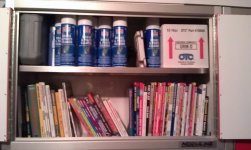
In order to fit my shop books I needed to raise the shelf a notch. The shelves are fastened to the front rails with bolt/nuts and fit into slots in the back rail. Both are positioned in 2" increments. With nothing on the shelf the back rattles a bit as the slot is a bit bigger than the shelf but once anything is on it it doesn't move.
The books are loaded! I had originally thought to put them on an outside shelf but the obvious spot was about 1" too short, directly below this cabinet. It will probably keep the books cleaner anyway. I later moved the cans of brake clean elsewhere.
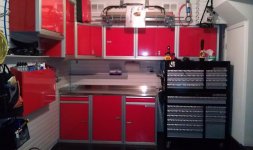
The next upper cabinet over is 3" tall by 2" wide with a single door. (the first was 2" all by 3" wide with double doors). All the uppers are 24" deep so plenty of storage there.

The next upper cabinet is the corner piece with double doors. This is a full corner inside (I noticed Ikea is now using regular units with two 'V' shaped adapters that effectively throw away the space in between!) so it is huge - bigger on the inside than the door. I'll have to put some thought into how to best utilize this space - Lazy Susan?

Loading proceeded quickly after the insides of the cabinets were all cleaned of the blackening aluminum oxide from the manufacturing process. The sliding door cabinets (not pictured) are pretty full although I still have a bit of room and I have one of the upper cabinets empty still. There lowers are mostly storing parts that will go away sooner or later - for now. I can't believe there was finally nothing on the floor of the garage again! Woot! Very Happy
In order to fit my shop books I needed to raise the shelf a notch. The shelves are fastened to the front rails with bolt/nuts and fit into slots in the back rail. Both are positioned in 2" increments. With nothing on the shelf the back rattles a bit as the slot is a bit bigger than the shelf but once anything is on it it doesn't move.
The books are loaded! I had originally thought to put them on an outside shelf but the obvious spot was about 1" too short, directly below this cabinet. It will probably keep the books cleaner anyway. I later moved the cans of brake clean elsewhere.
The next upper cabinet over is 3" tall by 2" wide with a single door. (the first was 2" all by 3" wide with double doors). All the uppers are 24" deep so plenty of storage there.
The next upper cabinet is the corner piece with double doors. This is a full corner inside (I noticed Ikea is now using regular units with two 'V' shaped adapters that effectively throw away the space in between!) so it is huge - bigger on the inside than the door. I'll have to put some thought into how to best utilize this space - Lazy Susan?
Loading proceeded quickly after the insides of the cabinets were all cleaned of the blackening aluminum oxide from the manufacturing process. The sliding door cabinets (not pictured) are pretty full although I still have a bit of room and I have one of the upper cabinets empty still. There lowers are mostly storing parts that will go away sooner or later - for now. I can't believe there was finally nothing on the floor of the garage again! Woot! Very Happy
taumac
Well-known member
my heavy machinery (engine stand + engine; hoist; jack; and the two main pieces of the lift)
Where you gonna put that stuff?
Have a good one, Gerard
The 5 Stitches Garage part 1 http://www.garagejournal.com/forum/showthread.php?t=142100
The 5 Stitches Garage part2 http://www.garagejournal.com/forum/showthread.php?t=211899
Where you gonna put that stuff?
Have a good one, Gerard
The 5 Stitches Garage part 1 http://www.garagejournal.com/forum/showthread.php?t=142100
The 5 Stitches Garage part2 http://www.garagejournal.com/forum/showthread.php?t=211899
taumac: I have a hope of building a small, weatherproof shed to fit the hoist and stand when not in use. Possibly moving the gardening implements as well. It will have to be fairly small given it has to fit behind a fence where the trash cans used to be. The lift parts will hang on the wall as they are only about 6" deep and 12" wide each - one reason I love the EZCarLift.
Next Phase Begins!
Well, the doors are FINALLY HERE! I didn't realize how anxious I was waiting for them for so long. What a huge relief. I can't wait to get them installed and be able to get a car back in the garage!
I spent the morning moving the last of the tent contents out to make room for the crates that were coming. Got everything out in front of the garage and moved the tent off the driveway. The plan was to allow the driver to back up the driveway and drop everything there rather than at the curb. Of course, it then started to rain.
I quickly started moving everything I could inside (jack, transmission jack, 2 main lift pieces, cases of oil, etc.) and, of course, had to violate my promise to not put anything in the clean garage that wasn't itself clean. Argh!
The Real Carriage Door Company folks told me to have 2-3 people there to help the driver unload. I had my brother and three friends from work and myself plus the driver. Glad to have everyone as the three crates totally 1650lbs were pretty unwieldy. They new entry door was crated separately and the two garage doors were crated together and was huge, maybe 10' by 2' by 5'. There was a third crate that was about 11' by 2' by 2' with what I assume are the trim pieces for the exterior box. Each had a base pallet beneath it, the two doors with pallets that extended about 6" on either side for a little more stability given how tall they are. Worked through a few contortions getting these large packages onto and off the lift gate included some nice driving by the delivery guy to drop and drive the trim piece (think 400lb coffin for a 10' guy) of the lift gate smooth as silk. Moved the tent back over the crates and called it a day. Phew! I still have to rearrange things as I need to get my engine hoist back under the tent!
Anyway, pleased to be moving again and the big stuff!
Well, the doors are FINALLY HERE! I didn't realize how anxious I was waiting for them for so long. What a huge relief. I can't wait to get them installed and be able to get a car back in the garage!
I spent the morning moving the last of the tent contents out to make room for the crates that were coming. Got everything out in front of the garage and moved the tent off the driveway. The plan was to allow the driver to back up the driveway and drop everything there rather than at the curb. Of course, it then started to rain.
I quickly started moving everything I could inside (jack, transmission jack, 2 main lift pieces, cases of oil, etc.) and, of course, had to violate my promise to not put anything in the clean garage that wasn't itself clean. Argh!
The Real Carriage Door Company folks told me to have 2-3 people there to help the driver unload. I had my brother and three friends from work and myself plus the driver. Glad to have everyone as the three crates totally 1650lbs were pretty unwieldy. They new entry door was crated separately and the two garage doors were crated together and was huge, maybe 10' by 2' by 5'. There was a third crate that was about 11' by 2' by 2' with what I assume are the trim pieces for the exterior box. Each had a base pallet beneath it, the two doors with pallets that extended about 6" on either side for a little more stability given how tall they are. Worked through a few contortions getting these large packages onto and off the lift gate included some nice driving by the delivery guy to drop and drive the trim piece (think 400lb coffin for a 10' guy) of the lift gate smooth as silk. Moved the tent back over the crates and called it a day. Phew! I still have to rearrange things as I need to get my engine hoist back under the tent!
Anyway, pleased to be moving again and the big stuff!
Coffin Sale
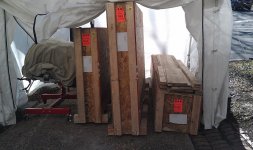
Rain stopped last night and the sun was out for a beautiful day today. Finally! Took some pictures of the crates with the doors and the trim. To give some perspective the crates weigh 395lbs, 695lbs, 500lbs, left to right. The tallest on is about 5'6" and the low one is almost 12' long. The engine hoist sure came in handy to move them to the left so I could put the hoist and the engine stand back in.
Got everything I moved in yesterday cleaned up and stowed in the garage. Yay! Back to a clean garage with most of the floor cleared. Getting closer!
Rain stopped last night and the sun was out for a beautiful day today. Finally! Took some pictures of the crates with the doors and the trim. To give some perspective the crates weigh 395lbs, 695lbs, 500lbs, left to right. The tallest on is about 5'6" and the low one is almost 12' long. The engine hoist sure came in handy to move them to the left so I could put the hoist and the engine stand back in.
Got everything I moved in yesterday cleaned up and stowed in the garage. Yay! Back to a clean garage with most of the floor cleared. Getting closer!
Planning Next Phase: Lighting
Right now I have a single 100w incandescent roughly in the middle of the space. The space is remarkable bright now that all that StoreWall is in there and the shiny cabinets must also reflect quite a bit of the light as well as the black, but somewhat satiny floor tiles. But obviously that's not optimal or quite as bright as it seems once you're working for awhile on something small or not directly under the light. Although I haven't really noticed it I guess shadows are an obvious factor.
So, I set about moving my original plans to put 1'x4' troffers in between the joists and changed to a wrap type design surface mounted each of which puts out 4,000lumens. I also modeled under cabinet lighting putting out 200lumens/foot. The software I used, DiaLux Evo, doesn't allow for modeling the contents of the room but since the lights are all pointing down the measurements at the work surface so be reasonable. Targeting 750lux with 1000 on the table tops.
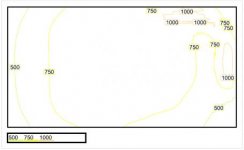
Home Sweet 3D doesn't really do technical lighting modeling. So I had to monkey with the relative light power to get two renderings. The first with mostly just the under cabinet lights and the second with the main lights up.


The design thought is to have the ambient light strongest along side the car and in front of the sliding door cabinets and then provide light to the engine area of the car (my car would actually be backed in as it is mid-engine and accessed from the back). Additional task lighting is then provided by the under cabinet lights to the main counter and the fold down workstation. All will be dimmable, just in case. I'm thinking the two parallel sets of mains will be on one circuit and the two over the work area on a separate circuit. Finally, all the under cabinet lights will be on a third circuit of a dual driver controller.
Right now I have a single 100w incandescent roughly in the middle of the space. The space is remarkable bright now that all that StoreWall is in there and the shiny cabinets must also reflect quite a bit of the light as well as the black, but somewhat satiny floor tiles. But obviously that's not optimal or quite as bright as it seems once you're working for awhile on something small or not directly under the light. Although I haven't really noticed it I guess shadows are an obvious factor.
So, I set about moving my original plans to put 1'x4' troffers in between the joists and changed to a wrap type design surface mounted each of which puts out 4,000lumens. I also modeled under cabinet lighting putting out 200lumens/foot. The software I used, DiaLux Evo, doesn't allow for modeling the contents of the room but since the lights are all pointing down the measurements at the work surface so be reasonable. Targeting 750lux with 1000 on the table tops.
Home Sweet 3D doesn't really do technical lighting modeling. So I had to monkey with the relative light power to get two renderings. The first with mostly just the under cabinet lights and the second with the main lights up.
The design thought is to have the ambient light strongest along side the car and in front of the sliding door cabinets and then provide light to the engine area of the car (my car would actually be backed in as it is mid-engine and accessed from the back). Additional task lighting is then provided by the under cabinet lights to the main counter and the fold down workstation. All will be dimmable, just in case. I'm thinking the two parallel sets of mains will be on one circuit and the two over the work area on a separate circuit. Finally, all the under cabinet lights will be on a third circuit of a dual driver controller.
Last edited:
The beginnings of a major step forward. The doors have been picked up for finishing. Some unintended additional costs associated with doing things right. Since I have a south facing (into the hot sun) house and I am not painting the doors to protect them I have to use a penetrating stain (for both cosmetic and as a UV protector) and then many coats of spar varnish in order to avoid completely throwing away the original investment. If done right and well I'll have to lightly sand and reapply another coat of spar varnish every 2-3 years as maintenance. Not exactly low effort but I think it will be worth the impact in any case. I don't regret the decision, just my lack of planning!
Anyway, another step forward!
Anyway, another step forward!
taumac
Well-known member
Foward progress is a good thing.... Got to see theses door.
Have a good one, Gerard
Florida GJers ( FGJ)
http://www.garagejournal.com/forum/group.php?groupid=117
The 5 Stitches Garage
http://www.garagejournal.com/forum/showthread.php?t=211899
Have a good one, Gerard
Florida GJers ( FGJ)
http://www.garagejournal.com/forum/group.php?groupid=117
The 5 Stitches Garage
http://www.garagejournal.com/forum/showthread.php?t=211899