To avoid these ads, REGISTER NOW!

options for detached garage feeder line connections

Dlint

Member
Joined
Jul 26, 2023
Messages
11
Hi all,

I'm wiring in my detached garage and may have put the cart before the horse a little. I've trenched and buried four 1/0 conductors to feed a 100 Amp panel (I realistically will probably only push out 50A max) inside the shop. The trench goes ~100 feet to the meter/main disconnect combo box on the side of my home. The main disconnect breaker, and the panel inside my home which it feeds, are also both 100A. Now that I'm nearly to the point of terminating my feeders, I've discovered that a new breaker for my box with lugs rated for dual conductors is either nonexistent or very hard to find. Here are my options as far as I can tell, please let me know if you have a better suggestion:

1. Find a breaker that fits my box with dual lugs-one set of feeders for the home panel and another for the shop's. This is my preferred route assuming one exists.
2. use something like this and/or Polaris taps and tap into the existing home panel feeders. Things would get pretty tight in that box but it could be done. more importantly, I believe this is still technically double tapping, though I'd be surprised if that main disconnect saw over 100 sustained amps even from the home and shop combined.
3. feed the shop via the home panel. No, the home panel isn't a feed-through, and I'm not sure the shop feeder lines would even reach it without being extended, but the shop's panel is the feed-through version of the home's panel (Homeline 24 slot) and it seems like the guts are interchangeable. This would obviously be very labor intensive, but at the end of the day would still be doable.
4. get a different meter combo box that's better set up for what I'm trying to do. This is the most straight forward but least preferable from a budgetary standpoint.

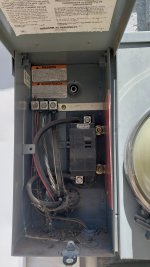
Thanks in advance for any suggestions. Here's a pic of my meter combo box for reference (The shop feeder lines would be coming in from the bottom):20230714_133220.jpg
 
To avoid these ads, REGISTER NOW!

dscheidt

Well-known member
Joined
Apr 26, 2017
Messages
2,906
Put a subpanel right next to the meter main. Feed it from the main, feed the house and garage from there. You can splice the existing house feed in the main if you need to extend them. There's a homeline panel that's suitable for about $60, plus breakers. Your stuff is already a subpanel, so nothing should need changing in the house or the plans for the garage.
 

wyliesdiesels

Well-known member
Joined
Aug 14, 2012
Messages
20,061
Location
Modesto, CA
Hi all,

I'm wiring in my detached garage and may have put the cart before the horse a little. I've trenched and buried four 1/0 conductors to feed a 100 Amp panel (I realistically will probably only push out 50A max) inside the shop.

1/0 is way overkill for 100a and the ground conductor/EGC did not need to be 1/0. It can be #8 cu or #6 AL for 100a. 100a is probably overkill for what youre doing as well.

#2 AL MHF wouldve been better and cheaper

The trench goes ~100 feet to the meter/main disconnect combo box on the side of my home. The main disconnect breaker, and the panel inside my home which it feeds, are also both 100A. Now that I'm nearly to the point of terminating my feeders, I've discovered that a new breaker for my box with lugs rated for dual conductors is either nonexistent or very hard to find.

yeah youre not gonna find what youre looking for.

youll either need to:

replace the main with a multispace panel
set a subpanel next to it, feed the sub with the current 100a and then feed the house and shop from the new sub
feed from the subpanel inside the house
do an outside tap where you splice onto the wires coming off that breaker though that box is pretty full and will be difficult to do

theyre in order from most expensive to least expensive

Here are my options as far as I can tell, please let me know if you have a better suggestion:

1. Find a breaker that fits my box with dual lugs-one set of feeders for the home panel and another for the shop's. This is my preferred route assuming one exists.

not gonna happen.

2. use something like this and/or Polaris taps and tap into the existing home panel feeders. Things would get pretty tight in that box but it could be done. more importantly, I believe this is still technically double tapping, though I'd be surprised if that main disconnect saw over 100 sustained amps even from the home and shop combined.

that part would not be appropriate since it is not insulated and it would be a lot of work to insulate it. the polaris taps on the other hand would work for an outside tap. That would not be considered double tapping the lug. that is where you put 2 wires under a lug.

If you pull more than 100a the breaker would just trip so now issue there

3. feed the shop via the home panel. No, the home panel isn't a feed-through, and I'm not sure the shop feeder lines would even reach it without being extended, but the shop's panel is the feed-through version of the home's panel (Homeline 24 slot) and it seems like the guts are interchangeable. This would obviously be very labor intensive, but at the end of the day would still be doable.

thats your other option.

4. get a different meter combo box that's better set up for what I'm trying to do. This is the most straight forward but least preferable from a budgetary standpoint.

yup that would probably be the most expensive since you most likely need a permit and you have to have the PoCo come out.
 

mm08822

Well-known member
Joined
Jan 13, 2012
Messages
6,021
Location
NJ
Here is what I would do w/o upgrading to a 200A service meter/main.

Run your 1/0's into the disconnect pictured. Leave the conductors long for future modification but also for the splice today.
Disconnect the 4 wires in the disconnect for the house panel.
Use 4 polaris connectors or split bolt connectors to attach the house feeder wires onto the garage feeder wires several inches back from the end of each garage feeder conductor. The garage feeder wires then attach to all 4 locations that the house feeder is currently using.

In the future, this can be undone and each feeder connected to its own cb at the new meter/main whenever that day comes. You could shorten the garage feeder conductors to eliminate the uninsulated areas used with the split bolts at this later time.
 

Bert_

Well-known member
Joined
Dec 24, 2016
Messages
9,765
Location
NW Iowa
What size is the wire in that box now? #2? You could probably do it with some Polaris connectors. You better plan out exactly where each wire needs to lay or you won't get the cover back on. There's no code issue with this. I would move those copper wires to a new ground lug and land your neutral in that existing spot.
 
OP
D

Dlint

Member
Joined
Jul 26, 2023
Messages
11
Thank you guys for the great responses!
Put a subpanel right next to the meter main. Feed it from the main, feed the house and garage from there. You can splice the existing house feed in the main if you need to extend them. There's a homeline panel that's suitable for about $60, plus breakers. Your stuff is already a subpanel, so nothing should need changing in the house or the plans for the garage.
I hadn't thought of this, thanks for the solid suggestion. Do you mind sharing which panel you had in mind?
1/0 is way overkill for 100a and the ground conductor/EGC did not need to be 1/0. It can be #8 cu or #6 AL for 100a. 100a is probably overkill for what youre doing as well.

#2 AL MHF wouldve been better and cheaper
You're right--I wanted the electrical to be pretty future proof, especially since I was going direct burial, and scored some 1/0-1/0-1/0-2 AL for about $300. considering the distance it seemed like a no brainer.

That would not be considered double tapping the lug. that is where you put 2 wires under a lug.
If you pull more than 100a the breaker would just trip so now issue there
That was my thinking as well. I brought it up to an electrician I know who said it was a violation because if the breaker failed to trip the potential 200A would be supplied by equipment only rated (or required to be rated) at 100A.
Here is what I would do w/o upgrading to a 200A service meter/main.

Run your 1/0's into the disconnect pictured. Leave the conductors long for future modification but also for the splice today.
Disconnect the 4 wires in the disconnect for the house panel.
Use 4 polaris connectors or split bolt connectors to attach the house feeder wires onto the garage feeder wires several inches back from the end of each garage feeder conductor. The garage feeder wires then attach to all 4 locations that the house feeder is currently using.

In the future, this can be undone and each feeder connected to its own cb at the new meter/main whenever that day comes. You could shorten the garage feeder conductors to eliminate the uninsulated areas used with the split bolts at this later time.
So my option #2 but it's the home that taps into the shop feeders rather than the other way around. That makes sense, I will ty to get an idea of how best to fit that in the limited space. Thanks.
What size is the wire in that box now? #2? You could probably do it with some Polaris connectors. You better plan out exactly where each wire needs to lay or you won't get the cover back on. There's no code issue with this. I would move those copper wires to a new ground lug and land your neutral in that existing spot.
I'm glad you brought that up, I was wondering if the phillips screw to the right of the lugs on the neutral bus was to fill vacant threads for mounting a 4th lug?
 

wyliesdiesels

Well-known member
Joined
Aug 14, 2012
Messages
20,061
Location
Modesto, CA
That was my thinking as well. I brought it up to an electrician I know who said it was a violation because if the breaker failed to trip the potential 200A would be supplied by equipment only rated (or required to be rated) at 100A.

that would not be a violation. no clue what that electrician is referring to. where does he even get 200a? if more than 100a is pulled thru that breaker it will trip. nothing would ever get to 200a. impossible

So my option #2 but it's the home that taps into the shop feeders rather than the other way around. That makes sense, I will ty to get an idea of how best to fit that in the limited space. Thanks.

no the home subpanel feeder is already connected. the shop feeder would be tapping into those lines
 
To avoid these ads, REGISTER NOW!

mm08822

Well-known member
Joined
Jan 13, 2012
Messages
6,021
Location
NJ
1767893372712.png

I'm saying, use the new longer conductors (and larger) to terminate into the cb and neutral bar. Bug the existing home panel feeders onto these new 1/0's. This way, when/if a new meter/main is installed, OP has max length on those home feeder conductors to re-use w/o a bunch of tape on them.
 
OP
D

Dlint

Member
Joined
Jul 26, 2023
Messages
11
that would not be a violation. no clue what that electrician is referring to. where does he even get 200a? if more than 100a is pulled thru that breaker it will trip. nothing would ever get to 200a. impossible
He got the 200A because of the two separate panels, each capable of drawing 100A, wired in parallel to the load side of the main CB on the combo box. I don't know if he was assuming a mechanical failure, super cold temps, short duration current spikes, etc. that would cause that CB to pass through that much current without tripping? I wanted to remind him that the sum of all the breaker values in a typical panel exceed the main breaker by multiple times it's value, but I didn't want to be argumentative. Regardless, confirming it's not a violation might be my most valuable learning from creating this post.
 
Last edited:

wyliesdiesels

Well-known member
Joined
Aug 14, 2012
Messages
20,061
Location
Modesto, CA
He got the 200A because of the two separate panels, each capable of drawing 100A, wired in parallel to the load side of the main CB on the combo box. I don't know if he was assuming a mechanical failure, super cold temps, short duration current spikes, etc. that would cause that CB to pass through that much current without tripping? Regardless, if it's not a violation than that might be my most valuable learning from creating this post.

no combination of loads can pull more than 100a without the breaker tripping. I have not heard of issues with Sq D mains not tripping due to mechanical failures

and you dont add up all the breakers to determine the load. you do a load calc.... I doubt you even have 100a of load there. that would be really hard to do even with 2-3 people.

the only thing that would have "current spiking" (aka in-rush current) are motors. such thing as pool pumps, ACs, well pumps, etc. but the duration of the in-rush is a few hundred milliseconds....
 

mm08822

Well-known member
Joined
Jan 13, 2012
Messages
6,021
Location
NJ
He got the 200A because of the two separate panels, each capable of drawing 100A, wired in parallel to the load side of the main CB on the combo box. I don't know if he was assuming a mechanical failure, super cold temps, short duration current spikes, etc. that would cause that CB to pass through that much current without tripping? Regardless, if it's not a violation than that might be my most valuable learning from creating this post.
Shoving two conductors under a lug that was not designed for it, is a violation.

However, your electrician is making up stuff. Is what you are proposing any different than having 300A of cb's installed in a 100a panel? No. A tripped cb ain't the end of the world anyway.

What you are asking to do is acceptable by code. (Maybe gutter space and bending radius' being tight.)
 
OP
D

Dlint

Member
Joined
Jul 26, 2023
Messages
11
no combination of loads can pull more than 100a without the breaker tripping. I have not heard of issues with Sq D mains not tripping due to mechanical failures

and you dont add up all the breakers to determine the load. you do a load calc.... I doubt you even have 100a of load there. that would be really hard to do even with 2-3 people.

the only thing that would have "current spiking" (aka in-rush current) are motors. such thing as pool pumps, ACs, well pumps, etc. but the duration of the in-rush is a few hundred milliseconds....

Shoving two conductors under a lug that was not designed for it, is a violation.

However, your electrician is making up stuff. Is what you are proposing any different than having 300A of cb's installed in a 100a panel? No. A tripped cb ain't the end of the world anyway.

What you are asking to do is acceptable by code. (Maybe gutter space and bending radius' being tight.)
I am in total agreement with you guys. I was just trying to understand his rationale, even if it's grasping at straws.
 

mm08822

Well-known member
Joined
Jan 13, 2012
Messages
6,021
Location
NJ
I am in total agreement with you guys. I was just trying to understand his rationale, even if it's grasping at straws.
I can understand that it's not the prettiest solution and replacing the existing with accommodating hardware as a permanent solution is much better.
BUT, if that's the limits of the customer's budget/priorities and no code issues, then do it.
He can write any sort of disclaimer he feels is needed on the proposal, contract, invoice, or wherever.
Otherwise, he can walk away.
 
To avoid these ads, REGISTER NOW!
Top Bottom