To avoid these ads, REGISTER NOW!

Osb ?

mjshore

Active member
Joined
Apr 26, 2015
Messages
27
Location
SW Florida
I am ready to start sheathing my roof and am attracted to OSB basicly because of Price. Has anyone used OSB and wished they had not and why?
 
To avoid these ads, REGISTER NOW!

kd3pc

Well-known member
Joined
Aug 10, 2013
Messages
3,630
Location
Northern Neck
as long as you know it's shortcomings, it performs well, better than other options in most.

Most areas require hurricane clips between trusses/rafters
It needs to be installed properly according to your AHJ (print side down where an inspector can see it)
edges kept properly away from moisture
Price is good, unless a hurricane has recently hit, then it can easily double

Others will chime in, I am sure
 

stikman56

Well-known member
Joined
Jun 12, 2014
Messages
3,127
It performs well as long as it stays dry. It tests stronger than plywood, and plywood is now so full of voids and no longer really a good product, and it cost more too. My Dad was a lumber guru and told me so much stuff about wood , I forgot most of it. He was top notch at what he did and his knowledge and had many awards showing just that. I go with what he said when I have questions. I'd use it in a heartbeat. Only problem it really ever has was edge swelling if it got wet if I remember it right.
 

Cyberbear

Well-known member
Joined
Nov 23, 2013
Messages
1,524
Location
California
OSB is often fairly rigid and will not endure much flexing before it snaps, depending on thickness used. I haven't used any in several decades but the glue smell took years to fade away and soaked up paint a lot. Never liked the way it worked, too many splinters for my preference.
 

WVBrady

Well-known member
Joined
May 5, 2005
Messages
1,679
Location
WV
...Most areas require hurricane clips between trusses/rafters...

I found that there was enough variation in thickness in the OSB that I got from Lowes that some of the clips "stood up". I was afraid that they would poke through the tarpaper, so I left them out.
 

Deej-79

Well-known member
Joined
Feb 8, 2016
Messages
502
Location
Washington
Its what all new roofs are sheeted with, at least around here. If your roof is installed properly you wont have a problem. I've never used clips btw, must not be code here.
 

rayra

Well-known member
Joined
Dec 1, 2014
Messages
4,724
Location
Escaped from Los Angeles
They're using it in 3/4" T&G style for roof decking in SoCal.

I'm using it for garage cabinet skins, it's been more stable in door panels for me than plywood.

garagecabimposingorder160209_zpsg4tcj6gw.jpg
 

ddawg16

Well-known member
Joined
Jul 11, 2008
Messages
21,005
Location
S. California
They're using it in 3/4" T&G style for roof decking in SoCal.

Really? Where? T&G for roofs?

You know what they say about roofs....there are 2 kinds....those that leak...and those that will leak.

I consider it to be a marginal product for roof sheathing at best. Maybe if you have your rafters at 16" OC....it might not sag too much.....but it will sag.

Builders use it because it's cheap....and by the time you notice the sag...you are well out of warranty.

But, why believe me........

http://www.builderonline.com/products/product-pros-and-cons-oriented-strand-board-vs-plywood_o

To get a sense how widespread OSB usage has become, you can do your own unscientific research. Drive through a subdivision under construction. House after house will be sheathed in the panels made with wood chips.

OSB hit the market in the late 1970s and was almost immediately a hit. According to the Structural Board Association, “in 1980, North American OSB panel production was 751 million square feet (3/8" basis),” says the Website of the Structural Board Association, which dissolved in 2008. “By 1990, this figure was 7.6 billion square feet. In 2005, this figure had grown to 25.0 billion square feet."

The product immediately found an audience with contractors and builders, despite the fact that many thought it looked like chipboard or particleboard, says Mary Jo Nyblad, sales and marketing manager for Boise Cascade’s plywood and particleboard division. “All it takes is for one guy to use it, and more followed,” she says. Boise, which used to make both types of panels, sold its OSB division to Ainsworth Lumber Co. in 2004.

Mainly due to its look, consumers and home buyers had the perception that OSB was cheap and an inferior product, but the panels found success among multifamily builders, Nyblad says. “It was readily accepted because there was no home buyer per se,” she continues. “It was a good fit.” The fact that the panel was economical also played a large role in its acceptance.

At first, plywood and OSB competed hammer and nail for market share. In the 1980s, Nyblad says, OSB started appearing on sidewalls and roofs, but plywood was still largely used for floors. Plywood tried hard to fend off OSB, but it could not compete well against OSB's lower cost. As a result, by the late 1990s, the panels had achieved parity in terms of usage, with OSB continuing to gain.

“In 2000, for the first time, OSB production marginally exceeded plywood production,” according to the Structural Board Association. “By 2006, OSB production grew to nearly 60% of the North American panel market share.” Manufacturers of both panel types agree OSB’s share of the production home market might even be closer to 75%.

To be sure, there is no difference between OSB and plywood as a structural panel, says APA - The Engineered Wood Association. The Tacoma, Wash.-based group is a nonprofit trade association that represents U.S. and Canadian manufacturers of plywood and OSB as well as other structural engineered wood products.

“Both products meet the local and national building codes,” says APA market research director Craig Adair. They are equally interchangeable for walls and roof sheathing, and for flooring underlayment, he adds. Moreover, both panels install fast and easily. Specified correctly, they perform as intended. Manufacturers from both sides claim their products offer better nail holding ability, but Adair says both meet the same requirements.

Still, after Hurricane Andrew tore through South Florida in 1992, leaving well over 250,000 people homeless and almost $30 billion in damage, the Miami-Dade County Board of County Commissioners banned OSB for use as roof sheathing.

Even though OSB dominates the construction market, some contractors and builders have problems with the performance of the product and have remained plywood loyalists. Nyblad says, for example, that there are regional preferences for plywood such as the Northeast, Northern California, Southwest, and Seattle in the rainy season. (In the dry season, these regions use OSB.) Plywood is particularly popular among DIYers and custom builders as well, she adds.

“We typically use plywood for all of our roof sheathing and subfloors,” says Steve Ronchelli, a senior project manager with custom builder Jim Murphy & Associates in Santa Rosa, Calif. Ronchelli says it’s partly due to the performance, but he allows that “it might just be a regional thing.” Northern California is close to the forest of the Pacific Northwest, so the lumber comes from nearby, he adds.
 

James-W

Well-known member
Joined
Feb 3, 2013
Messages
12,432
Location
Southeastern Wisconsin
I found that there was enough variation in thickness in the OSB that I got from Lowes that some of the clips "stood up". I was afraid that they would poke through the tarpaper, so I left them out.
It's code where I live and if you leave them out, you will not pass inspection.

I used 5/8 plywood on my roof. I got a good deal on it so I decided to spend a little extra money on each sheet and use plywood rather than OSB.

The OSB works fine on roofs, provided it doesn't get wet, it is used a lot around here for roofs but the builder makes sure the roof is completely done without getting wet. They use it for the walls too but they cover the walls with a house wrap as soon as they get them up.
 

ADSR

Well-known member
Joined
Jan 12, 2013
Messages
10,713
OSB is awesome! when it gets wet, it swells from 1/2 to 11/16 and gets even stronger.

On all the custom homes I've built, we use plywood for the roof and OSB for sheeting.
 

nadogail

Well-known member
Joined
Jan 23, 2009
Messages
31,908
Location
Coronado, CA
I see in the houses being built in my town what seems to be 100% OSB sheathing.

In my shop, I put 3/8 OSB on top of the bottom chords of the roof trusses to make an improvised attic floor, been 20 years without a problem.
 

G McKay

Well-known member
Joined
Mar 6, 2014
Messages
6,849
Location
In the garage in Bremerton
I guess it's OK for roof sheathing. But I hate to see it used for inside walls and/or cabinets. Geez that stuff is ugly. Especially when it's painted. I used outside siding on the INSIDE of my garage. It cost more but it really looks great.

:dunno:
 

Jason280

Well-known member
Joined
Mar 4, 2012
Messages
3,157
I've never used clips btw, must not be code here.

Not sure if its code here, either, but I've only seen them used on roofs with centers >16".

I love OSB, use it for a lot of different things. I'm finishing up a 24x32' build, and its on the external and internal walls, the roof, and the ceiling. Its an absolute PITA to put up by yourself on the ceiling, but everywhere else is gravy.
 

G McKay

Well-known member
Joined
Mar 6, 2014
Messages
6,849
Location
In the garage in Bremerton
Not sure if its code here, either, but I've only seen them used on roofs with centers >16".

I love OSB, use it for a lot of different things. I'm finishing up a 24x32' build, and its on the external and internal walls, the roof, and the ceiling. Its an absolute PITA to put up by yourself on the ceiling, but everywhere else is gravy.

In some states like Florida it is code. Louisiana too, especially after Hurricane Katrina.

:dunno:
 

MushCreek

Well-known member
Joined
Jan 14, 2015
Messages
9,747
Location
Upstate South Carolina
Here in SC, you can get by with 7/16", but you can see the trusses telegraphing through the roofing on all of the new houses. I used 5/8". Mine get wet plenty of times, as I'm one old guy, working alone, but it didn't seem to hurt it.
 

matt_i

Well-known member
Joined
Mar 14, 2008
Messages
10,723
Location
SE Michigan
After the nasty 4-ply pringled 1/2" CDX plywood I just got in (has been kept dry stacked until I put it up), I'd rather have OSB as I think it would have been delivered flat. It does lay out eventually but a pain to deal with. I would use the clips, it helps keep the panel edges aligned and not deflecting when you walk on it. The clips are not 12ga steel, they can be bent, must use appropriate finesse when installing.
 

Jazz1

Well-known member
Joined
Jan 3, 2016
Messages
4,184
Location
Thunder Bay On.
When I built my garage 20 years ago I used plywood for roof in the event there were ever a leak which never occurred. Plywood only cost a few more bucks for peace of mind. OSB for exterior wall. Drywall on interior
 
To avoid these ads, REGISTER NOW!

Kevin54

MEMBER EMERITUS
Joined
Jan 12, 2005
Messages
29,341
Location
Urbana, Ohio
Clips are normally used on roofs where the OSB is 7/16" to 1/2". Thicker OSB, like 5/8" the clips are not required.
 

justanengineer

Well-known member
Joined
Apr 5, 2011
Messages
7,722
Location
Motor City
At the risk of sounding like a cheesy one-liner - OSB is a pain in the nuts for roof decking, literally. I've had one foot go through a roof on several occasions, always with the dam OSB. Wet, rotting plywood has some strength and bounce to it, OSB has none IME. Call me old fashioned, but I still prefer 1x (or thicker) roof decking for houses, it doesnt take much longer to install but is far stronger than either sheeting and less likely to need repair when roofs are replaced. Barns and larger roofs tho require compromises for the sake of getting the job done, so choice is entirely situational.
 

James-W

Well-known member
Joined
Feb 3, 2013
Messages
12,432
Location
Southeastern Wisconsin
At the risk of sounding like a cheesy one-liner - OSB is a pain in the nuts for roof decking, literally. I've had one foot go through a roof on several occasions, always with the dam OSB. Wet, rotting plywood has some strength and bounce to it, OSB has none IME. Call me old fashioned, but I still prefer 1x (or thicker) roof decking for houses, it doesn't take much longer to install but is far stronger than either sheeting and less likely to need repair when roofs are replaced. Barns and larger roofs tho require compromises for the sake of getting the job done, so choice is entirely situational.
Are you saying you would rather have boards on the roof rather than 4X8 sheets of building material?
 

Deej-79

Well-known member
Joined
Feb 8, 2016
Messages
502
Location
Washington
I guess it's OK for roof sheathing. But I hate to see it used for inside walls and/or cabinets. Geez that stuff is ugly. Especially when it's painted. I used outside siding on the INSIDE of my garage. It cost more but it really looks great.

:dunno:

It's not really used for cabinets, at least from manufacturers. There is an osb like product used, sort of an in between of osb and mdf. It *****, I hate hanging those cabinets.
 

theoldwizard1

Well-known member
Joined
Feb 22, 2011
Messages
43,100
Location
SE MI
It is the standard, but I prefer plywood.

One thing you can do, is get the slightly thicker material (And clips to match).

A few years ago, my son was getting a new roof. He was having the decking replaced because he wanted to upgrade the insulation (cathedral ceilings). I did a lot of research and could not come up with a convincing argument to go to plywood.

He did pay for the upgrade from 7/16" to 1/2" OSB. Clips on any unsupported span of more than 48" should be mandatory.
 

theoldwizard1

Well-known member
Joined
Feb 22, 2011
Messages
43,100
Location
SE MI
Are you saying you would rather have boards on the roof rather than 4X8 sheets of building material?

Yes, he is.

And a lot of us have that.

I do. The roofers doing my roof (house built in the middle 50s and had 2 roofs) about 25 years ago had a clause about replacing "X" number of sheet of plywood. I told then it was 1x6 and they were shocked !
 

James-W

Well-known member
Joined
Feb 3, 2013
Messages
12,432
Location
Southeastern Wisconsin
I have boards on the house roof as well, but if I ever had to replace the roof for some reason I would go with either 5/8 or 3/4 inch plywood. There are cracks (a little space) between the roof boards that could potentially allow water in if there would be a leak toward the peak of the roof. I am sure the cracks (spaces) were not there when the house was built, the boards were no doubt laid tight together. I am sure the boards dried out over the years and the result is the space between the boards you see if you go up into the attic. Water can get in between the plywood sheets as well, but the water has to go down 4 feet to get to a joint first. Presumably the felt paper would help keep water out as well, but water has been known to get under the felt paper.

Anyway, personally, I would go with plywood. It is quicker to install, and after having purchased a few 1X6 pine boards this past week I can tell you straight out that it is awfully hard to find any decent lumber. I h ad to pick thru several boards to find anything half way-decent. I am not saying they were good boards, just half-way decent. I would hate to have to pick out enough boards for my whole roof. Some of the plywood isn't all that great these days either, but the boards are ridiculous.
 

justanengineer

Well-known member
Joined
Apr 5, 2011
Messages
7,722
Location
Motor City
I have boards on the house roof as well, but if I ever had to replace the roof for some reason I would go with either 5/8 or 3/4 inch plywood. There are cracks (a little space) between the roof boards that could potentially allow water in if there would be a leak toward the peak of the roof. I am sure the cracks (spaces) were not there when the house was built, the boards were no doubt laid tight together.

No, the boards very likely werent tightly spaced. We've sold millions of board feet of lumber from the family mill for roofing and often its neither straight nor even edged bc it doesnt have to be, odds of punching a nail through the gap are pretty insignificant and easily remedied anyway. In my Indiana house there was a solid ~1/2" gap between boards. As mentioned, not only are the boards stronger but theyre also much less prone to water damage and easier to replace when damage does occur.
 

Bill Anderson

Well-known member
Joined
Nov 9, 2011
Messages
97
I am ready to start sheathing my roof and am attracted to OSB basicly because of Price. Has anyone used OSB and wished they had not and why?

Nothin wrong with osb. The contractors used it on our house when it was built, and it has been almost 15 years and not an issue one. I walk on it pretty much every year and its solid.

And I've used it on shed projects and such, for both wall sheathing and roof sheathing.

Just make sure to put the rough side up, otherwise you'll have an experience sledding off the roof.

Looks like yr getting a hundred different opinions. The only real way to say for 100% is to look up the structural strength fail test results for osb, plywood, and 1x boards. Opinions are like...well...ok i won't say it, but u get the idea. And it would take one hellavu leak, and be neglected for a very long time for osb to fail, and cause a foot to go through.
I left some osb out it the weather for approximately a year or so, just to see what the effcts would be. It holds up surprisingly well.
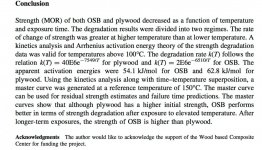
The glues/adhesives/bonding agents in today's osb is far superior to the glues/adhesives of 30+ years ago. Check out national building codes and the structural inforation should be there, or a google search.
 
Last edited:

James-W

Well-known member
Joined
Feb 3, 2013
Messages
12,432
Location
Southeastern Wisconsin
No, the boards very likely weren't tightly spaced. We've sold millions of board feet of lumber from the family mill for roofing and often its neither straight nor even edged bc it doesn't have to be, odds of punching a nail through the gap are pretty insignificant and easily remedied anyway. In my Indiana house there was a solid ~1/2" gap between boards. As mentioned, not only are the boards stronger but they're also much less prone to water damage and easier to replace when damage does occur.
Whatever the case, you can have the boards, if I need to replace my roof I am going with the plywood rather than the boards. OSB works OK too, but my preference for a roof is plywood.
 
Last edited:

Bill Anderson

Well-known member
Joined
Nov 9, 2011
Messages
97
I am ready to start sheathing my roof and am attracted to OSB basicly because of Price. Has anyone used OSB and wished they had not and why?

Here ya go, study/research paper from UMASS-Amherst,explaing the benefits/drwbacks of each. It is a 2005 paper, but the explanation/paper is still sound, as engineered products have remained consistent, if not improved since 2005.

Here's part of the article:
On the plus side, osb is a more consistent product. It is truly an engineered material. You never have a soft spot in the panel because 2 knot holes overlap. You don’t have to worry about knot holes at the edge of a panel where you are nailing. Delaminations are virtually nonexistent.

Osb is perhaps 50 strands thick, so its characteristics are averaged out over many more “layers” than plywood. Osb is consistently stiff. Plywood has a broader range of variability. During the manufacturing process, plywood veneers are randomly selected and stacked up into panels. You may get 4 veneers of earlywood stacked above 1 veneer of latewood. Who knows? Most plywood panels are overbuilt to cover the statistical range that guarantees each sheet of plywood meets the minimum standard. Osb, on average, is 7% less stiff because it stays closer to its target spec. However, osb feels stiffer when you walk across a floor covered with it because there are no occasional weak panels like plywood. Smaller trees can be used to make osb. Wood fiber is used more efficiently in osb.

Osb is stronger than plywood in shear. Shear values, through its thickness, are about 2 times greater than plywood.This is one of the reasons osb is used for webs of wooden I-joists. However, nail-holding ability controls performance in shear wall applications. So both products perform equally well as shear-wall components.
 

Bill Anderson

Well-known member
Joined
Nov 9, 2011
Messages
97
I am ready to start sheathing my roof and am attracted to OSB basicly because of Price. Has anyone used OSB and wished they had not and why?

And here's the UMASS link: Note: When I clicked on the link, it stated 'possibly unsecure, yadayada, but it is safe, I used the link and its safe.

https://bct.eco.umass.edu/publications/by-title/choosing-between-oriented-strandboard-and-plywood/

Hope this helps you make your decision, and clear up any myths about osb vs. plywood vs. traditional plank/board roofs. Everyone has an opinion, including me, but its always best to rely on something more close to fact.
 
Last edited:

Bill Anderson

Well-known member
Joined
Nov 9, 2011
Messages
97
I am ready to start sheathing my roof and am attracted to OSB basicly because of Price. Has anyone used OSB and wished they had not and why?

And just to clear up some misinformation that was on the 1st page. OSB was not produced until 1991. OSB was not around in the 1970s. That was waferboard. People use/confuse the terms interchangeably OSB, waferboard, chipboard, BUT they are notthe same.

And if you want to do an 'unscientific study' and drive through neighborhoods to look at OSB roofs to see them sag, then you should drive through neighborhoods built post 1991, and preferably post 1995 to guarantee you are driving through a neiborhood with OSB roofs. Its most certain you will not find post 1991-95 roofs/panels sagging.

Pre-1990s you're looking at roofs with either plywood,waferboard, or chipboard, and not OSB.

Our first new house was built in 1998, and it has OSB for roof sheathing, its not far from where we live now,and i still drive through the old neighborhood and check out our previous house, and there is not a sag one in that roof, and it still looks great.

Just like i said, everyone has an opinion, including me, but old beliefs die hard, and people tend to put forth those old beliefs as fact, when they're nothing more than opinion. Just want clarify, bc fact/research is much better and more reliable than opinion.
And i intend this with respect, absolutely no disrespect intended.
Regards, Bill
 
Last edited:

FullRaceMerc

Well-known member
Joined
Jan 9, 2015
Messages
3,836
Location
SoCal (SGV)
Here in SoCal we prefer to use the radiant barrier. It helps keep the attic cooler in the warm climate. I'm guessing a Florida house would benefit as well. Shiny side down. Try not to blind yourself while handling it. A 4x8 mirror reflects a lot of sun.
 

Jason280

Well-known member
Joined
Mar 4, 2012
Messages
3,157
I left some osb out it the weather for approximately a year or so, just to see what the effcts would be. It holds up surprisingly well.

I built several shooting benches out of the stuff back in the mid/early 90's, and they held up quite well out in the elements. I can remember going around new home construction, that stuff was everywhere! The key was whether or not moisture was allowed to "sit" on the OSB, or whether it wicked away. Either way, it held up better than I expected.

I've put up a pretty good bit of it on the interiors of both my shops, and every piece has been attached with wood screws. All exterior pieces were nailed with 8's out of a Paslode, but everything inside was screwed in place....wanted to make sure that each piece could be easily removed if necessary. Plus, there were a few places I was worried errant nails might contact wiring.
 

Notgrownup

Well-known member
Joined
May 5, 2014
Messages
5,859
Location
Snow Hill NC
Used it on my shop, with clips between....2 years now and still looks straight, no sag I mean. 24" on center I think. It was up to code.
 
To avoid these ads, REGISTER NOW!
Top Bottom