mjshore
Active member
I am ready to start sheathing my roof and am attracted to OSB basicly because of Price. Has anyone used OSB and wished they had not and why?


...Most areas require hurricane clips between trusses/rafters...

They're using it in 3/4" T&G style for roof decking in SoCal.
To get a sense how widespread OSB usage has become, you can do your own unscientific research. Drive through a subdivision under construction. House after house will be sheathed in the panels made with wood chips.
OSB hit the market in the late 1970s and was almost immediately a hit. According to the Structural Board Association, “in 1980, North American OSB panel production was 751 million square feet (3/8" basis),” says the Website of the Structural Board Association, which dissolved in 2008. “By 1990, this figure was 7.6 billion square feet. In 2005, this figure had grown to 25.0 billion square feet."
The product immediately found an audience with contractors and builders, despite the fact that many thought it looked like chipboard or particleboard, says Mary Jo Nyblad, sales and marketing manager for Boise Cascade’s plywood and particleboard division. “All it takes is for one guy to use it, and more followed,” she says. Boise, which used to make both types of panels, sold its OSB division to Ainsworth Lumber Co. in 2004.
Mainly due to its look, consumers and home buyers had the perception that OSB was cheap and an inferior product, but the panels found success among multifamily builders, Nyblad says. “It was readily accepted because there was no home buyer per se,” she continues. “It was a good fit.” The fact that the panel was economical also played a large role in its acceptance.
At first, plywood and OSB competed hammer and nail for market share. In the 1980s, Nyblad says, OSB started appearing on sidewalls and roofs, but plywood was still largely used for floors. Plywood tried hard to fend off OSB, but it could not compete well against OSB's lower cost. As a result, by the late 1990s, the panels had achieved parity in terms of usage, with OSB continuing to gain.
“In 2000, for the first time, OSB production marginally exceeded plywood production,” according to the Structural Board Association. “By 2006, OSB production grew to nearly 60% of the North American panel market share.” Manufacturers of both panel types agree OSB’s share of the production home market might even be closer to 75%.
To be sure, there is no difference between OSB and plywood as a structural panel, says APA - The Engineered Wood Association. The Tacoma, Wash.-based group is a nonprofit trade association that represents U.S. and Canadian manufacturers of plywood and OSB as well as other structural engineered wood products.
“Both products meet the local and national building codes,” says APA market research director Craig Adair. They are equally interchangeable for walls and roof sheathing, and for flooring underlayment, he adds. Moreover, both panels install fast and easily. Specified correctly, they perform as intended. Manufacturers from both sides claim their products offer better nail holding ability, but Adair says both meet the same requirements.
Still, after Hurricane Andrew tore through South Florida in 1992, leaving well over 250,000 people homeless and almost $30 billion in damage, the Miami-Dade County Board of County Commissioners banned OSB for use as roof sheathing.
Even though OSB dominates the construction market, some contractors and builders have problems with the performance of the product and have remained plywood loyalists. Nyblad says, for example, that there are regional preferences for plywood such as the Northeast, Northern California, Southwest, and Seattle in the rainy season. (In the dry season, these regions use OSB.) Plywood is particularly popular among DIYers and custom builders as well, she adds.
“We typically use plywood for all of our roof sheathing and subfloors,” says Steve Ronchelli, a senior project manager with custom builder Jim Murphy & Associates in Santa Rosa, Calif. Ronchelli says it’s partly due to the performance, but he allows that “it might just be a regional thing.” Northern California is close to the forest of the Pacific Northwest, so the lumber comes from nearby, he adds.
It's code where I live and if you leave them out, you will not pass inspection.I found that there was enough variation in thickness in the OSB that I got from Lowes that some of the clips "stood up". I was afraid that they would poke through the tarpaper, so I left them out.

I've never used clips btw, must not be code here.
Not sure if its code here, either, but I've only seen them used on roofs with centers >16".
I love OSB, use it for a lot of different things. I'm finishing up a 24x32' build, and its on the external and internal walls, the roof, and the ceiling. Its an absolute PITA to put up by yourself on the ceiling, but everywhere else is gravy.
Are you saying you would rather have boards on the roof rather than 4X8 sheets of building material?At the risk of sounding like a cheesy one-liner - OSB is a pain in the nuts for roof decking, literally. I've had one foot go through a roof on several occasions, always with the dam OSB. Wet, rotting plywood has some strength and bounce to it, OSB has none IME. Call me old fashioned, but I still prefer 1x (or thicker) roof decking for houses, it doesn't take much longer to install but is far stronger than either sheeting and less likely to need repair when roofs are replaced. Barns and larger roofs tho require compromises for the sake of getting the job done, so choice is entirely situational.
I guess it's OK for roof sheathing. But I hate to see it used for inside walls and/or cabinets. Geez that stuff is ugly. Especially when it's painted. I used outside siding on the INSIDE of my garage. It cost more but it really looks great.
Are you saying you would rather have boards on the roof rather than 4X8 sheets of building material?
It is the standard, but I prefer plywood.
One thing you can do, is get the slightly thicker material (And clips to match).
Are you saying you would rather have boards on the roof rather than 4X8 sheets of building material?
Yes, he is.
And a lot of us have that.
I have boards on the house roof as well, but if I ever had to replace the roof for some reason I would go with either 5/8 or 3/4 inch plywood. There are cracks (a little space) between the roof boards that could potentially allow water in if there would be a leak toward the peak of the roof. I am sure the cracks (spaces) were not there when the house was built, the boards were no doubt laid tight together.
I am ready to start sheathing my roof and am attracted to OSB basicly because of Price. Has anyone used OSB and wished they had not and why?
Whatever the case, you can have the boards, if I need to replace my roof I am going with the plywood rather than the boards. OSB works OK too, but my preference for a roof is plywood.No, the boards very likely weren't tightly spaced. We've sold millions of board feet of lumber from the family mill for roofing and often its neither straight nor even edged bc it doesn't have to be, odds of punching a nail through the gap are pretty insignificant and easily remedied anyway. In my Indiana house there was a solid ~1/2" gap between boards. As mentioned, not only are the boards stronger but they're also much less prone to water damage and easier to replace when damage does occur.
I am ready to start sheathing my roof and am attracted to OSB basicly because of Price. Has anyone used OSB and wished they had not and why?
I am ready to start sheathing my roof and am attracted to OSB basicly because of Price. Has anyone used OSB and wished they had not and why?
I am ready to start sheathing my roof and am attracted to OSB basicly because of Price. Has anyone used OSB and wished they had not and why?
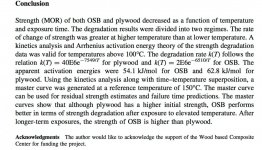
Oregon State University research on OSB vs. Plywood
http://woodscience.oregonstate.edu/sites/default/files/gupta/pdf/56-Sinha-Nairn-Gupta_WST.pdf
I left some osb out it the weather for approximately a year or so, just to see what the effcts would be. It holds up surprisingly well.