To avoid these ads, REGISTER NOW!

Outbuilding wiring

txrankin

Member
Joined
Aug 17, 2019
Messages
7
Location
Detached about 30 ft from house
Hello all!

I am new to this community. Thanks for having me. Last winter I bought a 12x20 prefab building for a man cave. I ran about 100ft of 10/2 w/ground to it and installed a receptacle that I am running a small window unit off of. I also have a power strip plugged in that I use to power a TV and other small electronic devices. I would like to install a few other receptacles and some lighting. I will add that the incoming wire is buried in about 30 ft of conduit.

Question is do I need to install a subpanel or can I just keep adding to what I have?

The panel that runs this building has all the neutral and ground wires connected to the same bar. Anything wrong with that? Do i need to change something?

I appreciate any help and/or advice!

Doug


***Since posting this I have done some searching and found that a 30 amp 2 pole switch would be the way to go? Could I then use that to power some bus bars in a box that would feed the different receptacles and lights?
 
Last edited:
To avoid these ads, REGISTER NOW!

wyliesdiesels

Well-known member
Joined
Aug 14, 2012
Messages
20,268
Location
Modesto, CA
Neutrals need to be isolated from ground.

If you put in a subpanel, then you will need to put in ground rods.

You are aware that this 10/2 will not provide 240v?

It wouldve been better to use 3cnd and ground.

BTW what kind of cable did you run? Is it NM-b or UF-B?

What size breaker did you use to feed this? If 30a, then you need a subpanel because 15 and 20a putlets cannot go on a 30a breaker.

Also, 100’ is pushing it for any kind of significant load with an AC unit running.
 
OP
T

txrankin

Member
Joined
Aug 17, 2019
Messages
7
Location
Detached about 30 ft from house
Neutrals need to be isolated from ground.

If you put in a subpanel, then you will need to put in ground rods.

You are aware that this 10/2 will not provide 240v?

It wouldve been better to use 3cnd and ground.

BTW what kind of cable did you run? Is it NM-b or UF-B?

What size breaker did you use to feed this? If 30a, then you need a subpanel because 15 and 20a putlets cannot go on a 30a breaker.

Also, 100’ is pushing it for any kind of significant load with an AC unit running.


Thanks for the reply!

Forgot to add, the panel I ran it from is what I believe to be a sub panel inside the house which runs from a small box outside the house with a 100amp breaker and a couple of 300 amp breakers (which i believe runs the AC system). This is an old house and the original breaker panel was on the front porch, so I had a licensed electrician install the box inside the house and he ran the neutrals and grounds to the same bar. When I ran this 100ft (NM-B) wire to the outbuilding i hooked it to an empty 15 amp breaker and also connected the neutral and ground to the same bar. I realize this is not a 220v circuit. I didn't figure i needed it.

So you would suggest a subpanel and a grounding rod at the outbuilding? Then isolate the neutral and ground there?

Thanks!

Doug

ps I have had this little ac running all summer long, sometimes 24+ hours at a time. I am always checking the temperature of the wire and it doesn't even get warm. Not sure if that means anything.
 
Last edited:

wyliesdiesels

Well-known member
Joined
Aug 14, 2012
Messages
20,268
Location
Modesto, CA
If the neutrals and grounds are connected to the same bar in the feeding subpanel in the house, then that needs to be fixed as well.

There should only be one neutral to ground bond per system.

Also, NM-b is not rated for underground use and will rot. That wire needs to be changed.

Can you post some pics of the wire including the label on the jacket as well as the panels with the covers on and off.

Also, you need 2 ground rods at the outbuilding not 1.
 

AntonLargiader

Well-known member
Joined
Nov 20, 2016
Messages
1,372
Location
Charlottesville, VA
If you had the right wire in there already, you could just fix the N and G and run it as a 120V 20A branch circuit. But since you need to change the wire anyway, you get to make a choice. 1) pull 4-wire and add a sub. That way you can have 240V for whatever. 2) run a MWBC with 4-wire without a sub or ground rods. That gives you two 20A circuits. Only you know if that will be enough in the long run. You could convert to a panel in the future if you needed more circuits.

No matter what, you should run 4-wire if you are going to run a 120V window unit so the window unit can have its own circuit.
 
OP
T

txrankin

Member
Joined
Aug 17, 2019
Messages
7
Location
Detached about 30 ft from house
If the neutrals and grounds are connected to the same bar in the feeding subpanel in the house, then that needs to be fixed as well.

There should only be one neutral to ground bond per system.

Also, NM-b is not rated for underground use and will rot. That wire needs to be changed.

Can you post some pics of the wire including the label on the jacket as well as the panels with the covers on and off.

Also, you need 2 ground rods at the outbuilding not 1.


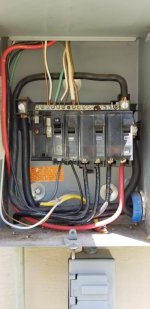
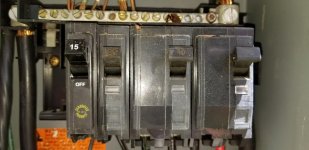
This is the first box off the meter.
 

Attachments

  • 20190817_122017.jpg
    20190817_122017.jpg
    44.5 KB · Views: 72
  • 20190817_122133.jpg
    20190817_122133.jpg
    62.6 KB · Views: 95
  • 20190817_122156.jpg
    20190817_122156.jpg
    139.9 KB · Views: 69
OP
T

txrankin

Member
Joined
Aug 17, 2019
Messages
7
Location
Detached about 30 ft from house
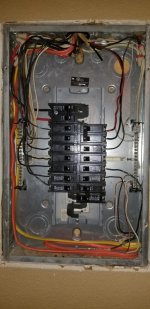
Then it goes to this box. I couldnt get a good pic of the wire let me know what you need and i will let you know if it is on there. Also the wire in the ground is in conduit. The orange wire runs to the out building.

Thanks!

Doug
 

Attachments

  • 20190817_121629.jpg
    20190817_121629.jpg
    49.7 KB · Views: 41
  • 20190817_121731.jpg
    20190817_121731.jpg
    83.9 KB · Views: 84

walta

Well-known member
Joined
Jan 13, 2017
Messages
2,322
Location
Dutzow Missouri
I think you selected the wrong wire for this appellation NM cables is not allowed for use outdoors or underground.

I think you should replace it with 3 conductors plus a ground UF cable. That way you have one conductor for lights another for the other loads the third is a neutral. If you should happen to trip the breaker you will not be in the dark. This is considered one circuit additional grounding rods should only be required if more than one 20 amp circuit is connected to the outbuilding.

Walta
 

wyliesdiesels

Well-known member
Joined
Aug 14, 2012
Messages
20,268
Location
Modesto, CA
This is the first box off the meter.

Is there a disconnect on the meter or before this panel? If so then this panel needs to be fixed because it has neutrals and grounds together. Also I do not see a large grounding electrode conductor coming from grounding electrodes which leads me to believe this is another sub panel.
 

theoldwizard1

Well-known member
Joined
Feb 22, 2011
Messages
43,650
Location
SE MI
Is there a disconnect on the meter or before this panel? If so then this panel needs to be fixed because it has neutrals and grounds together. Also I do not see a large grounding electrode conductor coming from grounding electrodes which leads me to believe this is another sub panel.

Assuming there is NO disconnect ahead of this, I am sure at some time in the past this was legal. Wouldn't it be "grandfathered" ?

Admittedly adding a separate ground bar is not a big deal, but you can not expect that the OP would pull new wire for everything coming out of that box !

There appear to be 2 240V circuits and 2 120V circuits. Also their appears to be 3 neutrals (white) and 4 grounds (bare/green). I wonder where that one big white conductor goes ?
 

Attachments

  • Capture.JPG
    Capture.JPG
    68.5 KB · Views: 49
Last edited:

theoldwizard1

Well-known member
Joined
Feb 22, 2011
Messages
43,650
Location
SE MI
Question is do I need to install a subpanel or can I just keep adding to what I have?
IMHO (not a sparkie), just keep "adding on". It would be a good idea to have a switch the kills the entire building near the door, but you are going to have a hard time finding a simple wall switch that will accept 10/2 !
 
To avoid these ads, REGISTER NOW!

Zeke

Well-known member
Joined
Aug 13, 2009
Messages
17,176
Location
Long Beach CA, the sewer by the sea.
Assuming there is NO disconnect ahead of this, I am sure at some time in the past this was legal. Wouldn't it be "grandfathered" ?

Admittedly adding a separate ground bar is not a big deal, but you can not expect that the OP would pull new wire for everything coming out of that box !

There appear to be 2 240V circuits and 2 120V circuits. Also their appears to be 3 neutrals (white) and 4 grounds (bare/green). I wonder where that one big white conductor goes ?

I assume that would be an EGC or GEC for the red/white 240v on the right breaker.

The question is, where is such for the 240 going down?
 
OP
T

txrankin

Member
Joined
Aug 17, 2019
Messages
7
Location
Detached about 30 ft from house
Assuming there is NO disconnect ahead of this, I am sure at some time in the past this was legal. Wouldn't it be "grandfathered" ?

Admittedly adding a separate ground bar is not a big deal, but you can not expect that the OP would pull new wire for everything coming out of that box !

There appear to be 2 240V circuits and 2 120V circuits. Also their appears to be 3 neutrals (white) and 4 grounds (bare/green). I wonder where that one big white conductor goes ?


Pretty sure the big white wire goes to the inside breaker box?
 

exranger06

Well-known member
Joined
Aug 9, 2015
Messages
1,686
Location
CT
I'm not an electrician, but I'd say that since you have a grounding conductor coming out of the meter enclosure, and the outside panel is connected to the meter enclosure via metal conduit, the outside panel is effectively grounded and you're good to go there. Everything else in the outside panel looks good to me. The inside panel needs to have the neutrals and grounds separated, but that looks really easy in your case. Remove the bonding ******** the right-side bar. That will isolate it and it will become your new neutral bar. Move all your neutral wires over to that bar (the big #3 white neutral from the outside panel is already connected to it too), and move all the ground wires to the bar on the left. The left bar remains bonded to the panel enclosure. Make sure that green #8 wire that comes from the outside panel is connected to the left bar.
 

exranger06

Well-known member
Joined
Aug 9, 2015
Messages
1,686
Location
CT
Assuming there is NO disconnect ahead of this, I am sure at some time in the past this was legal. Wouldn't it be "grandfathered" ?

Admittedly adding a separate ground bar is not a big deal, but you can not expect that the OP would pull new wire for everything coming out of that box !

There appear to be 2 240V circuits and 2 120V circuits. Also their appears to be 3 neutrals (white) and 4 grounds (bare/green). I wonder where that one big white conductor goes ?

It's pretty obvious the large white wire is the neutral that goes to the inside subpanel. Subpanels need 4 wires- 2 hots, neutral, and ground. He has the big white neutral, the #8 green ground wire also connected to the ground bar, and the black and red hot wires connected to the breaker on the right. The breaker 2nd from the right is apparently a 240V-only circuit that doesn't need a neutral. The other 2 white neutrals are for the 2 single pole breakers on the left.
 

wyliesdiesels

Well-known member
Joined
Aug 14, 2012
Messages
20,268
Location
Modesto, CA
Then it goes to this box. I couldnt get a good pic of the wire let me know what you need and i will let you know if it is on there. Also the wire in the ground is in conduit. The orange wire runs to the out building.

Thanks!

Doug

Ok so this panel is wired incorrectly.

The outside panel next to the meter is your main service panel.

All panels after this, including this one on the inside are subpanels and are required to have isolated neutral bars.

You need to remove the bonding jumper on the right side bar and add a couple of listed ground bars. move all ground wires to these new bars.

Otherwise, you have a shock hazard here.
 

theoldwizard1

Well-known member
Joined
Feb 22, 2011
Messages
43,650
Location
SE MI
Ok so this panel is wired incorrectly.

The outside panel next to the meter is your main service panel.

All panels after this, including this one on the inside are subpanels and are required to have isolated neutral bars.

You need to remove the bonding jumper on the right side bar and add a couple of listed ground bars. move all ground wires to these new bars.

Otherwise, you have a shock hazard here.

What you are saying is clearly correct, by today's NEC. However, I believe sometime in the past, this was "acceptable".

What I find odd is the ground coming out of the meter pan !

IMHO (but I yield to the expert),

  • Shouldn't the first load center (directly next to the meter pan) have a separate ground bar directly connected to the ground rod ?
  • Then the the system "bond" would be in that first box
  • A ground (bare or green) should run from the first box to the second
  • The second (larger) load center should have two separate un-bonded bus bars, one for ground and one for neutral.
  • In BOTH load center, all circuit grounds and neutral should be separated and attach to the appropriate bus bar.

Making these corrections is really not that difficult. Adding a ground from the first box to the ground rod, a couple of listed ground bus bars (one in each box and confirming no bonding in the second box) and a ground wire from the first box to the second.
 
Last edited:

CJ7VFR

Well-known member
Joined
Jan 13, 2015
Messages
2,942
Location
Central New Jersey
What you are saying is clearly correct, by today's NEC. However, I believe sometime in the past, this was "acceptable"...

It was acceptable in New Jersey where I live. My fathers house was like this. He had a panel with a main shut off between the meter and his load center for all the house breakers, making his load center a sub-panel. In his load center all the neutrals and grounds were attached to the same bus bars.

Fast forward to now. My father passed away and we had to sell his house. I hired an inspector to come in and let me know what things needed to be fixed before we put the house on the market. First thing he said was separate the neutrals and the grounds at the load center.

It may have been acceptable decades ago, but it is not acceptable now. Because the job of separating the grounds and neutrals is not a huge deal in most modern load center panels, it can be done in a short time by a licensed electrician (preferred) or by someone who knows how to do it.

We could NOT sell my fathers house without doing this, as it would not pass our local township codes. This type of wiring was not grandfathered in like some things were, and the township said I had to do it or no sale.

I did not argue with them. I had the work done, which took an electrician about an hour to do and only cost me a few bucks for the peace of mind.

Jim
 
Last edited:

exranger06

Well-known member
Joined
Aug 9, 2015
Messages
1,686
Location
CT
What you are saying is clearly correct, by today's NEC. However, I believe sometime in the past, this was "acceptable".

What I find odd is the ground coming out of the meter pan !
Not too unusual. I have my ground rod wire coming out of my meter box, but I have no outside panel. My main panel is inside, right on the other side of the wall of the meter. The wire for the ground rod connects to the ground bar in the panel, and goes through the same conduit as the incoming feeder wires to the meter box. On the OP's house, I probably would've just run it from the outside panel though.

IMHO (but I yield to the expert),

  • Shouldn't the first load center (directly next to the meter pan) have a separate ground bar directly connected to the ground rod ?
    SEPARATE ground bar, no. You'd normally connect the ground rod to the one existing ground bar that's already in the panel. But since the ground rod is connected to the meter box, and the panel is bonded to the meter box via the metal conduit connecting the two, it's basically the same thing.
  • Then the the system "bond" would be in that first box
    Correct, but the system bond is ALREADY in that first box. Like I said, the panel's enclosure is already bonded to the meter box, which is bonded to the ground rod. The ground bar is bonded to the panel's enclosure. Everything is bonded together.
  • A ground (bare or green) should run from the first box to the second
    There already is a ground wire ran from the first box to second one. It's the green wire.
  • The second (larger) load center should have two separate un-bonded bus bars, one for ground and one for neutral.
    The second panel should have 2 bars, yes. But one of them should remain bonded and the other should be unbonded. The ground bar stays bonded, the neutral bar is unbonded. And this panel already DOES have 2 bars. All the OP needs to do is remove that bonding ******** the right bar and move all the neutrals over to it, leave the left bar bonded and move all the ground wires over to it and he's done.
  • In BOTH load center, all circuit grounds and neutral should be separated and attach to the appropriate bus bar.
    No, only the second panel inside the house. Only subpanels need neutrals and grounds separated. Main panels have neutrals and grounds on the same bar. The outside panel is the main panel. There is absolutely nothing wrong that I can see in the outside panel and he can simply leave it as-is.

Making these corrections is really not that difficult. Adding a ground from the first box to the ground rod, a couple of listed ground bus bars (one in each box and confirming no bonding in the second box) and a ground wire from the first box to the second.
Aside from unbonding the neutral in the 2nd box and moving the neutrals and grounds around, none of that stuff is necessary.
My comments in red above...
 
Last edited:

theoldwizard1

Well-known member
Joined
Feb 22, 2011
Messages
43,650
Location
SE MI
... we had to sell the house. I hired an inspector to come in and let me know what things needed to be fixed before we put the house on the market. First thing he said was separate the neutrals and the grounds at the load center.
I ASSUME a bond and a proper ground was created at the first disconnect !

I did not argue with them. I had the work done, which took an electrician about an hour to do and only cost me a few bucks for the peace of mind.
Smart !

I had friend who was selling a house for a deceased relative. The load center was old and questionable (the company was out of business). The buyer's inspector questioned it and I told my friend to drop the price $1,000 and let the buyer fix it.
 

CJ7VFR

Well-known member
Joined
Jan 13, 2015
Messages
2,942
Location
Central New Jersey
...I had friend who was selling a house for a deceased relative. The load center was old and questionable (the company was out of business). The buyer's inspector questioned it and I told my friend to drop the price $1,000 and let the buyer fix it.

Where I live in New Jersey, giving a credit for the non-compliant load center was not an option. I would not be given a certificate of occupancy for the sale of the house if the load center neutrals and grounds were not separated due it being a sub-panel.

It cost about $100.00 for the electrician to do the work and have the load center updated to what the township wanted. I was more than fine with that.

What gets me is there are people who will refuse to fix a known issue, which might cost a few hundred bucks to fix, and then have the house sit for months or even years without being sold because of it.

In the long run they end up spending tens of thousands of dollars on extra property taxes, mortgage payments, utility bills, maintenance, and other items related to having to keep the house going, instead of just fixing a simple issue that would have had the house sold months ago.

I am not saying this is the case with your friend, because perhaps their load center was so old it would require way more than a thousand dollars to fix, and where you live a house can be sold with non-complaint wiring.

But there are people around me who still have their homes for sale 6 months after we sold my dads house because they are too hard headed to fix the things that need to be fixed in order to sell the house.

Jim
 
To avoid these ads, REGISTER NOW!
Top Bottom