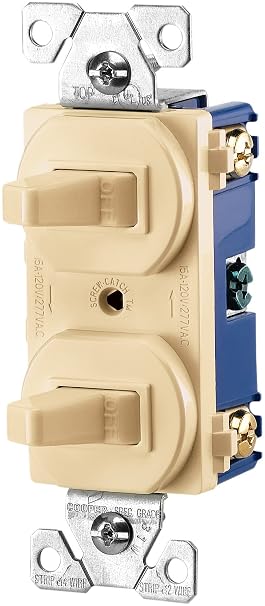
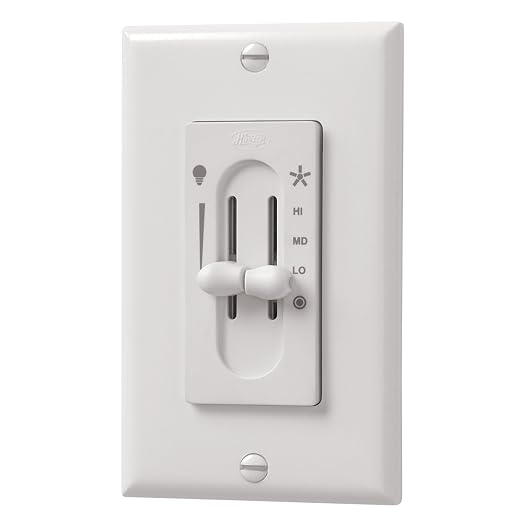
By all my outlets I mean all my outlets in my bedroom. This includes the top and bottom outlet of each outlet fixture. Every outlet in my bedroom is controlled by one switch.
Well, that's unfortunate -- and pretty damn dumb in a bedroom: For one thing, it leaves you no good place to plug in an electric alarm clock.
The first switch controls a ceiling mounted light (which will soon the light that is built-in with the fan).
The second switch controls all the outlets in my bedroom like mentioned above.
By two switches I mean, 2 single switches in a double gang box. I have a picture to help you out further.
OK, this helps clarify the situation significantly. And indeed, things might not be not quite as bad as they initially seemed.
OTOH, they are clearly not great, either...
Since taking this picture I've seem to do something where the lights/outlets won't even come on. I tried turning the breaker switch on and as soon as I do that it trips and the switch goes in the middle.
By "the switch goes in the middle", I am presuming that you mean the toggle handle on the circuit breaker, NOT the wall switch itself -- correct?
From here, I can only guess; but I strongly suspect that "pattenp" is correct, and when you pulled those switches out from the wall, at least one of the connections was compromised.
Again, I can't be certain; but judging from the photo, it looks like you've got a mix of "back stab" and traditional "wire under screw" connections. The former are notorious for being flaky & unreliable, especially after they've aged a bit. It also looks like at least the red wire leading to the left-hand switch is not fully tightened down; but again, I can't be certain from the photo.
I would suggest that the first thing you do is re-make those connections, keeping all the wires going to all the same places (electrically), but avoiding the "back-stab" ports entirely. This will likely require making up some short pigtails using wire nuts, as it is not "kosher" to put more than one wire under one screw head. Be sure to use the same color and AWG for those pigtails as whatever you're connecting to. Your existing wire appears to be (and probably is) AWG 14. So go buy yourself a foot or two of 14/3 NM-B (commonly called "Romex") cable at your local hardware (or big box) store, strip off the outer jacket (being careful to not damage the insulation on the individual conductors), and you'll now have plenty of raw stock to make the pigtails. This will cost you less than a dollar; spend another half a buck on a small handful of appropriately sized wire nuts.
Work on one "corner" of each switch at a time, so that you can avoid getting confused as to which wire goes where. Never tie different-color wires together via either a wire nut or a screw terminal (yes, there are SOME situations where mixing colors can be appropriate; this isn't one of them). When you're done with this little chore, everything SHOULD again work like it used to, and you can move on to making the desired modifications.
Unfortunately, that mish-mash of connection techniques is not the only weirdness going on in that box. Moving on...
I do know what I did since I didn't disconnect any wires. I simply pulled the switches out so I could take a picture.
You "do" know what you did, or you "do not" know what you did?
There seems to be 4 romex wires/bundles/whatever behind the gangbox.
That seems to be confirmed by the four Neutrals (white wires) bound together. The connector they used to make that connection is somewhat unusual, but probably not a problem. More interesting is the wire count itself, AND the fact that you apparently already have some 3-conductor (plus ground) cable in there, as evidenced by the red wire. There could be several different reasons for that. Are there any OTHER switches (such as, perhaps, across the room) which also control EITHER the ceiling light or the outlets? If so, that could possibly tell us a lot.
In the meantime, pending that answer, here is the typical run-down on what you PROBABLY have in that box...
For each neutral you ALSO have one "Hot" (probably black; but see below) wire, plus one bare copper "equipment ground" conductor. The grounds should be all tied together, AND to the green screw terminal on each switch. All the Neutrals (white wires) should also be tied together (as shown in the pic; so leave that alone). All switching occurs ONLY on the "Hot" legs (usually, but NOT always, the black wire) of each circuit.
One black/white/bare combo is undoubtedly the incoming power feed to the box, which in turn is fed (perhaps indirectly) from the circuit breaker.
A second set of wires should lead to the ceiling fixture. This will PROBABLY be another black/white/bare combo. But it just MIGHT be a four-wire (black/red/white/bare) combo -- and if it is, this could possibly make your future ceiling fan installation easier.
The outlets will be fed by yet another set of wires. In this case, I'm going to wager (but only quite modestly) that this is where that 14/3 (the black/red/white/bare combo) is going.
That leaves one set of wires unaccounted for. The most likely explanation is that something else (possibly outside of that room) is ALSO daisy-chained off that same circuit. Now that the breaker for this circuit is "Off", is there anything else around the house which suddenly isn't working?
What, exactly, do you now know?
I would think that even if the outlets were controlled by a switch they all would be in a series or something, but then again I don't know much.
There are a couple different ways this COULD be done. (And BTW, the correct term is "daisy-chained"; a "series" connection is something else entirely, and not suitable for this application.)
Given the ambiguity surrounding that red wire, the next step should be to pull the switch plates off all the duplex outlets, and CAREFULLY pull the outlets just far enough out of the boxes to see what wires (particularly what COLOR wires) attach to them, and where. Beware of more crappy "back stabbed" connections as you do this.
I half suspect that you're going to find at least SOME red wires in those boxes. If so, they may or may not be (but probably are) connected to the outlets. More importantly, if there is a red wire, there will near-certainly ALSO be a black wire. And if this is the case, then it will near-certainly be very easy to convert those outlets to what "justsam" calls "Half Hot" -- i.e., one socket switched, the other live 24/7. And if THAT is the case, this is the route I would strongly suggest you go. The "always live" outlets will give you places to plug in things like alarm clocks, TVs, etc.; and having at least SOME switched outlets in the room will likely also be quite useful. (Do you REALLY want to have to turn on a large overhead light just to walk into the room? More typically, a smallish table lamp is used for this purpose, especially in a bedroom, where you generally want to keep things "mellow", so to speak.)
Also, the light switch has a black wire that goes into the outlet switch, I do not know why.
Most likely to feed power from one circuit to the other. But why BOTH terminals on the right-hand switch have black wires feeding back into the box is still a bit of a mystery. Typically, only one wire would connect to each of those terminals; with MAYBE a second wire on one of them, if it were passing power to another circuit. This MIGHT be explained by having two separate wire runs to your outlets (each one feeding perhaps half the outlets); but at this point, I'm just not sure.
Lastly, there is a red wire that goes to the light switch. I also don't know why.
Ooops! I missed this on my first read-through. OK, since you have identified that switch as the one controlling the ceiling fixture, you can probably forget what I just said about checking all those outlet boxes; odds are you are NOT going to find any red wires there (tho' it certainly couldn't hurt to confirm this; so I'll leave the instructions intact).
The (potentially) good news is, you MIGHT already be wired for the ceiling fan, and not have to pull any new wire when you go to install that. To confirm this, you're going to have to pull down that ceiling fixture, and check it (and its box) for "what color wires go where". But be aware that, even if you "got lucky" in this respect, if you intend to mount a fan to the existing ceiling box, there are some serious requirements in terms of how that box is physically mounted to the building's structure, as well as for the box itself. You do NOT want a 50+ lb. fan falling on top of you in the middle of the night!