To avoid these ads, REGISTER NOW!

Overbending using press brake attachement

drummerdimitri

Well-known member
Joined
May 31, 2012
Messages
257
Location
Beirut, Lebanon
I just received my new 100 ton hydraulic press with a press brake attachment for it.

It came with a 4 sided die of 85 degree V and a gooseneck punch.

I have no bending experience and I an getting frustrated as I am not able to get a proper 90 degree bend with the tool. Bottoming out the material produces a smaller angle than 90 as can be seen in the attached picture which makes sense as I am most probably getting an 85 degree bend.

It is my understanding that one may need to overbend slightly to compensate for the material spring back but how does one do so?

How can I bend specific angles like 90 degrees consistently if I don't have a 90 degree V? Will a digital angle finder work or are there more accurate methods?
 

Attachments

  • 20250503_180452.jpg
    20250503_180452.jpg
    395.6 KB · Views: 97
  • 20250503_135347.jpg
    20250503_135347.jpg
    272.1 KB · Views: 100
To avoid these ads, REGISTER NOW!

whateg01

Well-known member
Joined
Mar 13, 2006
Messages
11,214
Location
doo dah, kansas, usa
The dies are made 85 specifically so that it can be over bent for spring back. Do some test bends in the material you're using to determine the right angle to bend it to to account for spring back.
 
OP
D

drummerdimitri

Well-known member
Joined
May 31, 2012
Messages
257
Location
Beirut, Lebanon
OP
D

drummerdimitri

Well-known member
Joined
May 31, 2012
Messages
257
Location
Beirut, Lebanon
The dies are made 85 specifically so that it can be over bent for spring back. Do some test bends in the material you're using to determine the right angle to bend it to to account for spring back.
I know that, but how can I determine how far to bend to get a 90 degree bend? Do I use a digital protractor?
 

OccupantRJ

Well-known member
Joined
May 15, 2009
Messages
10,979
Location
Eastern North Carolina
Fabrication is not a one shot cut and dried process. This is the part where your skill or lack of it comes into play, or setup of a machine. Consider adding threaded adjustable stops to each end of the bender if you want to do a lot of repeat angle bends, and even that will vary for each thickness, width, and type of material you bend.
 
Last edited:

whateg01

Well-known member
Joined
Mar 13, 2006
Messages
11,214
Location
doo dah, kansas, usa
I know that, but how can I determine how far to bend to get a 90 degree bend? Do I use a digital protractor?
Yes, a protractor can be used to measure how far you have bent the workpiece. How far you have to go past 90 to allow for spring back will require some test bends in the material you are using.
 

dr_clyde

Well-known member
Joined
Jan 7, 2009
Messages
6,431
Location
Holland, MI
Time to do some reading about air bending, bottom bending and coining and how the sheet forming process works.

Your punch and dies need to be set up for the kind of bending you're doing. If your tooling doesn't match the style of forming you're doing, you're not going to get the results you want. Not all brake dies are created equal.

From the looks of things, you're attempting to bottom bend on air bend tooling, resulting in a bend that's overbent. The dies and punch are designed to NOT bottom out on an air bend. This allows the punch to push the material past a 90° and then spring back to the desired shape, without touching the walls of the die.

Unfortunately with a hydraulic press, you lack the precise ram control needed to really get accurate air bends. Air bending is designed to be done in a CNC brake press so the ram can be positioned within a few thousandths of an inch. You really should have bottom bending dies, which are designed to basically stamp the material to the shape of the die and don't require extremely accurate ram positioning.
 

rlitman

Well-known member
Joined
Oct 18, 2010
Messages
24,589
Location
Long Island
...From the looks of things, you're attempting to bottom bend on air bend tooling, resulting in a bend that's overbent. The dies and punch are designed to NOT bottom out on an air bend. This allows the punch to push the material past a 90° and then spring back to the desired shape, without touching the walls of the die.

Unfortunately with a hydraulic press, you lack the precise ram control needed to really get accurate air bends. Air bending is designed to be done in a CNC brake press so the ram can be positioned within a few thousandths of an inch. You really should have bottom bending dies, which are designed to basically stamp the material to the shape of the die and don't require extremely accurate ram positioning.
You're 100% correct, but bottom bending dies need to have an angle that matches the material being bend, which gets inconvenient quickly unless you're doing large scale production. If it were me, I'd buy the 85 degree dies, and lay a piece of copper wire in the bottom. Do a few test bends to see what gauge wire gets you to 90 degrees on contact. You could also 3D print "triangle" pieces to do the same thing.

... I am most probably getting an 85 degree bend...
To dr_clyde's point, you're getting something between 85 and 90. How much depends on how much the metal springs back.
 

Innovate1

Well-known member
Joined
Jul 28, 2014
Messages
4,283
Location
Illinois near St. Louis, Missouri
You're 100% correct, but bottom bending dies need to have an angle that matches the material being bend, which gets inconvenient quickly unless you're doing large scale production. If it were me, I'd buy the 85 degree dies, and lay a piece of copper wire in the bottom. Do a few test bends to see what gauge wire gets you to 90 degrees on contact. You could also 3D print "triangle" pieces to do the same thing.


To dr_clyde's point, you're getting something between 85 and 90. How much depends on how much the metal springs back.
I would think trying to control to just the point of contact with copper wire and a 100 ton press is going to result in smashed wire but perhaps control is better than that. Maybe put some slightly thicker material in the die at both ends and put the part to be pressed between. That will limit how far the die comes together. Might be very fine adjustment of thickness to get the proper bend so not sure how practical this would be.
 

rlitman

Well-known member
Joined
Oct 18, 2010
Messages
24,589
Location
Long Island
I would think trying to control to just the point of contact with copper wire and a 100 ton press is going to result in smashed wire but perhaps control is better than that...
My thinking is that even if the wire turns into a chevron at the bottom, it still occupies some space. It's not going to play-doh extrude out the ends (much).
 

Firebrick43

Well-known member
Joined
May 12, 2015
Messages
14,003
Location
West central Indiana
Non CNC hydraulic press brakes have a switch on an adjustable mount that stops the press. The mount has a counter on it so you can reset it to bend the same material in the future but you still have to bend a test piece on that punch/die to get the initial setting.

You could get a cheap magnetic long range dial indicator to put on the punch aside of what your bending so with your hydraulic press position can be repeated with some accuracy. It will still be a trial and error for the first piece however but if your careful and don’t over bend on the first one you can bend, measure, repeat until you get to 90

HHIP Dial Indicator - Amazon


RSC Magnetic - Amazon

 
Last edited:

cannuck

Well-known member
Joined
Nov 30, 2021
Messages
4,604
Location
Rural SK
On my very non-digital 12' break there is a micrometer adjustable down limit switch that is set by bending test coupons of same material and orientation (i.e. down grain or cross grain - not what pronoun to use) plus a side-to-side eccentric to give same break angle end-to-end. I also use a 100 ton and 20 tone open frame with various punches and dies that I watch from end through open frame to guestimate the bend angle and springback. The solution is to repeat, repeat, repeat until you have a good feel for freebending in your tooling. my 14 YO grandson can do these freebends almost as well as I can, so not an impossible task.
 
OP
D

drummerdimitri

Well-known member
Joined
May 31, 2012
Messages
257
Location
Beirut, Lebanon
Lots of good information on here thanks for that.

Not sure why the press manufacturer decided it would be best to include an air bending die and not a coining die especially on a high tonnage machine with a short die length.

I will try multiple test bends using and angle gauge for repeatability on material and will get myself one of those DROs for repeatable ram positioning as someone mentioned.

I can control the speed of the ram infinitely with the help of a joystick so it should be relatively easy to reach the same position as i can creep up to it.

the pressing force is also infinitely adjustable from 0 to 100 tons with the help of a knob.
 
To avoid these ads, REGISTER NOW!

Innovate1

Well-known member
Joined
Jul 28, 2014
Messages
4,283
Location
Illinois near St. Louis, Missouri
Not sure why the press manufacturer decided it would be best to include an air bending die and not a coining die especially on a high tonnage machine with a short die length.

I will try multiple test bends using and angle gauge for repeatability on material and will get myself one of those DROs for repeatable ram positioning as someone mentioned.

I can control the speed of the ram infinitely with the help of a joystick so it should be relatively easy to reach the same position as i can creep up to it.

the pressing force is also infinitely adjustable from 0 to 100 tons with the help of a knob.
If I understand correctly, an air die is flexible for different materials so is a good general purpose choice. A coining die would have to be designed for a particular material and not adjustable or easily reworked for different materials. Although for some materials with little spring back a fixed die might be fine.

You have good control so getting good bends is just sneaking up on the amount of press needed.
 

dr_clyde

Well-known member
Joined
Jan 7, 2009
Messages
6,431
Location
Holland, MI
Sheet metal forming is one of those trades that looks easy on the outside, then once you start to understand the nuances and little details that affect the process it get very complex, very fast.

Bend radius, neutral axis, K factor, air/bottom/coin, grain direction, material type, tonnage, bed crowning, the list goes on. There's a reason sheet metal forming is a skilled trade lol.
 
OP
D

drummerdimitri

Well-known member
Joined
May 31, 2012
Messages
257
Location
Beirut, Lebanon
Sheet metal forming is one of those trades that looks easy on the outside, then once you start to understand the nuances and little details that affect the process it get very complex, very fast.

Bend radius, neutral axis, K factor, air/bottom/coin, grain direction, material type, tonnage, bed crowning, the list goes on. There's a reason sheet metal forming is a skilled trade lol.
Surely I can understand that.

Just didn't think it would be the case.

I've been able to teach myself how to machine and weld so I don't see any reason not to be able to bend as well.

There just isn't much content online on how to do it like the other two trades.
 

4 FN 27

ALLIANCE MEMBER
Joined
Oct 19, 2015
Messages
4,635
Location
Minnesnowta
Local badass @4 FN 27 might have some advice

@tarbellb...lol...

I can't add much more than @dr_clyde has already stated about the theory/facts/Types.

@drummerdimitri show me a picture, an end view of the 4-way and the Punch you are using.

Do you know what the Radius is on the Punch?

What are the 4 Die Opening Widths and what is the the thickness of the material you are bending.

85° tooling requires Air Bending. Thus bring the Ram down bending the metal over 90° allowing it to spring back to 90° as the pressure is relieved from the Ram. Trick is, where do you stop before bottoming to get the spring back at 90°.

How I would do it is add a measuring device as @Firebrick43 mentions, something accurate to .001. Without any material between the Punch and Die, bring the ram down applying pressure to the Die with the Punch and bring the tonnage up to 5 tons. Zero your measuring device. Now put the material in between start the bend and bring it up to as close to 90° as you can eyeball. Record the distance noted on the measuring device. Check the angle and keep hitting it and recording that number until you achieve 90°.

That will give you a good baseline for that particular thickness and bend length. Keep in mind the longer the bend the deeper you may have to go to get 90°. Based on that Ram design with all the pressure in the middle the ends of a longer part may be slightly open due to flex in the system. So be consistent where you take you angle measurement or you will be chasing your tail.

On thin materials or very narrow parts, material thicknesses or widths where just the weight of the Ram and Punch can deform the material with zero pressure it gets a little more complex but following the same process can yield accurate angles. What I mean is unless you are taking the "backlash" out of the system you can have variations in the angles on lighter gauges or widths.

Bottom Die selection for the thickness of the Material is critical. Tighter is better for accuracy but requires more tonnage and depth of the Punch becomes more critical to hold 90°. My rule of thumb is 5 or 6 times the material thickness if the Punch radius is .031 ( or if metric tooling 1mm) or less. Bigger than .031 (1mm) use 5-6 times material plus the Punch Radii.

.060 (16 ga) .031R or less Punch = .300 or a 5/16 or 15mm V-Die

.060 (16 ga) .250R Punch = .55 or a 5/8 or 14mm V-Die

Hope this helps. Once I see the answers to the questions above I'll give you my best recommendation.
 
Last edited:

RoninB4

Well-known member
Joined
Jul 22, 2020
Messages
3,492
Location
Under My House
-Good advice from other members. I'll just throw this in because nobody else has mentioned it. When trying to establish a setting for bending the grain direction of the material can make a difference. Same piece of material oriented 90° from the previous piece will likely produce a slightly different angle. This also happens with different material batches. As a former die maker I've seen where a different coil from the same supplier would produce different results and the die had to be adjusted for the new coil. Might/might not make a difference to what the OP is doing. Hope it helps someone.
 
OP
D

drummerdimitri

Well-known member
Joined
May 31, 2012
Messages
257
Location
Beirut, Lebanon
@tarbellb...lol...

I can't add much more than @dr_clyde has already stated about the theory/facts/Types.

@drummerdimitri show me a picture, an end view of the 4-way and the Punch you are using.

Do you know what the Radius is on the Punch?

What are the 4 Die Opening Widths and what is the the thickness of the material you are bending.

85° tooling requires Air Bending. Thus bring the Ram down bending the metal over 90° allowing it to spring back to 90° as the pressure is relieved from the Ram. Trick is, where do you stop before bottoming to get the spring back at 90°.

How I would do it is add a measuring device as @Firebrick43 mentions, something accurate to .001. Without any material between the Punch and Die, bring the ram down applying pressure to the Die with the Punch and bring the tonnage up to 5 tons. Zero your measuring device. Now put the material in between start the bend and bring it up to as close to 90° as you can eyeball. Record the distance noted on the measuring device. Check the angle and keep hitting it and recording that number until you achieve 90°.

That will give you a good baseline for that particular thickness and bend length. Keep in mind the longer the bend the deeper you may have to go to get 90°. Based on that Ram design with all the pressure in the middle the ends of a longer part may be slightly open due to flex in the system. So be consistent where you take you angle measurement or you will be chasing your tail.

On thin materials or very narrow parts, material thicknesses or widths where just the weight of the Ram and Punch can deform the material with zero pressure it gets a little more complex but following the same process can yield accurate angles. What I mean is unless you are taking the "backlash" out of the system you can have variations in the angles on lighter gauges or widths.

Bottom Die selection for the thickness of the Material is critical. Tighter is better for accuracy but requires more tonnage and depth of the Punch becomes more critical to hold 90°. My rule of thumb is 5 or 6 times the material thickness if the Punch radius is .031 ( or if metric tooling 1mm) or less. Bigger than .031 (1mm) use 5-6 times material plus the Punch Radii.

.060 (16 ga) .031R or less Punch = .300 or a 5/16 or 15mm V-Die

.060 (16 ga) .250R Punch = .55 or a 5/8 or 14mm V-Die

Hope this helps. Once I see the answers to the questions above I'll give you my best recommendation.
I've attached pictures of both the die and the punch.

Seems like the nose radius of the punch is 0.8 mm and has a matching V of 85 degrees so the same as the die.

The V sizes and specs are mentioned on the die.

According to my calculations, since the length of the die is 83.5 cm, the max tonnage that can be exerted safely is around 65 metric tons.

Currently bending 2.5 mm mild steel. That being said however, what is the thickest piece that I can safely bend without risking damaging the die and/or the punch.

If the largest V is 50 mm wide, can I safely bend 8-10 mm as that is what you mentioned if I understood correctly.

Also, will a smaller V result in a tighter bend radius?

I was able to get a very close to 90 degree bend by slightly overbending to 92 degrees. I guess it really is trial and error when you don't have a CNC press brake.

Also, do I need to apply some kind of grease to the die and punch to reduce friction when bending and galling?
 

Attachments

  • 20250503_131234.jpg
    20250503_131234.jpg
    313.6 KB · Views: 43
  • 20250503_131232.jpg
    20250503_131232.jpg
    1.1 MB · Views: 44
Last edited:

4 FN 27

ALLIANCE MEMBER
Joined
Oct 19, 2015
Messages
4,635
Location
Minnesnowta
I have a breakfast meeting this morning so I'll answer a few questions addressing the part you are bending and a few things on safety.

More later tonight...busy day ahead!!!

2.5mm thick material:

Use the 16mm V in the die. 12mm or 14mm would be a better choice but you don't have that option.

According to my calculations, since the length of the die is 83.5 cm, the max tonnage that can be exerted safely is around 65 metric tons.

Currently bending 2.5 mm mild steel. That being said however, what is the thickest piece that I can safely bend without risking damaging the die and/or the punch.

The max tonnage without damaging the tooling is based on material hardness, length of bend and thickness of the material.

As noted in the pic of the Die, V = 16 @ 85° use a 2mm Radius Punch, however your .8mm punch is perfectly acceptable and will use less tonnage to bend the material. We use .8mm punches up to 6.35 thick material in most cases.

Your Die is good for 800 kN/m. As long as you do not exceed that you are fine according to the manufacturers specs noted. A 100mm long bend will take 10 times the force than a 10mm long bend in the same material.

Your Punch is rated for 1000 kN/m which seems a little high to me with that small of a Radius???

I need to dig into the manufacturers site.

More later...gotta run!
 

cannuck

Well-known member
Joined
Nov 30, 2021
Messages
4,604
Location
Rural SK
Nice to run a bunch of calcs and realize your 100 ton ram can easily overpower the tooling. Might help, though, to bring a little dose of reality in dealing with such a tool. If you look at a dedicated 100 ton 48" press brake you might have noticed it will be close to 6'/2M tall That i because the huge bed for the dies and the upper beam that holds the punch they NEED to be that deep to be sufficiently rigid to minimize bending deflection of both punch and die that will result in a bit of underbend toward middle under high loads. Don't get me wrong: these little tool from frame presses are extremely useful but not going to be dead accurate when heavily loaded.
 
OP
D

drummerdimitri

Well-known member
Joined
May 31, 2012
Messages
257
Location
Beirut, Lebanon
Nice to run a bunch of calcs and realize your 100 ton ram can easily overpower the tooling. Might help, though, to bring a little dose of reality in dealing with such a tool. If you look at a dedicated 100 ton 48" press brake you might have noticed it will be close to 6'/2M tall That i because the huge bed for the dies and the upper beam that holds the punch they NEED to be that deep to be sufficiently rigid to minimize bending deflection of both punch and die that will result in a bit of underbend toward middle under high loads. Don't get me wrong: these little tool from frame presses are extremely useful but not going to be dead accurate when heavily loaded.
That makes a lot of sense, however I gotta work with what I got so will have to do the necessary compromises knowing this moving forward.

I will definitely be investing in a compact CNC press brake in the near future but for now, this will do nicely as it is better than not having the ability to bend metal at all.
 

cannuck

Well-known member
Joined
Nov 30, 2021
Messages
4,604
Location
Rural SK
That makes a lot of sense, however I gotta work with what I got so will have to do the necessary compromises knowing this moving forward.

I will definitely be investing in a compact CNC press brake in the near future but for now, this will do nicely as it is better than not having the ability to bend metal at all.
I have a 12' break but I do 10x the number of bends on my 20 ton press with a pretty crude punch and die setup I built 40 years ago. Haven't fully tooled my 100 ton press yet, but is open frame so had done some huge shaft straightening - but will eventually get another DIY punch and die setup similar to old 20 ton. As long as you realize their limits you can do a LOT of work with one.

The secret of success is to simply do as much bending as you can and you will soon reach a point where you get useable parts with not too much reject. I find the most rewarding bit is making the tools.
 
Last edited:

RoninB4

Well-known member
Joined
Jul 22, 2020
Messages
3,492
Location
Under My House
-Bend calculations are a good starting point but the K-Factor (neutral bend axis) is theoretical. This may/may not prove to be accurate enough for what is needed. Some of the shops I've worked at had decided to establish expectation charts and had gone through the laborious testing of all the materials they commonly used. Anything not on the charts was a guess-timation. As has already been posted the material type, thickness, temper, and grain direction all affect metal forming.

-Also as others have already posted "Lots of test bends" and record those results for future reference. It's not always straightforward or easy to anticipate.
 

4 FN 27

ALLIANCE MEMBER
Joined
Oct 19, 2015
Messages
4,635
Location
Minnesnowta
Sorry busy day yesterday. Didn't get up to the house until later. Making parts...
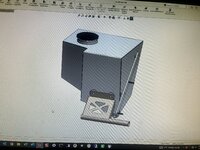
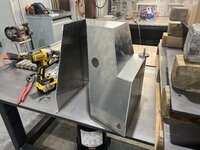
IMG_7433.JPG

IMG_7432.JPG

No test bends. You just need to know the science of bending. Easy to say, hard to do unless you did it everyday for 42 years.

Bending is a 80% science and 20% art. The science is getting the correct part size and the art is figuring out how to get the part through the machine using the tooling and machine capability you have on hand.

In your case @drummerdimitri, you have a machine and 1 set of tools. You can work with that and bend everything that fits in your machine.

Making your tooling last and not damaging it due to "point loading" is a good goal. I stopped up at the plant yesterday and snapped a couple of pics of our "Dies/Punches for carving" drawers. These are Dies and Punches that have been "point loaded" causing damage to the tools. Thus when the force of the material to be bent pushes back greater than than the tooling can handle or was designed for.

This can happen because the material is hard, the Punch is too sharp or the Die is too small...or simply the depth of the bend exceeded the limits of the tooling by traveling to far with too much tonnage. This can be dangerous. Tooling can shatter. I have seen several people take a "lip" from a Die to the chest/stomach when the die lets go. In almost all the situations the operator had the max tonnage too high and or fat fingered the depth of the bend.

In this pic you can see how the tip of this Acute Punch was damaged. The part being formed was narrow and the tonnage per inch exceeded what the tool could handle. Or the Die was too narrow for the material thickness and the tonnage required caused to tool to get damaged.
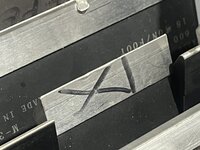
IMG_7430.JPG

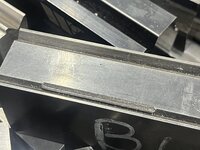
Here is a Die where, either the top Punch was not aligned with the Die or the Die "rocked" back on the rail and when the operator was starting the next bend on a different tooling set-up on the same rail (Multiple Hit Part) he hit the pedal not noticing the Die tipped and the Punch tip embedded itself in the Die. The machine doesn't see this and it doesn't care.

I couldn't find a split Die due to wrong selection or over tonnage.
IMG_7428.JPG

Smaller Punch Radii take less tonnage to start the bend. But they also wear faster because of the lack of material or surface area.

Larger Die openings take less tonnage to start the bend. But you loose accuracy because the bend radius will be bigger as it is not "captured" on the tool.

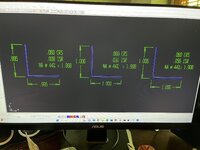
For these reasons I/we have found a good starting point is to design/layout using a .031 inside radius and .44% Neutral Axis for any angle. This will work well for material up to 1/4 in Stainless, Aluminum and Mild Steel.

86° or 88° Tooling for Air Bending (adds to tool life since you not ponding the hammer on the anvil).

At the Machine: Start using a .008 (.2mm) Punch and a Die that is 6 times the material thickness. I know above I said design the part with a .031 ISR and here is why: when you Air Bend the ISR will always be slightly bigger than the Punch Tip radius since you are not coining it. Softer materials the radius will be slightly smaller and the harder the material, like Stainless the actual radius will be slightly bigger. This will get you close.

Now you have options if your tolerance requirements are not met. If you need to take up more material meaning taking material from each flange and pushing it into the Bend you can use a smaller Die opening thus casing the actual bend radius to shrink sucking up material.

If you need to push material out on to the flanges you can use either a bigger Punch tip or a larger bottom die opening causing the ISR to get slightly larger.

Here you can see the effect of changing the ISR slightly. Keep in mind this is theoretical but it the science.
IMG_7435.JPG

As others have mentioned, keep track of your data per material thickness and type.

As far as galling? Keep your material and tooling clean and you really don't need to do anything. However if you are running material with mill scale on it or Galvanized this can cause issues. Oil can help but I would suggest 2-4 mill plastic over the bottom die, Keep moving the plastic as it rips, and it will rip every hit.

On one offs I have run a strip of masking tape on the die side of the bend line. This works great but usually needs to be wiped down with solvent.

What ever you do, don't use Silicone based lubricants. Paint does not like Silicone and it will stay on the surface of the tooling cross contaminating parts for a long time.

Hope this helps!!!
 
To avoid these ads, REGISTER NOW!
Top Bottom