To avoid these ads, REGISTER NOW!

Overhead Door Threshold

Wubicon

Well-known member
Joined
Jan 10, 2025
Messages
368
Since I bought my house I have struggled with water coming in under the garage door. The garage was built in 1973 and is a detached, oversized single car garage. The drive way is 60' or so long leading up to it and then slopes down towards the garage door the last 15'. So water will always be running toward it. At some point, someone hammered out the asphalt of the drive way and attempted to concrete in some slight curbing to help direct water away from the garage. The west side does an ok job as long as I keep sand, snow, ice etc clear. The east side goes right to a garden bed. I dug the garden bed 1-2" below the concrete on the east side and usually does an ok job unless it rains really hard for long time, 30 mins or more. The floor and door are not level after 50+ years, so I replaced the seal on the bottom of the garage door but only makes contact in the center, where there is no water intrusion.

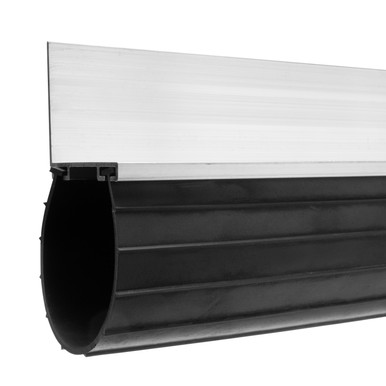
So I was looking at some of these rubber garage door thresholds to put on the floor to try and close up the gaps under the door and help direct water to stay in the concrete gutters. https://www.amazon.ca/Jin-Bao-Unive...c1f91183f56a3d04ff6204282c1&gad_source=1&th=1

Has anyone tried anything like this? It seems to me most adhesives don't take to concrete very well. But I was thinking about using construction adhesive and then maybe some tap cons with big washers to help keep the threshold from lifting.
 
To avoid these ads, REGISTER NOW!

ToolsRCool

Well-known member
Joined
Dec 28, 2024
Messages
231
Location
Plymouth, MI
I don't think you'll ever be able to make a water-tight seal at the base of the door. My dad had this same issue. He cut a rectangular box out of the concrete just in front of the door and installed a drain the entire width of the door that led further away and lower than that area. Has not been a drop of water inside since, and his doors are old as well and don't seal well.
 
OP
W

Wubicon

Well-known member
Joined
Jan 10, 2025
Messages
368
Yeah, that is probably the the most *right* way to do it. That's not off the table. But I think I still have to address the imperfect seal of the not level floor and door.
 

dave*99

Well-known member
Joined
May 5, 2009
Messages
4,247
Location
Coastal NJ
Since I bought my house I have struggled with water coming in under the garage door. The garage was built in 1973 and is a detached, oversized single car garage. The drive way is 60' or so long leading up to it and then slopes down towards the garage door the last 15'. So water will always be running toward it. At some point, someone hammered out the asphalt of the drive way and attempted to concrete in some slight curbing to help direct water away from the garage. The west side does an ok job as long as I keep sand, snow, ice etc clear. The east side goes right to a garden bed. I dug the garden bed 1-2" below the concrete on the east side and usually does an ok job unless it rains really hard for long time, 30 mins or more. The floor and door are not level after 50+ years, so I replaced the seal on the bottom of the garage door but only makes contact in the center, where there is no water intrusion.

So I was looking at some of these rubber garage door thresholds to put on the floor to try and close up the gaps under the door and help direct water to stay in the concrete gutters. https://www.amazon.ca/Jin-Bao-Unive...c1f91183f56a3d04ff6204282c1&gad_source=1&th=1

Has anyone tried anything like this? It seems to me most adhesives don't take to concrete very well. But I was thinking about using construction adhesive and then maybe some tap cons with big washers to help keep the threshold from lifting.
My neighbor did exactly this. Our street floods and when cars drive by he gets wave action against his doors. He said it helps his issue.
He put 3 pieces in a U shape with mitered corners directly on the garage floor inboard of the door. The door does not sit on them. This is because his door sits in a recess about an inch below the garage floor. He wanted this new curb as high as possible.
 
OP
W

Wubicon

Well-known member
Joined
Jan 10, 2025
Messages
368
I was thinking about doing something like that too since part of my door makes good contact with the floor but outer edges don't make any contact at all.
 

CraigStu

Well-known member
Joined
May 22, 2014
Messages
4,009
Location
Blacksburg, Va
There was a thread here 1-2 years ago w/ links to the bottom of the door seals that were maybe an inch think, maybe a little more. They were fairly soft so they could help seal up problems like you have. Sorry I don't have a link for you. I'd be looking for those seals before doing anything else.
 
OP
W

Wubicon

Well-known member
Joined
Jan 10, 2025
Messages
368
There was a thread here 1-2 years ago w/ links to the bottom of the door seals that were maybe an inch think, maybe a little more. They were fairly soft so they could help seal up problems like you have. Sorry I don't have a link for you. I'd be looking for those seals before doing anything else.
I did find a thread, but it seemed like they were mostly talking about steel thresholds from commercial applications. I'll keep looking though.
They make extra tall astragal rubber too.
I shoved a piece of caulk backer noodle into my garage door seal. It made a world of difference.
Maybe trying to make the edges of the seal on the door bottom thicker/stiffer would help too. Thanks for the suggestions!

This has been a good brain storming session!
 

racecougar

Well-known member
Joined
Jan 26, 2021
Messages
4,980
Location
Missouri
I'll second the trench drain suggestion. I'll throw in a secondary suggestion of grinding down the hump in the middle of the doorway to allow the door to contact the floor evenly.
 

dave*99

Well-known member
Joined
May 5, 2009
Messages
4,247
Location
Coastal NJ
I was thinking about doing something like that too since part of my door makes good contact with the floor but outer edges don't make any contact at all.
Is the floor uneven or is the door bowed? I had this issue with an old 16' wide wood door. It sagged in the center.
 
OP
W

Wubicon

Well-known member
Joined
Jan 10, 2025
Messages
368
Is the floor uneven or is the door bowed? I had this issue with an old 16' wide wood door. It sagged in the center.
It's 50 years old. The answer is yes. How and to what degree, I have not measured.
 
OP
W

Wubicon

Well-known member
Joined
Jan 10, 2025
Messages
368
I would try and put in a french drain in front if it was me
I'll second the trench drain suggestion. I'll throw in a secondary suggestion of grinding down the hump in the middle of the doorway to allow the door to contact the floor evenly.

I agree better drainage is the *best* or *correct* solution...
Grinding the hump down in the center is an interesting idea. I think as long as I don't inadvertently make a trench to invite more water in. It doesn't have to be perfect but if I took off up to 1/2" of material it would allow the door to come down a bit more and certainly close the gaps up significantly and help keep out the other random debris that blows in.
 
Last edited:
To avoid these ads, REGISTER NOW!

dave*99

Well-known member
Joined
May 5, 2009
Messages
4,247
Location
Coastal NJ
It's 50 years old. The answer is yes. How and to what degree, I have not measured.
Wood door?
Any point in scribing the bottom board to match the concrete floor?
Maybe build it up with another board if necessary?
Ultimately if this is getting submerged, I think the drain is the only effective solution.
 
OP
W

Wubicon

Well-known member
Joined
Jan 10, 2025
Messages
368
I'll take some pics tonight. But maybe putting a french drain in on 1 side might be enough to improve drainage to the desired location (the flower bed on the east side).

As I do, I created a new problem last night when fitting a new panel on a wall around a light switch and tripped the breaker and now the breaker won't allow power down stream after reset. So that's this weekend project; figure out why the breaker does not allow power down stream when reset.
 
OP
W

Wubicon

Well-known member
Joined
Jan 10, 2025
Messages
368
Wood door?
Any point in scribing the bottom board to match the concrete floor?
Maybe build it up with another board if necessary?
Ultimately if this is getting submerged, I think the drain is the only effective solution.
It's a 1 piece steel or maybe galvanized deal. I thought about trying to put spacers in on the sides when I put the bottom seal on to sort of shape it to the floor better. But I started running into introducing gaps between the seal and the door bottom.

It's not submerged perse, but pools in. Because the floor is not level, the water naturally finds the low spot/path of least resistance to exit the garage which happens to be back out the side door...
 

DGersic

Well-known member
Joined
Mar 12, 2017
Messages
6,260
Location
DeKalb, IL
I like the idea of a trench drain in front of the door, catch and direct the water elsewhere.

You could then mud jack the floor to level it and your door should seal. Maybe even jack the back an extra inch to slope the floor up from the door opening.
 
OP
W

Wubicon

Well-known member
Joined
Jan 10, 2025
Messages
368
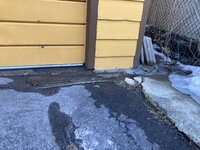
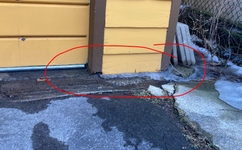
This is the west side of garage door. Water collects just in front of the door then follows a channel in the slab around the building. As long as long as the channel stays clear of snow/ice/debris.
1741692785602.jpeg

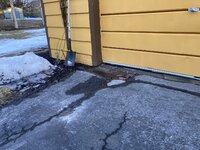
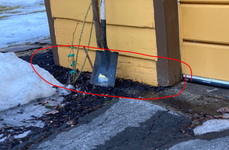
This is the east side. The real problem maker. Part of the issue is that he concrete has sunken on the west side so it doesn't drain into the garden bed where the shovel is, part of the problem is that the ground freezes and can't absorb the run off.
1741692874854.jpeg

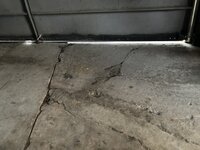
Gap under the door. I know these over head door seals are never water tight, but it could be better...
1741692975109.jpeg

I've been stewing about the french drain idea and the problem as I see it is that it will still drain into frozen ground and back up. How do you deal with that problem?
 

Bert_

Well-known member
Joined
Dec 24, 2016
Messages
9,690
Location
NW Iowa
Trench drains freeze up and don't work this time of year. Works fine is the summer but just something to be aware of.

What does the grade around the garage look like. Is there anywhere for the water to go?
 
OP
W

Wubicon

Well-known member
Joined
Jan 10, 2025
Messages
368
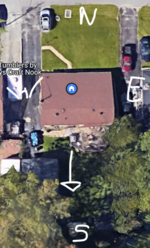
There's a natural slope north to south. Garage faces north. So of course the water really just wants to go through the garage. There is some natural low spots in the yard, but generally water flows south beyond my property line to a very low spot (8+" lower than my yard).

Excuse my child drawing. Garage is in the lower left corner partially obstructed by a tree.

1741697343446.png
 

firebirdparts

Well-known member
Joined
Jun 8, 2016
Messages
10,576
Location
Kingsport, TN
OP
W

Wubicon

Well-known member
Joined
Jan 10, 2025
Messages
368
Some sort of drive-over threshold really could help you here temporarily. Obviously, gravity is better. If you ever get the chance to install some gravity, that'll be better.

I would just go nuts with something like this https://www.amazon.com/Weather-Defe...Threshold/dp/B07F2PCXLR/?tag=atomicindus08-20

If it's a hobby garage and you're not driving over it 4 times a day, might last forever.
I was wondering what kind of adhesive might be best for this? Sometime over the summer I'll lay it down to get the best odds of adhesion.

I think I can make things a little better with doing something with the sunken concrete and digging the garden bed down a little further. Cheap and easy things to do.
 

dave*99

Well-known member
Joined
May 5, 2009
Messages
4,247
Location
Coastal NJ
I was wondering what kind of adhesive might be best for this? Sometime over the summer I'll lay it down to get the best odds of adhesion.

I think I can make things a little better with doing something with the sunken concrete and digging the garden bed down a little further. Cheap and easy things to do.
It comes with adhesive. Prep is always the important part, clean, possibly with muriatic acid etc. You have wood in contact with soil and rotten jambs too, so as you mention, getting the water away from the structure externally is key.
 

racecougar

Well-known member
Joined
Jan 26, 2021
Messages
4,980
Location
Missouri
This is more concerning, IMO.

1741782085883.png1741782107285.png

It looks like you can dig away the mulch and soil at the East side to get the siding, trim, and framing out of the soil, but is it directly on concrete on the West side? Any idea if this is a thickened edge slab, foundation, or just a 3"-4" flat slab? You don't want to undermine whatever concrete you have supporting the framing, but as it stands now, your framing is rotting away.
 
OP
W

Wubicon

Well-known member
Joined
Jan 10, 2025
Messages
368
Both sides are directly on concrete. The framing is on the concrete, inside the building. The outer siding is touching grade in some places. Believe it or not, that mulch is dug pulled away from the siding. The "framing" you see in these images is not faming but is in fact trim/siding.

I *think* it's a only a flat slab a few inches deep. It's definitely shifted and cracked over the years but seems stable now.

I mean, it's 50 years old and has had many many cycles of wet/dry over the decades. So yeah, those parts are rotting away. Hence why I'm asking for help and actively trying to keep the water away.
 

racecougar

Well-known member
Joined
Jan 26, 2021
Messages
4,980
Location
Missouri
Yes, I realize that the framing hasn't been shown to us yet, but it's pretty clear that it's behind the trim shown. If it's a thickened edge slab or foundation, you could dig deeper without undermining the slab/foundation, but it sounds like that isn't the case here. I'd like to see the framing and siding set 6" higher than grade, but if this building is just sitting on a 3"-4" slab, you won't get there. I would dig a quick test hole alongside the pad to see just how deep it goes. If you get lucky and find that it's at least a thickened edge slab, you can drop the grade on the East side, cut a trench drain across the driveway, slope it to the East, and run it to a French drain around the building or at least to a dry well on the East side.
 
OP
W

Wubicon

Well-known member
Joined
Jan 10, 2025
Messages
368
I had been thinking about something like that too. I'll have to take more pics, but along the east side of the building the grade gently falls away and more of the slab of the building is exposed. But I have no way of knowing if it's the same thickness every where. I guess I could drill, but that seems like slab to repair later...
Someone in the past cut out some of the asphalt to put in some of the concrete "drainage" that's there now. Maybe it's more like "concrete water directing". I digress...

It seems that the threshold will help, but the big solution is improving the drainage. On the list for this summer/fall and see how it works out next winter.
 
Last edited:
To avoid these ads, REGISTER NOW!
Top Bottom