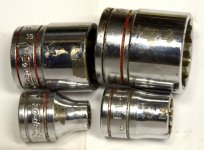
I use them. There just tools.
it’s never affected how they work or kept me from grabbing and using them.
I'm of the opinion that if the fastener the tool is applied to doesn't complain, then who am I to say anything.
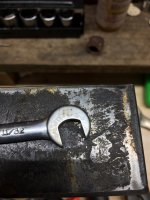
From a strictly utilitarian point of view, this is all mainly true. While owner's marks don't usually affect the structural integrity of a tool, they can, as 2oolhound points out, be abrasive and, therefore, potentially dangerous in the hand.
However, whether you agree with it or not, whether you like it or not, and whether you acknowledge it or not, vintage tools
do have a monetary value beyond the mere utilitarian, as collectibles. One look at antique and vintage tools being bought and sold on eBay, CL, etsy, etc, as well as right here in the GJ Classifieds section, for values
well in excess of the cost of a modern version of the same tool that will perform the same function demonstrates that all kinds of people are selling and buying antique and vintage tools for no other purpose than to indeed put up on a high shelf and admire. I am loudly, proudly one of them.
In the antique and vintage tools collectibles market, what ssdave said, and what four.cycle anecdotally confirmed, is true. In general, owner's marks reduce value. Pristine is preferred. And there is absolutely nothing petty about that.
Having said that, I think some of the older markings on well-maintained, handsome, antique tools, when done with care and flair - a set of three initials, well-placed, aligned, and symmetrical, stamped or engraved in a antique fancy font matching the age of the tool, with serifs and even curliecues - actually enhance the tool. But that is not the rule of thumb.
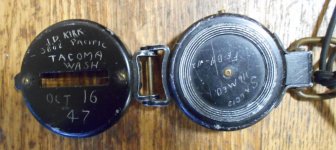
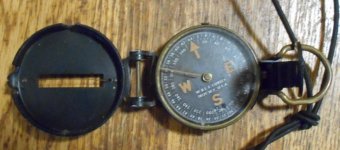
There are exceptions. Some marks can actually enhance the value, especially when they provide provenance to the tool. In the WWII militaria world, for example, martial "U.S." inscriptions (extraneous to the COO) are desirable. Or a name and rank that can be traced to an actual WWII veteran.
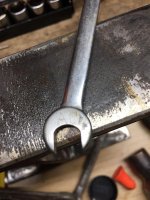
In certain eras and areas, owner's marks are almost unavoidable. I have lost count of the number of DOE wrenches from the 1930's with well-placed and polished notches in the edge of the shank or a series of period marks made with a stamping kit. The number of the notches or periods identified the owner. Joe's tools had three, Mick's had five, and so on. I kind of like the simplicity of those markings vs initials, as long as they don't detract. As others alluded to, though, sometimes they do detract or cross the line into...