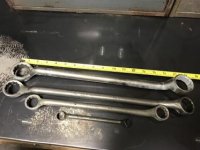
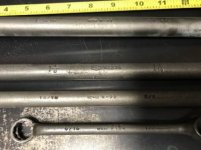
Nothing to forgive, Brian. I'm not sure the disconnect is lack of comprehension so much as lack of interest. Or different interests. There’s really nothing to discuss for the same reason. But I’ll give it a go.
It's not inaccurate to say that all DBE wrenches made by P&C are Plomb tools, from the perspective of ownership, any more than it wouldn't be inaccurate to say that Plombaloy adjustables made a few years later (by J.P. Danielson) were Plomb tools, from the perspective of ownership. It's just unnecessarily vague. And in this case, faced with so many facts to the contrary (distinct contracts, distinct tools, and probably related by that distinction), it’s inappropriately vague.
It might help to not let your insistence on looking at this exclusively from the perspective of ownership obscure the facts established by the record at a much more detailed level, from the perspective of manufacturing. You may have missed me say that establishing an OEM and location was the purpose of the WPB Major War Supply Contracts records. Your desire to keep things at the highest level where all those details can be ignored is further reflected by your Kaiser analogy (you may have no interest in knowing which ships were built in which shipyards, but I can guarantee you there are Navy guys out there to whom it matters), as well as your emphatically emboldened reference to the "US Government", as if one gigantic monolithic Uncle Sam handed good ol' Alphonse a check for $12M and said, "Just go make us some tools."
Multiple agencies (different services, different branches, and different bureaus with different aviation, automotive, shipyard and shipboard maintenance needs) awarded multiple contracts to Plomb for specified amounts and specified tools at specified times. That wasn’t random, and those aren’t subject to interpretation, they are historical facts maintained by the WB completely unaffected by the matter of ownership. You don't have to pay attention to those distinctions if you don't want to, but they are important to other collectors in understanding tools and tool-sets, in concert with other period documents, such as Army and Navy manuals and catalogs.
Finding out that P&C had its own distinct contracts - and one of them with the US Army Air Corps, adds even more detail to that picture.
Ownership of P&C Hand Forged Tools by the Plomb Tool Company has NO IMPACT WHATSOEVER on the historical fact of contract 535 AC 33915 worth $362K being awarded on 10/42 to P&C Hand Forged Tools instead of to the Plomb Tool Company. If there was no distinction between the tools being ordered by the US Army Air Corps from P&C under that contract and the tools being ordered by the US Army Air Corps from Plomb under contract 535 AC33176 worth $4.283M awarded the very same month, why didn't the US Army Air Corps simply and more efficiently award Plomb a $4.645M ($4.283 + $362K) contract instead? Details like that do matter. The significance is that the US Army Air Corps wrote a separate contract to P&C at the very same time they were in the process of awarding a huge contract to Plomb. Why? One of the most obvious answers is that the orders were different. And the P&C N series tools with a US Army Air Corps WF-like numbering scheme - but with additional tools that the WF- contracts did not produce, is clearly shaping up to be one possible explanation.
With all due respect to the Bard, a rose is a rose is a rose, but there are 37 different classes of roses alone, with hundreds of varieties, and to horticulturalists, floral shops, mothers, sweethearts, the ladies in the local garden club, it’s the varieties that make all the difference in the world, akin to the difference between round shanks and flat shanks, N markings instead of WF markings, and [P&C] N markings on DBE wrenches bearing US Army Air Corps numbers that their owners, their legal parent corporate entity – the Plomb Tool Compay – DID NOT MAKE.