
You are using an out of date browser. It may not display this or other websites correctly.
You should upgrade or use an alternative browser.
You should upgrade or use an alternative browser.
P&C Stuff
- Thread starter jabberwoki
- Start date

Rileysan
Well-known member
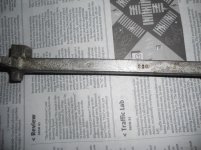
found this in a box i bought. took a while to find out what it was.
Drain plug wrench. Very nice find!
Brian
Drain plug wrench. Very nice find!
Brian
thanks, when i found 1 similar (not p&c), i was a little surprised. i don't see a lot of plugs like that.
Rileysan
Well-known member
thanks, when i found 1 similar (not p&c), i was a little surprised. i don't see a lot of plugs like that.
I was just involved in a similar conversation about unusual tools for non-standard auto parts, so your post is timely.
This tool was an attempt at a universal drain plug wrench to fit some of the more common sizes used by Auto manufacturers back in the teens through 30s. I honestly don't know how useful/successful this tool was, but it's not common.
I brought one from a shop that was closing after 70+ years and have only seen one other in person. If you want to sell, you have the right crowd here!
Brian
r_olson_06
Well-known member
They are pretty common in these parts. Do not know if it is because of the tractor crowd or what but I see at least 5 a year. Herbrand is the most common one I see. Never seen a P&C.I was just involved in a similar conversation about unusual tools for non-standard auto parts, so your post is timely.
This tool was an attempt at a universal drain plug wrench to fit some of the more common sizes used by Auto manufacturers back in the teens through 30s. I honestly don't know how useful/successful this tool was, but it's not common.
I brought one from a shop that was closing after 70+ years and have only seen one other in person. If you want to sell, you have the right crowd here!
Brian
Sent from my XT1080 using Tapatalk
Rileysan
Well-known member
They are pretty common in these parts. Do not know if it is because of the tractor crowd or what but I see at least 5 a year. Herbrand is the most common one I see. Never seen a P&C.
Sent from my XT1080 using Tapatalk
Have picture of the Herbrand? I'm wondering if they made it for P&C ...
Brian
r_olson_06
Well-known member
I do not. I usually pass on them. They look identical to a tee including the finish.Have picture of the Herbrand? I'm wondering if they made it for P&C ...
Brian
Sent from my XT1080 using Tapatalk
Ole Slewfoot
Well-known member

Private Lugnutz
Well-known member
N wrenches are longer than their WF counterparts.Only difference seem to be - vs / in the size.
Private Lugnutz
Well-known member
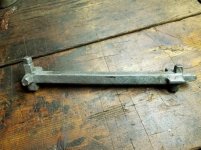
FWIW, here is one of those ubiquitous universal drain plug wrenches. This is pure conjecture, but I suspect they may have been made by a third party for all or at least many of the major tool mfgrs. It's a crude tool.
Attachments

OP
jabberwoki
Well-known member
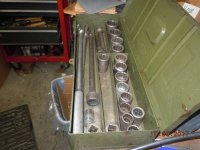
Old 3/4 drive set on PNW C/L
https://bellingham.craigslist.org/tls/d/3-4-inch-socket-set/6349249740.html
https://bellingham.craigslist.org/tls/d/3-4-inch-socket-set/6349249740.html
Attachments

Smokeshow69
Well-known member
Old 3/4 drive set on PNW C/L
https://bellingham.craigslist.org/tls/d/3-4-inch-socket-set/6349249740.html
I would be all over that but I just picked up a p&c toolmobile this weekend [emoji1] I did pick up these pieces a few weeks ago! I really like the compound leverage pliers! They grip much better than regular pliers

The clutch driver is in mint condition and still has the yellow price tag!
Sent from my iPhone using Tapatalk Pro
Attachments

Rileysan
Well-known member
I would be all over that but I just picked up a p&c toolmobile this weekend [emoji1]
Sent from my iPhone using Tapatalk Pro
And I would do the same but I have no interest in driving to Bellingham!
Brian
Smokeshow69
Well-known member
And I would do the same but I have no interest in driving to Bellingham!
Brian
Calling drivesitfar [emoji3]...[emoji51]
Sent from my iPhone using Tapatalk Pro
gregaz
Well-known member
And I would do the same but I have no interest in driving to Bellingham!
Brian
Coincidentally, I am going to be in Bellingham for business this week - if this is truly desirable for someone, happy to facilitate. Let me know!
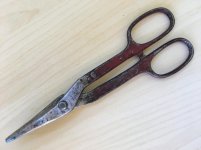
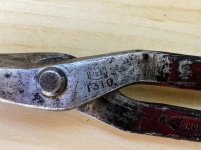
Picked up these P&C 1310 tin snips yesterday. Appear to be in good shape overall!
Attachments
Catfishdan
Well-known member
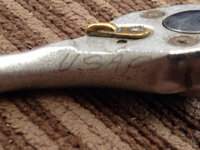
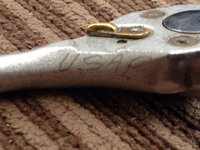
I just got a craftsman 1/4 inch set off eBay and the ratchet didn't match. The good news is it was this one! Anyone know how old? Looks like plomb pebble era stuff. It's also engraved USAF. Air Force issue? Can't find any info on the web. 

Sent from my iPhone using Tapatalk
Sent from my iPhone using Tapatalk
Attachments


Rileysan
Well-known member
I just got a craftsman 1/4 inch set off eBay and the ratchet didn't match. The good news is it was this one! Anyone know how old? Looks like plomb pebble era stuff. It's also engraved USAF. Air Force issue? Can't find any info on the web.
Sent from my iPhone using Tapatalk


Fantastic find! Those are very hard to come by.
Yes, that's a Plomb/Proto design. I don't know how long those were made, but I would date it from the 50s.
As for the USAF inscription, it seems certain to have been acquired and used by the USAF, but that wrench was not issued for the USAF.
I'm hoping our WWII collectors have some insight into how tools were acquired post-war for all branches of the military ...
Brian
Attachments


Private Lugnutz
Well-known member
That's a very intriguing ratchet.
It's very tempting to date it to no earlier than 10/1947, when the US Air Force was established, to at least March 1948, which is the last time a pebbled Plomb tool showed up in a Plomb catalog (19-R FOURTH PRINTING). On the basis that pre-1941 acquisition P&C designs (with the exception of the DBE wrenches) had gradually been replaced with Plomb designs, and at that time (late 1947 to early 1948) they were plating again, and still selling tools to the military.
But, your ratchet is not a P&C version of the pebbled Plomb 4797! The pebbled Plomb 4749 had a very rectangular handle. Not pseudo-bullet shaped like this. And furthermore, the P&C 0246 1/4-inch ratchet in the 1948 P&C catalog looks exactly like the Plomb 4749 1/4-inch ratchet in the 1948 No. 4820 Plomb-Proto Catalog. No pebbling. With a round knurled handle.
Your ratchet is actually in the 1953 P&C Catalog. You can see it here.
I had no idea that P&C was using a pebbled field on any tool in 1953.
Was there a Proto-branded ratchet like this?! The PENENS ratchets we see don't look like this, and they don't look like this in the 1950 PENENS catalog, either.
It's very tempting to date it to no earlier than 10/1947, when the US Air Force was established, to at least March 1948, which is the last time a pebbled Plomb tool showed up in a Plomb catalog (19-R FOURTH PRINTING). On the basis that pre-1941 acquisition P&C designs (with the exception of the DBE wrenches) had gradually been replaced with Plomb designs, and at that time (late 1947 to early 1948) they were plating again, and still selling tools to the military.
But, your ratchet is not a P&C version of the pebbled Plomb 4797! The pebbled Plomb 4749 had a very rectangular handle. Not pseudo-bullet shaped like this. And furthermore, the P&C 0246 1/4-inch ratchet in the 1948 P&C catalog looks exactly like the Plomb 4749 1/4-inch ratchet in the 1948 No. 4820 Plomb-Proto Catalog. No pebbling. With a round knurled handle.
Your ratchet is actually in the 1953 P&C Catalog. You can see it here.
I had no idea that P&C was using a pebbled field on any tool in 1953.
Was there a Proto-branded ratchet like this?! The PENENS ratchets we see don't look like this, and they don't look like this in the 1950 PENENS catalog, either.
Private Lugnutz
Well-known member
Can you show me Plomb/Proto branded examples? I've never seen one with a shapely handle like this. And if they exist, why does AA cut off the pebble period at 1948? I agree with them on that, by the way. Plomb/Proto catalogs in 1948, 1949, and 1950 show ratchets with round knurled handles.Yes, that's a Plomb/Proto design.
I'm not following you on this, Brian. If it was acquired by the USAF (EDIT: from P&C) and used by the USAF, it was issued by the USAF. Some mechanic probably electric-penciled that "USAF" on the shank.Rileysan said:As for the USAF inscription, it seems certain to have been acquired and used by the USAF, but that wrench was not issued for the USAF.
All the services and their branches etc bought tools after the war the same way they bought them during the war - by contract. While the GSA was established in 1949, and helped usher in a new Federal Stock Number system (5120-***-xxxx) by 1953, it took many years for them to get to a condition where services were buying equipment off of a GSA schedule, being filled by huge GSA contracts.
Last edited:
Rileysan
Well-known member
Can you show me Plomb/Proto branded examples? I've never seen one with a shapely handle like this. And if they exist, why does AA cut off the pebble period at 1948? I agree with them on that, by the way. Plomb/Proto catalogs in 1948, 1949, and 1950 show ratchets with round knurled handles.
I'm not following you on this, Brian. If it was acquired by the USAF (EDIT: from P&C) and used by the USAF, it was issued by the USAF. Some mechanic probably electric-penciled that "USAF" on the shank.
All the services and their branches etc bought tools after the war the same way they bought them during the war - by contract. While the GSA was established in 1949, and helped usher in a new Federal Stock Number system (5120-***-xxxx) by 1953, it took many years for them to get to a condition where services were buying equipment off of a GSA schedule, being filled by huge GSA contracts.
I'm trying really hard not to argue semantics with you, but dear lord you're making it hard!
That is clearly a Plomb/Proto "Pear-head" ratchet but the handle is uniquely P&C. Find me a patent for that P&C ratchet, and I'll concede it's a P&C design. Else, it's just a new handle on an already patented design.
As for my point about the USAF, you've already answered my question. Contract, or no, this ratchet was in a catalog and being sold to the public by 1953. Unless you have proof otherwise, it was not made for the USAF, according to their specifications (like many other WWII tools), but was almost certainly ordered by the USAF from a catalog of existing tools. I think the intent of my previous post was pretty clear.
Brian
Private Lugnutz
Well-known member
I wasn't trying to make any claims for a P&C patent, just making the observation that I've never seen a Plomb/Proto version of that ratchet. That's noteworthy, in my opinion, that a P&C ratchet in 1953 did not have the same handle shape as its Plomb/Proto family brethren. And with a blast-from-the-past pebble field no less!That is clearly a Plomb/Proto "Pear-head" ratchet but the handle is uniquely P&C. Find me a patent for that P&C ratchet, and I'll concede it's a P&C design. Else, it's just a new handle on an already patented design.
Aha. Now I see why you think this is merely a case of semantics, Brian. You seem to be under the impression that each service was specifying unique tools in WWII. Not true. Most WWII mechanics tools could be found in the Federal Standard Stock Catalog. This was maintained by the Treasury Dept, Procurement Division, a pre-cursor to the GSA. US Army, US Army Air Forces, and US Navy manuals and supply catalogs all include tools listed by Federal Stock Number (EDIT: for clarity, 41-W-xxxx), from the Federal Standard Stock Catalog. We have found instances of special tools or odd sizes or size combinations. But the overwhelming majority of tools were in the Federal Standard Stock Catalog. The Army and Navy had unique stock numbers, sometimes more than one for the same tool (e.g., US Army Signal Corps vs US Army Air Forces vs US Army Ordnance Dept), but Federal Stock Numbers were common across services and intra-service branches. Every tool in the US Army Air Corps' "WF" set of tools also has a Federal Stock Number. There is nothing about that set of drive tools or wrenches that is unique to the US Army Air Corps. In fact, Plomb was providing many of the exact same tools, not marked "WF", to the Navy and the Ordnance Dept. I didn't go into this in my post above because I assumed you had been tracking that in all the various 41-W, 41-B, etc FSN discussions. All those FSNs were allocated by the Treasure Dept., not the technical services.Rileysan said:it was not made for the USAF, according to their specifications (like many other WWII tools),
Agreed. The same way it was done during WWII.Rileysan said:but was almost certainly ordered by the USAF from a catalog of existing tools.
Last edited:
3baygarage
Well-known member
I thought that handle was unique to 1/4 drive, and looks like it is in that '53 catalog.
Private Lugnutz
Well-known member
If you mean the 1953 P&C cat, yes, I linked it above, 3eeb. And yes, it's only on the midget handle. A very cool looking ratchet! It's like they took the old rectangular pebble Plomb era handle, including the pebble field, and sort of bullet shaped it. Very stylish. I have never seen one before.I thought that handle was unique to 1/4 drive, and looks like it is in that '53 catalog.
Catfishdan
Well-known member
Here's a comparison with a plomb 4749. Definitely the same head and internals. Just a different handle design. 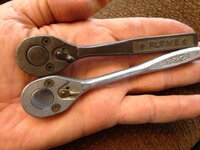

I don't think it was made for the military. I think they must have just bought some and engraved them. Or maybe it belonged to a guy named Umberto Stevenson Alfonso Francisco.
Sent from my iPhone using Tapatalk
I don't think it was made for the military. I think they must have just bought some and engraved them. Or maybe it belonged to a guy named Umberto Stevenson Alfonso Francisco.
Sent from my iPhone using Tapatalk
Attachments


Username already in use
Well-known member
I posted this 1/4" drive ratchet in the 'ratchet collection thread', but it seems a good time to cross post it here as well.
This paddle design was likely wartime. Similar to the WF-8 and WF-8S ratchets, but 2 screws in the cover plate instead of just 1.

This paddle design was likely wartime. Similar to the WF-8 and WF-8S ratchets, but 2 screws in the cover plate instead of just 1.
Private Lugnutz
Well-known member
Dan, very few of the tools supplied to the military are made exclusively for the military. Special tools, yes, but not common tools. That is no different today than it was in WWII, or 1953. The overwhelming majority of tools supplied to the military during WWII were no different than the same tools being made by the same mfgrs for commercial sale. (Commercial sales tailed off after WPB Limitation Order L-216 was put in place, but that's another subject.) If that was a wartime tool proprietarily engraved USAAF instead of USAF I wouldn't hesitate to identify it as a tool bought from P&C by the US Army Air Forces, and I have very little to no doubt that ratchet was bought from P&C, probably with a mess of drive tools, by the USAF for their use some time after 1953, apparently.I don't think it was made for the military. I think they must have just bought some and engraved them.
I love the design.
Catfishdan
Well-known member
Thanks for all the info guys. I'm pretty stoked with it. Much cooler than the ratchet I thought I was getting.
Rileysan
Well-known member
Aha. Now I see why you think this is merely a case of semantics, Brian. You seem to be under the impression that each service was specifying unique tools in WWII. Not true.
Well, yes and no. I knew that the different military departments ordered existing tools that met their needs, but I was under the impression that tools ordered for the war all had some sort of identifying code or number specified by the agency making the order. Perhaps my assumption was wrong?
Brian
Last edited:
Private Lugnutz
Well-known member
I wish you weren't! Collecting would be a lot easier. 
The Plomb Air Corps "WF" tools are exceptional in that regard. Consider that Snap-On, Williams and others also sold tools to the same customer (Air Corps) and they are not marked "WF". They are not marked at all! Some US Army Signal Corps tools are readily identified by their unique Signal Corps stock number (TL-29, for example). And we do see some US Navy aviation tools with NAF- numbers. But that's not so for the bulk of Navy tools, for the Army Corps of Engineers, just to name a few examples, and especially not so for the single largest buyer, the US Army Ordnance Dept. They bought 157,000 119-piece GMTKs for the ETO alone, and none of those tools are specially marked. And that's just one of many Ord tool-sets.
The Plomb Air Corps "WF" tools are exceptional in that regard. Consider that Snap-On, Williams and others also sold tools to the same customer (Air Corps) and they are not marked "WF". They are not marked at all! Some US Army Signal Corps tools are readily identified by their unique Signal Corps stock number (TL-29, for example). And we do see some US Navy aviation tools with NAF- numbers. But that's not so for the bulk of Navy tools, for the Army Corps of Engineers, just to name a few examples, and especially not so for the single largest buyer, the US Army Ordnance Dept. They bought 157,000 119-piece GMTKs for the ETO alone, and none of those tools are specially marked. And that's just one of many Ord tool-sets.
Last edited:
Rileysan
Well-known member
I posted this 1/4" drive ratchet in the 'ratchet collection thread', but it seems a good time to cross post it here as well.
This paddle design was likely wartime. Similar to the WF-8 and WF-8S ratchets, but 2 screws in the cover plate instead of just 1.
I've seen a P&C ratchet like Catafishdan's (in person) but never this design. Not to take anything away from the other ratchet, but for some reason, this one is far more intriguing to me.
Checking the catalogs, I found your ratchet in the 1948 catalog - sold as part of a set in a cardboard box!
Catfishdan's ratchet is shown in the 1953 and 1959 catalogs, but by 1963, only the open-gear ratchet is shown. And to confuse matters worse - all 4 variations of the P&C 1/4" ratchet sold post-WWII have the same model number - 0246.
I can see how frustrating it would be for a customer in a hardware store:
Customer: "Hi, I'd like a P&C No. 0246 1/4" drive ratchet like I saw in the catalog."
Salesman: "Which one? We have four designs to choose from."
Brian
Attachments
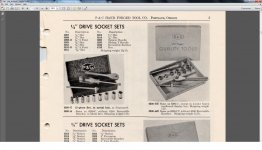
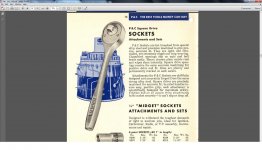
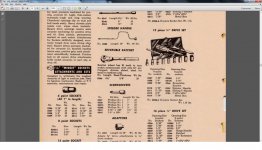
Last edited:
Username already in use
Well-known member
By '48, these tools would have been marked MFD USA.
This one is still marked 'Made In USA', so it's an earlier version. It came to me in an unmarked green box with just 2 extensions. The extensions are also marked 'Made In USA'. I've since added some period correct sockets to the set.
Here's where I'm at now.

This one is still marked 'Made In USA', so it's an earlier version. It came to me in an unmarked green box with just 2 extensions. The extensions are also marked 'Made In USA'. I've since added some period correct sockets to the set.
Here's where I'm at now.
Attachments

Smokeshow69
Well-known member
Thanks for all the info guys. I'm pretty stoked with it. Much cooler than the ratchet I thought I was getting.
It's not really that cool [emoji1] you should just trade me for a craftsman 1/4 rhft since I am such a nice guy [emoji108] seriously good find !
Sent from my iPhone using Tapatalk Pro
Smokeshow69
Well-known member
By '48, these tools would have been marked MFD USA.
This one is still marked 'Made In USA', so it's an earlier version. It came to me in an unmarked green box with just 2 extensions. The extensions are also marked 'Made In USA'. I've since added some period correct sockets to the set.
Here's where I'm at now.
This set is absolutely amazing! I really love the ratchet design and patina it had !
Sent from my iPhone using Tapatalk Pro
d42jeep
Well-known member
I like that 1/4" drive set!
-Don
-Don
r_olson_06
Well-known member
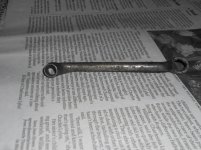
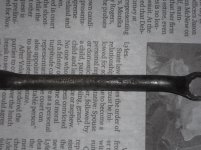
That has the boarder it is just wore off. That appears to be an early wrench. Nice find.hi all, going through some misc wrenches. did P&C ever mark their tools without the border around the initials? this 1 looks like it's either worn smooth or never had it (the border).
Sent from my XT1080 using Tapatalk
That has the boarder it is just wore off. That appears to be an early wrench. Nice find.
Sent from my XT1080 using Tapatalk
thanks r, that had to have been 1 of his favorites. looking at it closely there is no evidence of the original marking, kind a looks like parenthesis.
Rileysan
Well-known member
That has the boarder it is just wore off. That appears to be an early wrench. Nice find.
Sent from my XT1080 using Tapatalk
I think the stamp was too large for that small, round shank wrench. I have small wrenches that look just like this one.
Brian
Smokeshow69
Well-known member
I think the stamp was too large for that small, round shank wrench. I have small wrenches that look just like this one.
Brian
I second that! You can see partial border on the top of the stamp... I have a few like this !
Sent from my iPhone using Tapatalk Pro
